Science
A tour of the sound and heat hellscape that is L.A.


Blanca Lucio likes to spend her mornings tending to her zucchinis, cucumbers, watermelons and traditional Mexican herbs at a small community garden near downtown Los Angeles. With its cool, damp air, the garden brims with what Lucio calls “magic.”
The only sound comes from green June bugs buzzing by her ears and children playing at the community center across the street.
“Outside of here, you’re exposed to a lot of noise and a lot of pollution,” Lucio said while giving a tour of the garden, a short distance from her home in South-Central L.A. “This space renews me and the other gardeners who grow plants here. I feel more content when I’m here.”
Noise pollution and excessive heat can seem inescapable in L.A. What would the city be without random bursts of fireworks and car sound systems thumping loud enough to shake you from your dreams? And the nearly 365-days-a-year sunshine is practically what defines L.A. sunshine, even though it means commuters often must wait under the blazing sun at bus stops that lack cover.
Busy roads and airports are a large contributor of noise pollution in Los Angeles

U.S. Department of Transportation
Sean Greene LOS ANGELES TIMES
But just because we’ve grown used to L.A.’s jarring soundscape, shadeless streets and pockets of intense heat, it doesn’t mean they are harmless.
Noise and heat together can pose a special kind of health threat, one that the city’s most vulnerable people are least able to protect against, said Valerie Tornini, a neurobiologist at UCLA.
With climate change ushering in stronger and longer heat waves, a growing body of evidence suggests that excessive heat has become a public health crisis. An estimated 1,300 people die of extreme heat each year, according to the Environmental Protection Agency, and that number will only grow in coming years.
Both heat and noise can harm the nervous system, interfere with metabolism and disrupt sleep patterns. They can also aggravate conditions such as diabetes, hypertension and cardiovascular disease, according to a paper published in Environmental Health Perspectives.
Tornini leads a team of brain researchers trying to figure out how the combination of these two environmental dangers affects brain health and behavior among residents of Central and South L.A.

Her team is working with the Boston-based nonprofit Prospera Institute and the South L.A. social justice nonprofit Esperanza Community Housing Corp. to collect stories from local Latino and Black Americans, like Lucio, about how they cope.
The collaboration started in 2024 after Tornini, who had been studying the effect of noise and heat on neural development in zebrafish, reached out to Joanne Suarez, who founded Prospera to promote health equity in Black, Latino and Indigenous communities.
Their partnership sprang from a recognition that brain science has lagged behind other disciplines in recognizing the need for community-centered research that treats study participants as equal partners, Tornini said.
The project revolves around two interwoven prompts, she said: “How can it do good and no harm, and how can it serve the cause of justice?”
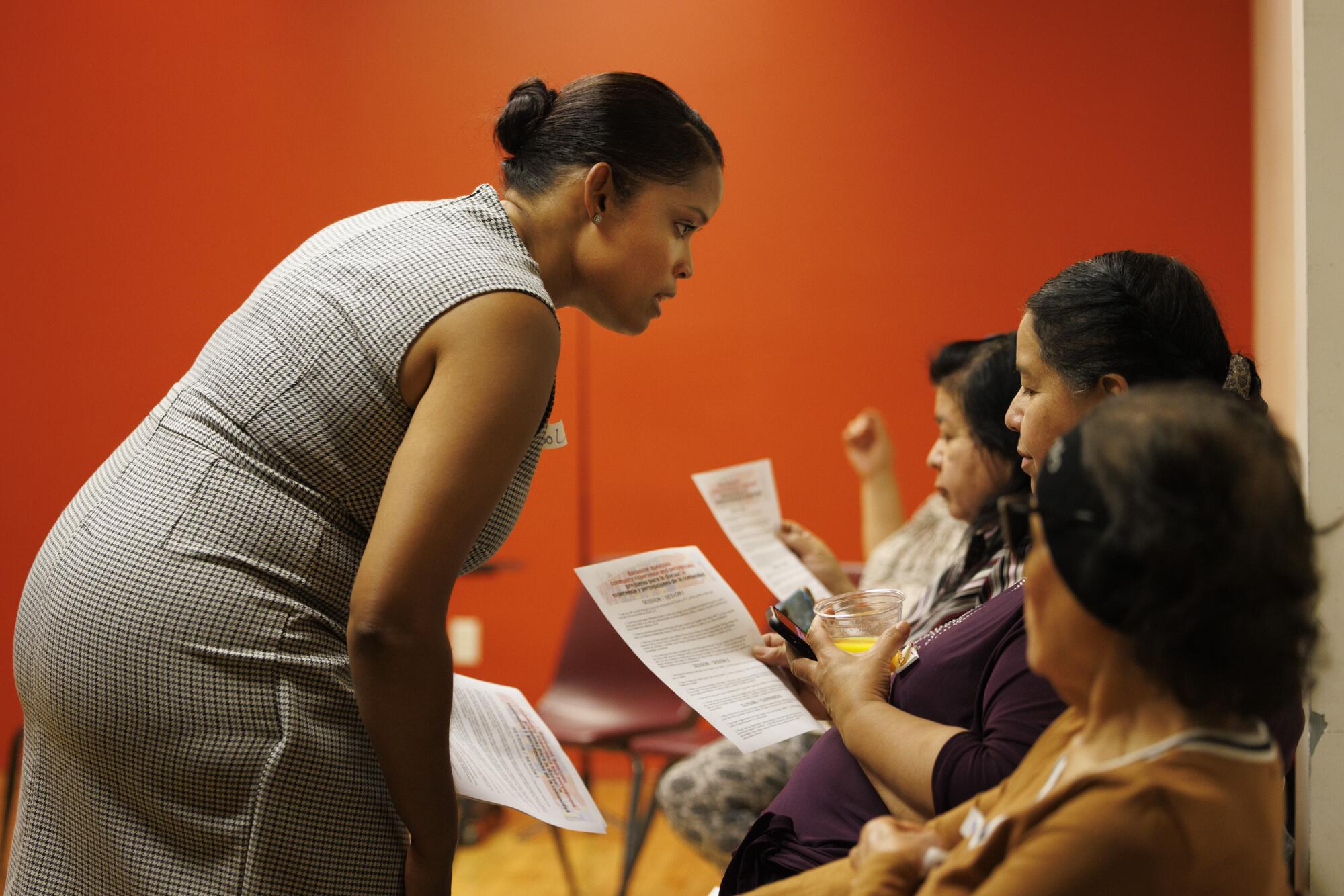
Joanne Suarez speaks with South L.A. community members about how they’re affected by excessive heat and noise during a focus group at Esperanza Community Housing.
(Carlin Stiehl / Los Angeles Times)
“Sometimes [research] is not aligned with what the community wants and needs,” Tornini said. “I want to listen: What are your concerns? What are your lived experiences? People’s stories and oral histories … can influence the kind of questions that we ask in the lab, and then that data goes back to them.”
That shift in thinking was in evidence on a Saturday morning in July at Mercado La Paloma — a South L.A. food hall that houses the Michelin-starred Mexican seafood restaurant Holbox as well as Esperanza Community Housing’s offices.
A dozen women sat in a circle with Suarez and Tornini for an intimate listening session, held in Spanish, about living with noise and heat.
Suarez invited the women to speak in response to a series of questions printed on a handout. For example: “How do environmental factors like noise and heat impact your health and daily life?” and “Have you noticed changes in your ability to focus, think clearly or even remember things when it’s extremely hot or noisy in your community?”
One woman said it’s hard to mitigate one disturbance without exacerbating the other, such as when she opens the window of her bedroom at night to let in fresh air, only to be kept awake by noise from passing planes and sirens. A mother worried about the effect of sun and heat on her kids during gym class and recess at school. One woman told the group that excessive heat worsens her hypertension headaches, while another said that when it’s hot out, she gets more irritated by noises she can’t control.
Another participant said she fears getting caught in the crossfire of warring gangs in her neighborhood and so won’t sit outside to get fresh air, no matter how hot it gets indoors.
The UCLA initiative is as much an experiment in trust-building as data collection, said Monic Uriarte, a public health advocate and community organizer at Esperanza Community Housing who has lived and worked in L.A.’s urban core for three decades.
Wariness of scientists and healthcare professionals — born of a history of one-sided research that never benefited study volunteers or their communities; nonconsensual lab experiments; and racial discrimination among medical practitioners — is commonplace in some communities of color.
“I love higher education, but we are tired of being guinea pigs for different studies,” Uriarte said. “We need this kind of collaboration — a space for our community to share, in our own words, the experience of living in South Los Angeles.”
She’s excited about the prospect of volunteers being able to cite whatever findings result from the research when asking city officials for noise mitigation for their homes, tree plantings or more open spaces.

Living and commuting in L.A. means navigating an environment that can make you want to cover your ears and run for the shadows.
The relentless flow of vehicles and Metro light-rail trains drowned out Blanca Lucio’s voice as she gave a tour of South-Central L.A., walking past auto-body shops and restaurants at the intersection of San Pedro Street and Washington Boulevard.
Not far away in the downtown jewelry district, sidewalk vendors selling wares as varied as avocados, roasted corn, cellphone cases and brass lanterns shielded themselves from the intense midday sun with beach umbrellas, or by clustering in the shadows of high-rises.
During L.A.’s recent heat wave, when temperatures regularly surpassed 90 degrees, a woman selling rose bouquets out of buckets at Pershing Square looked beleaguered while standing in the paltry shade of a tree. A man pushing a cooler full of 50-cent bottled waters wiped sweat from his forehead and tried to cool down with a Spanish fan.

A woman sleeps on a bench in Los Angeles’ Pershing Square in June 2024.
(Brian van der Brug / Los Angeles Times)
There was no escape from the onslaught of car horns, rumbling motors and pedestrians blasting music from speakers stuffed in backpacks.
About 10 miles south is the Harbor Freeway transit terminal, an important hub for commuters who need to catch a bus or train in South L.A.
The terminal is located on a raised platform in the middle of a concrete tangle of ramps and the elevated lanes of the 105 Freeway. The commotion and noise are unnerving; cars speed by so close you can feel whooshes as they pass.
But even if you don’t have to wait daily for transport while being inundated with the sounds of a Los Angeles freeway, you may be forced to endure some noise pollution seemingly designed to disturb the peace. On any given evening in the city, drivers and bikers amp up the soundscape by revving their engines while waiting at traffic stops, then slam on the gas when their light turns green, screeching down the street.
Nighttime also brings the piercing sound of street takeovers. Drivers draw crowds of spectators as they perform stunts such as “doughnuts” — spinning their cars in circles until their tires burn rubber marks on the pavement. The phenomenon has become such a problem countywide — with shootings and cars set on fire at some of them — that officials have vowed to crack down on the illegal gatherings.
L.A. is notoriously noisy and hot, but experiences like these are widespread across the U.S.
About 95 million Americans, nearly one-third of the U.S. population, are subjected to transportation-related noise pollution, with Latino, Black and Asian communities disproportionately exposed to it, according to data compiled by researchers at the University of Washington.
Noise is measured in decibels, with a middle range of 50-60 considered a normal level of ambient sound that doesn’t pose a risk to health. Most people experience noise at this level while doing routine things such as working at an office or walking down a street with little to no traffic. Emergency sirens, lawn mowers and music in a nightclub, by contrast, can exceed 90 decibels.
While grating noises and intolerable heat may be experienced in pockets across the city, making it hard to draw direct comparisons, some whole sections of L.A. feel conspicuously beset by these environmental disturbances. Other neighborhoods feel more insulated.
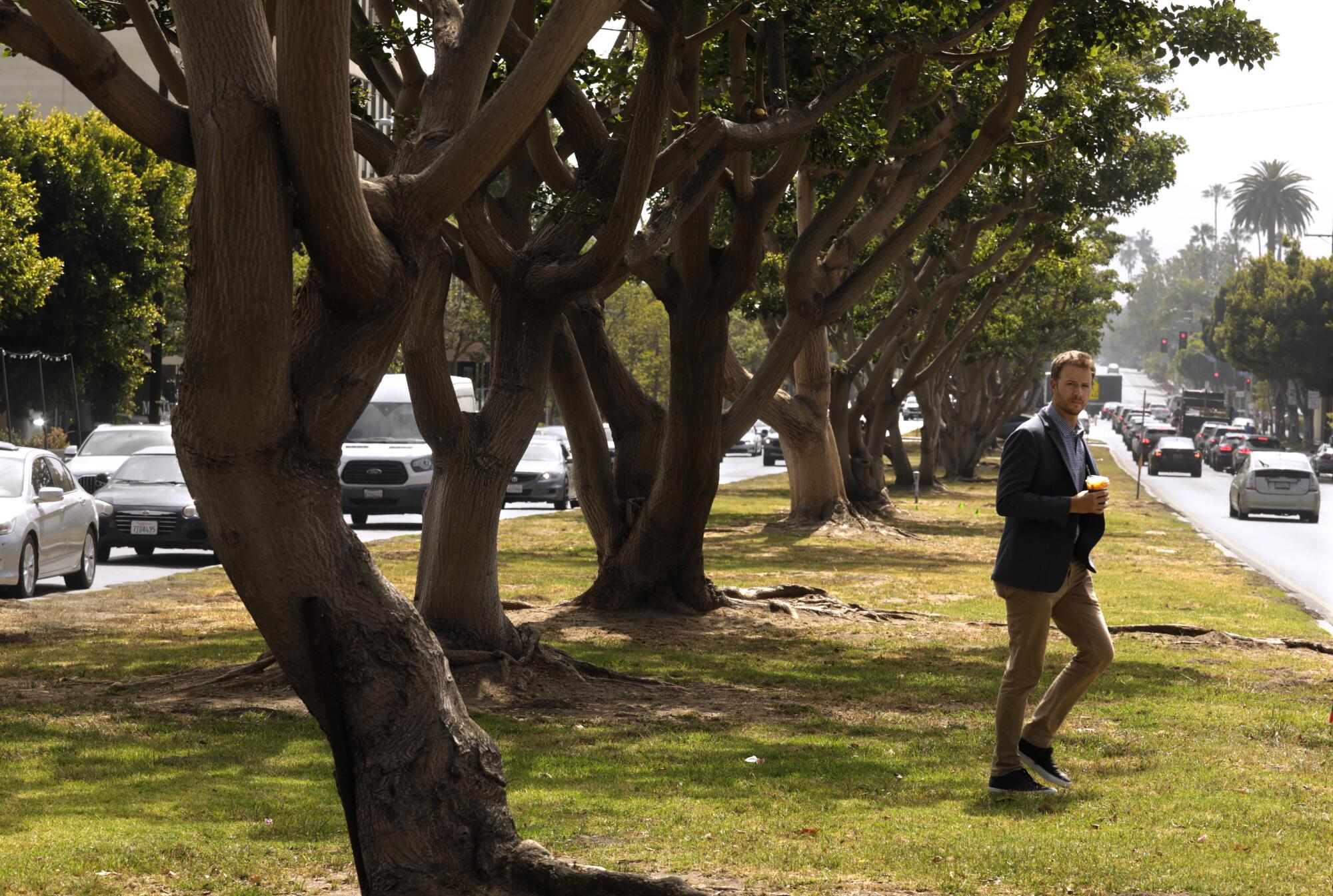
A pedestrian crosses a median as traffic passes along San Vicente Boulevard in Brentwood.
(Genaro Molina / Los Angeles Times)
The urban core and South L.A. — where the median household income ranges from $48,000 to $62,000 a year and Latino and Black people make up the majority of the population, according to the U.S. census — is a wall of sound and a bubble of heat. But farther west in predominantly white Brentwood, where the median annual household income is more than $160,000, walls of semi-tropical foliage insulate many private homes from intrusive noises and overhanging trees form of canopies of coolness over gently curving streets.
A treeless city
U.S. Geological Survey, U.S. Census Bureau
Sean Greene LOS ANGELES TIMES
Take a sunset walk along the gently sloped, flower-scented streets above busy Sunset Boulevard in Brentwood — you will be immersed in a stillness broken only by birds chirping in the treetops. To the south, along the historic canals of Venice, ocean breezes cool the air and the prevailing sound is of fountains trickling in homeowners’ yards.

By contrast, noises associated with law enforcement are such familiar nuisances on the relatively bare streets of South L.A. that they are treated as if they are part of the natural environment. The late artist 2Pac rapped about the menacing presence of “ghetto bird” police helicopters in 1996‘s “To Live and Die in L.A.,” and Compton-born rapper Kendrick Lamar referenced ghetto birds and samples the piercing wail of police sirens on “XXX,” released in 2017.
“Basically, the Blacker the neighborhood, the more flight hours; the more Latinx the neighborhood, the more flight hours … and the Blacker the neighborhood, the lower the helicopters are flying,” said Nick Shapiro, a multidisciplinary environmental researcher at UCLA.

Shapiro has spent years using L.A. Police Department flight data to map helicopter trajectories across the city in studies of “sonic inequality” that his team conducted jointly with residents of South L.A.
Helicopter noise is an issue citywide — even in typically serene, higher-income neighborhoods. The noise is a problem for outdoor TV and film productions too, Shapiro said.
Still, Shapiro said, “there’s pretty extreme inequality between Malibu and Watts.”
Meanwhile, it’s even worse for those in South L.A. who live in the L.A. International Airport flight path and have to contend with both helicopters and the earsplitting sonic reality of jets landing and taking off.
West Century Boulevard runs along the airport’s flight path, meaning that every couple of minutes, a low-flying jet cuts a trail of the high-frequency whines and low-frequency roars on its approach to the airport, sending decibel levels into the 90s. Because of all the broad, shadeless streets that define many of South L.A.’s neighborhoods, the hot summer sun seems to bear down more intensely on these communities of color too.
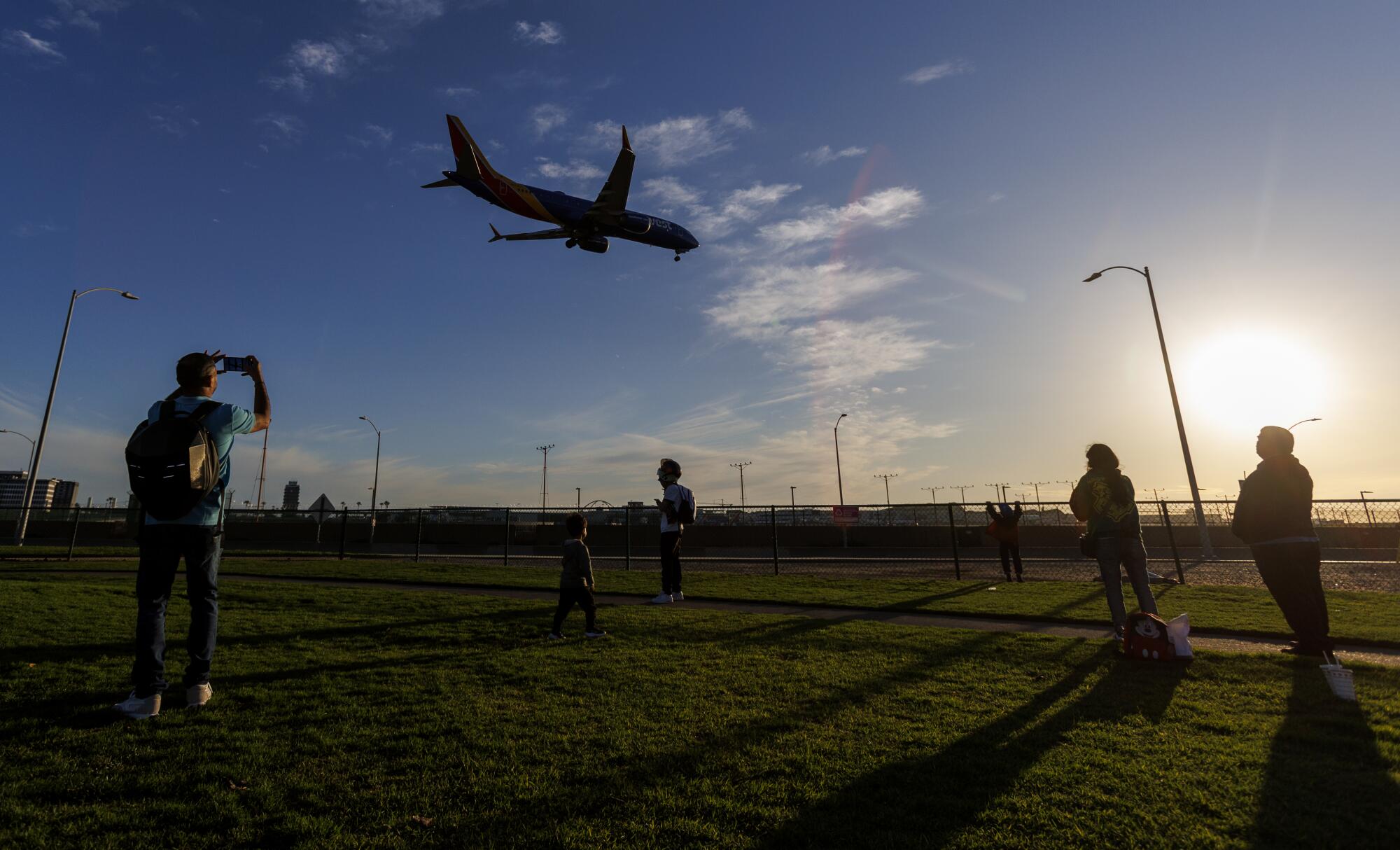
Plane spotters get a close-up view of planes on their final approach to Los Angeles International Airport.
(Gina Ferazzi / Los Angeles Times)
One sunny afternoon in August, Charles Lewis, a retired store clerk, sat in a folding chair under a solitary shade tree and watched a steady stream of cars and trucks rush past him on Century. As one plane after another shrieked across the cloudless sky, jet-shaped shadows raced across the pavement, alongside cars.
Lewis lives close by but lamented that sidewalks along residential streets closer to his home are too exposed to the sun. He’s witnessed shade gradually disappear in the 40 years he has lived in the neighborhood and believes law enforcement agencies are partly to blame.
Los Angeles Police Department Deputy Chief Donald Graham acknowledged that his agency has asked city crews to trim publicly maintained trees to improve street lighting and deter illegal activity in specific trouble spots.

“We’re always trying to balance the beautification of the city and the need to have a tree canopy with public safety,” he said.
The cacophony of the boulevard offers little in the way of tranquility, but Lewis said the noise from jets is so bad at home that he has to turn up the volume on his TV and wait for aircraft to pass to have a conversation without yelling.
At least his perch on Century provides a refuge from the excessive heat.
“This is the only shade I have,” Lewis said.
Nearby, the late-day sun felt oppressive along a busy, tree-less stretch of Slauson Avenue near the 110 Freeway. Two women at a food stand squinted in the sunlight as they cooked whole chickens on a hot grill to serve with freshly made tortillas and beans and rice.
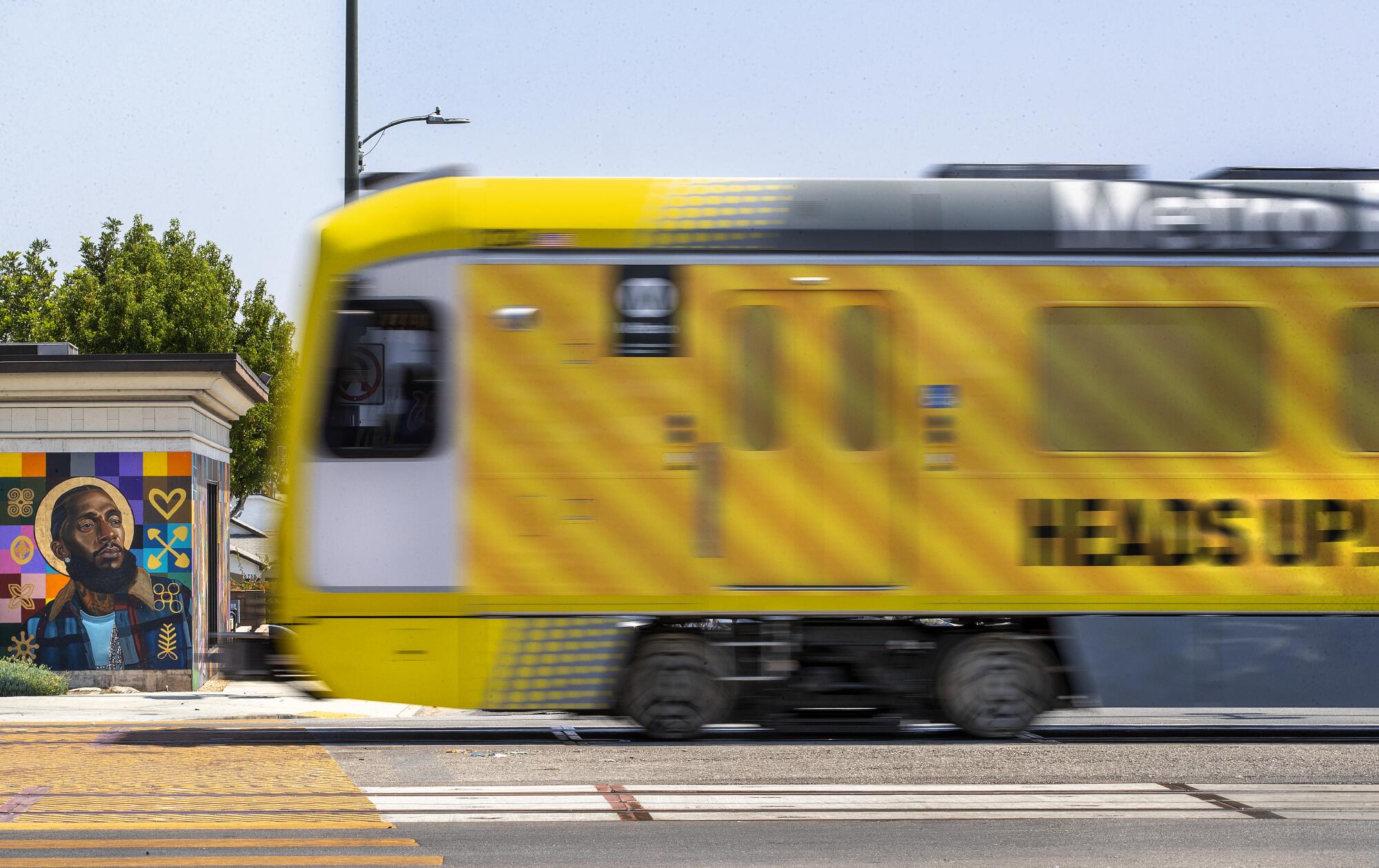
A metro train traveling on the K Line passes a mural of the late rapper Nipsey Hussle that is located on Crenshaw Boulevard at Slauson Avenue in Los Angeles.
(Mel Melcon / Los Angeles Times)
Too busy filling orders to talk, the women laughed and said they’ve given up trying to stay cool while working on days like this.
Meanwhile, six miles north, things weren’t much better. At the junction of Olympic Boulevard and Western Avenue in Koreatown, a search for both shade and quiet was an exercise in futility. The sparse landscaping on the thoroughfares left sidewalks exposed to the bright sun, and the constant rumble of trucks and buses assaulted the eardrums.

A mile away, in the flats of Hollywood near Paramount Studios, the block letters of the district’s famous hilltop sign appeared like a vision through the smoggy air above a bustling intersection at Melrose Avenue and Vine Street — though on a recent August day, the 85-degree temperatures, blazing sunlight and din of speeding vehicles made it that much more difficult to savor the view.
Traditional lab-based brain research has too often discounted the health challenges that come with navigating an ecosystem as complex and inequitable as L.A.’s, said Helena Hansen, professor and interim chair of psychiatry and behavioral sciences at UCLA’s Geffen School of Medicine.
The noise and heat study, along with the analysis of helicopter noise, are part of a broader effort to incorporate information about social and physical conditions into research design, she said.
“We’re really trying to rethink the way science is done,” she said.

At the listening session in July, the idea of breaking down the barrier between laboratory science and real life was on full display. Nearly all the women nodded in agreement when one brought up her struggle to focus on tasks or relax because of heat and noise. It was clear that for these Angelenos, stress is the norm — peace the exception.
Lucio was among those who attended. She is participating in the UCLA study not just to help the researchers, she said, but also to make living in L.A. more comfortable and healthier for herself and her neighbors.
The surrounding neighborhood, just across a busy freeway from the University of Southern California’s campus, is one of several in Central L.A. that the budding citizen scientist has surveyed as part of her own study of the area’s spotty tree canopy.
“We need more trees,” Lucio said. “I’ve noticed people walking around searching for shade and clustering in the few spots where they can find it…. I’ve even seen dogs searching for shade in this neighborhood.”

Trees provide a canopy for travelers along Grayburn Avenue in Los Angeles’ Leimert Park neighborhood.
(Brian van der Brug / Los Angeles Times)
It’s little slices of life and firsthand observations such as these that the UCLA scientists and Prospera facilitator want to heed as they pursue their research. The group just secured additional funding for further study and possibly to record accounts of lived experiences on video, Suarez said. For now, Tornini, the brain scientist, just wants to keep the line of communication open with participants.
“The goal is for this to be a living relationship that is shaped mutually,” Tornini said. “What the community does with this information is within their own power. And if they ask — how can we help?”


Few substances are as deeply woven into everyday life as alcohol. It is a fixture at holiday celebrations, work-related social gatherings, sporting events, airports, and brunch or dinner tables. All demonstrate how deeply alcohol has become embedded in social customs and cultural traditions.
Yet alcohol contributes to millions of deaths globally each year and is linked to cancer, liver disease, unintentional accidents, violence and, importantly, dependence and addiction. Despite this, the disconnect between alcohol’s cultural role and its serious health burden is striking. An estimated 2.3 billion people worldwide consume alcohol.
As a physician working in addiction medicine, I regularly care for patients whose alcohol use affects nearly every organ system. It is often not until these patients end up admitted to the hospital that they learn the effects of alcohol on various parts of their body besides their liver.
Newer evidence challenges assumptions about what was long considered “safe drinking.” Even moderate drinking carries risk and is not as harmless as people, including experts, once thought.
Many people associate alcohol risk primarily with addiction or dangerous behaviors such as driving while intoxicated. However, its effects extend far beyond this, into nearly every aspect of a person’s well-being.
While alcohol may transiently improve mood and ease social anxiety, long-term alcohol use can lead to a worsening of mood, cognition and sleep, which can further compound use.
A 2021 literature review found that consuming approximately two standard drinks roughly doubles the odds of sustaining injuries — with or without a vehicle involved. The review also found that heavy episodic (binge) drinking can increase the risk of injury by 50-fold, depending on the amount of alcohol consumed and the type of injury. While alcohol’s effects on the liver are well known, it can also lead to gastrointestinal complications and heart disease
The World Health Organization estimates that 2.6 million deaths each year are attributable to alcohol, accounting for nearly 1 in every 20 deaths worldwide.
While many people recognize the risks of alcohol addiction, people are generally much less aware of the links between alcohol use and cancer risk.
The World Health Organization classifies alcohol as a Group 1 carcinogen — the same category as tobacco and asbestos. In 2025, the U.S. surgeon general emphasized that alcohol increases the risk of at least seven cancers, including cancers of the breast, colorectal, liver, oral, esophagus and larynx. An advisory called for updated warning labels.
Yet fewer than half of Americans recognize alcohol as a risk factor for cancer, particularly for cancers such as breast cancer that are not commonly associated with alcohol use.
Throughout the 1990s and early 2000s, observational studies suggested that moderate alcohol consumption might offer cardiovascular benefits. Over the past decade, however, higher-quality studies have challenged these findings, suggesting that much of the apparent benefit may have reflected differences in the health and lifestyles of moderate drinkers rather than a protective effect of alcohol itself.
Current evidence increasingly suggests that even low levels of alcohol may increase cancer risk.
Federal guidelines acknowledge that adults should “consume less alcohol for better overall health.” However, the most recent version of the “Dietary Guidelines for Americans,” updated in January, removed the previous recommendation to limit intake to no more than one drink per day for women and two for men. It also omitted explicit discussion of alcohol’s links to cancer.
These changes have drawn criticism from public health experts, who argue that the revised language plays down the growing evidence of alcohol-related harms and provides less specific guidance to consumers. The current administrator of the Centers for Medicare & Medicaid Services characterized alcohol as a “social lubricant” that brings people together, rather than emphasizing its well-established health risks.
This may be true physiologically, at least temporarily, but obscures the fact that relying on it as a social lubricant can lead to chemical and psychological dependency. In my view, statements to that effect are shortsighted, prioritizing short-term social effects over more insidious and long-term issues, including addiction.
While many dangerous mind-altering substances are hidden from public perception, alcohol is often placed at the center of it – a trend that shows no sign of changing imminently.
Further, large companies often profit from ads that appeal to young people.
Looking back at the history of tobacco smoking provides some helpful insights. In 1965, 42.4% of the U.S. population smoked. By 2022, that figure had dropped to 11.6%.
This steep decline did not happen because of a single intervention, but through decades of accumulating scientific evidence, public education campaigns, warning labels, restrictions on advertising, smoke-free policies, higher tobacco taxes and shifts in social norms. Together, these efforts transformed smoking from a widely accepted social behavior into one broadly recognized as a major health risk and correspondingly, less socially accepted.
Although alcohol consumption has modestly declined in recent years, it remains deeply embedded in social life in ways cigarette smoking no longer is.
People often assume that if a substance is legal, common and widely socially accepted — even encouraged — it must also be safe. But public health history suggests those assumptions can and should change.
Emma Fenske is an addiction medicine fellow and internal medicine physician at Oregon Health & Science University. This article was produced in partnership with the Conversation.
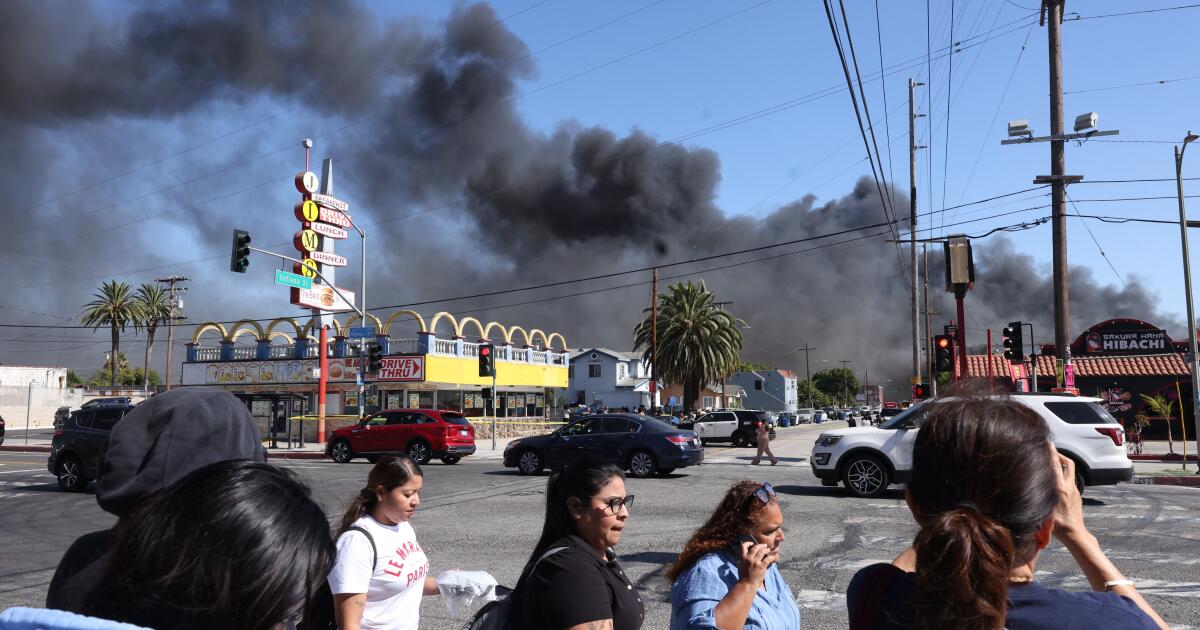
The air near the Lineage refrigerated warehouse fire in Boyle Heights carried astronomically high levels of smoke and soot, surpassing some of the worst air pollution during the Los Angeles County fires in January 2025, according to preliminary data from air officials.
The fire spewed thick black smoke for days. From downtown Los Angeles to the San Gabriel Valley, tens of thousands were enveloped in unhealthful levels of smoke, even as some local officials told residents that the air posed no danger.
As the days wore on, worst off were communities nearest the blaze. On June 19, three days after the facility ignited, a temporary air quality monitoring station at Eastman Elementary in unincorporated East Los Angeles measured an extremely hazardous 755 micrograms per cubic meter of fine particles for more than an hour, according to the South Coast Air Quality Management District.
For comparison, a Caltech air monitor in Pasadena recorded about 650 micrograms per cubic meter during the Eaton fire.
These high levels of fine particles, known as PM 2.5, probably resulted in the surge of residents into local emergency rooms during the fire, according to local health officials. But even now with the smoke gone, people still have not been told what chemicals they were breathing in during the weeklong ordeal.
Michael Jerrett, an environmental health professor at the UCLA Fielding School of Public Health, said his concern is the composition of materials emitted when the building burned.
“These contain many particularly toxic components,” Jerrett said, “and we know little about how these mixtures affect health.”
There is no completely safe level of fine particulate pollution, he noted, meaning higher concentrations are always worse.
During the 2025 L.A. County fires, local air officials announced that several monitors downwind had detected elevated levels of brain-damaging lead and cancer-causing arsenic from toxic paint and construction materials used in older homes.
The Lineage warehouse, built in 2018, is likely to contain different materials of concern. Thick insulation foam required for a massive refrigeration operation, solar panels and refrigerants were burned, leaving many residents on edge.
Even though three public agencies conducted air monitoring, the picture is still murky.
“[Public officials] are speaking with a lot of confidence but not a lot of information,” said mark! Lopez, a community organizer with East Yard Communities for Environmental Justice. “We’ve gotten in the room with folks to discuss where the gaps lie and where assumptions are being made. And I think they are realizing these agencies supposed to protect our air and our health aren’t as reliable as they thought they were.”
In response to the Boyle Heights fire, the South Coast air district deployed a mobile monitoring vehicle to screen for toxic substances in the community near the fire, according to Nahal Mogharabi, a spokesperson for the air district. It found increased levels of bromine, a chemical commonly found in fire retardant, and chlorine, often released from burning plastic. Both were below short-term health-based exposure thresholds.
Toxic metals, including lead and arsenic, were not elevated, according to air district data.
“That was the reassuring piece, that they were not picking up any of the metals,” said Dr. Nichole Quick, chief medical advisor for the Los Angeles County Department of Public Health. “But … that smoke is unhealthy. “You don’t want to be breathing it, regardless.”
The U.S. Environmental Protection Agency set up air monitors around the perimeter of the facility to test for toxic air contaminants, has the results and has not made them public. Julia Giarmoleo, an EPA spokesperson, said the monitors did not detect elevated metals, but would not provide a copy of the data without a federal records request.
The Los Angeles Fire Department’s hazardous material team also tested for ammonia, which is used in refrigeration, and hydrogen fluoride, a toxic chemical that could be released by burning lithium-ion batteries and solar panels.
Fire officials previously said they measured low levels of hydrogen fluoride on the second day of the fire. But the department would not answer questions about its air monitoring. It also told a reporter to submit a public records request.
It remains unclear whether any agency has tested for hydrogen cyanide or isocyanates, highly toxic gases that could be released from burning chemical-laden insulating foam inside the building.
“The real issue is what monitoring has not been done to protect the fence-line community from the air toxics,” said Jane Williams, executive director of California Communities Against Toxics.
Without the EPA or LAFD data, what is known of the smoke’s toxicity rests on the air district’s mobile monitoring.
Jerrett, the UCLA researcher, said that is not ideal for understanding the kind of plume released by the Boyle Heights fire, which rapidly changed direction with the wind.
“This can in some instances lead to levels that look low, but they are resulting from a mismatch between the location of the vehicle and the plume,” he said.
The Boyle Heights blaze, similar to the Eaton and Palisades fires, has revealed the region’s air monitoring can’t always tell people what they’ve been exposed to in a disaster.
“We do need a better monitoring system in place,” he said.
Local officials are now shifting their focus to the rancid odors from millions of pounds of rotting food in the ruined wing of the warehouse. Decomposing food can release hydrogen sulfide, a toxic gas synonymous with landfills and garbage. Lineage hired contractors who are measuring this noxious gas and other pollution. Their data indicate they have not detected hydrogen sulfide.
As Lineage workers haul the rotting food to local landfills, they are using deodorizing mist and have discussed using shrink wrapping to suppress the stench and minimize issues for nearby homes.
At this point, the odors are believed to be an inconvenience rather than a public health threat, according to Quick, the county medical advisor. She said running air purifiers may help to reduce odors indoors.
“It’s very important for folks to understand that the odors themselves do not indicate any dangerous levels of toxins, mold, bacteria, and so forth,” Quick said. “But the odors are a public nuisance.”
The air district is still encouraging residents to report odors to its online complaint system or by calling (800) 288-7664.

Federal employees who were axed during waves of cuts by the Trump administration have fought back against the dismantling of a key climate science website, Climate.gov, and put up a new site, Climate.us, that can now do everything the original did.
The site, with millions of users each year, was known for colorful charts that anyone could freely download and that simplified giant sets of data, such as temperature readings. Now it refers to another page and is no longer being updated.
Daniel Swain, a UC Agriculture & Natural Resources climate scientist, called the resources available at Climate.gov “the most efficacious dollars spent by NOAA on public-facing science, possibly ever.” He has used graphics from the former website on his popular weather blog.
“I am a terrible artist or illustrator. It would be very bad if I had to create those on my own.” Swain said. The website didn’t just make graphics that were beautiful, he said, they were accurate and reliable because of the network of researchers who fact-checked them.
Rebecca Lindsey was the editorial lead and program manager for Climate.gov until February 2025, when her position at the National Oceanic and Atmospheric Administration was eliminated by the Elon Musk-led Department of Government Efficiency, or DOGE. She explained that the online resource was “a bridge between scientists, data and the public.”
Lindsey and her team have now rebuilt the bridge piece by piece, if just a bit further downstream.
The team is made of the same editorial and technical staff that ran Climate.gov. It’s paid for through a crowdfunding campaign and one large, anonymous donation.
The group has raised some $380,000, about $100,000 of which came in the last week. They also have recruited 80 scientists who are willing to volunteer as subject matter experts and fact checkers. It’s enough to keep the work going through February while they seek more long-term funding.
The first iteration of Climate.us went online in 2025 to keep the last 15 years of work from the government website available. The newest version restores the full function of the previous website.
For Californians, the timing could be important.
“We’re headed for a very strong El Niño event that will have significant implications for Southern California,” Swain said. “Climate.gov and the scientists behind it did a great job walking people through the last one, and I would expect that’s the case this time as well.”
Climate.gov excelled at tapping into a pool of academic experts to explain what was happening in nearly real time. This allowed the public to see how events such as wildfire, drought or large weather patterns such as El Niño were shaping their lives when they needed the information most. Research from academic institutions, by contrast, can take years to publish results from major natural disasters.
Swain emphasized that cuts to resources that give context to hard-to-interpret data is not just a loss for the research community.
“It’s getting more and more difficult for the American public to access the science and the scientists that their tax dollars have supported for over half a century,” he said.
With the revival of Climate.us, Swain said he plans to directly use the site and its graphics to keep Californians connected to the world of climate science.
-

 Technology2 minutes ago
While you’re watching the World Cup, the feds may be watching you
-

 World9 minutes ago
Conservative Keiko Fujimori officially declared winner of Peru’s presidential runoff election
-

 Politics12 minutes ago
Trump hails America as ‘most exceptional nation ever to exist’ in Mount Rushmore speech
-

 Health17 minutes ago
Scientists discover possible link between 9/11 and accelerated aging
-

 Sports24 minutes ago
Messi, Argentina avoid a shocking upset in wild knockout stage match against Cape Verde
-

 Technology27 minutes ago
Zoox robotaxi redesign brings big rider upgrades
-
 Business32 minutes ago
Commentary: It’s not just vaccines — from infancy to adolescence, Republicans are waging war on children’s health
-
 Entertainment39 minutes ago
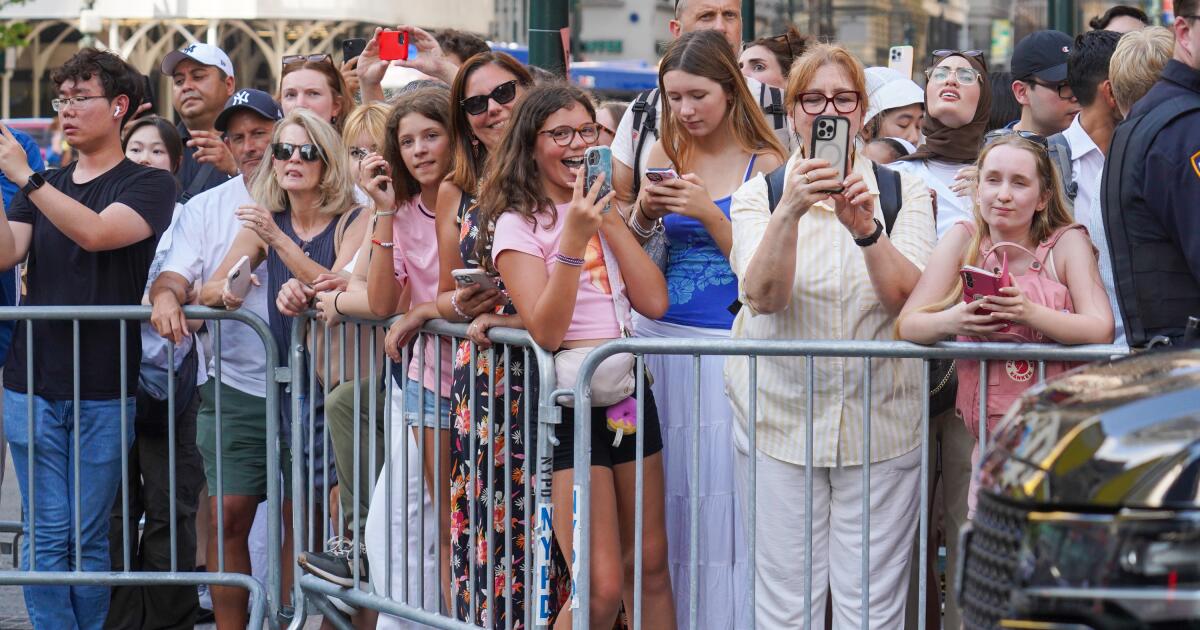
Taylor Swift, Travis Kelce married at lavish Madison Square Garden wedding

