Politics
Inside the Pentagon, fears of a disrupted war effort after Army chief’s ouster


WASHINGTON — Merely two weeks had passed since the Iran war began when Gen. Randy George, the Army’s highest-ranking officer, began sounding an alarm.
Touring a weapons depot in North Carolina, George warned lawmakers present that the conflict’s vast and ever-growing list of targets was straining U.S. capacity — “depleting our stockpiles faster than we can replace them,” as one congressman recalled. Since assuming Army leadership, George had made it his mission to strengthen the nation’s industrial base in anticipation of precisely this moment, when the United States would be engaged in a major war with a formidable adversary.
On Thursday, in a brief phone call, Defense Secretary Pete Hegseth fired George. No reason was given, a U.S. official familiar with the matter told The Times.
The forced departure of George in the middle of a war created yet another blow to morale inside the Pentagon, where multiple officials expressed dismay over the state of the department’s leadership. Over the last year, Hegseth has fired five sitting members of the joint chiefs of staff, with only two holdovers remaining in their posts.
“Whenever you have a change in leadership, military or otherwise, there is bound to be some churn in information management,” one U.S. official said, granted anonymity to speak candidly. “So what you’re doing, in the middle of a war, as we are taking U.S. casualties, is you’re taking out the general in charge of making sure the right people and equipment are flowing into the Middle East.”
Inside the building, officials believe that Hegseth’s next target is Dan Driscoll, the Army secretary and an ally to President Trump. Driscoll has been seen by Hegseth’s aides as outshining the Defense secretary on prominent policy initiatives.
Gen. Randy George, U.S. Army chief of staff, speaks with soldiers during training exercises at Lightning Academy at Schofield Barracks in Honolulu on Nov. 10, 2025.
(Christopher Lee/Bloomberg via Getty Images)
It is a purge that Republican lawmakers on Capitol Hill fear could have tangible, detrimental effects on the war effort. Sens. Roger Wicker of Mississippi, Tom Cotton of Arkansas and Joni Ernst of Iowa, all members of the Senate Armed Services Committee, have expressed private concerns over George’s firing, a second U.S. official said.
Forcing out Army leadership responsible for training and equipping its soldiers, and for ensuring weapons stockpiles continue to meet demand, risks bureaucratic chaos and despair in the ranks at a time when the Trump administration is openly considering a ground operation in Iran.
Others in the Pentagon have raised concern over the U.S. military stockpile, including Air Force Secretary Troy Meink, who last month warned at a defense conference that munitions shortages were a concern even before the war began.
“It was something that we were concerned about even before the operation,” Meink said. “It has just been the fact that we couldn’t see the threat evolving and what we’re facing. So we definitely have to improve on that.”
Trump has denied that the United States faces weapons shortages, even after meeting with the nation’s top contractors last month in a push for them to increase — and on some products, quadruple — their output.
“What interceptors we have for Iran is because of Randy George,” the first U.S. official countered. “He continued to work that problem set up through [Thursday]. It’s a problem set he was working in real time.”
Jerry McGinn, director of the Center for the Industrial Base at the Center for Strategic and International Studies, said U.S. forces have reached a stage in the war where they can pivot away from standoff weapons systems. With Iran’s air defenses largely degraded, they can instead rely on weapons such as laser-guided bombs, helping ease pressure on stockpiles.
But Iran’s downing of two U.S. aircraft on Friday suggests that longer-range weapons may still be necessary.
“When the stockpile is stressed, as it was after Ukraine and then now with Iran, any surge in need leads to a backlog as they try to replenish,” McGinn said.
“The three things they’ve been using a whole lot of are Tomahawks, [Terminal High Altitude Area Defense] and Patriots, and those inventories were already somewhat depleted after Midnight Hammer last summer,” McGinn added. “You can’t crank those out very fast.”
Beyond his role tending to the nation’s “magazine depth” — making sure the military isn’t firing more weapons than it is able to replenish — George also led the Pentagon’s effort to set up a joint task force last year aimed at speeding up the U.S. military’s ability to counter small unmanned aircraft systems, or drones.
The program has proved critical in the war effort. Tehran now relies heavily on its Shahed drones, with its missile production and launch capacity severely diminished.
Acknowledging the Pentagon expulsions, Iran’s embassy in South Africa posted photos on social media Friday x-ing out portraits of several top U.S. military officials fired in recent months.
“Regime change happened successfully,” the Iranians wrote.



Politics
Trump claims he’d win as the president of Venezuela — just needs to ‘quickly’ learn Spanish

NEWYou can now listen to Fox News articles!
President Donald Trump joked that he might run for president of Venezuela, claiming he polls higher than any other politician in the South American country.
Trump made those remarks during a Monday press conference centered on the rescue mission of an Air Force officer who had gone missing after a fighter jet was shot down over Iran.
“The people of Venezuela, they say, if I ran for president of Venezuela, I’m polling higher than anybody has ever polled in Venezuela, so after I’m finished with this, I can go to Venezuela,” Trump said. “I will quickly learn Spanish. It won’t take too long. I’m good at language and I will go to Venezuela. I’m going to run for president. But we’re very happy with the president-elect that we have right now.”
TRUMP TOUTS AIRMAN RESCUE MISSION, BOASTS IRAN COULD BE ‘TAKEN OUT IN 1 NIGHT’
President Donald Trump addresses the nation at the White House in Washington, D.C., on April 1, 2026. (Alex Brandon/Pool via Reuters)
Trump mentioned Venezuela on several occasions during the press conference. He compared the Easter weekend rescue mission’s success to the Pentagon’s capture of Venezuelan President Nicolás Maduro. He also suggested that the outcome in Iran would be similar to Venezuela. He described the conflict with Venezuela as being “over in 45 minutes,” and boasted that the United States has now taken hundreds of millions of barrels of oil from the country.
During a cabinet meeting late last month, Trump joked that he “may run” for president against acting President Delcy Rodriguez, whom he installed as the leader after Maduro was captured.
TRUMP TEASES VENEZUELA AS 51ST STATE AFTER TEAM ADVANCES TO WORLD BASEBALL CLASSIC FINAL
Venezuela’s acting President Delcy Rodriguez waves after bidding farewell to U.S. Energy Secretary Chris Wright following their meeting at Miraflores Palace in Caracas, Venezuela, on Wednesday, Feb. 11, 2026. (Ariana Cubillos/AP)
“The people — actually, I’m the highest polling person. In other words, after the presidency, I think I may go to Venezuela and run for president,” Trump said.
Trump described the prospect as a “wonderful option” for him.
While Trump boasted his “good” language skills at Monday’s press conference, last month he told Latin American leaders at the inaugural Shield of the Americas Summit that he would not learn a new language.
Secretary of State Marco Rubio speaks to reporters at Robert L. Bradshaw International Airport in Basseterre, St. Kitts and Nevis, on Feb. 25, 2026. (Jonathan Ernst/POOL/AFP via Getty Images)
CLICK HERE TO DOWNLOAD THE FOX NEWS APP
During his address, Trump praised Secretary of State Marco Rubio, who, as the son of Cuban immigrants, speaks fluent Spanish.
“He’s got a language advantage over me, ‘cause I’m not learning your damn language,” Trump said. “I don’t have time. I was okay with languages but I’m not gonna spend time learning your language. That much I won’t do.”

WASHINGTON — President Trump said Monday that the United States and Iran are at a “critical point” in negotiating a potential ceasefire agreement, but the chances of reaching a deal by a Trump-imposed deadline on Tuesday evening appeared uncertain.
In a lengthy news briefing at the White House, the president echoed an expletive-laden Easter Sunday warning to strike Iran’s vital infrastructure if Tehran does not agree to open the Strait of Hormuz by 5 p.m. PDT on Tuesday.
“The entire country can be taken out in one night and that night might be tomorrow night,” Trump told reporters.

Mediators from Egypt, Pakistan and Turkey sent the United States and Iran a draft proposal of the 45-day ceasefire on Friday, the Associated Press reported. Its prospects seemed dim amid the president’s threats and a lukewarm response from Iranian leaders, who dismissed the president’s diplomatic overtures as “unrealistic” and denying direct talks with the United States.
Iranian Foreign Ministry spokesman Esmail Baghaei rejected the latest ceasefire proposal, saying Monday that the American demands were “both highly excessive and unusual, as well as illogical.”
Still, Trump continued to assert that Iranian leadership has been negotiating in good faith. He characterized newly installed leaders as an improvement over their predecessors.
“The people that we are negotiating with now on behalf of Iran are much more reasonable,” he said Monday.
Trump declined to comment further on the ceasefire proposal at the news conference, but told reporters that Iran is negotiating ahead of his Tuesday deadline.
“I can tell you they’re negotiating, we think in good faith,” Trump said. “We are going to find out.”
The president did not say whom the United States is negotiating with, but said the most difficult challenge so far has been establishing a reliable channel of communicating with Iranian officials who he said have “no method of communicating.”
Trump also declined to say whether he was prepared to offer Iran assurances to wind down the conflict, or whether he would escalate by following through with his threats to bomb critical Iranian infrastructure, leaving the door open to both diplomacy and military action.
“I can’t tell you — it depends on what they do. This is a critical period,” he said,
Central to the negotiations is Iran’s control of the Strait of Hormuz, a choke point that, if left blockaded, could continue driving oil prices higher and further destabilizing global energy markets.
Trump, in characteristically unorthodox fashion, floated the possibility of the United States seizing operational control of the waterway and charging tolls for passage, a proposal that he provided without much detail.
“Why shouldn’t we?” Trump said. “We have a concept where we’ll charge tolls.”
He also mused openly about seizing Iranian oil, as he has in recent social media posts in which he floated the idea of using the war to claim Iranian energy resources. He acknowledged public pressure was holding him back from that course.
“Unfortunately the American people would like to see us come home,” he said. “If it were up to me, I’d take the oil, keep the oil and make plenty of money.”
In addition to reopening the Strait of Hormuz, Washington is also demanding the permanent decommissioning of Iranian nuclear sites and an end to its uranium enrichment programs. The proposal also requires Iran to halt support for regional proxies and accept strict ballistic missile limits.
In exchange, the United States says it will provide sanctions relief and assistance with civilian energy production, according to media reports.
Speaking at the White House Easter Egg Roll earlier Monday, Trump showed no signs of softening his posture to bring “hell” to Iran if a deal doesn’t materialize.
“We are obliterating their country. And I hate to do it, but we are obliterating. And they just don’t want to say uncle. … And if they don’t, then they’ll have no bridges, they’ll have no power plants, they’ll have nothing,” he said, adding ominously that “there are other things that are worse than those two.”
Iran has warned of “more severe and expansive” retaliations if Trump follows through on the threats.
Also at Monday’s briefing, Trump celebrated the dramatic rescue of the American officer whose fighter jet was downed by Iran last week. He told reporters the operation to retrieve the wounded officer from “one of the toughest areas in Iran” was possible with a mix of “talent” and “luck.”
The president, however, was angered that a news outlet, which he did not name, reported that the weapons system officer had gone missing and was stranded behind enemy lines. Trump vowed to root out the source of that information, including by threatening to jail the journalist who broke the story.
“We have to find that leaker because that is a sick person,” Trump said. “We are going to find out, it is national security. The person who did the story will go to jail if he doesn’t say.”
Also Monday, Israel struck Iran’s largest petrochemical facility in Asaluyeh and killed Gen. Majid Khademi, the head of the Islamic Revolutionary Guard Corps’ intelligence organization.
The Israeli military also hit three Iranian airports, purportedly targeting dozens of helicopters and aircraft it said belonged to the Iranian air force.
Iran responded with missile strikes targeting Haifa, Israel, and energy infrastructure in Kuwait and Bahrain.

John Thune blasts Democrats’ DHS shutdown demands
Senate Majority Leader John Thune accuses Democrats of playing politics with the DHS shutdown, explaining how the Senate passed a bill to fund most agencies. He also addresses President Donald Trump’s remarks on rising gas prices.
NEWYou can now listen to Fox News articles!
A party-line tactic to ram legislation through Congress and bypass the Senate filibuster has become a dumping ground for Republicans’ legislative priorities throughout the year.
Now, as Democrats refuse to fund immigration operations, Republicans are once again readying a budget reconciliation package. The hard part will be getting enough of the GOP on the same page to craft a bill that can pass and survive the strict rules underpinning the process.
Republicans used the same process to pass President Donald Trump’s “big, beautiful bill” last year. It’s a time-consuming, labor-intensive legislative maneuver that nearly blew up and could fail unless both the Senate and House align on what exactly they want to include.
SENATE PASSES BILL TO FUND MOST OF DHS AFTER HOUSE GOP CAVES
President Donald Trump answers questions from reporters after signing an executive order in the Oval Office of the White House Tuesday, March 31, 2026, in Washington. (Alex Brandon/AP Photo)
Trump officially backed using reconciliation again this week as a way to skirt Democrats’ refusal to fund Immigration and Customs Enforcement (ICE) and Customs and Border Protection (CBP), as Congress inches closer to ending the ongoing Department of Homeland Security (DHS) shutdown.
Trump demanded that Republicans get the bill on his desk by June 1.
“We are going to work as fast and as focused as possible to replenish funding for our Border and ICE agents, and the Radical Left Democrats won’t be able to stop us,” Trump said on Truth Social.
Still, Republicans have viewed reconciliation as a vehicle to tackle fraud, affordability, Trump’s tariff authorities, additional tax provisions, healthcare, funding for the Iran war, supplemental agriculture spending, and election integrity measures in the months since passing the “big, beautiful bill.”
DHS SHUTDOWN BREAKTHROUGH COMES AT COST FOR REPUBLICANS AS FUNDING FIGHTS NEARS END
Senate Majority Leader John Thune, R-S.D., said Republicans need to “keep our expectations realistic.” (Stefani Reynolds/Bloomberg via Getty Images)
Senate Majority Leader John Thune, R-S.D., has warned that if reconciliation is going to work — especially given the limited timeframe lawmakers have to start and finish the process — Republicans need to “keep our expectations realistic.”
“Our theory of the case behind all this was to keep that thing as narrow and focused as possible, and that maximizes the speed at which we can do it and the support for it,” Thune said.
“There will probably be some attempts to add things,” he continued. “There are things out there that, obviously, many of us are interested in. But on a reconciliation vehicle like this — which we need to move with haste, as the president has pointed out — it’s probably not a likely magnet for all these other issues.”
Senate Budget Committee Chair Lindsey Graham, R-S.C., told voters at an event this week in South Carolina that he is eyeing two new reconciliation packages, which could ease concerns about cramming all the GOP’s priorities into one massive bill.
GOP RAILS AGAINST ‘S— SANDWICH’ DEAL AS ALL EYES TURN TO HOUSE TO END DHS SHUTDOWN
Sen. Lindsey Graham, R-S.C., walks to the Senate chamber for votes after meeting behind closed doors with fellow Republicans on the Homeland Security budget stalemate, at the Capitol in Washington, March 26, 2026. (J. Scott Applewhite/AP Photo)
“We want to do it quick — ICE, Border Patrol — fund it as much as you can, multi-year,” Graham said. “Then there’s another one coming. I just made news. There’s another one coming in the fall, and that’s going to be about going after fraud.”
House Republicans spent their recent policy retreat earlier this year pushing a so-called “reconciliation 2.0,” gearing up to load the package with several provisions that could drain time and struggle to earn support in the Senate — where strict guidelines could kill proposals entirely if they don’t comply with the rules.
The Republican Study Committee (RSC), which has long called for a second reconciliation bill, also wants to add proposals addressing affordability concerns.
“We support pursuing funding for military readiness and Homeland Security through this legislative process, while simultaneously codifying the president’s agenda to deliver lower costs for working families,” the RSC Steering Committee said in a statement to Fox News Digital.
Some Republicans are also pushing to include the latest policy fight: the Safeguarding American Voter Eligibility (SAVE) Act. The voter ID and citizenship verification legislation has no chance of passing the Senate given unified Democratic opposition.
CLICK HERE TO DOWNLOAD THE FOX NEWS APP
It’s also unlikely to survive the Senate’s reconciliation rules, which allow only provisions that directly impact spending.
“I think we have to set our sights a little bit lower on this reconciliation bill,” Sen. Roger Marshall, R-Kan., told Fox News Digital. “It’s got to be targeted to fund ICE for 10 years — I think that’s the number one thing for us. If we can nibble at the edges of the SAVE Act, that would be great, but the parliamentarian is not going to let us do the SAVE Act. That’s just an impossibility.”
Some of the loudest proponents of the bill in the House GOP acknowledge that adding the SAVE Act to reconciliation would be a challenge — largely because they would prefer to keep the bill intact and push it through the Senate.
“Look, it’s time for them to do a walk-and-talk and filibuster, and let’s make this thing happen,” Rep. Ralph Norman, R-S.C., said. “The American people are watching — piecing it together just to try to get a piece.”

Can You Name These Novels Based on Their Characters?

Even when Arsenio Hall’s show was a hit, ‘everyone wanted it to be something else’

Wisconsin governor says ‘no’ to age checks for porn

Mauro compares Iran rescue of missing colonel to Maduro capture, credits intelligence preparation

Trump claims he’d win as the president of Venezuela — just needs to ‘quickly’ learn Spanish

Florida High School Football Rankings: Top 25 teams – Oct. 21

How old is Bo Nix? What to know about Oregon quarterback ahead of 2024 NFL Draft

Cleary's 21 help Le Moyne down Central Connecticut State 69-64 in OT

99th annual Pony Swim held in Virginia

Indiana Members Credit Union announced as new anchor tenant at Bottleworks District
Trump claims he’d win as the president of Venezuela — just needs to ‘quickly’ learn Spanish

US Supreme Court clears path for Steve Bannon criminal case dismissal
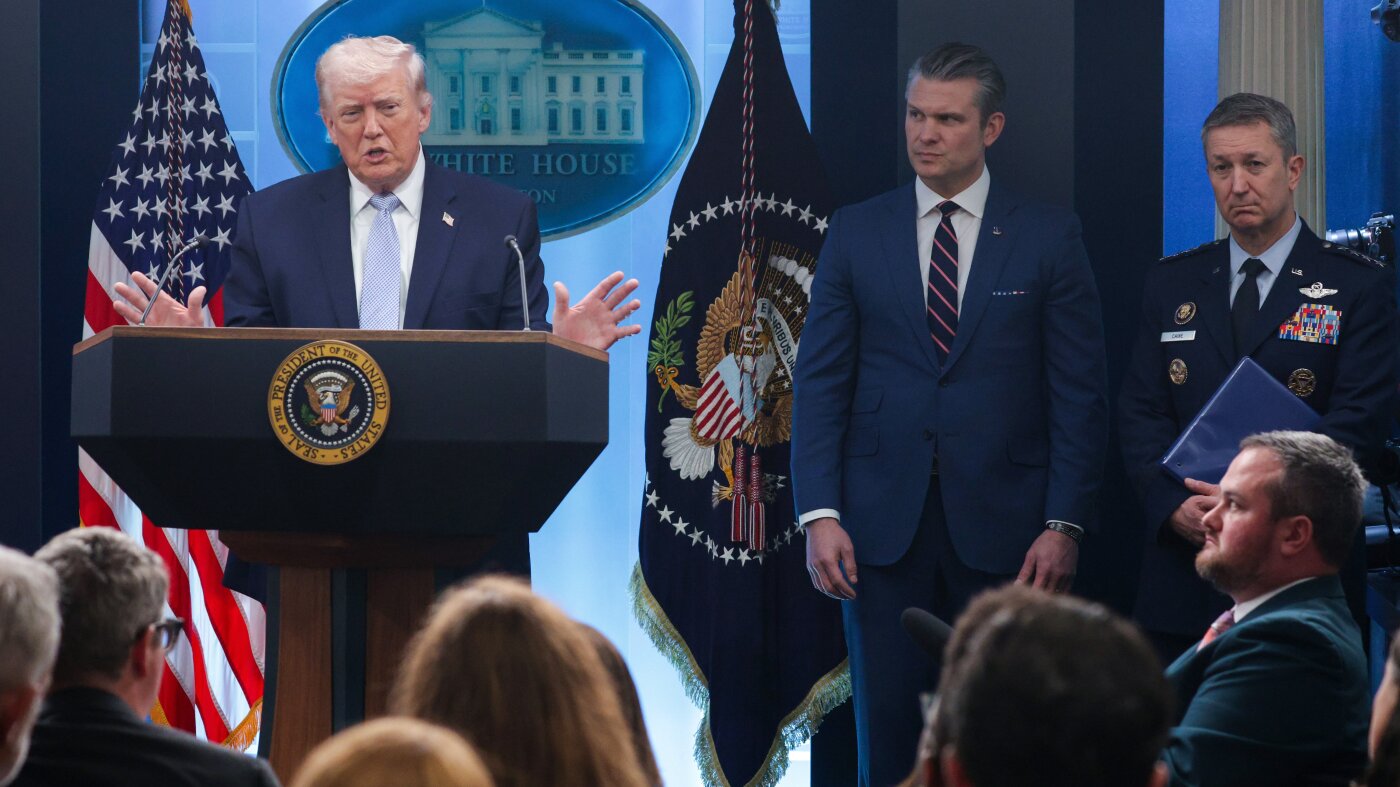
Trump reiterates threats to bomb Iran’s power plants and bridges

Trump threatens Iranian infrastructure over Strait of Hormuz | BBC News

GOP races to pass ICE, Border Patrol funding bill as priorities pile up, divisions emerge
-

 South-Carolina1 week ago
South Carolina vs TCU predictions for Elite Eight game in March Madness
-

 Atlanta, GA2 days ago
1 teenage girl killed, another injured in shooting at Piedmont Park, police say
-

 Vermont1 week ago
Skier dies after fall at Sugarbush Resort
-

 Movie Reviews5 days ago
Vaazha 2 first half review: Hashir anchors a lively, chaos-filled teen tale
-

 Politics1 week ago
Trump’s Ballroom Design Has Barely Been Scrutinized
-
 Entertainment5 days ago
Inside Ye’s first comeback show at SoFi Stadium
-

 Atlanta, GA1 week ago
Fetishist ‘No Kings’ protester in mask drags ‘Trump’ and ‘JD Vance’ behind her wheelchair
-

 Politics1 week ago
JD Vance says he was ‘obsessed’ with UFOs, believes aliens are actually ‘demons’