Politics
Haley says pardoning Trump would be 'healing' as she faces tough questions days before NH primary


GOP presidential candidate Nikki Haley said that pardoning former President Trump would be “healing for the country” as she took tough questions from voters days ahead of the New Hampshire primary election.
Haley fielded a series of tough questions at the town hall Thursday night, which came just five days before Granite State voters head to the polls for the GOP primary.
TRUMP SAYS NIKKI HALEY ‘HAS NO CHANCE’ AHEAD OF NEW HAMPSHIRE PRIMARY: ‘MAGA IS NOT GOING TO BE WITH HER’
GOP presidential candidate Nikki Haley said that pardoning former President Trump would be “healing for the country” as she took tough questions from voters days ahead of the New Hampshire primary election. (Kathryn Gamble/Bloomberg via Getty Images)
PARDONING TRUMP WOULD BE ‘HEALING FOR THE COUNTRY’
During Haley’s town hall on CNN, the former United Nations ambassador said she would pardon Trump if elected, but only if the GOP frontrunner were convicted of a crime.
Haley said that “the last thing we need is an 80-year-old president sitting in jail” because “that’s just going to further divide our country.”
“This is no longer about whether he’s innocent or guilty,” Haley said. “This is about the fact, how do we bring the country back together?”
Haley said she is “determined” to make the “division” and “chaos” go away and that she believes pardoning Trump “would make all of that go away.”
“And I think it would be healing for the country,” Haley said.
AMERICA
Haley got pushback from CNN when she answered a question about whether America was a fundamentally racist country.
She said if one tells a black or brown children they live in a racist country, “you’re immediately telling them they don’t have a chance.”
Townhall moderator Jake Tapper pushed back, saying “You’re talking about the ideals of America, but America founded institutionally on many racist precepts, including slavery.”
Haley said America’s ideals were present from the founding, but the country needed to correct certain places where the nation fell short of the intent of the Constitution.
“When you look at said all men are created equal, I think the intent the intent was to do the right thing. Now, did they have to go fix it along the way? Yes, but I don’t think the intent was ever that we were going to be a racist country. The intent was everybody going to be created equally,” Haley said.
Even though it took decades to fix certain aspects of the nation, Haley said she refuses to believe that the country was based on racism.
MARIJUANA LEGALIZATION
Another moment for Haley came when asked about marijuana legalization, which Haley said was a state-by-state issue. (AP Photo/Tony Dejak, File)
Another top moment for Haley came when she was asked about marijuana legalization. Haley said was a state-by-state issue, but wouldn’t commit to descheduling the substance.
Haley said she would “go with the scientists” on marijuana legalization, and added that she thinks “it’s obviously not in the same class as heroin.”
“But I also think when you’re looking at the legalization of this, I want states to be able to decide that,” Haley said.
“That’s something that should be as close to the people as possible,” she added.
CHILD TAX CREDITS ‘ACROSS THE BOARD’
Haley also said that she is “for child care tax credits for everyone” and said that the tax credits need to be done “across the board” to remain “fair.”
Haley also said that she is “for child care tax credits for everyone.” (Eric Thayer/Bloomberg via Getty Images)
If you’re going to do it, do it across the board and make sure that it’s fair,” Haley said. “Look, when you look at the welfare system and you look at all of those other things, when you look at those programs, the goal that I want to look at is what are we doing to lift them up?”
“What are we doing to make life better for them?” Haley continued, citing her work as South Carolina governor to move people off of welfare and into jobs.
FREEDOM OF SPEECH FOR AMERICANS, NOT FOREIGN ACTORS
Haley was also asked about the idea she floated of social media companies identifying online users by their real name, as a national security concern.
The former U.N. ambassador said she “will always fight for freedom of speech.” She faced widespread criticism for her comments, but on Thursday defended her statement. She said she speaking about “when it comes to our tech companies, is there is a responsibility that our social media companies have.”
“What I think they should do is they should show us their algorithms,” Haley said. “They should be completely transparent so that you know why they push what they push, why you see what you see, all of that, that’s a business transparency situation.”
Haley was also asked about her floated idea of social media companies identifying online users in the name of national security. (AP Photo/Kiichiro Sato, File)
“I’m not saying that Americans have to disclose their name. What I’m saying is you have millions of foreign bots where there are no people behind them. When I was at the United Nations, Russia, China and Iran knew, and said it was the cheapest form of warfare. There are millions of bots that are spreading disinformation, that are sowing division in our country, and they’re doing this to spread harmful things to our younger teenagers.”
“And what I’m saying is those social media companies have to do something with the foreign bots,” Haley continued. “I will always fight for Americans’ freedom of speech, but I am not going to fight for Russians’ and Iranians’ and Chinese freedom of speech. And that’s what’s happening.”
DEMOCRATIC SUPPORTERS IN NEW HAMPSHIRE
Haley was also asked about the support she has been garnering from Democrats in New Hampshire — where around 4,000 voters switched their registration from the Democratic Party, which some speculate could potentially help Haley in the primary.
The former governor said she has seen some independents align with her, and said “some Democrats say they want to support us because they’re not happy with Joe Biden.”
“What I want everybody here to remember is Republicans have lost the last seven out of eight popular votes for president,” Haley said. “That is nothing to be proud of. We should want to win the majority of Americans.”
“The problem is, if you’re going to win the majority of Americans, you have to make sure as a leader, you don’t decide who’s good and who’s bad, who’s right and who’s wrong,” Haley said.
“You bring out the best of people and get them to move forward,” she added.

Politics
California will play a big role in the fight for power in Congress. Tuesday’s primary sets the stage

California’s decision to redraw its congressional map to flip as many as five House seats to Democrats in November is poised to play a big and potentially decisive role in the nation’s broader, bare-knuckle fight for control of Congress.
Tuesday’s primary races — where the top two candidates will advance to November runoffs — won’t determine which Republicans are ousted in most cases, but they will provide an important first look at voter sentiment and bring the fall’s most crucial head-to-head contests into focus.
“There will be some real cues and signals about what to expect,” said Christian Grose, a redistricting scholar and political science professor at USC. “We’re going to know how strong the Democrats’ chances are going to be based on who advances.”
As one example, Grose pointed to the redrawn 22nd Congressional District in the Central Valley, where incumbent Rep. David Valadao (R-Hanford) is facing challenges from moderate Assemblymember Jasmeet Kaur Bains (D-Delano) and progressive college professor Randy Villegas.
Grose said Bains is probably a stronger challenger than Villegas in a district that’s still a reach for Democrats — even if “either one could probably beat Valadao if 2026 is a big Democratic wave.”
Grose will also be closely watching the race between incumbent Reps. Young Kim (R-Anaheim Hills) and Ken Calvert (R-Corona) in the redrawn Congressional District 40, which covers a swath of inland Orange County and portions of San Bernardino and Riverside counties, including parts of Kim’s and Calvert’s current districts.
The district race wasn’t designed to deliver Democrats a seat, but will produce “one of the first casualties for Republicans from the new map” — months before other expected ousters — if Kim and Calvert don’t both advance.
The national picture
The redistricting war was prompted by President Trump’s unprecedented pressuring of Republican-controlled states to redraw their maps mid-decade for partisan advantage in order to retain control of Congress, given his sinking approval ratings and a history of midterm voters punishing the president’s party.
After Texas Republicans heeded Trump’s call to redraw five districts in their party’s favor, California Democrats responded with Proposition 50, a ballot measure passed by voters in November to sideline the state’s independent redistricting committee and allow Democrats to redraw five congressional districts in their favor.
The war ratcheted up — with more Republican states suddenly considering map changes — after a U.S. Supreme Court decision in April that weakened the 1965 Voting Rights Act and its long-standing protections for majority-Black districts in the South.
Republicans have now acted to redraw congressional maps in Alabama, Florida, Louisiana, Missouri, North Carolina, Ohio and Tennessee, with varying degrees of success, while a battle in Utah could add a single additional Democratic seat there. Attempts in other states have failed, including by the GOP in South Carolina and Democrats in Virginia.
Experts say the net result from the flurry of redistricting will probably be a gain of a handful or more seats for Republicans — but in a year when Democrats are expected to make gains more broadly, leaving control of the House up for grabs. California’s new map is “a huge deal” precisely because that math is so close, said David Wasserman, senior editor and elections analyst for the independent, nonpartisan Cook Political Report.
“Democrats are modest favorites for House control based on the political environment, but also because of California,” Wasserman said in an interview with The Times. “Picking up these four or five seats is a prerequisite to Democrats getting the majority.”
California seats in play
California has 52 seats in the U.S. House of Representatives, by far the most of any state. With their new map, California Democrats are hoping to increase their 43 House seats to 48. That would leave just four seats represented by members of the GOP despite Republicans accounting for a quarter of the state electorate.

But that outcome isn’t guaranteed.
Paul Mitchell, a Democratic redistricting expert who devised California’s new map, said the reconfigured congressional districts had to create a pathway for new Democrats to win additional seats without undermining incumbent Democrats’ reelection. And the result is a map with three pretty safe pickups for Democrats, and two districts that are “100% on the table, ready for Democrats to win,” but will nonetheless “require shoe-leather and grit.”
The redrawn congressional district boundaries enacted by Proposition 50 promise to shake up at least three seats, experts said.

Congressional District 1: Held by the late Rep. Doug LaMalfa (R-Richvale) for 13 years until his death in January, the district is currently rural and conservative, stretching from the Sacramento outskirts through Redding to the Oregon border and California’s northeastern corner. Under the state’s new congressional district map, it loses some of its rural reaches and picks up liberal coastal communities, and favors a Democrat such as state Sen. Mike McGuire, who is one of the leading candidates.
Congressional District 3: The seat is currently held by Rep. Kevin Kiley (I-Rocklin) and stretches from the Sacramento suburbs through Lake Tahoe and south along the Nevada border. Under the new map, it holds more tightly to the Sacramento suburbs, favoring a Democrat.

The changes were enough to convince an incumbent Democrat, Rep. Ami Bera (D-Elk Grove), to leave his current district — Congressional District 6, which includes the city of Sacramento and the suburbs of Roseville and Rocklin in Placer County — and run in District 3 instead.
Meanwhile, Kiley did the reverse. He quit the Republican Party, became an independent and announced he would be leaving District 3 and running instead in District 6 — the one Bera is leaving — against a slate of new Democratic challengers.
Congressional District 41. The seat is now held by Calvert, a 17-term incumbent, and currently stretches from Corona to the Coachella Valley. The new map made the district more liberal, losing voters in Riverside County and gaining them in Los Angeles County, and Calvert decided to run instead in Kim’s redrawn but still Republican-leaning Congressional District 40 that is just to the west.

The two toughest flips for Democrats, experts said, are Congressional District 22, Valadao’s heavily Latino district in the Central Valley, followed by Congressional District 48 in San Diego and Riverside counties, where Rep. Darrell Issa (R-Bonsall) decided to retire rather than run for reelection.
Valadao is viewed as especially vulnerable because of his recent support for Medicaid cuts, but he has proved resilient in the past. Meanwhile, his two leading Democratic challengers, Bains and Villegas, are in a bitter fight, with Bains receiving Democratic establishment support and Villegas winning endorsements from prominent progressives.
In Issa’s district, moderate Republican San Diego County Supervisor Jim Desmond is running against several infighting Democrats, including San Diego Councilwoman Marni von Wilpert and former Obama labor official Ammar Campa-Najjar.
Not new, or over
Jeff Wice, a New York Law School professor who was involved in California redistricting efforts in 2010, said the state “has long played hardball politics on redistricting,” including when then-Rep. Phil Burton, a powerful San Francisco Democrat, bragged more than 40 years ago that the complex congressional boundaries he’d crafted for Democrats were his “contribution to modern art.”
But in five decades studying redistricting, Wice said he has never seen such “politically driven, partisan politics” as are occurring now across the nation, which he said have “no root in law, reason or fairness” — and are only likely to continue.
“This state-by-state war is far from over, and may continue all the way through 2030,” he said. “A lot of it depends on the outcome of this November’s election.”
Wasserman said the country has “entered an era of no-holds-barred redistricting,” and he also sees redistricting efforts continuing — including in California, where they would present a distinct threat to the state’s few remaining Republicans.
Michael Li, senior counsel in the Democracy Program at the Brennan Center for Justice at NYU Law, said California is a “big part of the story” this election cycle, thanks to Proposition 50. “Democrats in California proved to be very determined and resourceful and managed to get that done, and right now California is the big offset to Republican gerrymandering around the country,” he said.
But what will come of it all — in California and across the country — is still to be determined.
“When you’re gerrymandering, you’re making a bet that you know what the politics of the future will look like, and it’s hard to predict,” he said. “It’s a high-risk, high-reward venture.”

NEWYou can now listen to Fox News articles!
It hasn’t been a great last few days for Marxist political influencer Hasan Piker.
First, as Fox News Digital reported exclusively last week, the Treasury Department’s Office of Foreign Asset Control (OFAC) sent Piker an administrative subpoena seeking financial, logistical and communications records related to his March trip to Cuba as part of an investigation into whether he violated U.S. sanctions laws against doing business with the communist regime running the island nation.
Then last night, during protests outside an Immigration and Customs Enforcement facility in Newark, N.J., hecklers confronted Piker, calling him a “f—ing fraud, ” “fake-a– grifter” and “dog abuser,” telling him, “Go back to the desktop.” (Piker has denied allegations he trained his dog, Kaya, with a shock collar.)
Now, Piker told his loyal following on the gaming platform Twitch that British authorities denied his Electronic Travel Authorization, or ETA, preventing him from traveling to the United Kingdom for a series of scheduled appearances, including events at SXSW London and the Oxford Union. Approved U.S. travelers to the UK can enter the country with a simple Electronic Travel Authorization, which is easier to get then a formal visa.
“I’ve been banned from the UK,” Piker told viewers. “I’ve been to the UK on numerous occasions, and all of the things they’re complaining about now are things I’ve said before.”
He went on to say, “It’s f—ing ridiculous.”
HASAN PIKER DEFENDS PRO-COMMUNIST, ANTI-ICE SINGHAM NETWORK ACTIVISTS AS ‘WONDERFUL PEOPLE’
Hasan Piker speaks with an interviewer during a protest in New Jersey. (Michael Dorgan/Fox News Digital)
Although Fox News Digital could not confirm Piker’s claim, such a move by the UK would be significant because it would mark a potential red line that a Western government has drawn regarding the importation of extremist ideas and ideological movements that officials believe may contribute to social unrest, extremism or political violence.
At the tail end of a long livestream, Piker said he was denied entry for alleged antisemitism, which he denied, and then proceeded to lash out at Jewish organizations that he said had campaigned against his visit, claiming they wielded excessive influence over British policy.
“Israel advocacy organizations have unbelievable amounts of power over what even the United Kingdom has to say and do,” Piker said. “If you’re an avowed anti-Zionist, your travel will be restricted.”
Piker accused the UK government of bowing to pressure from pro-Israel advocacy groups and described the decision as evidence of a growing crackdown on political dissent across Western democracies.
The comments came weeks after several British Jewish organizations publicly urged the government to block Piker’s entry into the country, citing remarks they described as antisemitic and supportive of extremist groups. Piker has said he believed the U.S. deserved the 9/11 attack as “backlash” for its foreign policy decisions. The Jewish Leadership Council and Community Security Trust argued that Piker’s presence in Britain would not be “conducive to the public good,” pointing to his comments about Hamas, Hezbollah, Zionism and Orthodox Jews.
Labour MP David Taylor also called on the Home Office to revoke Piker’s visa ahead of scheduled appearances at SXSW London, arguing that his rhetoric had contributed to concerns within Britain’s Jewish community.
Punctuating his commentary about the UK decision with deep sighs, cursing and rage at suggestions from his followers, Piker repeatedly rejected accusations of antisemitism, saying criticism of Israel was being conflated with hatred of Jews. He said the decision reflected a broader trend in which governments are suppressing anti-Israel voices.
“This is straight-up fascism,” Piker said. “Being critical of Israel while combating antisemitism is not a good enough reason to bar someone entry into the country.”
HOW A RHODES SCHOLAR WITH TIES TO CUBA’S PRESIDENT ORGANIZED THE CONVOY THAT BROUGHT HASAN PIKER TO HAVANA
(left) Cuba’s President Miguel Diaz-Canel raises his fist next to Progressive International’s general coordinator David Adler during an event at the Cuban Institute for Friendship with the Peoples in Havana on March 21, 2026. (right) Hasan Piker joins a convoy to Cuba in March 2026. (Ernesto Mastrascusa/AFP and CodePink via Storyful)
The streamer said he had planned a week-long trip that included appearances alongside former Greek finance minister Yanis Varoufakis, a live podcast recording and an event at Oxford Union.
Varoufakis is the co-founder of the 501(c)(3) nonprofit group, Progressive International, which Piker credits with getting him to Cuba for a March aid convoy that may have violated U.S. laws. A Fox News Digital investigation chronicled how Progressive International and its co-founder David Adler have allegedly been a critical part of a foreign influence operation by the Communist Party of Cuba. Progressive International and Adler didn’t respond to a request for comment.
The U.K. government didn’t respond to a request for comment. However, in recent weeks, Home Secretary Shabana Mahmood, a critic of Israeli policies, recently revoked the travel authorization of Piker’s uncle, Cenk Uygur, founder of “The Young Turks,” after concluding his presence would not be “conducive to the public good.”
During the livestream, Piker warned that the alleged UK decision could set a precedent for other Western countries, including Australia and Canada, potentially restricting his future travel.
HASAN PIKER NAMES PRO-CCP TYCOON SINGHAM AS FINANCIER OF ‘POLITICAL MOVEMENTS’ DESPITE NONPROFIT VENEER
Hasan Piker and Jodie Evans and Neville Roy Singham (Getty Images)
“I genuinely did not think this would happen,” he said. “We’re moving into a very different timeline.”
Piker said he and his team were exploring whether he could apply for a standard visa despite the denial of the Electronic Travel Authorization, though he acknowledged it was a long shot.
Piker’s case intersects with a broader inquiry into the influence of transnational activist networks operating in the United States. During a livestream this week, Piker said that the Treasury Department’s investigation into his Cuba trip may ultimately be focused on Neville Roy Singham, an American Marxist businessman living in Shanghai who has funded a network of nonprofit organizations and activist groups that have drawn scrutiny from lawmakers and administration officials.
Among the organizations funded by Singham is CodePink, which also received a Treasury Department administrative subpoena related to its participation in the March convoy to Cuba, as well as groups such as the Party for Socialism and Liberation and the ANSWER Coalition. All three organizations openly identify with socialist or communist political traditions and have been prominent organizers of anti-Israel demonstrations across the United States since the Oct. 7, 2023, attacks by Hamas against Israel.
Critics argue that some of those demonstrations have created hostile environments for Jews in the UK, U.S., and elsewhere, including the use of slogans such as “From the river to the sea,” which calls for the elimination of Israel.
Trump administration officials are investigating the groups tied to Singham as a transnational network advancing anti-American, pro-Chinese Communist Party and anti-Western narratives while exploiting political and social divisions inside the U.S.
Lawmakers, Treasury officials and national security analysts have increasingly examined whether such networks are helping to amplify polarization, social discord, and hostility toward democratic institutions. Meanwhile, last night at the ICE protest, Piker defended the groups as led by “wonderful” people.
The debate has been particularly acute in Europe, where governments have grappled with alliances between far-left activists and Islamist organizations that have joined forces around anti-Israel activism and antisemitism. Critics argue that some of these coalitions have fomented rhetoric and violence hostile to Jews, leading to rising antisemitism in the UK, much like in the U.S.
For his part, Piker ended his podcast defiant, angry and seemingly deflated for the moment, repeating again, “Bro, they banned me from the UK,” and then finally closing the podcast, saying, “I’m done for the day.”
CLICK HERE TO DOWNLOAD THE FOX NEWS APP
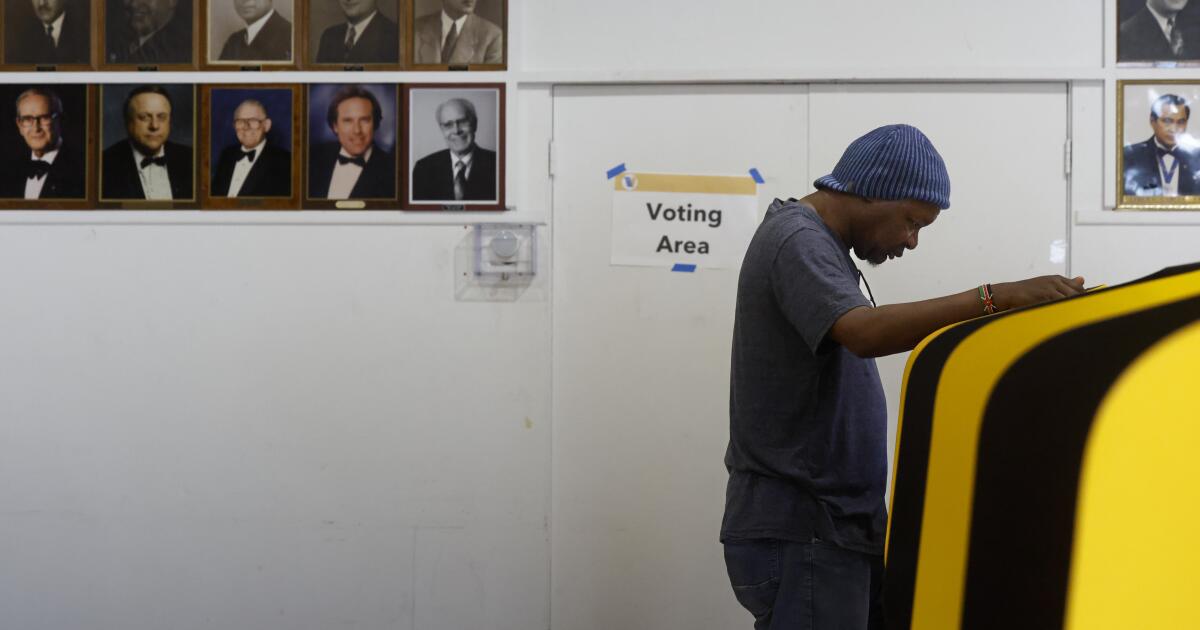
Yes, voting centers will be open across Los Angeles this week. And no, you don’t have to cast your ballot by mail.
With days left before the June 2 primary, President Trump made a round of misleading claims about the electoral process, this time falsely suggesting that the city was holding elections only by mail.
Trump’s comments came Saturday during an appearance on Fox News when he was asked by host Lara Trump — the president’s daughter-in-law — about his predictions for the upcoming primary.
“You know, they don’t have voting booths; everything’s by mail,” Trump responded. “I don’t think a Republican can win in California unless you pass the Save America Act — then they’re gonna have to show proof of citizenship, they’re going to have to get rid of mail-in voting.”
The L.A. County registrar-recorder moved to set the record straight in a tweet posted Sunday morning that read “MISINFORMATION ALERT.”
Noting that in-person voting was in fact allowed, the agency announced that it had 646 vote centers across the county — each with multiple voting booths. The centers will be open from 10 a.m. to 7 p.m. on Monday and Tuesday, the agency said in the posting, while tagging Fox News and the White House.
A map of polling locations featured on the agency’s website shows that there are dozens of voter centers available countywide. Mobile vote centers also were made available at various sites in the county. Mobile voting runs for the 10 days before election day and will not be available on June 2, according to the county registrar-recorder.
As of Friday morning, 333,000 mail-in votes had been cast in the June 2 primary for Los Angeles mayor, city attorney, city controller and eight of the 15 City Council seats. This was up from 321,000 at the same time in 2022, according to registrar-recorder.
Registered voters already should have received a ballot in the mail. Those who choose to vote in person can take their mail-in ballot to a vote center and ask to vote in person instead. Residents who haven’t yet registered to vote can still do so by requesting a conditional voter registration application at any voter center and filling out their ballot as they normally would.
Recent polling suggests that, ahead of Tuesday’s primary, incumbent Los Angeles Mayor Karen Bass has what pollsters deem a statistically insignificant lead in her bid for reelection as the city’s top executive. Bass is locked in a tight race with councilmember and former ally Nithya Raman and Spencer Pratt.
Trump has signaled his support for Pratt but hasn’t formally endorsed the former reality TV star and registered Republican. Former Trump advisor Steve Bannon said the president hadn’t done so out of the fear it would hurt Pratt’s chances in Democrat-dominant Los Angeles.
In 2020, during the outbreak of the COVID-19 pandemic, Gov. Gavin Newsom took the unprecedented step of issuing a statewide order for voting by mail for that year’s election in what he described as a necessary step to limit the virus’ spread.
A handful of rural counties had no in-person voting locations that March.
In 1979, the state eliminated the need for an excuse to receive an absentee ballot, and an option to choose permanent absentee voting was created in 2002. In the decades since, Californians have embraced the flexibility that voting away from a polling place offers. In nearly every statewide election since 2008, the majority of votes have not been cast at a traditional polling place.
Fourteen more counties — including Orange, Sacramento and Santa Clara — have adopted the state Voter’s Choice Act, an optional state law that requires them to mail every voter a ballot and to replace traditional neighborhood polling places with multipurpose vote centers. Those in-person locations offer multiple election services for up to 10 days before election day.
Los Angeles, the 15th county to adopt the new state law, was initially given special permission by the Legislature to implement it without mailing every voter a ballot.
Trump has for years repeated baseless claims that the 2020 election was stolen and that undocumented immigrants were swaying elections by voting illegally.
In light of these claims, Trump and some Republicans have pushed for new restrictions on voters. A federal proposal known as the Save America Act — which would require Americans to prove they are U.S. citizens before they register to vote and to show identification at the polls, among other things — cleared the U.S. House but stalled out in the Senate.
In November, California voters will weigh in on a similarly contentious ballot measure pushed by Republicans that would require all voters in future elections to show identification every time they vote in person or provide a special PIN when submitting mail-in ballots.
Under current state law, Californians are required to provide identification when registering to vote and must swear under penalty of perjury, a felony, that they are eligible to vote and are U.S. citizens. They are not required to show or provide identification when casting a ballot in person or by mail.
If passed, the California ballot measure would require voters to present government-issued identification, such as a state driver’s license, every time they vote. Voters mailing ballots would be required to write a four-digit number, essentially a PIN, on their ballot envelopes matching the one generated when they registered to vote.
Critics of California’s voter ID initiative, including many legal scholars, say the ballot measure addresses a problem that does not exist.
In May, a federal judge handed Trump a victory by declining to halt the president’s executive order creating a federal list of eligible voters and then directed the U.S. Postal Service to deliver mail ballots only to those on the list. Observers say the decision opens the door for potential sweeping changes in how American elections are run shortly before this year’s midterm elections.
The Associated Press contributed to this report.
-
 Entertainment3 minutes ago
Happier than ever, Gary Oldman isn’t ready to quit ‘Slow Horses’ anytime soon
-
 Lifestyle10 minutes ago
L.A. Times Concierge: ‘I’m interested in photography. What great L.A. historic sites should I capture?’
-
Politics13 minutes ago
California will play a big role in the fight for power in Congress. Tuesday’s primary sets the stage
-
 Sports25 minutes ago
UCLA softball coaches Kelly Inouye-Perez and Lisa Fernandez inspire nation’s top offense
-

 News28 minutes ago
Xi’s last frontier: China’s plan to transform its west
-

 World33 minutes ago
Iran’s IRGC launches retaliatory strike after US attacks
-
 News58 minutes ago
One by one, U.S. civil rights agency dismantles tools to fight discrimination
-

 Los Angeles, Ca2 hours ago
Ballots burned, vote center vandalized in possible acts of election interference, Los Angeles County officials say

