Vermont
UVM lab spotlights gadgets that make independent living safer and easier – VTDigger

BURLINGTON — Do you ever feel anxious wondering if you left the oven on or whether you closed the door?
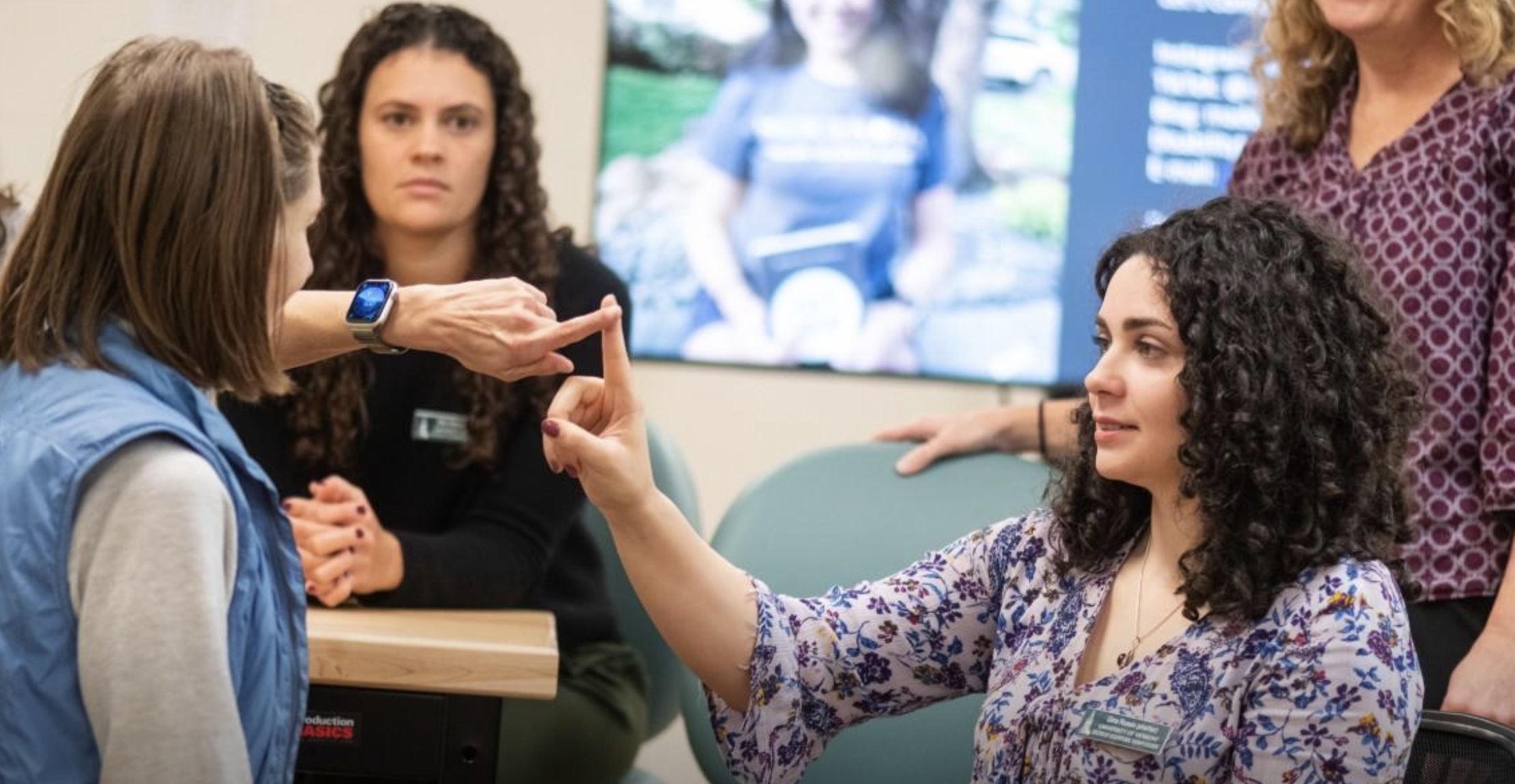
At an open house at the University of Vermont, visitors explored a recreated apartment with low- and high-tech devices that could make it easier to live independently and make people less worried.
Designed to benefit anyone — but particularly older adults and people with disabilities — these innovative devices can assist with everyday tasks and enhance independent living, as demonstrated by UVM students in the occupational therapy program at Friday’s open house.
“If you would ask most people, most people would prefer to be independent and prefer to stay in their homes as long as they can,” said Victoria Priganc, program director for the UVM occupational therapy program.
An oven that can be controlled via smartphone or set on a timer, a remote control for locking and unlocking doors, and a “bed ladder” to assist those with limited trunk strength were some of the tools showcased.
The students providing information about the devices at the event are all enrolled in the college’s new occupational therapy program. The University of Vermont launched the program last year in response to the growing demand for occupational therapy services in Vermont, according to a press release from the university on Nov. 22.
“The whole promise behind occupational therapy is to really help people wherever they’re at in life to do what they want to do as independently as they can,” Priganc said.
The device that drew the most “wows” was the Samsung smart fridge, featuring a sleek touchscreen control panel that responds to touch and voice commands. The high-tech appliance can assist with creating grocery lists, planning meals and tracking expiration dates, students said.
For those who find it difficult to open the fridge door, an internal camera allows users to check its contents from the outside, with the option to label items with the touchscreen keyboard for easy organization. The smart fridge can also connect to smartphones, enabling users to view what’s inside while grocery shopping.
Another crowd favorite was the “tornado dryer,” a whole-body built-in air dryer in the bathtub area that activates with the push on a button. With different settings, it provides a convenient and accessible alternative to using towels, making post-bath drying easier for those in need of mobility assistance.
Another bathroom feature was the cut-out part of the bathtub, allowing users to step directly into the tub without having to climb over the edge. It offers a safer, more accessible option and is not as expensive as one might think, according to Priganc.
“It doesn’t cost that much to have a company come in and do that,” Priganc said. “That’s a lower tech solution for people who really can’t get into the bath.”
The bathroom also had adjustable handles, a heated toilet seat inspired by Japanese toilets and a tap that changes color according to the water temperature, helping people with sensory issues.
The devices on display vary widely in price, from affordable options to high-tech gadgets costing several thousand dollars. For instance, the Samsung smart fridge is priced at $2,399, while the bed ladder, a simple tool to assist people with limited trunk strength in pulling themselves up, only costs a couple of dollars.
The smart apartment also included voice-activated controls for lights, appliances, and adaptive tools for eating and reading.
“It was through collaboration and clinical experience that we decided what we put in the lab (open house),” Priganc said.
Helping out at the open house was Allie Kelly, a consultant from the assistive technology program, a partnership with the college’s Center on Disability and Community Inclusion and Vermont’s Department of Disabilities, Aging and Independent Living.
Kelly had a table full of different buttons to help turn on a ventilator, leave a Zoom meeting or control a tablet. She said the Vermont Assistive Technology Program has hundreds of tech devices that people can try out.
“People can try out these devices for 30 days for free before they make a decision to buy it,” Kelly said.



BARRE, Vt. (WCAX) – For the fourth consecutive year, Vermont communities have faced heavy and damaging rains in July, and across the state, communities are still rebuilding and redesigning to protect against future floods.
Central Vermont saw pelting rain Thursday. The heavy rains came as a surprise to Bob Nelson, a Nelson Hardware owner in Barre, and others in the city who had flashbacks on the eve of the devastating flooding three years ago.
“I could hear pounding on the roof of our house, and my wife and I go out onto the deck and the water is sheeting off over our gutter,” Nelson said. “It’s crazy; it’s the same day the last three years.”
Barre’s infrastructure and homes were largely spared, but the downtown took on about a foot of water.
“It’s a bit of a helpless feeling. All you can do is say a prayer and watch the water come up and hope it stops raining,” Barre Mayor Thom Lauzon said.
Barre has been working to upgrade culverts, remove debris, improve stormwater systems and more. But Lauzon said with limited dollars, it will take time to adjust to a future filled with flooding.
“We spent 75 years encroaching on the Stevens Branch and making it smaller. Now we’re going to take the next 75 years reversing that process,” Lauzon said.
Vermont has conducted some 250 home buyouts, paid out $40 million to families and shelled out some $200 million in infrastructure repairs.
“You always wish you were farther along than you are, but you’re also grateful for all of the hard work that’s gotten you here,” said Doug Farnham, Vermont’s chief recovery officer.
Farnham said most of Vermont’s small and medium flood recovery projects are complete or near complete, but the process with FEMA has been slow because of red tape.
“In many cases, we’re over three years into this. We’re not happy with how long it’s gone, but it’s consistent with the historical performance,” Farnham said.
He added that for Vermont’s downtowns, many of which are built in the floodplain, it will take many decades to build for the future.
Vermont may receive up to another $400 million for new wastewater plants in Hardwick, Johnson and Ludlow, and for upgrades in Montpelier’s Capitol Complex.
Copyright 2026 WCAX. All rights reserved.

Stowe Country Club in Stowe, Vermont, has reopened after a restoration by architect Beau Welling.
Erik Matuszewski
Vermont might be best known for its breathtaking ski resorts when it comes to outdoor pursuits, but the golf offerings in the historic community of Stowe are now better than ever with the recently completed redesign of the Stowe Country Club by architect Beau Welling and his team.
The transformation at the course, set on a former dairy farm with views of the Green Mountains, firmly establishes Stowe as one of New England’s top 36-hole golf destinations.
The wide open and walkable nature of Stowe CC complements the ruggedness and dramatic elevation changes at The Mountain Course at Spruce Peak just minutes up the road, with both courses accessible by guests staying at The Lodge at Spruce Peak as well as members of The Club at Spruce Peak.
“This project honors the history of the course while reimagining it for the next generation, creating a place where members, guests, and local residents can gather to enjoy the landscape, the sport, and the shared experiences that define this region,” said Sam Gaines, who is the president of Mt. Mansfield Company, the ownership group behind Stowe Country Club, and lives in the town with his wife and three children.
Golfers return to the course as Stowe Country Club re-opened after a restoration by architect Beau Welling.
Stowe Country Club
Stowe CC has transitioned from a public facility to a private club (with the limited guess access) as part of the redevelopment, which reflects a broader vision for the area as a four-season mountain destination. Also in the plans are a new clubhouse, expanded dining, racquet sports, fitness and wellness activities, and additional recreational offerings.
But improving the golf course was the first step in that evolution and the results are the culmination of a process that started more than a decade ago when Gaines first invited Welling to see the property. The two had met at gatherings of the Urban Land Institute, which puts a focus on the environment in transforming communities, and Gaines was eager to have Welling offer advice on what needed to be done most urgently on “175 acres in the middle of the most affluent and amazing historic town” in Vermont.
Architect Beau Welling at the re-opening ceremony for Stowe Country Club. Stowe Country Club
Welling, who for years has worked with Tiger Woods and his design team, traces his New England ties back to his days playing for the Brown University golf team in Rhode Island.
“I could see the potential, almost immediately, of how special an environment this place is,” said Welling. “But when we first started talking about this project, I think it was more of a dream.”
The revamped 18th hole at Stowe Country Club, a shorter par 4, features a new “lion’s mouth” bunker in front of the green.
Erik Matuszewski Early efforts included Welling redesigning two greens encumbered by wetlands and other issues. But the scope of the project expanded dramatically after the pandemic, as golf surged in popularity.
Around 2022, Welling started to put together a full 18-hole redesign plan for Stowe Country Club, which had long been a welcoming and community-focused public course. It was popular in a hybrid community of sorts that brought together a diverse mix of year-round residents, seasonal residents, and tourists – whether for ski season or during the spring, summer and fall (peak leaf-change season) months. When the work started on the first nine holes in 2024, the breadth of the project continued to grow, becoming much more than new green complexes.
Stowe Country Club is one of two 18-hole championship courses available to members of the Club at Spruce Peak as well as guests staying at the Lodge at Spruce Peak.
Erik Matuszewski Today’s finished product includes complete reconstruction of all greens and tees, a reshaping and regrading of all fairways, modernization of the bunkers, upgraded irrigation and drainage systems, and a full re-grassing of premium bentgrass across greens, tees and fairways.
Several holes were changed significantly, notably the 13th and 15th holes, and a new comfort station – the Sugar Shack – has been added between the 5th and 14th tees. Hundreds of non-native pine trees were removed from the course itself, with about 150 new ones planted on its perimeter. The removal of the interior trees opened views of the surrounding mountains, including Mt. Mansfield, and the addition of waving fescue grasses to replace them helps better frame the holes.
Sam Gaines (middle), the president of Stowe Country Club ownership group Mt. Mansfield Company, at the new Sugar Shack comfort station during opening day at Stowe CC. Stowe Country Club For Welling, the overall focus was on improving playability, variety, strategy, and aesthetics.
“It feels like the sort of classic Northeast golf course, with rolling topography, distinctive bunkering, challenging greens contours, fescue grasses,” said Welling. “The environment feels classic and special to me.”
A secondary club logo, a flying cow, is a nod to the property’s history.
The new flying cow logo alongside Stowe Country Club’s traditional logo.
Stowe Country Club For Gaines, who’s worked in private equity and real estate for well over a decade and was accustomed to executing strategic plans with little deviation, the artistic process of an evolving golf course redesign was something he said he had to “hold onto my seat” for. Especially if it involved the relocation of an entire green complex. He joked that part felt “a little bit building the airplane while you’re flying it, but it’s also pragmatic problem solving. And that’s what you’re after.” The par 3 10th hole at Stowe Country Club.
Erik Matuszewski The initial response to the course changes and broader project have been overwhelmingly positive.
More than 200 new members have been added at Stowe Country Club and The Club at Spruce Peak, many of them coming from the Boston and New York areas.
And for those looking to travel to Vermont for golf (and any number of other outdoor activities) rather than skiing, Stowe and The Mountain Course are both accessible through stay-and-play packages in guestrooms, suites and private residences at the luxurious Lodge at Spruce Peak.
Stowe Country Club sits in the valley, at a different elevation than the nearby Mountain Course at Spruce Peak, but has dramatic topography and scenic views of the surrounding mountains. Stowe Country Club While the Mountain Course remains a wild ride, climbing and diving across elevations of about 1,800 feet, Stowe Country Club in the valley is drastically different – and now better than ever.
“For the most part, we left the topography the way it is, because it’s naturally undulating,” said Gaines. “There are golf course developers who will pay $40 million to end up with this result. The only difference is they start with a flat site.”
Full Redesign
An Artistic Process
Powerball, Mega Millions jackpots: What to know in case you win
Here’s what to know in case you win the Powerball or Mega Millions jackpot.
Just the FAQs, USA TODAY
The Vermont Lottery offers several draw games for those willing to make a bet to win big.
Those who want to play can enter the MegaBucks and Lucky for Life games as well as the national Powerball and Mega Millions games. Vermont also partners with New Hampshire and Maine for the Tri-State Lottery, which includes the Mega Bucks, Gimme 5 as well as the Pick 3 and Pick 4.
Drawings are held at regular days and times, check the end of this story to see the schedule.
Here’s a look at July 9, 2026, results for each game:
Winning Gimme 5 numbers from July 9 drawing
08-15-26-27-30
Check Gimme 5 payouts and previous drawings here.
Winning Pick 3 numbers from July 9 drawing
Day: 1-5-4
Evening: 6-2-8
Check Pick 3 payouts and previous drawings here.
Winning Pick 4 numbers from July 9 drawing
Day: 5-0-2-1
Evening: 2-6-7-6
Check Pick 4 payouts and previous drawings here.
Winning Millionaire for Life numbers from July 9 drawing
02-15-22-54-58, Bonus: 04
Check Millionaire for Life payouts and previous drawings here.
Feeling lucky? Explore the latest lottery news & results
Are you a winner? Here’s how to claim your lottery prize
For Vermont Lottery prizes up to $499, winners can claim their prize at any authorized Vermont Lottery retailer or at the Vermont Lottery Headquarters by presenting the signed winning ticket for validation. Prizes between $500 and $5,000 can be claimed at any M&T Bank location in Vermont during the Vermont Lottery Office’s business hours, which are 8a.m.-4p.m. Monday through Friday, except state holidays.
For prizes over $5,000, claims must be made in person at the Vermont Lottery headquarters. In addition to signing your ticket, you will need to bring a government-issued photo ID, and a completed claim form.
All prize claims must be submitted within one year of the drawing date. For more information on prize claims or to download a Vermont Lottery Claim Form, visit the Vermont Lottery’s FAQ page or contact their customer service line at (802) 479-5686.
Vermont Lottery Headquarters
1311 US Route 302, Suite 100
Barre, VT
05641
When are the Vermont Lottery drawings held?
- Powerball: 10:59 p.m. Monday, Wednesday, and Saturday.
- Mega Millions: 11 p.m. Tuesday and Friday.
- Gimme 5: 6:55 p.m. Monday through Friday.
- Lucky for Life: 10:38 p.m. daily.
- Pick 3 Day: 1:10 p.m. daily.
- Pick 4 Day: 1:10 p.m. daily.
- Pick 3 Evening: 6:55 p.m. daily.
- Pick 4 Evening: 6:55 p.m. daily.
- Megabucks: 7:59 p.m. Monday, Wednesday and Saturday.
- Millionaire for Life: 11:15 p.m. daily
What is Vermont Lottery Second Chance?
Vermont’s 2nd Chance lottery lets players enter eligible non-winning instant scratch tickets into a drawing to win cash and/or other prizes. Players must register through the state’s official Lottery website or app. The drawings are held quarterly or are part of an additional promotion, and are done at Pollard Banknote Limited in Winnipeg, MB, Canada.
This results page was generated automatically using information from TinBu and a template written and reviewed by a Vermont editor. You can send feedback using this form.
-

 Movie Reviews6 minutes ago
‘Only Beautiful Things to Look At’ Review: A Handsome but Muffled Portrait of State-Sanctioned Cruelty
-

 World14 minutes ago
Colombia Adds Massive Soundstage as Bogotá Audiovisual Market Attendance Soars and ‘Narcos’ Star-Led ‘Rookies’ Cleans Up in Project Prizes
-
News21 minutes ago
How a Beer Hall Keeps Up With a World Cup Crowd
-
 Lifestyle54 minutes ago
Shy on the dance floor? Virtual reality ‘partners’ aim to help you find your groove
-

 Technology1 hour ago
Are you filthy enough for a $700 portable shower?
-

 World1 hour ago
Former British MP and reality TV star Ann Widdecombe found dead; man arrested for murder
-

 Politics1 hour ago
Trump takes unusual step, lets bipartisan housing bill become law unsigned amid SAVE pressure campaign
-

 Health1 hour ago
Eating common dairy food every day may slow biological aging, study suggests

