Connect with us

Vermont

How trans, nonbinary Vermonters are prepping for Trump's gender policies

Published

on

How trans, nonbinary Vermonters are prepping for Trump's gender policies


Vermont’s Attorney General’s Office and Human Rights Commission said Thursday that the state will continue to enforce local laws that protect people from discrimination based on their gender identity.

This comes after President Donald Trump signed an executive order stating that the federal government will only recognize two, unchangeable sexes — male and female — and will rework federal funding and policies accordingly.

Trump’s executive order effectively rejects the widely recognized medical condition known as gender dysphoria. That’s when someone experiences psychological distress because of a mismatch between their sex assigned at birth, and their gender identity.

The American Psychiatric Association says that forcing someone with gender dysphoria to identify as their sex assigned at birth can harm a person’s mental health, including increasing the risk of suicide.

Advertisement

Elodie Reed

/

Vermont Public

Signage at the Pride Center of Vermont is pictured on Wednesday, Jan. 22.

While state officials in Vermont are pledging to protect transgender and nonbinary people, organizations that work with these communities say people are worried. And they’re trying to prepare for the changes happening at the federal level.

Advertisement

Planned Parenthood of Northern New England, for example, has reported an increase in calls from patients wanting to talk about maintaining access to gender-affirming care.

And at the Pride Center of Vermont, Trans Program Manager and SafeSpace Advocate Em Russo says people are thinking through gender markers on their documents, coming together in support group settings and — finding moments of joy.

Russo sat down this week with Vermont Public health equity reporter Elodie Reed inside the Pride Center’s library in Burlington.

This interview was produced for the ear. We highly recommend listening to the audio. We’ve also provided a transcript, which has been edited for length and clarity.

Elodie Reed: We now have one executive order that Trump has signed, declaring there are two sexes. I guess I’m wondering how that’s landing — I know it’s only been a couple days, but how that’s landing so far in the community?

Advertisement

Em Russo: I mean, I think the vibes are palpable here — and I think that it’s a tough time. And that first executive order is obviously so harmful and invalidating for so many folks in our community.

But we, you know, added a couple of additional support spaces right before this to try to, like, lead up, for people to come and talk about what’s coming up for them. And then doing some more of that behind-the-scenes work with the ACLU and legal teams to know more of our rights, and know what implications this will have on us as an organization and also a community.

We can’t be erased. We have always been here. We always will be here.

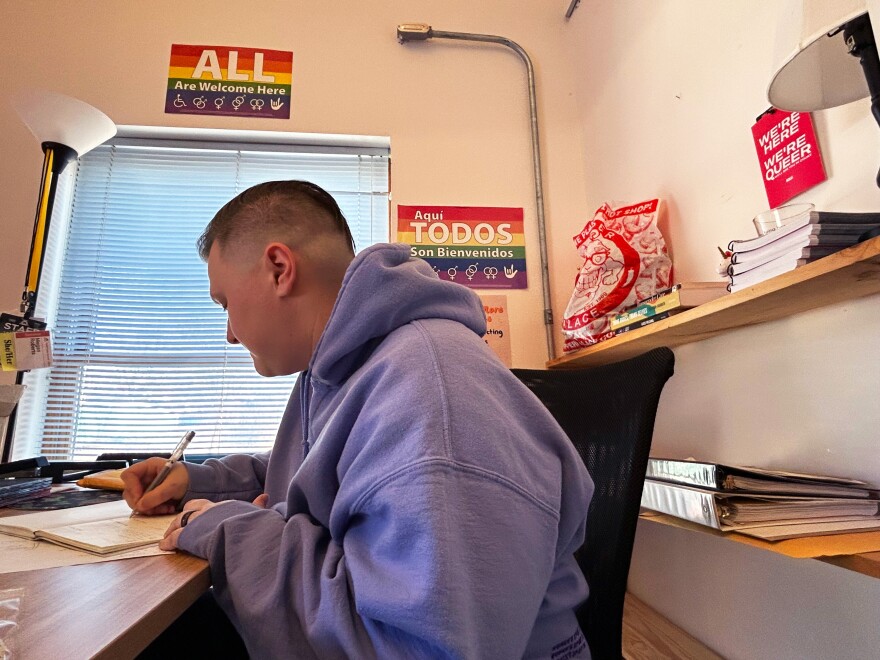
A person with short hair and wearing a gray hooded sweatshirt sits at a desk and writes in a book.

Elodie Reed

Advertisement

/

Vermont Public

Em Russo in their office at the Pride Center, where they’ve worked for four years.

Elodie Reed: Do you know what the implications will be yet?

Em Russo: Invalidating so, so many people’s identities, obviously doesn’t feel good, but what legal implications that will have, we don’t necessarily know what that will look like yet.

There were ways that we were working with folks beforehand to kind of — if this happens, what can we do to protect ourselves? Is it changing your paperwork now before anything goes to the courts? And that is like an individual’s choice, right? So some people think, “Yes, I want all my things to match,” or “No, that’s not feasible.”

Advertisement

Elodie Reed: And by paperwork, you’re talking about, like, people’s gender marker on their official documents, passport?

Em Russo: Yeah, that. We also did a session with a family law attorney about how to protect your family, like your queer family, at this time. And that had to do a lot with paperwork around adoption and making sure for people who are like having children to know how to best protect them and their family here in Vermont. But then also, like, when you’re traveling.

Elodie Reed: Do you get federal funding for the Pride Center, and what happens now with that?

Em Russo: Yeah, we do receive federal funding. We don’t know anything for certain yet. But we’ve worked a lot on having plans. And just like, I think that is also kind of leaning on our communities, leaning on the allies that, you know, support us.

Now is the time to come together and find diverse funding streams and figure out because we’re not going anywhere. So if we have to shift course a little bit, we’ll shift course.

Advertisement

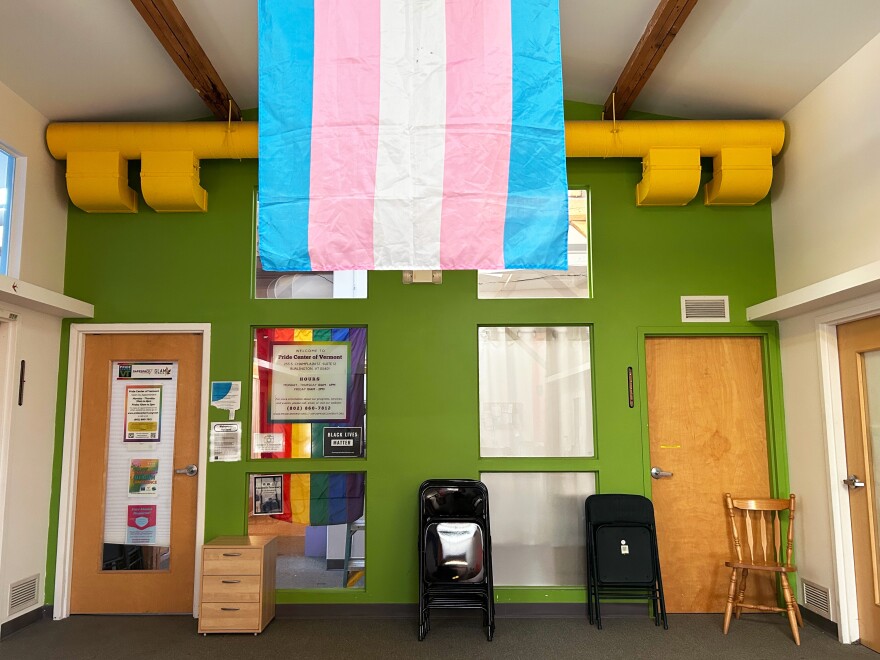
The trans pride flag, a flag with blue, pink and white stripes, hangs from the center of the ceiling in a room painted bright green with two wooden doors and some chairs.

Elodie Reed

/

Vermont Public

The entrance to the Pride Center of Vermont in Burlington.

Elodie Reed: What are the resources folks are needing most?

Advertisement

Em Russo: So I think lately, the needs have been really focused on accessing services. There’s a lot of not knowing whether people will have access to medical care, and being able to have access to hormones has been a really big topic, as of late. We are working with pharmacies to see — ’cause we’ve heard there have been some shortages of hormones.

Housing is another big resource that we hear the most need for. We work with some other organizations to kind of give those resources for different housing and shelter options for folks.

And focusing our work on trans joy. So trying to, like, open this space up, the center space, to have folks drop in and be able to get some food and some warmth and just be here with community.

Elodie Reed: Can you talk a little more about joy events?

Em Russo: It’s such a big focus, I think, especially now when it feels like so many rights are being taken away from our community, to create spaces where we exist and we’re able to celebrate our identities and validate each other.

Advertisement

We have a TransPlant sale every year. That’s one of our happiest events, I feel. It’s where we just see a ton of people come together and get to, like, all dork out about plants and stuff, but then also be in space together, in kind of like a block party-style event.

A framed poster with blue, white and pink zigzag stripes and text that reads "trans people belong" hangs outside a doorway.

Elodie Reed

/

Vermont Public

Advertisement
The entrance to Em Russo’s office at the Pride Center of Vermont, where they work as the Trans Program Manager and SafeSpace Advocate.

Elodie Reed: Do you mind if I ask, like, how you’re feeling when this is, you know, your life, but also your work?

Em Russo: I am part of the community that I work in, and so I definitely have some feelings of grief. And on Inauguration Day, had some spirally thoughts as I just kind of absorbed everything that was going on. And I think it was really easy to like, just kind of feel a lot of doom and sadness and realizing just how layered and deep this is for our community.

And we have seen a lot of people leaving places where they or their kids can’t get health care. And coming to Vermont as a place where there’s more access to gender-affirming care and it’s not illegal. Kind of just like feeling all of the weight of that, and then some gratitude of the state we live in, and just holding my friends and my community close.

It’s still a little fresh, but also ready to do what’s next and make sure that we’re protecting people as best as we can.

Elodie Reed: I appreciate you doing this with me during a complicated week.

Advertisement

Em Russo: Yeah, I thank you for having this conversation, it’s really important.

If you or someone you know is in crisis, you can call or text the National Suicide Lifeline at 988.

Have questions, comments, or tips? Send us a message.


Source link

Advertisement

Vermont

Can filmmakers grow VT’s movie industry?; ‘Leather Clad’ ready to try

Published

on

Can filmmakers grow VT’s movie industry?; ‘Leather Clad’ ready to try


MONTPELIER — A local filmmaker’s latest movie is headed to Montpelier’s Savoy Theater next  week as part of a larger effort to bring more movie-making to the state.

Hosted by the Vermont Production Collective, the April 16 event will feature the latest version of  “Leather Clad,” written and directed by Thomas Benton. The movie itself was filmed in Vermont, after Benton and co-producer (and lead actor) Matt Munroe wanted to see what they’d be able to bring to the big screen.

Years later, the film has been shot and edited into this final version, now ready for its larger release.

Advertisement

“There’s something special about bringing it to Montpelier and exposing the lawmakers to this ground level of debauchery,” Benton said. “There’s something exciting about that.”

Filming in Vermont

Benton is one of many people across Vermont interested in growing the movie industry in the Green Mountains. Because, Hollywood isn’t doing so great. Worldwide box office numbers continue to deteriorate post-pandemic and few movies — outside of James Cameron’s “Avatar” films and endless CGI movies for kids — have been able to bring in the revenue that was common just a decade ago.

Could Vermont fill the gap? Maybe.

Benton and his team have tried to answer that entertainment problem by going niche. Using a low budget and unique approach, the goal was to film something that felt a little more real.

“We’ve gotten to such a corporate, mass media perspective, where we’re at such a point where nothing looks like life as we know it,” he said. “You look at movies in the ‘70s and ‘80s, and it was like, you look at the actors and think, they remind me of someone, or maybe I could be that. You can find that there was a still tangible connection in reality. There’s none of that now.”

Advertisement

Eventually, he was able to find the talent to do it. After a little searching, it turns out Vermont has an abundance of people with movie-making experience.

“We clearly have a really bizarre amount of film industry expats in the state who are just looking for work and going elsewhere,” Benton said.

In many ways, it’s how his own movie got off the ground. Benton ran into Munroe — who has performed in a handful of roles in movies and television — and found a shared vision about wanting to get a movie together. So they pushed ahead. 

The result is “Leather Clad.” Due to budgetary constraints, they stuck to simple locations and  cast Munroe to play the main character while bringing on multiple actors — some from New England — to fill out the ensemble.

Benton and his team then took care of much of the production crew work as well as post-production to edit the movie down into its current version. Benton already showed a first cut of the movie, rolling it out at the Welden Theatre at an event this past September, but he said that version has since been updated extensively for the showing at Montpelier’s Savoy.

Advertisement

“The first cut is – I think it should be this. The second cut is – okay, it’s not that. Maybe it could be this? And then the third cut is – this is what it is. Here’s what we actually shot. Here’s how it works,” he said. 

VPC and movies

If “Leather Clad” entertains audiences and gains fans, then Benton is hoping that Vermont’s moviemaking industry might gain some momentum. The Vermont Production Collective is definitely trying to push the needle by featuring the local movie. It’s the second feature to be a part of the new series rolled out by the organization, called VPC Presents, to focus on grassroot perspectives.

Altogether, the group has identified 55 separate movies — some features and some shorts — which have had portions shot in Vermont. Some are well-known, like “Beetlejuice,” but most come from Vermont’s slate of independent filmmakers, many of them organized under the VPC name.

Enosburgh’s own Shayna Sherwood, for example, serves on the group’s advisory board. As an experienced casting director, she too would like to see movie-making take off in Vermont.

“I personally believe we are at a turning point in film, television and media. The way we create and consume content has changed dramatically and is changing daily,” she said in a written statement. “My hope for this (VPC Presents) event is we start to build a bridge between Vermont’s creative community, its policymakers and the out-of-state professionals who have a connection to this beautiful place. Because there is a real opportunity in front of us.”

Advertisement

Benton agreed, although he sees three obstacles to that goal — funding, branding and bankability. Essentially, much of Vermont’s film industry consists of smaller productions, sometimes self-funded, and there needs to be more financial backers who are comfortable taking the chance to invest in something larger. 

Most states offer incentive programs to help, but Vermont has shied away from the approach after the legislature put together a report researching the idea.

There also needs to be a few more advocates for filmmakers, especially on the state level. While Vermont likes to brand itself as being a “remote worker” hub in order to grow its workforce, few lump film professionals into that list. That could be changed to help re-orient people’s ideas of what the state could be if there was a larger industry.

And finally, Benton said the local film industry could use a bigger hit — a movie that gets people talking on a wider regional level — in order to be able to expand and grow. Until that happens, any “grassroots” efforts will likely continue to be overshadowed by Hollywood’s glossy content factory.

“This isn’t a huge industry anyway, so how do you budge the needle? You’ve got to have, honestly, even just a big success splash or something, to get it going,” Benton said.

Advertisement

“Leather Clad” could be it. The movie starts at Montpelier’s Savoy Theater (located at 26 Main St.) at 7 p.m. on April 16. A pre-film reception is also planned at 5:30 p.m. at Hugo’s Bar & Grill

Following the showing, Benton said there will also be a panel discussion featuring moviemakers and film advocates for those interested.

As for “Leather Clad,” VPC provided the following movie summary: “After a shooting sends them running for cover, a newly released ex-con and a game warden’s daughter realize they’re being hunted—and neither knows why.”  From Vermont filmmaker Thomas Benton, starring Vermonter Matt Munroe, Anne Clark, Paul Romero, Jeff Elam and Jamison Jones. Runtime: 82 minutes.


Source link

Continue Reading

Vermont

Vermonters reimagine solar farms with sheep and pollinators

Published

on

Vermonters reimagine solar farms with sheep and pollinators


Via Community News Service, a University of Vermont journalism internship, in partnership with Vermont Public

🎧 This story was produced for the ear. We highly recommend listening to the audio. We’ve also provided a print version of the story below.

On solar farms, the ground beneath the solar panels is often planted with turf grass and left alone. But some Vermonters are experimenting with productive ways to use that land: grazing livestock, growing crops, and creating habitat for threatened pollinators and birds.

Solar makes up about 16% of the energy Vermont generates, and that number has been growing for over a decade. As solar grows, so does Vermont’s capacity for agrivoltaics — the dual use of land on solar farms for agriculture.

Advertisement

Lewis Fox is a sheep farmer in Leicester, Vermont. With his wife, Niko Kochendoerfer, he runs a business called Agrivoltaic Solutions. They are hired by solar companies to manage the vegetation on solar farms. “We’re in charge of keeping the vegetation within certain limits, and the sheep are the tools that we use to do it,” Fox said.

Maeve Fairfax

/

Community News Service

Lewis Fox of Agrivoltaic Solutions herds sheep into his trailer after grazing a solar field in Colchester on Oct. 23, 2025. Fox brings the sheep to solar sites within a two hour radius of Leicester.

Fox said that sheep are ready-made for solar farms. “They’re pretty short stature, so they can really fit into nooks and crannies,” he said. “They’re also not really interested in chewing on wires or jumping on panels.” The panels also provide sheep with protection from the elements and shade, which means that the sheep don’t need to drink as much water on hot days.

Advertisement

Fox and Kochendoerfer work with farmers from Buffalo, New York to Bangor, Maine, helping them learn the ropes of solar grazing. Fox is also a founding member of the American Solar Grazing Association, an organization that promotes solar grazing and provides educational materials for farmers who want to get into it.

In the winter, when there is no grazing to be done, Fox and Kochendoerfer breed the sheep and sell grass-fed lamb. Fox said that the additional revenue they earn from agrivoltaics is a huge help financially. “For us as livestock producers, being able to use the animals in another way is very significant in terms of farm viability,” he said.

Solar grazing has exploded in recent years. There are currently about 130,000 acres of solar arrays in the United States grazed by sheep. “We think it’s got a bright future,” Fox said.

 A man unlocks a gate to a grassy field of solar panels.

Maeve Fairfax

/

Advertisement

Community News Service

Mike Kiernan, co-founder of Bee the Change, opens the gate to a solar site in Stowe on Oct. 21, 2025.

Sheep aren’t the only animals that can find food on a solar farm.

The Weybridge-based nonprofit Bee the Change is turning solar fields into habitat for bees and other pollinators. Since 2015, they’ve created habitat on 30 solar sites.

Mike Kiernan is a co-founder of Bee the Change. He said one of the organization’s main goals is to support Vermont’s native bees, many of which are threatened by loss of habitat, disease or pesticides.

Kiernan said that although some invasive plant species can be helpful to pollinators, the team at Bee the Change tries to plant native species at these sites. “Our goal is to get the highest percentage possible of native plants, because they have the longest relationship with these species,” Kiernan said.

Advertisement

And their efforts are working.

Grass and flowers grow in a field of solar panels.

Maeve Fairfax

/

Community News Service

Asters on a solar farm managed by Bee the Change in Stowe on Oct. 21, 2025.

Through careful monitoring, the leaders at Bee the Change have seen pollinator populations on their sites increase dramatically in both number and diversity.

Advertisement

Supporting pollinators also helps support the plants they pollinate, which helps people, too. “We’re all actually connected, and our survival is connected,” said Kiernan. “And when people see a habitat that is enriched with pollinators, they are appreciative.”

Encore Renewable Energy, a Vermont-based B Corp, has hired both Kiernan and Fox to manage the vegetation on its solar sites. The company specializes in community-scale solar projects.

Chad Farrell is the co-CEO of Encore Renewable Energy. He said the company prioritizes using agrivoltaics because it’s good for local economies and good for the environment.

Solar grazing is often cheaper than mowing, and it cuts down on emissions because mowers, which run on fossil fuels, are not needed as often.

Planting native plants to build pollinator habitat can increase the soil’s potential to store carbon by 65%. It’s also good for the soil’s overall health — potentially paving the way for future agriculture on the land. “At the end of the useful life of the project, we’re actually able to return that land in a better condition than what we found,” Farrell said.

Advertisement
Sheep stand in and around of a livestock trailer in a field.

Maeve Fairfax

/

Community News Service

Sheep on a solar farm in Colchester on Oct. 23, 2025.

Some Vermonters don’t like to see agricultural land repurposed for energy production, but agrivoltaics can help alleviate this tension. “Everybody loves driving by one of our projects and seeing a bunch of sheep out there doing their thing,” Farrell said.

Lewis Fox, the sheep farmer, agrees.

Advertisement

“It’s often difficult for people to see solar being built on ag land, for various reasons, and I think you could argue the merits either way,” he said. “But we can help bridge the gap in that. What we’re able to do is have solar production coexist with agriculture. And it’s not just window dressing. It’s real agriculture.”


Source link

Continue Reading

Vermont

Tourism Leaders To Gather In Killington For Vermont Tourism Summit

Published

on

Tourism Leaders To Gather In Killington For Vermont Tourism Summit


Tuesday, April 28-Wednesday, April 29 —KILLINGTON— The Killington Grand Resort Hotel & Conference Center will host the 41st Annual Vermont Tourism Summit, bringing together business owners, operators, and industry professionals from across the state for two days focused on collaboration, strategy, and growth within Vermont’s tourism economy.


Source link

Continue Reading

Trending