Rhode Island
Audit faults MBTA for CharlieCard misuse by transit ambassadors • Rhode Island Current


BOSTON — The MBTA knew as early as 2019 that some of its transit ambassadors were using agency-issued CharlieCards for personal use, but the transit authority has failed to address the problem, according to a new state audit.
The ambassadors, who work for a private contractor that operates under the name Block By Block, help passengers buy tickets and navigate stations and also serve as the T’s eyes and ears monitoring safety hazards and maintenance needs inside the subway system.
“The MBTA should hold Block By Block accountable for inappropriate use of these cards,” said the report from Auditor Diana DiZoglio’s office.
The report also found that the T could not verify that ambassadors were fully trained before assuming their posts and that spot checks of station infrastructure (elevators, escalators, and other equipment) were not being conducted at agreed-upon twice-per-hour intervals.
The audit — covering the two-year period from January 1, 2021, to December 31, 2022 – was released on Sunday, which is unusual. A spokesman for the auditor’s office said the audit was released over the weekend to reduce overlap with another audit or audits scheduled to be released this week.
According to the audit, the problem of ambassadors abusing T passes first surfaced in April 2019, when the MBTA decided to replace CharlieCards assigned to specific stations with passes assigned to individual transit ambassadors.
In a communication at the time to transit ambassadors and Block By Block, the T said the change was needed because there had been a significant increase in what it called “courtesy taps” with the CharlieCards and not all taps were being reported. The communication also reiterated that the CharlieCards were to be used for work only and their use would be closely monitored.
Three months later, the MBTA shifted gears and went back to the system of assigning cards to stations and not individuals, in part because high turnover of transit ambassadors made it difficult to track card usage.
Nevertheless, the audit said, the three-month experiment “revealed signs of misuse of the courtesy taps (e.g., BBB employees letting people in for free and cards being used at locations not covered by those employees).”
At the end of the two-year audit period on December 31, 2022, the problem had not gone away. The audit said the station-based cards were used for more than 2.5 million taps over the two years, but only 669,547, or 27 percent, were reported by transit ambassadors along with specific reasons for the taps.
“Failure to properly record courtesy taps, at a rate of $2.40 per transaction, increases the risk for significant lost revenue,” the audit said. “Our analysis also identified 83,990 instances where these fare access cards were used at different MBTA locations than the ones where the cards were assigned. In 445 of these instances, the fare access cards were used on an MBTA bus, indicating a high probability that the card was used for personal use.”
Transit ambassadors reported that they used their passes to let riders into the subway system in many instances because of problems with passenger gates, faulty fare passes, and mixups involving riders unfamiliar with the system.
But the cards were also used to let in members of the military (48,038 taps), customers experiencing homelessness (75,532 taps), customers who didn’t have enough money for the fare (92,492 taps), and for station checks (113,295).
The audit included a response from the MBTA, which disputed the suggestion that ambassadors were tapping in customers and costing the T significant fare revenue.. The T said many of the taps not reported by ambassadors were related to infrastructure checks, mostly for elevator inspections. The agency also said the CharlieCards are secured in station booths and instances where passes are being used “at an abnormally high rate” are investigated by the T’s fraud department.
The audit, however, said the T’s deputy director of fraud detection and analytics revealed that his team does not monitor courtesy taps. The audit also said on-site monitoring of ambassadors indicated the passes are not confined to a station booth but typically carried by the ambassadors themselves.
The audit urged the T to set a specific threshold for courtesy taps that, if exceeded, would trigger an investigation.
“It is also important to investigate instances that exceed the established threshold or when station-assigned fare access cards are used at locations other than where they are assigned,” the audit said. “For example, as part of our data analysis, we noted that on December 31, 2022, one station-assigned fare access card was used 40 times at the Orient Heights station when it was assigned to the Wood Island station. The use of this pass 40 times in one day in a station where it was not assigned—and certainly not secured in the station booth—and the MBTA’s response to this issue indicates a lack of monitoring and control and a lack of awareness by MBTA management about how its operations are being conducted.”
This article first appeared on CommonWealth Beacon and is republished here under a Creative Commons license.
GET THE MORNING HEADLINES DELIVERED TO YOUR INBOX



If you thought the smart money was on pop icon Taylor Swift and gridiron star Travis Kelce tying the knot in Rhode Island, an online crypto casino and sportsbook is here to tell you you’re wrong.
The Ocean State was the second favorite at +155 and 39.22%, and Pennsylvania and Ohio were together at a distant third at +1,600 and 5.88%.
Tennessee was the fifth choice at +2,000 and 4.76%.
“New York is the favourite because it’s the city most closely tied to Taylor Swift’s public life, with multiple residences, strong emotional branding, and world‑class venues that offer privacy and security for a high‑profile event,” an unidentified spokesperson said in a media release.
Human Remains Found Near Taylor Swift’s Mansion Identified: Report

Part of the story is the pandemic-era shift toward smaller cities. But the larger truth is Providence has not built enough housing to keep up with demand. In 2024, Rhode Island ranked 50th in the nation for new housing permits – dead last. That isn’t ideology; it is economics.
As housing experts have said, including HousingWorksRI Executive Director Brenda Clement, we have a basic supply-and-demand problem. Expanding housing supply for everyone should be the focus.
To its credit, Providence has begun to move. Recent efforts by Mayor Brett Smiley, the City Council, nonprofit partners, and private developers have created hundreds of new units. More are in the pipeline. That progress must continue.
As rents rise, pressure for immediate relief has grown. The City Council’s proposed solution is rent control: a cap on annual rent increases at 4 percent. In practice, it fails to solve the underlying problem, and creates new ones.
First, rent control does not make today’s rent affordable, it only limits future increases by creating a cap. Many landlords will raise rents to the cap each year. A $2,000 apartment under a 4 percent cap becomes $2,433 after five years – an increase that renters still feel acutely. That is basic compounding, not a worst-case scenario.
Second, rent control would create a hole in Providence’s budget, as it reduces the taxable value of properties. The Smiley administration examined rent-controlled cities and applied the outcomes to Providence’s tax base. The projected annual revenue loss ranges from $10.3 million to $17.5 million.
When rental property values decline, cities are left with two choices: raise taxes or cut services. Education funding, park improvements, library funding, and basic infrastructure all come under pressure. Experience elsewhere shows this burden does not fall on landlords; it shifts to single-family homeowners. Portland, Maine, saw a 5.4 percent reduction in its tax base after rent control, forcing these tradeoffs. The implementation of rent control will affect all Providence residents, whether they rent or own.
Third, rent control discourages new housing production, the opposite of what Providence needs. Developers are less likely to build in cities where future revenue is capped, financing is harder, and long-term costs are unpredictable. St. Paul, Minnesota, offers a cautionary tale. After voters approved a strict rent cap in 2021, new unit creation dropped by more than 84 percent in the first quarter, forcing city leaders to exempt new construction, which is exempt in the Providence City Council rent control proposal.
When we build more housing at all price points, market pressure eases, as supply catches up with demand.
That does not mean ignoring the pain people feel today. I grew up here, attended our public schools, and bought a modest single-family home in the neighborhood where I was raised. I feel today’s housing pressures firsthand and hear them daily from family and neighbors. After 12 years on the council, including a leadership role in 2011 when Providence was on the brink of bankruptcy, I know our elected officials genuinely want workable solutions.
That is why, as executive director of The Providence Foundation, an organization of 140 private business and nonprofit members from myriad industries, I recommended we commission a study by the Rhode Island Public Expenditure Council to educate the public on this issue and identify solutions. The report revealed the most effective approach to housing shortages and high costs pairs aggressive housing production with targeted rental assistance for households most at risk of displacement.
Cities across the country have shown what works: modernized zoning, faster permitting, conversion of underused commercial space, and temporary rental assistance to help families stay housed while new supply comes online. These strategies outperform rent control. Overcoming the housing challenge will require all levels of government to play a role.
Reasoned policy will meet Providence’s housing needs and strengthen our economy for a brighter tomorrow.
David Salvatore is the executive director of The Providence Foundation, a nonprofit organization committed to supporting visionary projects downtown, and a former Providence City Council president and member.

Audrey Finocchiaro, right, co-owner of The Nitro Bar, in the shop’s Providence location. Photography by Angel Tucker
It’s a late December Saturday, the morning sun promising a Rockwellian winter day as an impressive line of influenced coffee connoisseurs snakes nearly a block down Newport’s lower Thames Street.
The caffeine-craved and matcha-obsessed mob, queued behind The Nitro Bar’s roped barrier, represents a surprisingly universal archetype: selfie-snapping millennials, après-Pilates athleisure-clad women, young families, eager Alphas and the casually curious; a collective buzz in the air. Across the city, Nitro’s off-Broadway location boasts a similar scene, as does the cafe inside Dash Bicycle Shop on Providence’s West End. Locals stand shoulder to shoulder with others who have pilgrimaged from far beyond state lines, almost certainly among the ranks of the coffee micro-chain’s three-quarters of a million social media followers. To put that reach in perspective, the brand’s TikTok views exceeded more than 130 million in 2025 alone.
Countless posts, likes and shares across social media platforms underline Rhode Island’s thriving coffee culture, percolating from the more than 200 coffee shops and cafes statewide. Our collective consumption ranks eighth in the nation for both most daily cups per capita (1.9) and total cups consumed in a lifetime (40,223) in addition to having the fifth-highest lifetime expenditure on the drink ($166,523). Save for bottled water, more Americans drink coffee each day than any other beverage, according to the National Coffee Association, and specialty coffee continues to surge in popularity, hitting a fourteen-year high in 2025. But long before oat milk lattes and flat whites were all the rage, the Ocean State touted more than two and a half centuries of coffee consumption.
As early as the 1700s, Atlantic trade routes brought coffee into Rhode Island via Newport and Providence’s busy ports. While tea and ale were the more dominant beverages in Colonial times, the Boston Tea Party inspired Colonists to boycott tea and choose coffee in an act of rebellion against the crown. Taverns and inns pouring the new velvety elixir acted as popular social gathering places — including the Crown Coffee House on Newport’s Church Street — from the late 18th century onward.
In 1895, wholesale grocers Brownell & Field Co. of Providence created Autocrat Coffee, which continues to operate in Lincoln. Since the 1930s, the company has been widely associated with its coffee syrup, synonymous with Rhode Island culture itself. So are coffee cabinets — milkshakes blending coffee syrup, milk and ice cream — perhaps best known from the soda fountain at Delekta Pharmacy, now Delekta’s, anchoring Warren’s Main Street since 1858.
Feining for Caffeine
Coffee’s enduring popularity has evolved far beyond the eight-ounce Styrofoam cups of basic black or decaf of yesteryear. Cardboard-sleeved coffee cups clenched in the hands of young and old on the go are de rigueur from Woonsocket to Westerly.
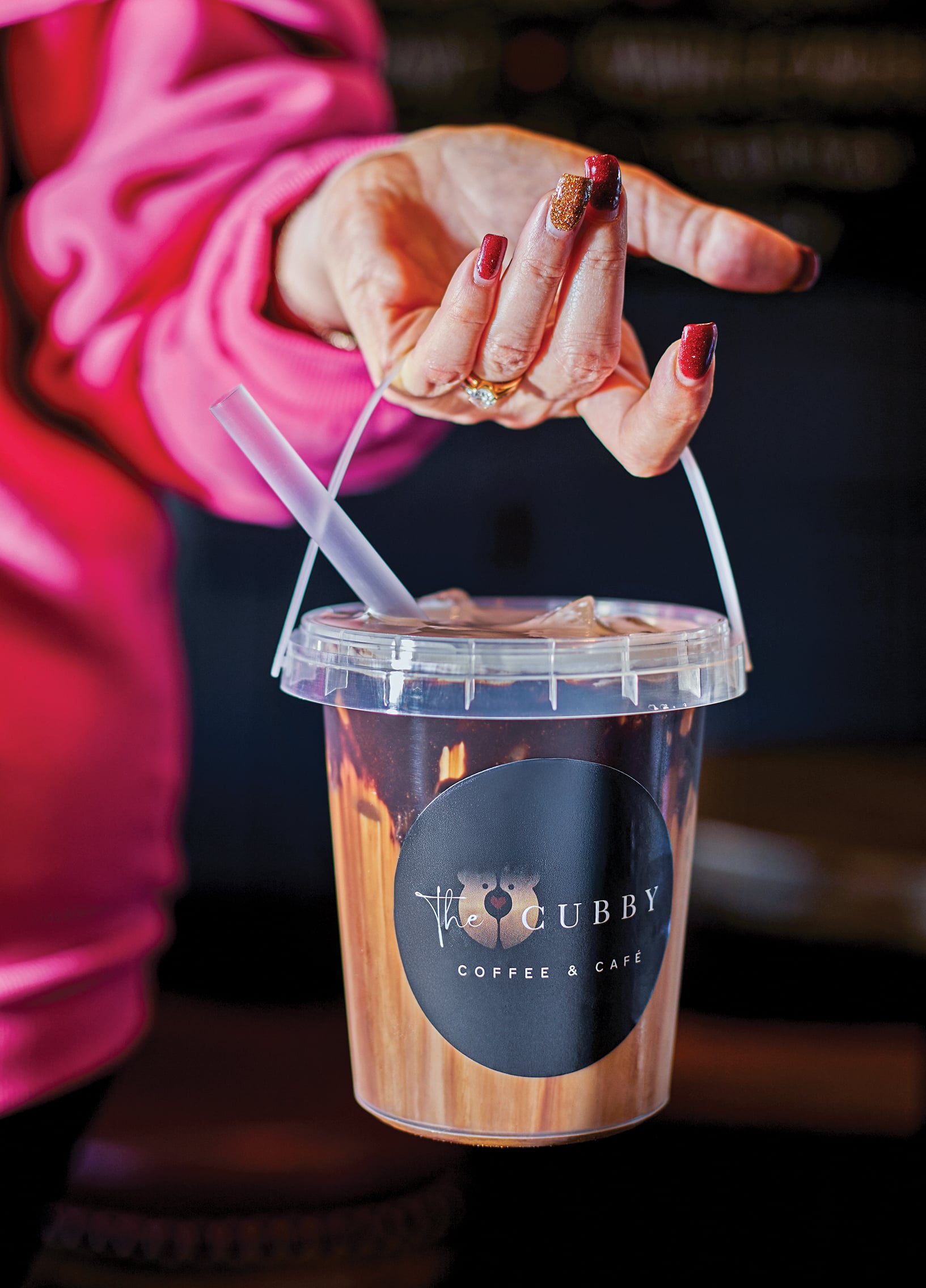
One of the cafe’s viral “coffee buckets.”
In July, The Cubby (formerly The Coffee Cubby) in Lincoln’s Manville village became internet-famous when its “coffee buckets” — thirty-four-ounce coffee drinks served in plastic buckets with handles — went viral. The eye-poppingly large, kitschy containers were the brainchild of operations manager Abbey Gardner, who was inspired by cocktail buckets found at beach bars and nightclubs. “Within three days, they just took off,” says Gardner of the social media-savvy sippers. “On one post … we had upwards of 650,000 views.”
The buzz lured even more creators to little Manville, eager to experience, review and amplify the newly crowned must-have brews. “We had content creators coming in as soon as they caught wind, and that helped spread it. Then there were just so many shares. We know one content creator has gotten [views] over the one million mark,” she says.
While quantifying the precise reach is murky, the stratospheric attention of the buckets proves the power of social influence is undeniable. “We had a person actually fly in from Tennessee,” to try the coffee buckets, says Gardner. “She was like, ‘I knew I wanted to come to this area, and I saw them, so, I flew to Boston, and I came here.’”
The “it drink” phenomenon was a boon for owners Jeremiah Carey and business partner Matthew Moylan, who bought and rebranded The Cubby in 2023. A second burst of momentum soon followed via the Fluffanutter Latte, a sweet and creamy concoction of peanut butter and marshmallow Fluff (the marshmallow creme has been made in nearby Lynn, Massachusetts, since 1920). A similar drink created by a Cape Cod cafe (using Newport-based Springline Coffee) went viral, which helped boost The Cubby’s rendition, even though the Fluffanutter had long been on their menu.
Rhode Island-based creator Katie Corcoran, who posts under @RhodeIslandNative across platforms, spotted the Cape Cod version of the drink blanketing her feed and saw an opportunity to pounce on the trend through a local lens.

Jeremiah Carey and Matthew Moylan purchased and rebranded The Cubby in Manville in 2023.
“I took the take, and I’ve done this before, of you don’t need to leave Rhode Island to get these trendy, delicious things. Save yourself the drive to Cape Cod and just go up to Lincoln,” she says. Her Instagram reel featuring the Fluffanutter has garnered nearly half a million views, while her TikToks on the drink have amassed more than 59,000. She attributes the virality of hers and other curated coffee content to a few things: East Coast lifestyle content being particularly trendy, a movement by coffee drinkers to eschew multinational coffee conglomerates in favor of local cafes, and a rebellion against the zeitgeisty argument that if millennials and Gen Zers simply sacrificed small luxuries, like lattes, they’d be on the path to home ownership.
“There was a lot of counterculture around that; of like, ‘Screw it. Go get your $6 latte,’” she says. “Coffee is definitely having its moment, and I think it goes along the lines of enjoying your life, romanticizing your life, getting the little treat.”
The Cubby’s viral sensations, though bringing an enviable spike in sales at $7–$10 per drink, also brought lines more than 100 people deep. Customers poured out the door and haphazardly weaved through the cramped parking lot, where on weekends, and sometimes weekdays, cars jockeyed for a space. Gardner worked with ownership to mitigate wait times by increasing staff and reworking the logistics of making the coffee buckets, adopting an assembly line format. Outside, they added more patio seating to accommodate the new wave of customers and erected a pop-up tent in the parking lot for shade.
But for some regulars, it wasn’t enough. “I love The Cubby and was a regular. But since the line is insane, I don’t go anymore. I’m sad about it,” wrote one follower on Facebook. To restore those relationships, Gardner says she reached out to as many regulars as she could to invite them back and streamlined a way The Cubby could expedite local orders by giving access to one of the cafe’s alternative entrances. “It was kind of word of mouth,” she says. “Like, ‘Hey, we want to make sure you’re taken care of, because obviously you’re one of the regulars. You stick with us year-round. You’re not just here for the hype of the moment.’”
From Cart to Cartel
The Nitro Bar has also adjusted to increased demand. What started as a simple coffee cart peddling across Providence by founders Audrey Finocchiaro and husband Sam Lancaster in 2016 has evolved into the trio of brick and mortars. Most recently, the couple has been scouting for a location in the Big Apple while bringing their social media followers along as they document their day-in-the-life journey.
“It’s just different logistical things that we’re figuring out, of how to open in New York City. The spaces are so small, and how we’ll run through that is definitely an interesting challenge,” Finocchiaro says. Both North Kingstown natives, the duo’s ties to the city stretch back a decade, when she attended college in Manhattan. “And it’s where we really, Sam and I, both fell in love with coffee,” she explains. Finocchiaro, thirty-two, has amassed more than 210,000 personal social media followers and has grown The Nitro Bar’s following to nearly 700,000.

A Nitro Bar barista prepares coffee drinks during a weekday lunchtime rush.
Such numbers mean that while location hunting in New York, she and Lancaster are recognized on the street, an experience she calls “surreal.” Finocchiaro speculates that part of the reason both she and her business have accrued such a considerable following is her transparency online. Her content includes everything from talking about maxing out her credit card to start the business and stripped-down entrepreneurial advice to having her own “Dunkin’ dad” candidly sample and rate new Nitro drinks and get-ready-with-me videos. She also discusses profoundly heavier topics, including the harsh realities of business ownership: long nights, early mornings, eighty-hour workweeks, money management, setting boundaries, tuning out “haters,” the stuff “no one wants to talk about,” and even mental health struggles.
“Authenticity online plays a huge role. I think people aren’t used to small business owners talking about how they run their business, or things they’ve learned, or challenges they face,” she says. “That connection with the audience is really strong because we’re being so ourselves and real online. It’s so crazy going to the shop and having people be like, ‘Thank you so much for talking about mental health’ or like, ‘You made me feel less weird about feeling this way or feeling like that,’ which is obviously the best part.”
Having that kind influence is clearly meaningful to Finocchiaro, who is forthcoming on social media that she, too, is still figuring it all out. “It feels really cool to have young girls come up to us and just be like, ‘You’re inspiring me that I could do this too, that I could open my own coffee shop,’ or ‘I can do my own thing,’ or ‘It’s OK if I’m not doing well in school — that doesn’t mean I’m going to be a failure.’”
The couple’s success story has become a blueprint business model, covered by multiple media outlets including Fortune and CNBC.com, which reported in April 2024 that The Nitro Bar raked in $4.5 million in sales that year according to documents reviewed by the outlet.
More than just fancy coffee, Nitro is also known for an ever-evolving food menu and trendsetting merch. New collections with hoodies ($87), ballcaps ($37), a fleece ($118) and more continually sell out, and not just on-site. “Hawaii, Alaska — we’ve shipped to every single state, and when we’re printing out the slips, we’re shipping and packing everything ourselves,” Finocchiaro says. “It’s so cool to be like, ‘This is going to New Mexico!’ ‘This is going to Idaho!’ ‘This is going to Oklahoma!’”

Customers sample the fare at The Nitro Bar.
While amusing to think of Oklahomans clad in quahog-emblazoned hoodies, it’s serious business: Swag accounts for about 10 percent of Nitro’s revenue.
That meteoric growth, however, has required the company to adapt. Its Thames Street location saw 300,000 customers walk through the door in 2025. Melissa Holder, manager of a neighboring business near the Newport store, says the cafe has brought a beneficial “rising tide floats all boats” effect to the neighborhood, along with a few learning curves. “We did struggle with [customers] this summer with the line blocking the doors, people sitting on the stoop,” she says. A conversation with ownership led to the addition of stanchions to better organize the lines while keeping sidewalks flowing and business doorways accessible.
Finocchiaro and Lancaster also wanted to accommodate the customers who were patiently waiting and improve their experience. As long lines become commonplace, the owners hired a “host” to engage with customers, pass out menus, offer water, and see if they could assist in any way. “How we can really up our hospitality game has been so fun and cool to figure out,” says Finocchiaro. “Because I think coffee shops are meant to be this watering hole where you feel this connection with community.”
Such lines have also meant greater visibility for some neighbors. “I wouldn’t say it’s impacted our bottom line, per se, but it’s brought a lot of happy, excited people to the block, so that’s obviously a good thing. Everybody’s in a good mood when they’re at Nitro,” says Phil Ayoub, owner of Beau Tyler, a retail shop on the block.
“We’ve been amazed at how busy they’ve been, even on off days. It’s been incredible to see. It’s been a Newport phenomenon, really; people coming to town just for them.”
“I’ve literally waited down the street in a line before. It’s so worth it,” says Rhode Islander Samantha Bousquet while waiting to get into Nitro on Thames Street this past December. She ordered her regular “go-to” drink but had recently seen a new one posted on social media. “So I got both,” she says with a laugh. “The coffee is just so good. I’ve seen girls on TikTok literally from New Jersey wake up at 5 a.m., drive here, and then drive home.” An Instagram post from September follows a creator from Pittsburgh who flew to Rhode Island specifically to go to Nitro.
Boston-based couple Carolyn Chambers and Mike Cronin rented a nearby home last summer and became Nitro regulars throughout the season. In town for a New Year’s Eve wedding, the two said a Nitro fix was top priority. “This is our first stop. We haven’t even gotten to the house yet,” Cronin says with a smirk.
Other Boston-area customers expressed hope that a Nitro Bar will one day open in the city. Finocchiaro is open to the idea, but says New York is their focus right now. However, Nitro fans everywhere will be able to make the cafe’s most viral drinks and more soon: Finocchiaro is working on a cookbook with Ten Speed Press to be released later this year.
‘Bachelor’ Brouhaha
An enviable buzz was instantaneous for Audrey’s Coffee House and Lounge in South Kingstown since the day it opened in 2021. Owners Jared Haibon and wife Ashley Iaconetti appeared on different seasons of “The Bachelorette” and “The Bachelor” ABC reality television series and eventually met on its offshoot, “Bachelor in Paradise.” With millions counted among the show’s global fanbase, dubbed “Bachelor Nation,” Audrey’s drew national press, which added an automatic level of pressure, but Haibon says the heat is on for any new small business owner.

Jared Haibon of “Bachelorette” TV fame owns Audrey’s Coffee House and Lounge with his wife, Ashley Iaconetti.
“There’s really no warm up with any business, for everybody when they open, whether you’re known or unknown, because a lot of people are going to give you a first chance, maybe a second, but after that, they’re going to have their mind made up,” he says. “Because of Ashley and I and our small notoriety, we knew we’d probably be pretty busy right off the bat. So we knew we’d have to be able to handle high volume as soon as we opened the doors for those first few weeks, because people just want to check it out and see what it was all about.”
Audrey’s has thrived during the past five years, with customers from far and wide continuing to post from the South County Commons coffeehouse, which doubles as a lounge with coffee cocktails by night. Haibon is used to coming around the counter to take photos with fans, but one couple’s epic trek truly shocked the reality star.
“They were on a road trip from Colorado, and I was like, ‘Oh, that’s awesome. What’s your end destination?’” he says. Audrey’s was the destination. Haibon calls these experiences both incredible and humbling, adding he’s grateful for the support. It also reinforces his commitment to consistently deliver a product that resonates, and the work’s paid off. A 2025 study based on user reviews shows Audrey’s was the number-two-rated celebrity-owned restaurant in the U.S., second only to Jon Bon Jovi’s JBJ Soul Kitchen.
The cafe will likely be thrust in the limelight again when Iaconetti appears as a cast member on the highly anticipated release of “The Real Housewives of Rhode Island” on Bravo. An official release date hasn’t been announced as of press time, but the series is expected to drop this spring. Haibon says he can’t confirm if the show filmed any scenes at Audrey’s, “but you know, it follows Ashley’s life, and Audrey’s is certainly a part of that.”
No stranger to leaning into trendy coffee drinks and capitalizing on cultural resonance, Haibon says, “We’ll have something up our sleeves for that as well.”
While tourism boards and public relations agencies work tirelessly to promote the spoils of the Ocean State from our seafood to our shoreline, social media has catapulted our coffee culture far and wide. Our percolating prowess isn’t news to locals though, where ordering shorthand is its own language (regular: cream and sugar, or “extra extra”) and our New England hardiness is flaunted with an iced coffee in the dead of winter (bonus points for sporting shorts and a parka).
No matter the time of day or season, the coffee is always on.
Dunkin’ Devotion
How influencers are helping draw social media attention to the locally founded national chain.

Ian Brownhill, third from left, with New England sports mascots. Photograph courtesy of Ian Brownhill.
No Rhode Island coffee culture conversation seems complete without mentioning the grande latte-sized elephant in the room: Dunkin.’ While the brand spans the globe, its stranglehold on the New England customer base is without comparison, especially as the Ocean State ranks high in most Dunkin’ locations per capita.
The brand has a long history of working with influencers and content creators (yes, there’s a difference) to amplify new products, build brand awareness, boost social media engagement and hop on viral trends. For nearly four years, Dunkin’ has collaborated with creator Ian Brownhill of Westerly, whose content mostly consists of comedic New England- and Rhode Island-centric skits.
“There’s definitely something to be said about how the power of social media can boost brands overnight,” he says. His audience of 2.3 million social media followers isn’t necessarily looking for the latest craze in coffee, so his content leans more relatable than aspirational. “My demographics are typically above the age of twenty-five or thirty into the mid- to late-sixties. So, demographically speaking, I’m in a world where people who are consuming coffee at that age are probably just looking to get a coffee fix on their way to work.”
Much of his Dunkin’ content is product placement: weaving in a “medium iced regulah” mention or having a Dunkin’ drink in hand, often with a doughnut topper. But he acknowledges that coffee content is having a moment.
“There is this new craze about curating something that is aesthetically rewarding to the naked eye on social media,” he says. But that’s not his lane. “I’m just speaking the language that my audience and my quote-unquote followers understand, versus me trying to be the popular ‘it’ girl, so to speak, where I’m like, ‘Hey guys, check out this new matcha!’”
Prep sports roundup: Redondo Union takes down No. 1 Mira Costa in boys volleyball

Rubio joins crucial G7 talks as Iran war set to dominate second day

A surprise resignation could open the door for an independent to win a Montana Senate seat

Metro Detroit weather forecast, March 26, 2026 — 11 p.m. Update

Man convicted in the deadly 2021 assault of a Thai grandfather in San Francisco avoids prison

Florida High School Football Rankings: Top 25 teams – Oct. 21

How old is Bo Nix? What to know about Oregon quarterback ahead of 2024 NFL Draft

Cleary's 21 help Le Moyne down Central Connecticut State 69-64 in OT

99th annual Pony Swim held in Virginia

Indiana Members Credit Union announced as new anchor tenant at Bottleworks District
Rubio joins crucial G7 talks as Iran war set to dominate second day
A surprise resignation could open the door for an independent to win a Montana Senate seat

Video: Savannah Guthrie Says She Believes Her Mother Was Taken for Ransom

Stefanik grills University of Michigan leader on lack of audit after string of Chinese national arrests

Photos: More than one million displaced by Israel’s evacuations in Lebanon
-

 Detroit, MI1 week ago
Drummer Brian Pastoria, longtime Detroit music advocate, dies at 68
-

 Science1 week ago
How a Melting Glacier in Antarctica Could Affect Tens of Millions Around the Globe
-

 Movie Reviews1 week ago
‘Youth’ Twitter review: Ken Karunaas impresses audiences; Suraj Venjaramoodu adds charm; music wins praise | – The Times of India
-
 Science1 week ago
I had to man up and get a mammogram
-

 Sports6 days ago
IOC addresses execution of 19-year-old Iranian wrestler Saleh Mohammadi
-

 New Mexico4 days ago
Clovis shooting leaves one dead, four injured
-

 Texas7 days ago
How to buy Houston vs. Texas A&M 2026 March Madness tickets
-

 Tennessee3 days ago
Tennessee Police Investigating Alleged Assault Involving ‘Reacher’ Star Alan Ritchson