Lifestyle
How to navigate gift returns and regifting this holiday season

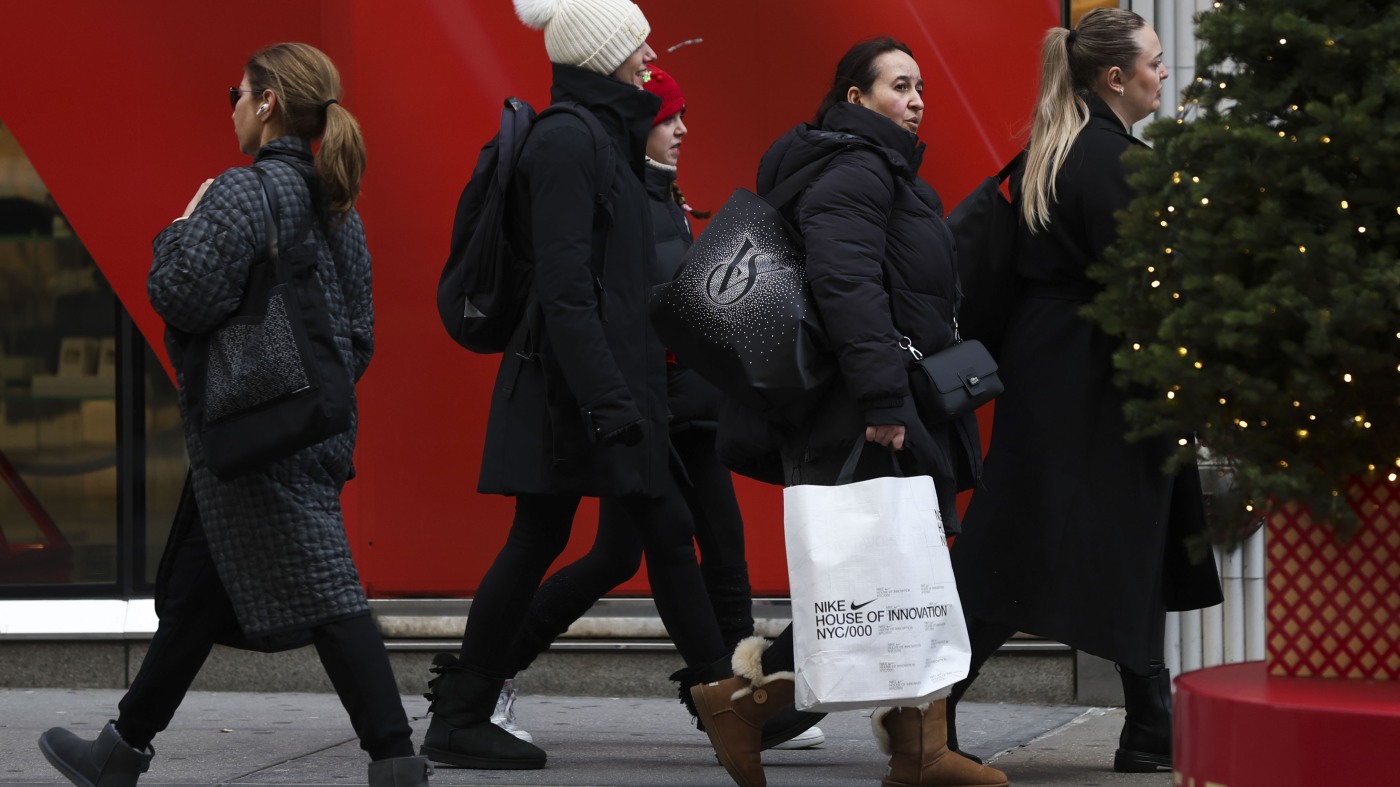
Shoppers walk along Fifth Avenue on Nov. 29 in New York City.
Heather Khalifa/AP
hide caption
toggle caption
Heather Khalifa/AP
If you’re feeling guilty for thinking about returning that unironically ugly sweater your least favorite aunt gave you this holiday season, maybe don’t. ‘Tis the season of giving — and returning, after all.
The National Retail Federation reports that returns will total $890 billion for all of 2024. Returns happen year-round, but are most prevalent during the holiday season, the organization said.
But etiquette experts caution there is a delicate art to returning, or even regifting, the presents you receive.
“When it comes to returning a gift, I think discretion is key so you never hurt the gift giver,” said Myka Meier, an etiquette expert who runs Beaumont Etiquette in New York City.
There are some things to consider before heading to the store to make a return, according to Jo Bryant, a British etiquette consultant.
“The best way to return an unwanted gift is to really examine the financial worth, and relationship with the giver. It always involves a tricky conversation, so it is best to prioritise this for more expensive gifts when it really would be [a] shame that you can’t use it, and a real waste,” Bryant wrote in an email to NPR. “You also need to know the person who gave you the gift very well to be so honest with them.”

People walk past shops on Dec. 11 in Philadelphia.
Matt Slocum/AP
hide caption
toggle caption
Matt Slocum/AP
Keep quiet and return
For Meier, it’s all about discretion when it comes to returning a gift.
She and Bryant differ on whether plans for returns should be shared with the gift giver.

Meier said don’t say anything “unless they specifically ask,” she said. “For most situations, it’s better to simply thank them graciously for their thoughtfulness without mentioning the return. The focus should always be on appreciating the gesture of being given a gift, not the item itself.”
And maybe keep mum even after some time has passed, she recommends.
“I would still try to avoid ever bringing it up, but I also would not lie,” she said.

So, if that aunt who bought that ugly sweater asks how it fits two months after Christmas?
“In that case, you can kindly and tactfully explain, for instance: ‘It was such a thoughtful gift! Unfortunately, it didn’t fit quite right, so I exchanged it for something similar that I’ll use every day and always think of you!’ “

A shopper carries a Christmas-themed bag in London on Dec. 2, 2020.
Alberto Pezzali/AP
hide caption
toggle caption
Alberto Pezzali/AP
But maybe direct honesty is more your style?
Bryant believes “honesty and tact is best.” Regardless, be sure to flatter the gift giver and heap praise on the present at the same time.
If something absolutely must be returned, instead of saying that you just didn’t like the present, give a reason for the return that is out of your control, Bryant said.
She suggested saying something like, ” ‘I loved the cashmere jumper — it is one of my favourite presents this year — but I think the size up would be more comfortable for me,’ or ‘Thank you for the crystal glass vase; we love it but my mother recently gave us one very similar. I really don’t want such a generous gift to be wasted, so I’d love it if we could look to choose something else together? You always get us the best presents and we are so lucky to get such amazing and thoughtful gift from you.’ “
To save on possible awkwardness with these kinds of exchanges, Bryant suggested that gift givers be proactive and include the gift receipt, when possible.
What are the rules on regifting?
Yes, regifting is allowable, under etiquette rules.
“But it should be done thoughtfully and carefully,” Meier said.
There are limits to what can be regifted. “If the gift was customized in any way or has sentimental meaning, it’s not something to regift,” she said.
She addresses this topic further in a post on Instagram.
Some things Meier recommends if you plan on sending that previously discussed hideous sweater to a new home:
- Make sure the gift is new, totally unused and in its original packaging
- Avoid giving this gift to someone in the same social circles. In other words: Don’t give the sweater your aunt gave you to your cousin.
- Rewrap the gift “to show effort and care, just as you would with a newly purchased gift!”



Lifestyle
L.A. Affairs: It’s hot when a man drives to me. But would this new guy make the trek from the Valley?

I met Dan on Hinge.
He lives in Woodland Hills, and I live in Venice. In Los Angeles, this is considered a long-distance relationship. In another city it might be nothing. Here, it’s a factor.
But I believe that with the right person, you can make anything work, so I stay open. I’m a native New Yorker, and if I were living in Brooklyn and a guy lived on the Upper West Side, that would be a 45-minute subway ride, which is truly nothing in New York. So with that same logic, I try to have flexibility with men in L.A.
When we started planning our first date, Dan suggested three options: a hike on mushrooms, a wine tasting or a walk on the beach.
A hike on mushrooms is something I’d only do with someone I already trust, not someone I just met online. I don’t do first-date hikes because I don’t like feeling trapped if the guy’s a dud. So I chose the wine tasting.
Then I learned the wine tasting was in West Hills.
On a Friday night, driving there from Venice would be insane. So I said I didn’t want to meet there because of the traffic. He suggested Malibu. That was also not ideal on a Friday.
I was getting annoyed — this was a pink flag because in my dating world, the guy is supposed to come to the woman’s neighborhood in the early days. I’ve gone out with plenty of men from the Valley who effortlessly suggested they come to me. It’s not rare or impossible.
I suggested he come to the Westside. I didn’t specifically say Venice, and in hindsight, I probably should have. He landed on Brentwood, which was manageable for both of us. On our first date, we met at an Irish pub on Wilshire Boulevard. He was cuter and more interesting than I had expected, and with the Guinness flowing, we had fun.
When I got home, he texted me: “Well, I like you 🙂 Less the tik tok and the lack of rock music in your life, but it’s not a deal breaker — there are other qualities 🙂 What are your thoughts?”
I noticed the slight negativity but was mostly dazzled that a man texted immediately after the date to say he liked me. In the modern dating economy, this felt rare.
The next day, both of our evening plans fell through, so we made a last-minute date. The wine tasting he originally suggested still sounded like fun, and although it meant me driving to the Valley, I was up for it now that we’d met.
We sipped flights at Malibu Wines & Beer Garden in its airy, romantic courtyard and played a flirty version of Truth or Dare. Halfway through, he dared me to kiss him.
We ended with sushi on Ventura Boulevard and a short make-out session in his car. He invited me to Thanksgiving at his uncle’s, which felt too soon, but also sweet.
After the second date, he texted and said he had his kids that week and was also hosting an event on Thursday, so his only day to meet was Wednesday. I said great.
On Tuesday night, he checked if we were still on, and I said yes.
Then he texted: “I’m flexible on time but not on location. I have a big event on Thursday, hopefully you can come to me again.”
My stomach tightened. This again?
So I texted back: “I drove to you last time, which was a bit of an exception for me especially in the early days, but the wine tasting location sounded special. Usually guys come to my area. How about we switch it up this time?”
He replied: “I appreciate the effort! Because of my event, I’d rather be close to a computer just if needed … Here is what i offer:
— I’ll come to your area anytime next week/end
— Lunch/dinner on me
I want to continue where we stopped last time 😉 No pressure of course, but let’s snuggle”
I responded: “Ok let’s meet next week. Snuggles sound nice … let’s see what happens …”
Then he wrote: “So I won’t see you tomorrow?”
I replied: “Unless you wanna come to me and bring your laptop along, let’s rain check until you have more flexibility.”
He said: “Dang, you are hard. I’ll let you know tomorrow around midday if it’s ok.”
And then — surprise — he decided to come.
He drove to Venice for a 5 p.m. date. He said his ETA was 5 p.m., and it ended up being 5:25 p.m., typical 405 Freeway.
When he showed up, he was in a cranky mood. On our way to KazuNori in Marina del Rey, I thanked him for picking me up and told him I think it’s hot when the guy comes to the girl.
“You’re just saying that because you want me to come to you more,” he said, not playfully, but aggressively.
That was basically the end for me. But there I was, in his car, heading to dinner. So I stayed pleasant and tried to make the best of it.
I shared that in the early stages of dating, I find it’s good etiquette for the guy to come to the woman’s neighborhood. He immediately disagreed and started ranting about how dating rules are ridiculous and how they swing in women’s favor. He resented paying for dates and declared he wasn’t looking to “sponsor a woman’s life.”
“If women want equality and equal rights,” he said, “then it should apply all across the board, including dating, and the man shouldn’t have to pay.”
I said women don’t actually have equal rights because we get paid less than men and often receive lower salaries than men in the same position.
I tried to change the subject and reset the mood, but he insisted we keep hashing it out.
I tried to explain masculine/feminine dynamics: providing and protecting, giving and receiving.
“What does the man get out of this arrangement?” he asked.
It was like watching someone’s personality warp into Mr. Hyde. Then he brought up another point: He’s a single dad of two kids, so he gets tired; and because I don’t have kids, that should factor into who drives where.
At this point, I was barely engaging and focused on eating my hand rolls, and I couldn’t wait to get home.
The check came, and I happily split it, wanting nothing further from him.
In the car back to my place, he remarked: “It’s obvious we’re never gonna see each other again.”
Obvious, but did it need to be stated?
Then he showed me a Spotify playlist he’d made for me of his favorite electronic music, because he knows I like EDM.
“Oh, that’s sweet,” I said.
“Yeah, that’s how I show interest. Through things like this, not who drives to who,” he replied.
When I got out of the car, we wished each other luck, and I headed inside and shut the door.
Two hours later, he sent me the playlist. I’ve yet to listen to it.
It wasn’t the distance that ruined it. It was the resentment. I’m not looking for a man who feels burdened by the effort. I’m looking for a man who sees the value of courting a woman in the first place.
The author is a writer, comedian and former psychologist who lives in Venice. She is the creator of the new vertical series “Manfari.” She’s on Instagram: @solange_neue and @manfari.show.
L.A. Affairs chronicles the search for romantic love in all its glorious expressions in the L.A. area, and we want to hear your true story. We pay $400 for a published essay. Email LAAffairs@latimes.com. You can find submission guidelines here. You can find past columns here.

Lonnie Bunch III is the 14th Secretary of the Smithsonian. He’s pictured above in September 2017.
J. Scott Applewhite/AP
hide caption
toggle caption
J. Scott Applewhite/AP
In a memo addressed to staffers sent Tuesday, the secretary of the Smithsonian, Lonnie G. Bunch III, defended the institution after the White House issued a 162-page report that characterizes the National Museum of American History as a place which has become “subject to institutional capture by a radical, activist ideology that is fundamentally opposed to telling the noble, honest story of the great country we know and love.”
In his email, which NPR has obtained, Bunch wrote in part: “While there will always be room for improvement, this report is not a fair characterization of the work and totality of the National Museum of American History. At the Smithsonian, our work is driven by scholarship, accuracy and an uncompromising commitment to tell the fullness of America’s story. As public servants and the keepers of this institution, we are charged with helping a nation find understanding, hope and clarity and as part of that duty, we are dedicated to excellence, reflection and growth.”

He continued: “We remain focused on what grounds us: a steadfast commitment to scholarship, nonpartisanship, independence, accuracy and integrity. For nearly 180 years, the Smithsonian has worked alongside partners across government — from the White House to Congress to our governing Board of Regents — guided by our enduring mission to increase and diffuse knowledge. That purpose remains: to pursue knowledge with rigor and to serve the American public with clarity and care.”
The White House report was issued on July 4 by the Domestic Policy Council under the title “Saving America’s Story: How Ideological Capture at the Smithsonian Institution’s National Museum of American History Erases Our Heritage.”

The council faults the National Museum of American History on a multitude of fronts, saying it underemphasized the Founding Fathers and early colonial and Revolutionary history; was not sufficiently celebratory of the country’s 250th anniversary; and that it engaged in “anti-white,” “illegal alien” and transgender activism.
It also accuses the museum of trying to “indoctrinate” teachers and students through its exhibitions, programming and teaching resources.
In the report, the council also specifically criticizes museum director Anthea Hartig, who has led the National Museum of American History since 2019 and is concurrently the president of the Organization of American Historians, calling her “an activist advancing an ideological agenda contradictory to the museum’s founding purpose of fostering patriotism.”

The Trump administration has made the Smithsonian museums one of its primary targets in its efforts to reshape cultural narratives to align with its viewpoints. In August 2025, the White House requested a “comprehensive internal review” of eight Smithsonian museums, including the National Museum of American History, following an executive order issued by President Trump in March 2025 in which he called for the removal of “improper ideology” from the Smithsonian’s offerings.
According to the Smithsonian’s charter, all of its 21 museums, 14 education and research centers, and the National Zoo are meant to be run independently of the federal government. The Smithsonian is overseen by Bunch and a board of regents, which includes Vice President Vance, Supreme Court Chief Justice John Roberts and other members appointed by Congress.
In an interview with NBC’s Meet the Press on Sunday, Bunch spoke about the Smithsonian’s 250th anniversary special exhibition at the Smithsonian Castle, which is called “American Aspirations.”
He told NBC: “It’s really important for people to understand that America is much an ideal as it is a place, that it’s a series of aspirations that have really shaped who this country is. And so for me, what is so powerful is to say, ‘Let us honor the words of Thomas Jefferson and the founders, but let us use those to challenge us to be better.’”
Jennifer Vanasco edited this story.

-

 Austin, TX2 minutes ago
Texas Has One Trait Almost Every National Champion Shares
-

 Alabama8 minutes ago
Final 2026 MLB mock draft projections for Alabama’s Justin Lebron
-
 Alaska11 minutes ago
Watch My Buddy Matt Not Get Eaten by Bears in Alaska
-

 Arizona16 minutes ago
Roller derby still has a home in Arizona despite myriad obstacles
-

 Arkansas23 minutes ago
Freshman OL Tucker Young never wavered through Arkansas football coaching changes | Whole Hog Sports
-

 California26 minutes ago
Northern California high school graduation shooting suspect arrested in Texas
-

 Colorado31 minutes ago
Colorado to weigh daily hunting limits, ban on fur sales for wildlife hunted for fur
-

 Connecticut38 minutes ago
Woman arrested, accused of murdering man in Farmington in March

