Connect with us

New Hampshire

Conference addresses housing needs: Is Montana an example for NH? – NH Business Review

Published

on

Conference addresses housing needs: Is Montana an example for NH? – NH Business Review


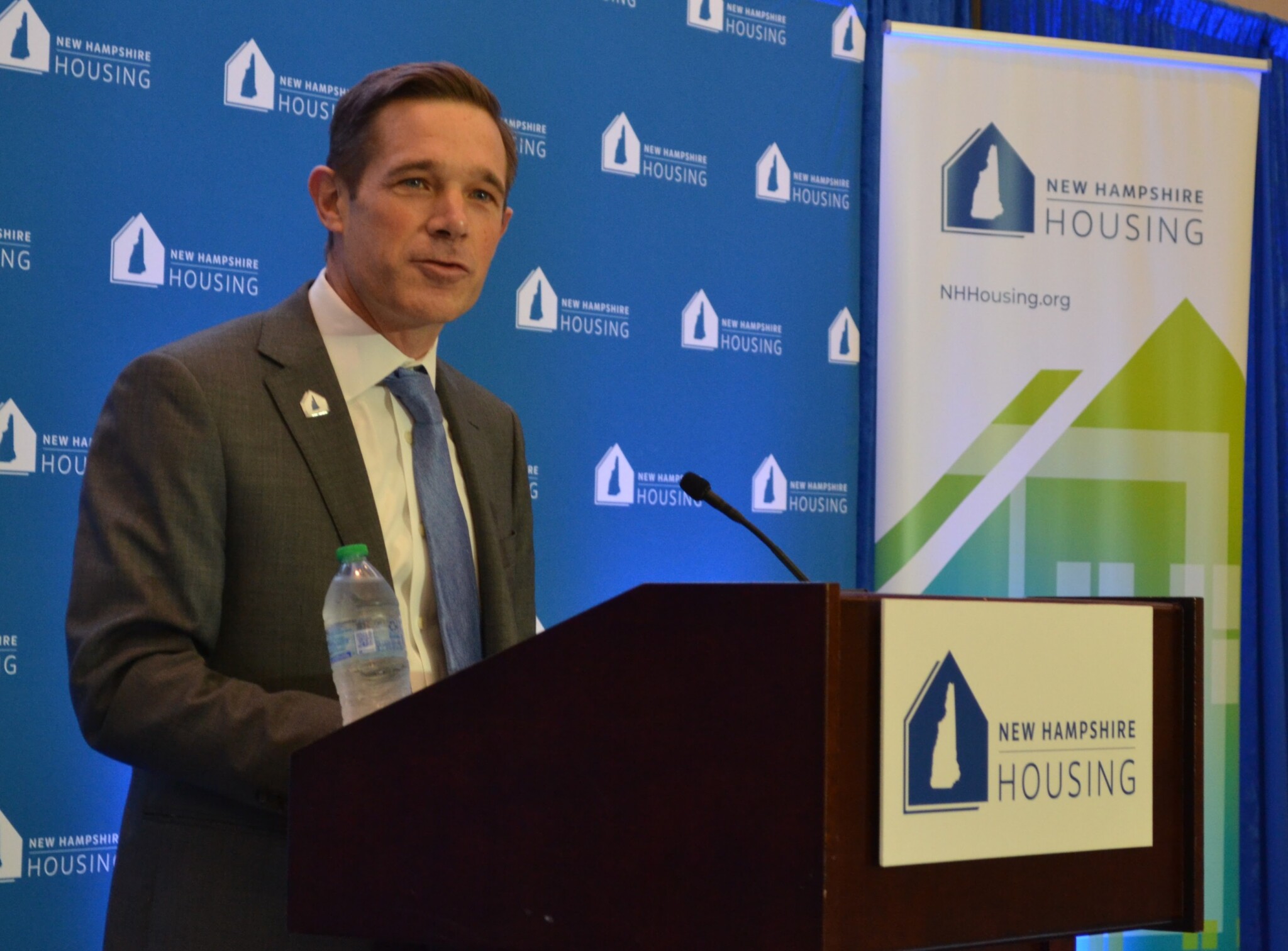
Montana State Sen. Forrest Mendeville talks about the “Montana Miracle” of legislation to encourage more housing at New Hampshire Housing’s 2024 Housing & Economic Conference. (Photo by Paul Briand)

When it comes to increasing the amount of affordable housing, can the state of New Hampshire take a lesson from the state of Montana?

The NH Housing Finance Authority thinks so.

The agency invited a Montana state senator, who’s been instrumental in housing-related legislation, to its annual conference held Oct. 23 at the Grappone Conference Center in Concord.

Advertisement

Forrest Mandeville, a Republican state senator from Columbus, Montana, was one of several presenters at the conference that addressed challenges and possible solutions to the housing crisis in the Granite State.

Mandeville reviewed legislation brokered in a bi-partisan fashion in 2023 designed to increase Montana’s housing supply.

Montana, like New Hampshire, is a mostly rural state that has experienced a housing dearth that makes homes expensive to buy and apartments expensive to rent. Montana, in fact, has it worse than New Hampshire in that it is the least affordable state in the country, according to National Association of Realtors tracking.

Montana, like New Hampshire, passed legislation easing the creation of ADUs — accessory dwelling units on residential property. Montana’s legislation also eased restrictions on duplexes.

The Montana Legislation in 2023 passed the Land Use Planning Act (LUPA), which requires that cities in Montana with populations over 5,000 people that are located in counties with populations over 70,000 people update their land-use plans and zoning and subdivision regulations within three years of its passage. LUPA’s ultimate goal is to ensure sufficient housing for the growing population and for different income levels through coordinated and planned growth across the state.

Advertisement

Politically, both the Montana House and Senate are controlled by Republicans, similar to New Hampshire.

Mandeville, who titled his presentation “Montana Miracle,” pointed to a governor who wanted to see more housing and a coalition of stakeholders — including politicians, builders and planners — who wanted to give him something he could sign into law.

“We streamlined a lot of processes,” said Mandeville. “We legalized a lot of stuff that’s not always been legal. Some of the main things we did that are often lumped into the ‘Montana Miracle’ is we legalized ADUs in single-family zones, legalized duplexes in single-family zones. We allow residential development in commercial areas, and we passed the Land Use Planning Act.”

Creators of the legislation did not pursue items they knew the governor wasn’t going to approve of, according to Mandeville.

“We focused really on the supply side and on the ability to address the demand, the ability of developers to meet the market demands, because that’s what was going to fly in Montana,” said Mandeville. “I’ve had some people tell me: You know, the Land Use Planning Act should have included a climate action plan. That was not going to pass. We were not going to vote for that because the governor was not going to sign. So as much as some people might want to see it, it’s not going to happen. So understand the political factors and take what you can get. You can always work on fixes later.”

Advertisement

Mandeville had four pieces of advice for housing stakeholders to navigate the political divide: take what you can get, know when you lost on an issue and move on, know when to compromise, and build a coalition.

Besides Mandeville, other presenters at the 2024 Housing & Economy Conference included:

  • Linlin Liang, principal associate at Pew Charitable Trusts, who spoke about policy approaches to improve housing supply and affordability.
  • Tina Lund from Urbanonics, who presented data that debunks the notion that more families with school-age children in a community means higher property taxes.
  • Angela Brooks, president of the American Planning Association, whose topic was “Overcoming Housing Obstacles.”
  • Lisa Prevost, freelance journalist and author, who spoke on how zoning in New Hampshire throws up roadblocks to affordable housing.
Rob Dapice Nh Housing Event2

Rob Dapice, executive director and CEO of the New Hampshire Housing Finance Authority, opens the 2024 Housing & Economic Conference held Oct. 23 at the Grappone Center in Concord. (Photo by Paul Briand)

NH Housing’s executive director and CEO, Rob Dapice, set the stage for the day by illustrating the need for purchased and rented housing in the Granite State. About 300 people registered for the event.

Dapice said the 2024 legislative session in New Hampshire produced a lot of activity with respect to housing but with few results, which he called “disappointing.”

Advertisement

“The market can’t do it all itself,” said Dapice, “and so we desperately need more money for the affordable housing fund so we can build more housing for Granite Staters. In addition, there are a number of great ideas and opportunities to lower regulatory barriers to housing.”

He noted that the state needs almost 60,000 new units between 2020 and 2030, nearly 90,000 new units between 2020 and 2040. To meet production needs, he said, local authorities need to increase permits by 36% over recent levels.

During her presentation, Liang tied lack of rental property to increasing rents to increasing homelessness here.

She noted that the median monthly rent in New Hampshire increased 57% from January 2017 to September 2024. At the same time, homelessness in the state grew by 68%.

Using the example of Minneapolis, she said the city made a concerted effort to increase its rental housing supply. Rents decreased and homelessness decreased by 13%, according to Liang.

Advertisement

Lund said Urbanomics, a consulting group that serves businesses and government in the areas of economics, public finance and urban planning, studied the perceptions and numbers of whether more school-age children in a community drives up property taxes.

“The perception is development, particularly multifamily housing, leads to additional public school children, which leads to higher property taxes on single-family homes,” said Lund. “Now our hypothesis, based on all the work we’ve done elsewhere in the country, is that developmental multifamily does indeed yield some additional public school children, but it also yields significant additional property taxes, so there is no additional implicit property taxes to existing residents.”

This notion supports prior data offered by the New Hampshire Association of Realtors (NHAR) that also addressed the issue as being false.




Source link

Advertisement

New Hampshire

N.H. lawmakers to vote on increasing tolls, civil rights, and k-12 education – The Boston Globe

Published

on

N.H. lawmakers to vote on increasing tolls, civil rights, and k-12 education – The Boston Globe


One proposal (Senate Bill 627) would generate more than $53 million per year in estimated revenue for turnpike projects by essentially doubling what certain cars pay on the state’s toll roads.

The cash fare for Hampton’s main toll booth on Interstate 95, for example, would jump from $2 to $4 for cars and pickup trucks. The toll wouldn’t increase at all for motorists who use New Hampshire’s E-ZPass transponders.

“Surrounding states already have the same in-state discount structure in place,” Democratic Representative Martin Jack of Nashua wrote on behalf of a House committee that unanimously recommended the bill.

A potential hitch: Governor Kelly Ayotte. She’s expressed opposition to the whole toll-hiking idea, and proven she’s not afraid to use her veto pen.

Advertisement

Modifying civil rights standard

Another proposal (Senate Bill 464) would add a few words to the state’s Civil Rights Act. Instead of addressing conduct that is merely “motivated by” a legally protected characteristic, the proposed revision would address conduct that is “substantially motivated by hostility towards the victim’s” protected characteristic (such as their race, color, religion, national origin, ancestry, sexual orientation, sex, gender identity, or disability).

The prime sponsor, Republican Senator Daryl Abbas, an attorney, testified the change was small and aligned with the law’s intent. But the attorney who oversees the Civil Rights Unit at the New Hampshire Department of Justice, Sean Locke, testified in opposition, saying the proposal could reduce protections, especially since the meaning of “substantially” is somewhat vague.

Advertisement

The House is also weighing a proposed amendment that would add a few more words than Abbas’s version, potentially narrowing the Civil Rights Act’s applicability a bit further.

Open enrollment for K-12 schools

A third proposal up for a vote on Thursday (Senate Bill 101) would make every K-12 public school in New Hampshire an “open enrollment” school. That way, students could freely choose to transfer to a district other than the one where they live.

The proposed policy is controversial, partly because of how schools are funded. Districts rely mostly on local property taxes to cover their costs, as the state government chips in relatively little, and property tax rates vary widely from one community to the next. That generates concern about who will foot the bill when a student transfers.

In light of those concerns, Republicans are offering a compromise amendment to SB 101 that would require the state to provide more money per pupil that a district receives via open enrollment, as the New Hampshire Bulletin reported. Democrats are offering their own amendment to establish a study commission on this topic, rather than adopt the proposed policy now.

Advertisement

Lawmakers have until May 14 to take action on the bills that came from the other chamber, though they have until June 4 to iron out any discrepancies.

Amanda Gokee of the Globe staff contributed to this report.


This story appears in Globe NH | Morning Report, a free email newsletter focused on New Hampshire, including great coverage from the Boston Globe and links to interesting articles elsewhere. Sign up here.


Steven Porter can be reached at steven.porter@globe.com. Follow him @reporterporter.


Source link

Advertisement
Continue Reading

New Hampshire

Boston MedFlight expands into NH

Published

on

Boston MedFlight expands into NH


Boston MedFlight often touches down at the scene of some of the worst tragedies in New England – where minutes can mean life or death for a victim. The critical care transport operation is now expanding with a new base in New Hampshire.

The organization is hosting an open house at the new Manchester location on Thursday.

Boston MedFlight flies a critical care transport paramedic and nurse on every flight. Jaik Hanley-McCarthy says their helicopters and ground vehicles are equipped to handle just about any emergency medical procedure.

“Anything that can be done in the ICU,” explained Hanley-McCarthy. “We have a mobile lab so we can draw blood and run labs in real time.”

Advertisement

Boston MedFlight now has five bases across the region.

“Having a base in Manchester just expands this Boston-level care even further north to the more remote areas of the state,” said Hanley-McCarthy.

Boston MedFlight operates as a network of bases and some of the locations are staffed 24 hours.

Chief Executive Officer Maura Hughes says the nonprofit operation survives on public and private donations.

“We provide about $7 million in free care every year to patients,” said Hughes. “Not every hospital can be everything to every patient. We’re really the glue that keeps the health care system together.”

Advertisement

Heather Young says her daughter, Teighan, is still alive because she was flown for a critical assessment and procedure after falling off a truck and hitting her head.

“She should not be driving and walking and talking and all the things she’s doing as quickly as she is,” said Young.

Teighan just turned 18 and plans to go to college to study the medical field.

“I want to be a nurse and help other people,” she said.

It’s stories like this that keep the men and women who work Boston MedFlight focused on their mission.

Advertisement

“I think we just go call by call and try to do the best we can,” said Hanley-McCarthy. “I think when we stop and truly think about it, I think that weight is pretty heavy.”

Boston MedFlight also has a yearly reunion where patients and the team get together here in Bedford to meet and check in on their progress. It really shows you how connected they are to the people they help.


Source link

Advertisement
Continue Reading

New Hampshire

Hiker who set out in warm spring weather found dead after snowstorm in New Hampshire mountains

Published

on

Hiker who set out in warm spring weather found dead after snowstorm in New Hampshire mountains


NEWYou can now listen to Fox News articles!

A Massachusetts hiker who set out in warm spring weather was found dead deep in New Hampshire’s White Mountains after a snowstorm dumped several inches of snow in the area, authorities said.

Kent Wood, 61, of West Roxbury, was discovered Tuesday evening on a remote section of the Kinsman Pond Trail in Franconia Notch, about 5.5 miles from his vehicle, according to New Hampshire Fish and Game.

Wood had driven to Franconia Notch on April 17 for a weekend camping and hiking trip, and set out on a hike the next morning in warm, clear weather, officials said. Family and friends last heard from him Saturday afternoon.

Advertisement

When he failed to return or make contact for two days, officials said relatives reported him missing Tuesday morning, prompting a large-scale search.

HIKER IDENTIFIED, POPULAR TRAIL CLOSED AFTER DEADLY FALL A UTAH’S ZION NATIONAL PARK

An aerial view of Franconia Notch State Park in New Hampshire, where a hiker was found dead on Tuesday. (Joseph Sohm/Universal Images Group, File)

Rescuers quickly learned Wood had packed for mild conditions, not the three to five inches of snow that fell in the area between Sunday and Monday.

Fog hovers over a narrow road through Franconia Notch in the White Mountain National Forest in New Hampshire on Dec. 27, 2021. (Andrew Lichtenstein/Corbis)

Advertisement

Search teams from Fish and Game, PEMI Valley Search and Rescue, and the Army National Guard launched a coordinated effort, focusing on the Lonesome Lake and Kinsman Pond areas.

FAMILY’S SPRING BREAK HIKE TURNS INTO LIFE-OR-DEATH RESCUE AFTER PARENT FALLS 70 FEET OFF UTAH CLIFF

Conservation officers located Wood’s body around 7:41 p.m. Tuesday. Crews carried him out overnight, reaching the trailhead shortly after 1 a.m. Wednesday.

Franconia Notch and the Appalachian Trail are seen in New Hampshire on Sept. 21. (Carol M. Highsmith/Buyenlarge/Getty Images)

CLICK HERE TO DOWNLOAD THE FOX NEWS APP

Advertisement

Since Friday, six hikers from Massachusetts have been rescued in the White Mountains, Fish and Game said.

Officials are reminding hikers that winter conditions still grip the mountains, with snow, freezing temperatures and rapidly changing weather.


Source link

Continue Reading
Advertisement

Trending
