Maine
Maine’s electricity prices grew at the third fastest rate in the country, analysis shows

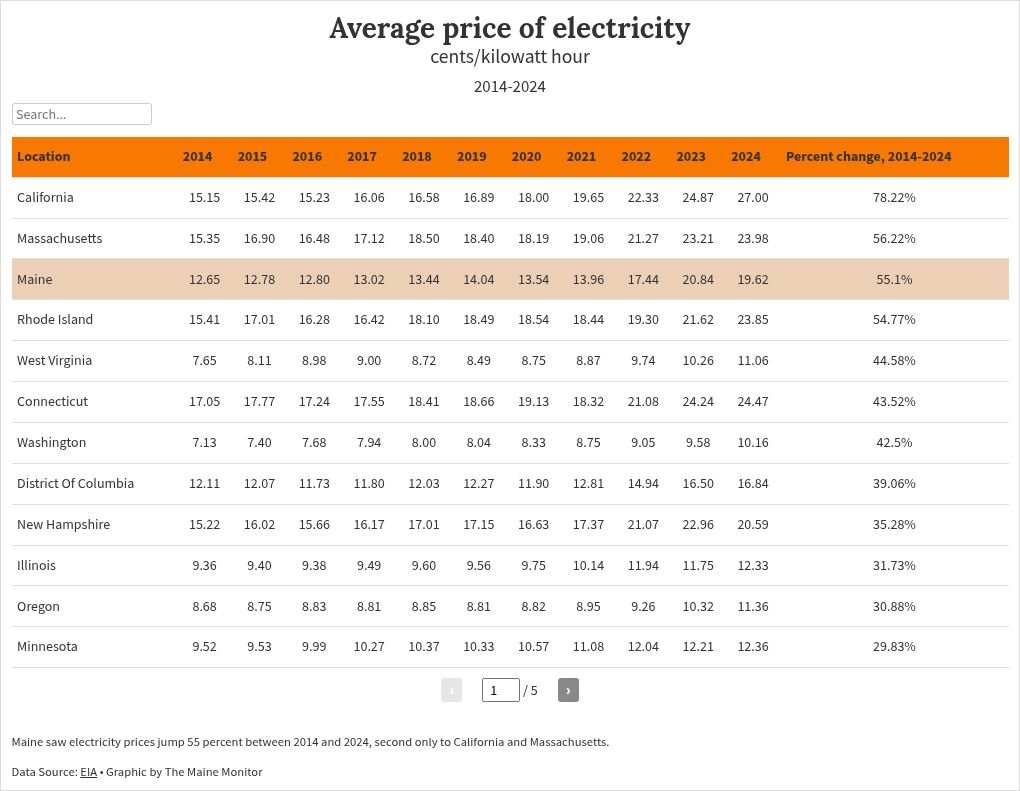
Between 2014 and 2024, the average retail price for electricity in Maine increased by the third highest rate in the country, according to an analysis by The Maine Monitor, surpassed only by California and Massachusetts.
The average retail price of electricity in Maine during the 10-year period rose from 12.65 cents/kWh to 19.62 cents, according to data collected by the federal Energy Information Administration. That’s an increase of 55 percent.
At the same time, the average retail price of electricity in the United States rose from 10.44 cents/kWh to 12.99, or 24 percent.
Maine’s rate of increase, then, was more than twice the national average. But it was considerably less than California, which saw its average price grow from 15.15 cents/kWh to 27 cents, a 78 percent jump.
In New England, Maine was followed by Massachusetts, which climbed from 15.35 cents to 23.98 cents, or 56 percent. Rhode Island grew at more than 54 percent, going from 15.41 cents in 2014, to 23.85 cents last year.
As electricity demand grows, affordable power is critical to a viable energy policy. But Maine’s energy policy is under fire: in Washington, the Trump administration is moving to withdraw most federal financial support for clean electricity in favor of boosting oil, coal and natural gas. It also has begun to challenge state efforts aimed at slowing global warming.
In Augusta, Maine continues to debate the impact of solar incentives on electricity bills.
Against that backdrop, why did Maine’s electricity prices grow so fast, and what might it mean for the quest to make electricity more affordable in the future?
Promoted by Gov. Janet Mills, Maine has set a goal of getting 100 percent of its electricity from clean energy sources by 2040. This aggressive target aims to blunt the impacts of a warming climate, largely by cutting the harmful emissions from burning oil and natural gas. But this goal is juxtaposed against another primary objective of the state’s updated energy plan: “Deliver affordable energy for Maine people and businesses.”
A key way to achieve both objectives, state energy planners say, is to shift the way we fuel our cars and heat our buildings to efficient, electric-powered technologies powered by renewable energy sources. This strategy is called “beneficial electrification.” Measures include heat pumps for air and water, battery-powered vehicles, solar and wind generation and energy storage.
But a corollary to beneficial electrification is that electricity has to be affordable. Otherwise, residents and businesses have little incentive to switch.
Here’s the dilemma. At the same time Maine’s cost of electricity has been rising steeply, some of the proposed pathways to an all-electric future are facing unexpected challenges, both in terms of cost and availability. Examples include offshore wind, electric vehicles, heat pumps and new transmission lines.
“It’s fair to say we are at a crossroads,” said Bill Harwood, who retired in January as Maine’s Public Advocate. “We need to continue to subsidize renewables for the foreseeable future, because we need to reduce our dependence on fossil fuels. But we need to be careful and thoughtful. We can’t over-subsidize it, like we did with (solar).”
Despite the increases, Maine’s electricity prices remain among the lowest in New England, noted Dan Burgess, who heads the Governor’s Energy Office. The factors pushing up prices are exactly why the state is working to move away from imported fuels in favor of homegrown renewable energy, he said.
Blaming natural gas, but it’s complicated
First, why did Maine’s electricity prices rise at such a fast pace?
Harwood and other energy experts blame three main factors — natural gas availability and price, a too-generous solar incentive program and recovery costs from recent violent storms.
Natural gas is the leading cause, but the reasons are more complicated than they may appear.
More than half of New England’s generating capacity comes from gas-fired power plants. This status dates back 25 years, as the region sought to phase out expensive and polluting oil generation.
Public opposition to more nuclear plants eliminated that carbon-free option. But new gas supplies in Canada and the Marcellus shale fields in Pennsylvania during the 1990s led policy makers and investors to back generators that promised cleaner air and lower prices. They were also quick to build. Several new gas power plants went up, including ones in Westbrook, Rumford, Veazie and Bucksport that benefited from two new gas pipelines from Canada.
But because these power plants respond daily to changing electricity demand, they aren’t able to secure the lowest gas prices through long-term contracts. As more businesses and homes converted to gas, the region’s pipeline system didn’t have enough capacity on frigid winter days. In response, developers sought to build new lines, including one through western Massachusetts.
A plan for Maine electric customers to help pay for some of the new capacity was championed by Gov. Paul LePage, a Republican. But new pipelines drew stiff opposition from local residents and some Democratic politicians.
Environmental groups also said new gas capacity would lock in the region’s dependence on fossil fuels for decades. Following legal actions, the projects were largely abandoned, including the $3 billion Northeast Energy Direct in 2016 that would have added to Maine’s supply.
Maine pays more for natural gas
This left New England electric customers at a disadvantage, according to Rich Silkman, an economist and former head of the Competitive Energy consulting firm in Portland. Pipelines carrying gas into the region from Pennsylvania face a pipeline constraint beyond the Hudson River, causing wholesale prices to rise significantly on the coldest days. This, in turn, caused electricity prices to soar.
Maine suffers the greatest impact, Silkman said. Gas from the Marcellus region must head first into the Boston area, before being delivered north into Maine and Atlantic Canada. This adds to the wholesale cost of gas for generators here, meaning that they run only at costly times to meet peak demand. On top of that, Burgess pointed out, the region depends on expensive, overseas shipments of liquefied natural gas in the winter to supplement domestic supply.
Over the 10-year period, electricity supply has been the single biggest share of a home’s monthly power bill. It has ranged from roughly 6 cents/kWh for Central Maine Power and Versant Power/Bangor Hydro customers in 2015, to more than 16 cents in 2023, following the spike in global energy markets tied to Russia’s invasion of Ukraine. These supply costs made up between 45 percent and 59 percent of a total bill.
It’s easy to blame natural gas price volatility for higher electricity costs. But Silkman said natural gas opponents also should acknowledge that Maine’s higher than average electric rates are partly self-imposed, through public opposition and public policy.
“Maine tried to get a gas pipeline built,” he said, “but it had to go through Massachusetts. We could have easily expanded the gas pipeline and that would have solved our winter pricing problems.”
Today, President Trump’s declaration of an “energy emergency” has revived talk of pipeline expansion in the Northeast. Whether Trump can overcome continued opposition, and if companies that lost millions of dollars on earlier efforts will take another gamble, remain open questions.
Also pushing Maine bills up is the cost of recovering from more-intense storms linked to climate change. Trees falling on power lines, in the country’s most-forested state, is the prime culprit.
For example: Central Maine Power serves nearly eight in ten electric customers. The cost of restoring power and fixing storm damage hovered around $32 million a decade ago. It increased to nearly $72 million in 2020, to $119 million in 2022 and $168 million in 2023, according to the Portland Press Herald. To blunt the impact on customers, the Public Utilities Commission has approved a strategy to spread out cost recovery over multiple years. Even so, storm recovery will add $20 to the average monthly CMP bill this summer, according to the energy office.
Solar benefits depend on “perspective”
Beyond gas and storms, few recent energy policies have received as much scrutiny as net energy billing, a practice in which renewable energy generators are compensated for excess power they provide. The program was initially aimed at small, rooftop solar panels. But in 2019, lawmakers advocating for cleaner energy greatly expanded the size of projects that could qualify for net energy billing, as well as the level of compensation. Today, more than 15,000 projects qualify.
By that measure, net energy billing is a huge success. When there’s enough sunlight, those projects can together generate 70 percent of the output of the Seabrook nuclear plant. This exceeds a state energy plan goal of building 750 megawatts of so-called distributed generation.
But electric customers pay for the generous subsidies, recently estimated by the Maine Office of the Public Advocate at $220 million a year. The rate impact today on a typical CMP home customer is roughly $7 a month; it runs more than $20,000 a month for a large business, according to Central Maine Power.
“Maine made some mistakes,” said Barbara Alexander, a consumer energy consultant who advises AARP Maine. “We could have built all this solar with competitive bids for half the price. We missed out on how to do this in the most cost-effective way.”
Alexander lamented that Maine has invested so heavily in solar, but isn’t seeing much benefit in rates.
“The bogeyman here in New England is that, except for a couple of volatile years, natural gas is the fuel of choice for generation,” she said. “So either make gas cheaper or replace it. Neither of those things has happened.”
As costs mount, lawmakers have been working to dial back the solar subsidy program. They’re still at it this legislative session, considering measures — largely promoted by Republicans — that range from trimming the subsidies to killing the program altogether. Harwood, the former Public Advocate, said the solution is to put experts at the PUC in charge of a competitive bidding program, rather than leave complex pricing and market details to a part-time Legislature.
But one element that colors the debate over how solar policy contributes to high electric bills is, literally, perspective.
By law, the PUC must annually study the costs and benefits of net energy billing. The latest analysis featured three “perspectives,” on the value of the program — for society in general, for Maine specifically and for electric ratepayers. The study’s primary focus is on the general society perspective.
By that measure, the 2024 program costs were $202 million and the societal benefits were $194 million. This calculation included $53 million of benefits for cuts in greenhouse gas emissions. By comparison, the ratepayer benefits were only $80 million. A bottom-line perspective: Reducing climate change emissions is good for the planet, but so far, has done little to lower your electric bill.
This story was originally published by The Maine Monitor, a nonprofit civic news organization. To get regular coverage from The Monitor, sign up for a free Monitor newsletter here.



PORTLAND (WGME) — Wednesday afternoon, Tassel Top Park officials posted on social media, reporting the beach was temporarily closed to swimming after routine testing found elevated levels of E. coli in the water.
Anna Goodnik, a visitor at the park, says she was disappointed to learn she could not swim.
“It’s a beautiful lake. I feel so sorry, it’s too bad this happened,” Goodnik said.
She says she drove from Portland to visit the park.
“Very sad because I came from Portland, I drove 40 minutes,” Goodnik said.
Goodnik says she has been coming to Tassel Top Park for 15 years and that while the park remained open, she was hoping to get in the water.
“The water is so smooth right now, I would just like to swim in it,” Goodnik said.
Raymond Town Manager Glenn Michalowski said in a statement that the Portland Water District provides weekly test results for 18 locations around Sebago Lake. Tassel Top Beach was closed for swimming because E. coli levels exceeded state water quality standards.
Michalowski said testing indicated the presence of waterfowl in the area, which can contribute to elevated bacterial levels. The statement also noted that high E. coli counts after rain events and in areas with waterfowl activity are a normal occurrence across Maine beaches and recreational water areas.
Ben Peierls, research director at the Lakes Environmental Association, says warmer water can lead to more bacterial growth.
“When water gets warmer, there’s more growth of bacteria,” Peierls said.
Peierls says E. coli can come from animals such as birds, dogs and other wildlife, or from human waste. He says this time of year can bring rain and runoff that carries contaminants into lakes.
“This time of year, there’s lot of rain and runoff materials coming into lakes, and it’s coming from sources where there may have been that fecal material, and it gets washed into lakes and it shows up in places people could be recreating,” Peierls said.
Tassel Top is not the only location reporting elevated bacteria levels. Ferry Beach in Scarborough and East End Beach in Portland also reported results above Maine’s safety threshold for enterococci in marine waters.
Town officials say Tassel Top Beach will reopen once retesting confirms the water has returned to safe levels, and residents will be notified when the closure is lifted. Swimming can resume once weekly testing confirms water quality is back within safe limits.
To check the status of all beaches in the state, click here.

HARPSWELL (WGME) — The Maine State Fire Marshal’s Office says a person was hospitalized after a shed fire Wednesday night.
Firefighters were called to 23 Smokehouse Road in Harpswell for a shed fire around 7 p.m.
Crews quickly put out the fire and kept it from spreading into the woods.
An unhoused person who had been living in the shed suffered burns and smoke inhalation.
They were taken to Maine Medical Center for treatment.
Investigators believe the fire may have been electrical in nature.
BE THE FIRST TO COMMENT
The fire remains under investigation.

Three tornadoes have been confirmed across New England so far in 2026, and remarkably, all of them have occurred in Vermont.
Two of those tornadoes touched down during severe thunderstorms on June 18, when a potent weather system swept across the region.
Vermont tornadoes in 2026 (WGME).
The National Weather Service confirmed an EF-1 tornado in Lincoln with peak winds of 105 mph and another EF-1 tornado in Woodstock with winds reaching 100 mph.
Earlier this spring, an EF-1 tornado struck Williamstown on April 16 with estimated winds of 90 mph.
This week’s Climate Chronicles question comes from Kate:
With severe weather last week, how often do we actually see tornadoes touch down in Maine?

Maine tornado activity (WGME).
Historically, Maine averages about two tornadoes each year, with most occurring between June and August.
Most storms develop during the late afternoon and early evening, typically between 3 and 9 p.m., when hours of sunshine have heated the ground and created the instability needed for thunderstorms to form.
The last confirmed tornado to touch down in Maine was in 2023.
Average amount of tornadoes that touch down in each New England state per year (WGME).
Massachusetts and Connecticut also average about two tornadoes per year, with many occurring across the flatter terrain of western portions of both states.
In Massachusetts, the broad Connecticut River Valley stretching through Springfield has earned the nickname “New England’s Tornado Alley” due to its history of tornado activity.
Vermont, on the other hand, typically averages just one tornado annually. With three confirmed tornadoes already in 2026, the state has already exceeded its yearly average by two, making this an unusually active year for tornadoes in the Green Mountain State.
Maine’s tornado history (GoSanAngelo, WGME).
Since 1950, Maine has recorded 140 tornadoes. None have been rated stronger than an EF2 on the Enhanced Fujita Scale, the system used to classify tornado intensity based on the damage they cause.
Unlike hurricanes, tornadoes are not assigned ratings while they are occurring. Instead, National Weather Service survey teams assess damage after the storm has passed, examining impacts to homes, buildings, trees, and other structures.
From that damage, meteorologists estimate the tornado’s wind speeds and assign an EF rating ranging from EF0 to EF5.
While Maine has experienced its share of tornadoes over the decades, the state has never recorded a violent EF4 or EF5 tornado.
Do you have any weather questions? Email our Weather Authority team at weather@wgme.com. We’d love to hear from you!
-
 Entertainment26 seconds ago
‘The Bear’ at closing time: Ayo Edebiri and Jeremy Allen White reflect on five seasons
-
 Lifestyle7 minutes ago
L.A. Affairs: After decades of near-misses, I finally told him: ‘I’m not leaving here without you’
-
 Politics10 minutes ago
Trump budget request omits funds for L.A. fire relief, prompting criticism from senators
-
 Science15 minutes ago
EPA touts crackdown on smuggled pesticides in L.A. visit
-
 Sports23 minutes ago
Commentary: Did Padres curse themselves by messing with that anti-Dodgers FTD burger?
-

 World30 minutes ago
Copernicus lead warns extreme heat measures needed or deaths to ensue
-

 News55 minutes ago
“It’s blood money”: Family of exonerated man in Texas yogurt shop murders speaks out after settlement
-

 Los Angeles, Ca2 hours ago
Woman ambushed, violently attacked by robber in downtown Long Beach

