According to ESPN, Boston has emerged as a leading destination in the Giannis Antetokounmpo sweepstakes. No deal is on the table (that we know of), but the mere possibility might raise a few concerns.
Northeast
Daniel Penny trial: Subway madman raised fists before Marine vet's deadly chokehold, witness testifies

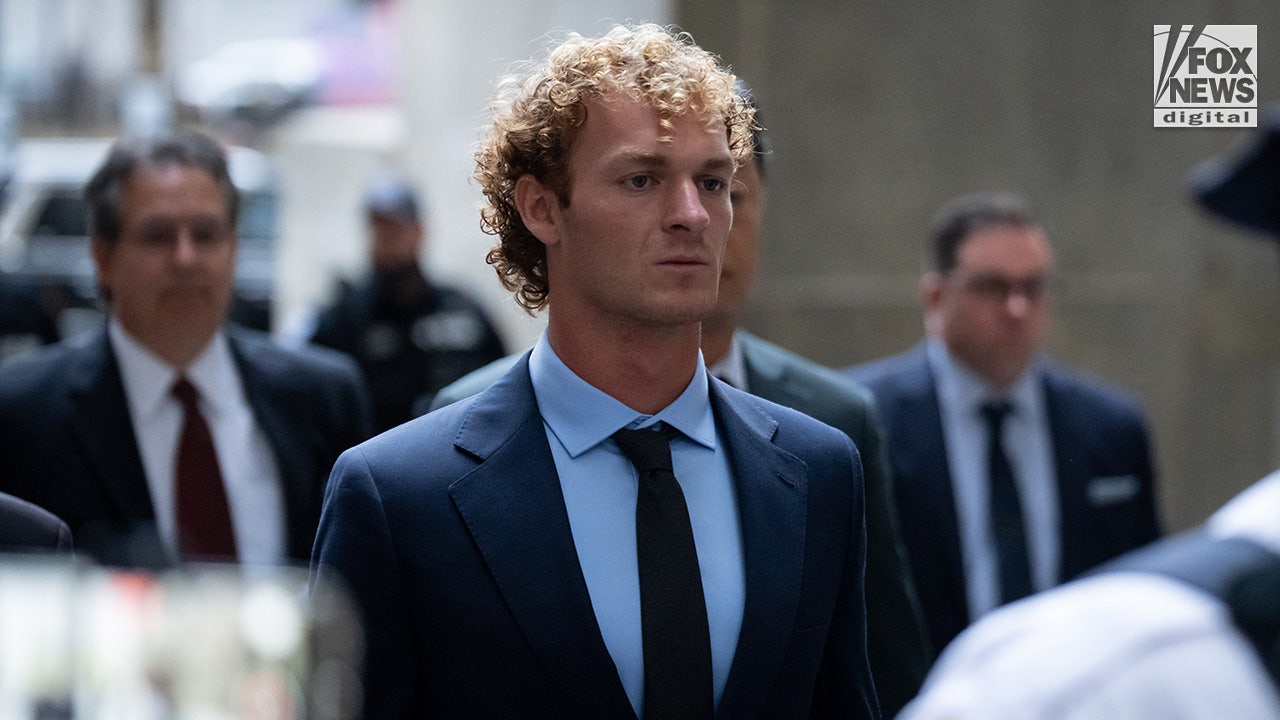
Moments before New York Marine veteran Daniel Penny placed the erratic Jordan Neely in a chokehold that proved fatal, the emotionally disturbed homeless man raised his fists in the middle of a subway car while shouting at passengers, a witness testified Thursday.
Moriela Sanchez, an 18-year-old from Harlem, said she was taking the train home from school when chaos broke out.
Neely, 30, threw his jacket down and squared up, she testified on day 11 of what is expected to be a six-week trial in New York City.
“If no one gives him water or food, he’s gonna start putting hands on people,” she said. “He was going to start attacking.”
TEEN WITNESS TO JORDAN NEELY CHOKEHOLD TESTIFIES SHE WAS ‘SCARED’ BY HIS SHOUTING, WANTED TO ‘GET AWAY’
Daniel Penny arrives for opening arguments in his trial at Manhattan Supreme Court in New York City on Nov. 1, 2024. Penny, a Marine veteran, is charged with second-degree manslaughter and criminally negligent homicide in the 2023 death of Jordan Neely on a New York City subway train. (Adam Gray for Fox News Digital)
She added that he was shouting it at everyone on the train car, not any specific rider. Despite the aggression, he did not touch anyone, she added.
“After that, Penny started putting his hands around his neck – and after that he dropped him down so he was closed off from attacking people,” Sanchez testified. “Penny dropped down on his back, and Jordan was on top of him.”
DANIEL PENNY TRIAL: MEET THE JURORS WHO WILL DECIDE MARINE VETERAN’S FATE IN SUBWAY CHOKEHOLD CASE
Screenshot from bystander video showing Jordan Neely being held in a chokehold on the New York City subway. (Luces de Nueva York/Juan Alberto Vazquez via Storyful)
She said that she believed that Penny was doing it to stop Neely from attacking people.
She got off at the next stop and called 911. She said Penny still had Neely in a chokehold at that time. She noted that a second man, whom she described as a Black male wearing a hat, helped Penny hold Neely down during the encounter.
Under cross-examination, she said “yes” when asked if she felt a sense of relief after Penny placed Neely in a headlock, but she contradicted her own grand jury testimony when she said it looked like Penny was squeezing Neely’s neck. She said it did on Thursday. She said the opposite during the grand jury proceedings.
Her previous grand jury testimony was read in court. She was asked, “Did it look like the white man was squeezing the black man’s neck?”
“No, he was holding him down so he wouldn’t attack nobody,” she said.
This was the first time in my life that I took a moment because I was scared that I was going to die in that moment.
The next witness was Kaydren Schrunk, a Nike senior brand manager who lives in Brooklyn and was on her way to meet a friend for coffee when Neely died.
She testified that Neely was shouting in the middle of the train, making threatening gestures. He smelled like “soiled sweatpants” and she feared he might have a gun or a knife, although she didn’t see one.
A still image from NYPD bodycam video shows responding officers examining Jordan Neely, who is on the ground after Daniel Penny placed him in a chokehold. Penny is on trial facing charges of manslaughter and criminally negligent homicide. (NYPD)
“It was a scent that took over the subway – it was like physically soiled sweatpants,” she said. “Mr. Neely may not have been showering appropriately – it was a very strong odor and his sweatpants were definitely soiled.”
She could not remember exactly what he was saying, but testified that he was making life-threatening statements.
“This was the first time in my life that I took a moment because I was scared that I was going to die in that moment,” she said.
Penny intervened with a takedown “at the highest level of the outburst,” she said, testifying that his arm was across Neely’s chest. Two other men helped him hold Neely down, she said.
This undated photo, provided by Mills and Edwards, LLP, in New York, Friday, May 12, 2023, shows Jordan Neely, left, with Carolyn Neely, an aunt. (Courtesy Mills & Edwards, LLP via AP)
Next to testify was Johnny Grima, a 40-year-old Bronx resident who is unemployed but spends time working with the homeless. He served 13 months behind bars for bashing someone over the head with a baseball bat – but he claimed on the witness stand he didn’t do it.
Grima said he didn’t see the start of the altercation but arrived after the train’s stopped and watched Penny let go of Neely, who was limp at the time.
Grima testified that he said outloud that they shouldn’t leave Neely on his back while unconscious. He should be on his side so he wouldn’t choke.
Grima, who poured water on Neely’s head, testified that Penny was “flinging Neely’s limbs around carelessly” as he repositioner him on the subway car floor.
After jurors left for lunch, Penny’s defense team took issue with how objections were handled during Grima’ testimony. Judge Maxwell Wiley said he believes that Grima’s “bias” was clear to the jury but that he still had relevant testimony to give.
A court sketch depicts Juan Alberto Vazquez testifying on the second day of testimony in Daniel Penny’s trial at Manhattan Supreme Court in New York City on Monday, November 4, 2024. Penny, a Marine veteran, is on trial for the 2023 death of Jordan Neely on the New York City subway. (Jane Rosenberg )
The trial resumed after lunch with testimony from the prosecution’s 14 witness, an NYPD 911 technician named Paula Williams. She testified about how the NYPD archives and organizes 911 calls, and described the first four calls that came in on the day of Neely’s death.
Then the court heard the first recording aloud, although it was partly muffled.
“Someone started acting crazy on the train talking about hes ready to go to jail hes gonna hurt someone so someone took him down with a chokehold,” the caller said.
“Is there a weapon?” the dispatcher replied.
Protestors gather calling for Justice for Jordan Neely outside of the trial of Daniel Penny at Manhattan Supreme Court in New York City on Friday, November 1, 2024. Today is the first day of opening statements in Penny’s trial, where he is charged with second-degree manslaughter and criminally negligent homicide in the 2023 death of Jordan Neely on a New York City subway train. (Adam Gray for Fox News Digital)
“Ma’am no, but this guys got him in a restraint,” the caller said.
Witness 15 was NYPD Officer Isatu Cesay, who responded to the scene and took the stand in uniform.
She said that by the time she arrived, Neely was unconscious and did not appear to be breathing. He did not have a pulse when she checked sometime later.
She said she asked Penny, “Did you see what happened?”
“Yeah,” he replied, according to her testimony. “The guy came on the train throwing s— and saying he was ready to die and go to jail for life. I put him in a chokehold and took him to the ground…I had him pretty good.”
Prosecutors then played her bodycam in court which showed a similar conversation.
Under cross-examination, she testified that other officers found a pulse before she checked herself and there wasn’t one.
Manhattan prosecutors say that Penny went too far and negligently caused Neely’s death. The defense argues that his actions were justified defense.
Penny, who is a 25-year-old Marine Corps veteran and college student majoring in architecture, could face up to 19 years in prison if convicted.
Neely had a history of mental illness and criminality, including a prior charge for assaulting a 67-year-old New York City woman in 2021.
This is a developing story. Stick with Fox News Digital for updates.
Read the full article from Here

Continue Reading

“It’s been 53 years. I’ve been waiting that long.” “It’s been a very long time, a long time coming. And I’m so excited that my Knicks finally brought a championship home.” “Let’s go Knicks.” “I had to wake up at six o’clock.” “Knicks in five.” “Let’s go, Knicks.” “Let’s go, Knicks!” “We just moved to D.C. a few years ago, but we’re so happy to be back in New York, celebrating. Once we won we were like — we’re absolutely coming home. So, we had to bring Chester with us. I mean, he’s the biggest puppy Knicks fan there is. Chester, can you say Knicks in 5? Knicks in five.” “I got hurt a couple weeks ago, but this is the first time they’ve been to the finals since I was a year old. And so to be able to be here, this is a once-in-a-lifetime thing.” “My man’s out here with a boot and a Josh Hart jersey. My man’s got heart.” “It feels so overwhelming but overwhelming in a good way, where, like, I want to be — I want to, like, shoot some balls. I want to, like, just vibe with everyone because everyone’s here for one purpose, and that’s celebrating the Knicks.” “This has been like a uniting situation for New Yorkers, and I just can’t wait to feel the love from everybody.” “I think it’s a great equalizer, right? It brings everyone together. It doesn’t matter if you make $900,000 a year, if you make $50,000 a year. You’re united because of the Knicks.” “So often when this city comes together, it is because we are forced to by a moment of tragedy or adversity. What a gift it is to be brought together by pure, unfiltered joy.” “Most importantly, thank you to the fans. I’m not going to lie though, y’all all are some pretty hard critics, but we appreciate it. At least I do, appreciate it a lot.”

Concern numero uno is obvious. Giannis is one of the handful of players capable of altering the championship picture by himself. Pairing him with Jayson Tatum would create an impressive combination of size, athleticism, versatility, and star power. The question is whether Brad Stevens and the Celtics can actually pull it off without creating a new set of problems for themselves.
Boston’s path to Giannis is narrower than it first appears. The Celtics would almost certainly need to move Jaylen Brown, either directly to Milwaukee or through a third team. Reports indicate Brown has little interest in joining the Bucks (in paraphrase: “Milwaukee?! Yuck!”), which complicates matters further. We start moving from a blockbuster trade to a three-team puzzle involving contracts, draft compensation, and competing agendas.
Even if Boston finds a way through that maze, there’s no guarantee the resulting team will succeed.
Giannis may be a better asset than Brown, but championships are not won by comparing players one-for-one. They’re won by building complete teams (case in point: YOUR WORLD CHAMPION NEW YORK KNICKERBOCKERS ).
Brown averaged more than 28 points per game last season while defending multiple positions. He can create his own offense, punish smaller defenders, and absorb primary scoring responsibilities when Tatum is unavailable (as Tatum was for most of last season, recovering from a torn Achilles). Replacing him with Giannis raises Boston’s ceiling, perhaps, but also changes the structure of the roster.
The Celtics have spent years building an ecosystem around two star wings. Remove one and the supporting cast suddenly becomes more important, which means Stevens would have many more decisions to make before the start of training camp.
What catches me up is, if the Bucks believed that Giannis has more great years ahead of him, would they so quickly offload him to a conference rival? Might he actually be a distressed asset?
Giannis will turn 32 this season. He has generally been durable over his career but has dealt with increasing lower-body issues (especially calves and knees) in recent years, leading to more missed time. To wit:
• 2022–23: 63 GP / 19 missed
• 2023–24: 73 GP / 9 missed
• 2024–25: 67 GP / 15 missed
• 2025–26: 36 GP / 46 missed
Wouldn’t that just be the worst if the Celts parted with Brown to get him, and then Giannis missed extended time due to injury? Like, the absolute worst? (Insert diabolical laughter.)
A healthy Tatum-Giannis pairing would present unique challenges for New York. The Knicks would need to defend relentless downhill pressure while also containing one of the league’s best bucket creators. But, given their depth, New York may be better equipped than most teams to handle it.
So if the Celtics’ pursuit of Giannis causes an initial flutter of worry, you can let that just drift on by. The scenario only noses toward Red Alert if Boston nabs him while somehow also acquiring a guard who makes up for what they’d lose with Brown’s departure.
But wait! This just in: Chris Haynes has pushed back on the idea that a Giannis Antetokounmpo-to-Boston deal is close. He writes that Boston does not appear to be a promising destination and suggested the situation could extend into July. Additionally, Marc Stein reported that the Celtics are frustrated by speculation involving Jaylen Brown, while Brian Windhorst said Brown has not been formally offered in a trade. So, to quote the great William Goldman (also a Knicks fan), “Nobody knows anything.”
It’s worth noting that the Miami Heat are also reportedly in the mix. We’ve heard that the lack of income tax is alluring to the Greek Freak. Plus Florida offers sunny, warm weather, which is not a defining feature of Wisconsin. In the end, though, joining Boston would allow Giannis to keep all his favorite green-themed items in his wardrobe, and shouldn’t looking good be a priority, too?
Pittsburg, PA
SportsNet Pittsburgh parts ways with Penguins rinkside reporter Hailey Hunter after three seasons

Penguins rinkside reporter Hailey Hunter is out at SportsNet Pittsburgh after three seasons.
The network announced the decision on Wednesday evening.
“We are grateful for all of Hailey’s contributions during her time at SportsNet Pittsburgh. We wish her the very best in her future endeavors,” reads a statement from SportsNet Pittsburgh. “We will soon begin a nationwide search for a rinkside reporter for our Penguins coverage.”
The daughter of former NHL player Tim Hrynewich (who played for Pittsburgh between 1982 and 1984), Hunter joined the network during the 2023-2024 NHL season.
Per TribLive’s Rob Owen, Hunter said she wasn’t given a concrete reason for the decision.
“Unfortunately, I was told the Penguins have decided that they simply wanted to move in a different direction with the role,” she wrote to Owen. “I really wasn’t given any details, but I understand that’s the business we are in.”
Hunter added that she “absolutely loved my time with SportsNet Pittsburgh. The network truly felt like family and everyone there will always be great friends of mine. I’ll be having a get-together with many of the people I worked with next week, from cameramen to producers to executives from our network, the Penguins org, and the Pirates org. Sounds like about 60 people are coming, which is so kind, but also speaks to how close friends I became with everyone. We are all pretty shocked, but everyone’s kindness and support has truly meant the world to me.”
Previous to her time with SportsNet Pittsburgh, Hunter worked for Golf Channel and PGA Tour Entertainment as well as a team reporter and host for the New York Islanders during the 2021-22 season.
According to social media posts, Hunter and fiancé Gage Posey got married on May 16.
-

 Wyoming19 seconds ago
June 18 recap: Wyoming news you may have missed today
-

 Crypto7 minutes ago
El Salvador Adds to Bitcoin Reserve Again as Daily Buys Push Stack Past 7,680 BTC
-

 Finance10 minutes ago
LUMIQ Raises Strategic Funding to Become the AI Decision Layer for Financial Services
-

 Fitness15 minutes ago
When is the best time to exercise in the heat?
-

 Movie Reviews25 minutes ago
‘Maa Inti Bangaram’ Movie Review: Samantha Rocks, Writing Suffers
-

 World37 minutes ago
US tells ASML it is concerned China may have top chip tool, Bloomberg News reports
-

 News40 minutes ago
San Francisco Film Patrons Are Found Dead on Side of Highway
-

 Politics45 minutes ago
Video: Reflecting Pool Turns Green, Paint Peels After Renovation

