Northeast
Complete mastodon jaw found in New York homeowner's backyard: 'Remarkable discovery'

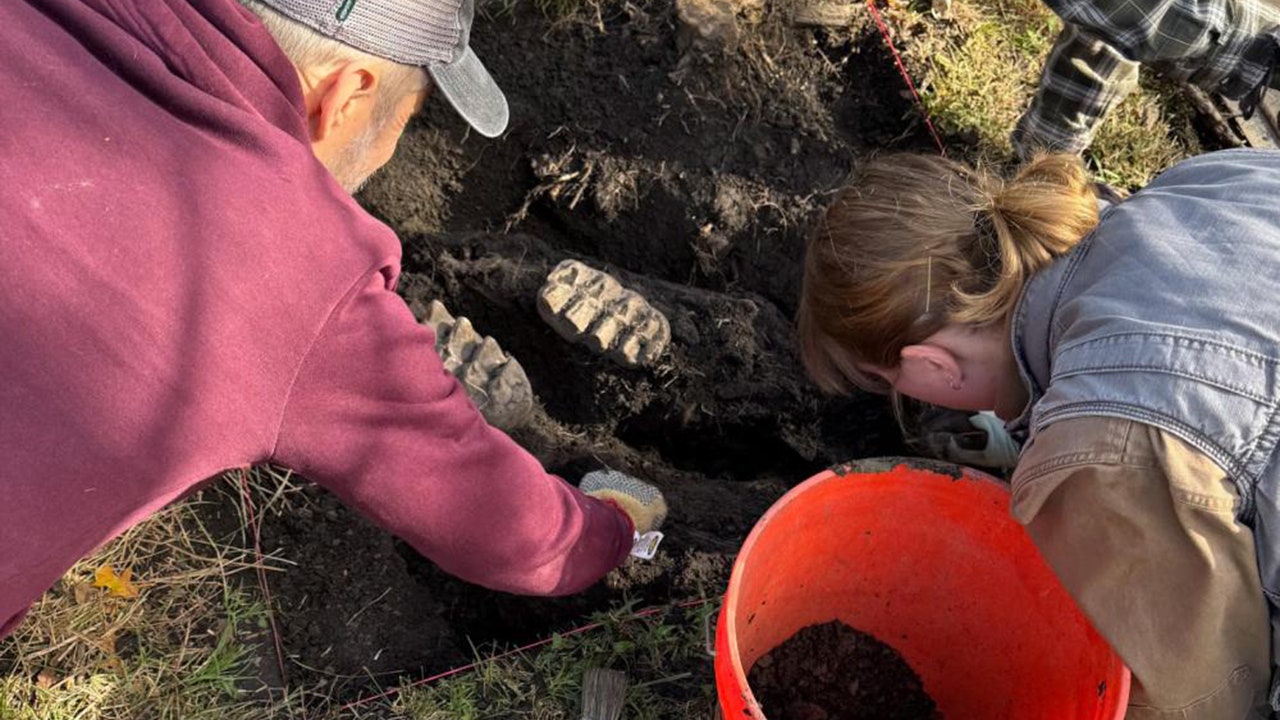
A homeowner in New York uncovered a complete mastodon jaw in their backyard in what officials are calling a “remarkable discovery.”
The jaw of the extinct mammal, which was similar to an elephant, and several bone fragments were excavated from a property in Scotchtown by researchers from the New York State Museum and SUNY Orange.
“The fossils – discovered by a curious homeowner – will undergo carbon dating and extensive scientific analysis to determine the mastodon’s age, diet, and habitat,” the New York State Museum said in a statement. “Once preserved and studied, the jaw and related findings will be showcased in public programming in 2025, offering visitors a glimpse into New York’s rich Ice Age history.”
The Albany-based Museum said the homeowner first noticed the jaw when they spotted “two unusual teeth concealed by plant fronds and, intrigued, dug a bit deeper to uncover two more teeth just inches beneath the surface.”
ARCHAEOLOGISTS UNEARTH 13,000-YEAR-OLD MASTODON SKULL IN IOWA
New York State Museum and SUNY Orange staff excavate a mastodon jaw found on a property in Scotchtown, N.Y. (New York State Museum)
“When I found the teeth and examined them in my hands, I knew they were something special and decided to call in the experts,” the museum quoted the homeowner as saying. “I’m thrilled that our property has yielded such an important find for the scientific community.”
The discovery is also being described by the museum as the first of its kind in New York in 11 years, and a “prehistoric treasure.”
480-YEAR-OLD FIREARM DISCOVERED IN ARIZONA DESCRIBED BY RESEARCHERS AS THE ‘OLDEST’ FOUND IN THE US
A mastodon tooth that was still embedded in the jaw found in New York’s Orange County. (New York State Museum)
“Excavation efforts by the New York State Museum and SUNY Orange unearthed a full, well-preserved mastodon jaw belonging to an adult individual,” it said. “Alongside the jaw, researchers also recovered a piece of a toe bone and a rib fragment, offering valuable additional clues about the mastodon’s life and environment.”
Museum officials said 150 mastodon fossils have been found across New York, but a third of them have come from Orange County, where the jaw was discovered.
A printed illustration of a mastodon from the book Animals of the Prehistoric World. (Florilegius/Universal Images Group via Getty Images)
“While the jaw is the star of the show, the additional toe and rib fragments offer valuable context and the potential for additional research,” Cory Harris, Chair of SUNY Orange’s Behavioral Sciences Department, said in a statement. “We are also hoping to further explore the immediate area for more bones that may have been preserved.”
Read the full article from Here

Boston, MA
Where to watch Boston Red Sox vs Los Angeles Angels: TV channel, start time, streaming for July 4


What to know about MLB’s ABS robot umpire strike zone system
MLB launches ABS challenge system as players test robot umpire calls in a groundbreaking season.
The 2026 MLB season has surpassed the quarter mark, and after each team’s first 40 games, there’s plenty of reasons to tune in all summer long.
Chicago White Sox slugger Munetaka Murakami has already proven doubters wrong by launching 17 home runs, Pittsburgh’s Paul Skenes consistently looks like the best version of himself on the mound and Milwaukee ace Jacob Misiorowski is throwing harder than any starter in the majors.
The MLB action continues on Saturday as the Boston Red Sox visit the Los Angeles Angels.
Here’s everything you need to know to tune in for the first pitch.
See USA TODAY’s sortable MLB schedule to filter by team or division.
What time is Boston Red Sox vs Los Angeles Angels?
First pitch between the Los Angeles Angels and Boston Red Sox is scheduled for 9:38 p.m. (ET) on Saturday, July 4.
How to watch Boston Red Sox vs Los Angeles Angels on Saturday
All times Eastern and accurate as of Saturday, July 4, 2026, at 6:35 a.m.
- Matchup: BOS at LAA
- Date: Saturday, July 4
- Time: 9:38 p.m. (ET)
- Venue: Angel Stadium of Anaheim
- Location: Anaheim, California
- TV: NESN and Angels.Broadcast Television
- Streaming: MLB.TV on Fubo
Watch MLB all season long with Fubo
MLB regional blackout restrictions apply
MLB scores, results
MLB scores for July 4 games are available on usatoday.com . Here’s how to access today’s results:
See scores, results for all of today’s games.

Ohio black bears
A third sighting of 2026 confirms black bears are back for good in Ohio.
If you see a black bear near Pittsburgh, give it space, and don’t let your pet bother it.
That’s the advice Allegheny County’s parks department gave locals after a bear was spotted in a lake north of Pittsburgh, with the department issuing a warning in partnership with Allegheny County Police Department on June 16.
Here’s what to know about the bear sighting and bears around the Pittsburgh area.
When, where was black bear spotted near Pittsburgh?
A black bear was spotted in North Park Lake in McCandless Township in Allegheny County just north of Pittsburgh.
Allegheny County Parks didn’t say when the bear was seen, but they posted about the sighting on Facebook on June 16, saying the Pennsylvania Game Commission had been notified and was monitoring the situation.
What should you do if you spot a black bear in Pittsburgh area?
After a black bear was spotted in North Park Lake, Allegheny County Parks and Allegheny County Police Department put out a joint statement warning residents not to bother bears.
If you see a bear, you should use caution and give it “plenty of space,” according to the county parks department. Don’t approach it, and don’t try to interact with it. If you have a pet with you, keep them controlled on a leash.
“The best thing you can do is view wildlife from a safe distance and allow it to move through the area undisturbed,” the parks department said.
The state also bans residents from feeding bears.
How common are black bears in Pittsburgh area?
Bears inhabit forested areas across more than three-quarters of Pennsylvania, though they’ve been spotted in every county, according to the state game commission. The bears seen in large urban centers and agricultural areas, like the southeastern corners of the state and parts of the western border, are generally transient, as those areas don’t have enough woods to create a good habitat.
The population of bears statewide is estimated to be about 19,000 and is managed through regulated hunting to reduce the risk of more frequent human-bear conflicts. Hunters harvested 2,873 black bears in 2026, with Tioga County reporting the most harvests. Allegheny did not rank among the counties with the top 10 most bears harvested.
Black bears are also not uncommon across the border in Ohio. The state set a record with more than 500 sightings in 2025, according to a report from the Ohio Department of National Resources, with the department finding “consistent evidence” that female black bears live in the northeast corner of the state.
Finch Walker is the Pittsburgh Connect Reporter for the USA TODAY Network. Contact Walker at FWalker@usatodayco.com. Instagram: @finchwalker_. X: @_finchwalker.

Connecticut State Parks announced that several parks, recreation areas, and beaches are closed on Friday after reaching capacity.
As of 1 p.m., the following are closed due to the parking lots being full:
- Rocky Neck State Park
- Millers Pond State Park
- Hammonasset Beach State Park
- Mount Tom State Park
- Gardner Lake State Park
- Squantz Pond State Park
- Silver Sands State Park
- Pattaconk Recreation Area (Cockaponset State Forest)
- Scantic River State Park, Powder Hollow
- Satan’s Kingdom State Park
Connecticut continues to face excessive heat heading into the holiday weekend.
For a full forecast, head here.
-

 Los Angeles, Ca1 hour ago
Man hospitalized in critical condition from L.A. car fire
-

 Detroit, MI1 hour ago
Which Lions player has the most to prove in 2026?
-

 San Francisco, CA2 hours ago
Lettuce | SF Jazz | Music in San Francisco
-

 Dallas, TX2 hours ago
WATCH: Australia soccer fans take over Walmart near Dallas Stadium
-

 Miami, FL2 hours ago
MDSO: Man killed in hit-and-run in northwest Miami-Dade; driver sought
-

 Boston, MA2 hours ago
Where to watch Boston Red Sox vs Los Angeles Angels: TV channel, start time, streaming for July 4
-
 Denver, CO2 hours ago
Out-of-order elevator at Denver Housing Authority property leaves disabled tenants looking for answers
-
Seattle, WA2 hours ago
Where to watch Portland Fire vs Seattle Storm on July 4: TV channel, start time and streaming

