News
What Trump's pick for Treasury secretary could mean for global markets


Scott Bessent speaks at the National Conservative Conference in Washington D.C., Wednesday, July 10, 2024.
Dominic Gwinn | Afp | Getty Images
Financial markets on Monday welcomed President-elect Donald Trump’s pick for U.S. Treasury secretary, with currencies across the globe rallying on hopes that hedge fund manager Scott Bessent can take some of the sting out of Trump’s more extreme economic views.
The U.S. dollar index, which measures the greenback against six major currencies, fell 0.5% to 107.01 on Monday, paring some of its recent gains after a remarkable rally since late September.
The euro was a top performer, rising 0.7% to trade at $1.049 at 12:50 p.m. London time. The Japanese yen, pound sterling and Antipodean currencies were also trading higher against the dollar.
The moves come as global investors reacted to news from late Friday that Trump signaled his intention to nominate Bessent to lead one of the most influential roles in U.S. government. The Treasury Department has broad oversight of tax policy, public debt and international finance.
Strategists regard Bessent, the founder of Connecticut-based investment firm Key Square Group, as a “safe pair of hands,” a well-known market participant and a more moderate pick compared to some of his rivals.
It is expected the 62-year-old will push for Trump to consider a softer approach to tariffs, strip back regulation to boost growth and target a reduction in deficit spending.
“Trump’s pick for Treasury Secretary has swelled investor sentiment further with stocks on Wall Street looking set for another flurry of gains,” Susannah Streeter, head of money and markets at Hargreaves Lansdown, said in a research note.
“Hedge fund manager Scott Bessent’s long career of navigating the twists and turns of markets, has boosted confidence about incoming pro-business policies and lifted hopes that any tariffs would be highly targeted and potentially less inflationary in nature,” she added.
A ‘layered’ approach to tariffs
Trump’s historic election victory earlier this month ratcheted up concerns about the prospect for higher prices, prompting strategists to rethink the outlook for global bond yields and currencies.
It is widely thought that Trump’s pledge to introduce tax cuts and steep tariffs could boost U.S. economic growth — but widen the fiscal deficit and refuel inflation.
An employee sorts navel oranges at a fruit processing factory of Nongfu Spring on November 23, 2024 in Xinfeng County, Ganzhou City, Jiangxi Province of China.
China News Service | China News Service | Getty Images
In an effort to raise revenues, Trump has suggested he could impose a blanket 20% tariff on all goods imported into the U.S., with a tariff of up to 60% for Chinese products and one as high as 2,000% on vehicles built in Mexico.
While many economists are skeptical about the effectiveness of tariffs, Bessent has defended them as “a useful tool for achieving the president’s foreign policy objectives.” He has also, however, called for tariffs to be “layered in” gradually.
“News that Scott Bessent is the top choice for incoming US Treasury Minister has raised the possibility that some ‘Trump trades’ may be watered down,” analysts at Rabobank said in a research note.
“Bessent, a successful macro hedge fund manager, is associated with a preference to reduce the US budget deficit to 3% of GDP, which clearly suggests less appetite for deficit spending,” they added.
Bessent, who once worked for billionaire philanthropist and investor George Soros, has advocated for a so-called “3-3-3” target, which refers to a plan to cut the deficit to 3% by 2028, achieve 3% economic growth and add 3 million new barrels of oil per day.
Business as usual?
Some strategists expect Trump’s Treasury chief pick to be welcomed as good news for Asian currencies over the coming months.
“The market view that Bessent is a ‘safe hands’ candidate, may see some relief rally in Treasuries from the open on Monday, as the risk of a more unorthodox candidate is priced out,” Scott Spratt, strategist at Societe Generale Corporate and Investment Banking, said in a research note.
“We suspect his view that tariffs should be ‘layered’ and that initial levels being discussed are ‘maximalist’ positions, should also provide an opening boost to Asia FX and [the Chinese yuan],” he added.
U.S. President-elect Donald Trump prepares to exit after viewing the launch of the sixth test flight of the SpaceX Starship rocket in Brownsville, Texas, U.S., November 19, 2024.
Brandon Bell | Via Reuters
Tesla CEO Elon Musk suggested that nominating Bessent as Treasury chief would be a disappointment. In a social media post via X on Nov. 16, Musk described Bessent as a “business-as-usual choice,” adding that “business-as-usual is driving America bankrupt.”
Bessent has also been an advocate of Trump’s embrace of the crypto industry, which means he could soon become the first Treasury chief openly in favor of crypto assets. Trump has previously pledged to make America “the crypto capital of the planet.”
Bitcoin breached the $99,000 level for the first time last week as investors continue to price in Trump’s return to the White House.



On Tuesday, the National Transportation Safety Board provided new details of the final minutes before an Air Canada jet collided with a fire truck at LaGuardia Airport in New York.
The timeline from federal investigators and air traffic audio reviewed by The New York Times both suggest that the controllers may have been distracted before the crash, which killed the plane’s two pilots and left dozens injured late Sunday.
Here are critical moments leading up to the deadliest collision at the airport in more than three decades:
Several minutes before crash
A United Airlines flight requests assistance
Air traffic controllers were responding to an emergency with United Airlines Flight 2384 several minutes before the crash, posing a possible distraction to air traffic controllers.
After being on the tarmac for over two hours, the United flight, bound for Chicago, had aborted its first takeoff attempt at 10:40 p.m. Passengers were told the plane had “a transient issue,” according to a passenger who requested anonymity in order to protect her privacy.
The pilots made a second attempt at takeoff about 40 minutes later and aborted again.
At 11:31 p.m., United flight had declared an emergency and requested a gate assignment, according to air traffic control audio reviewed by The Times. An odor on the plane had sickened members of the flight crew.
Four minutes later, the plane was assigned a gate and told to wait for emergency responders.
1-3 minutes before crash
Air Canada flight cleared to land
Air Canada Express Flight 8486 was set to land at LaGuardia Airport when the approach controller, who manages flights as they near the airport, ordered the airplane to contact the control tower, National Transportation Safety Board officials said on Tuesday.
The flight crew began lowering the landing gear. The plane was cleared to land on Runway 4 and advised that it was No. 2 for landing, said Doug Brazy, a senior aviation accident investigator with the National Transportation Safety Board.
One minute and 26 seconds before the crash, an electronic callout indicated that the plane was 1,000 feet from the ground.
A passenger told The Times that a flight attendant warned the passengers to leave any luggage behind if the plane made an emergency landing. It’s unclear why this warning was made.
20-28 seconds before crash
Fire truck cleared to cross runway
Around 11:37 p.m., or 25 seconds before the crash, “Truck 1” made a request to cross Runway 4 at Taxiway D, the same runway that the Air Canada jet was set to land on. The request was made to respond to the emergency with the United Airlines plane.
Five seconds later, the truck, which later crashed with the jet, was cleared to enter the runway, officials said. An air traffic controller quickly responded: “Truck 1 and company, cross 4 at Delta.”
12-17 seconds before crash
Fire truck approaches runway as Air Canada jet is landing
The officers aboard “Truck 1” read back the runway clearance. That’s a mandatory practice to ensure that the message was received correctly, and to verify that both the air traffic controllers and the recipient of the information understood the instructions.
Five seconds later, the plane was 30 feet above the ground, and the tower instructed a Frontier Airlines aircraft to hold its position.
Air Canada flight and fire truck collide
LaGuardia Airport has a “Runway Status Lights” system that includes red runway entrance lights at taxiway and runway crossings. The lights, which are set in the pavement, activate automatically when high-speed traffic is on the runway or approaching it.
While there is speculation about whether the fire truck ran a red runway status light, a Times analysis of the crash footage suggests the lights on Runway 4 appeared to be functioning properly when the fire truck entered the runway.
By design, the lights can go dark a couple of seconds before a landing or taking-off plane passes the intersection. The truck may have entered the runway in that brief window. What remains unknown is whether the crew members heard the controller’s instruction to stop, and, if so, why they proceeded regardless. The lights do not replace clearances given by the air traffic controllers.
Nine seconds before the collision, an air traffic controller instructed “Truck 1” to stop. There were other vehicles behind the fire truck that did not proceed to the runway.
“Stop, stop, stop, stop, Truck 1, stop, stop, stop,” the controller said. Sounds consistent with the plane’s landing gear slamming against the pavement could be heard in the audio from the cockpit voice recorder.
Four seconds before the regional jet plowed into the fire truck, the controller again said, “Stop, Truck 1, stop!”
Investigators have not determined whether the operators of the fire truck heard orders to stop before colliding with the Air Canada flight.

December 2022
The Strateg, originally named Melodia and sailing under the Marshall Islands flag, is part of a fleet exporting crude oil from Russia
June 2023
The ship is renamed Li Bai and changes its flag to Panama
2024
It makes calls to Russian ports where oil consistently breaches the $60 price cap
January 2025
The vessel is placed under sanctions by the US
February 2025
Renamed Azuron and registered under a false Guyana flag
April 2025
Renamed Danshui and registered under a false Comoros flag
May 2025
Sanctions imposed by the EU
July 2025
Sanctions imposed by the UK
Registered under a false Benin flag
December 2025
The vessel, now in effect stateless, is reportedly sold to Russian buyers. Photographs show it entering the Bosphorus Strait with a freshly painted Cyrillic name, Strateg, and flying the Russian flag


February 2026
FT analysis of ship tracking data and satellite imagery analysis shows the Strateg engaging in ship-to-ship transfers with other vessels under sanctions near the Suez Canal


March 2026
The vessel is en route to deliver crude to the Vadinar refinery on India’s west coast, a facility backed by Russia’s state oil company
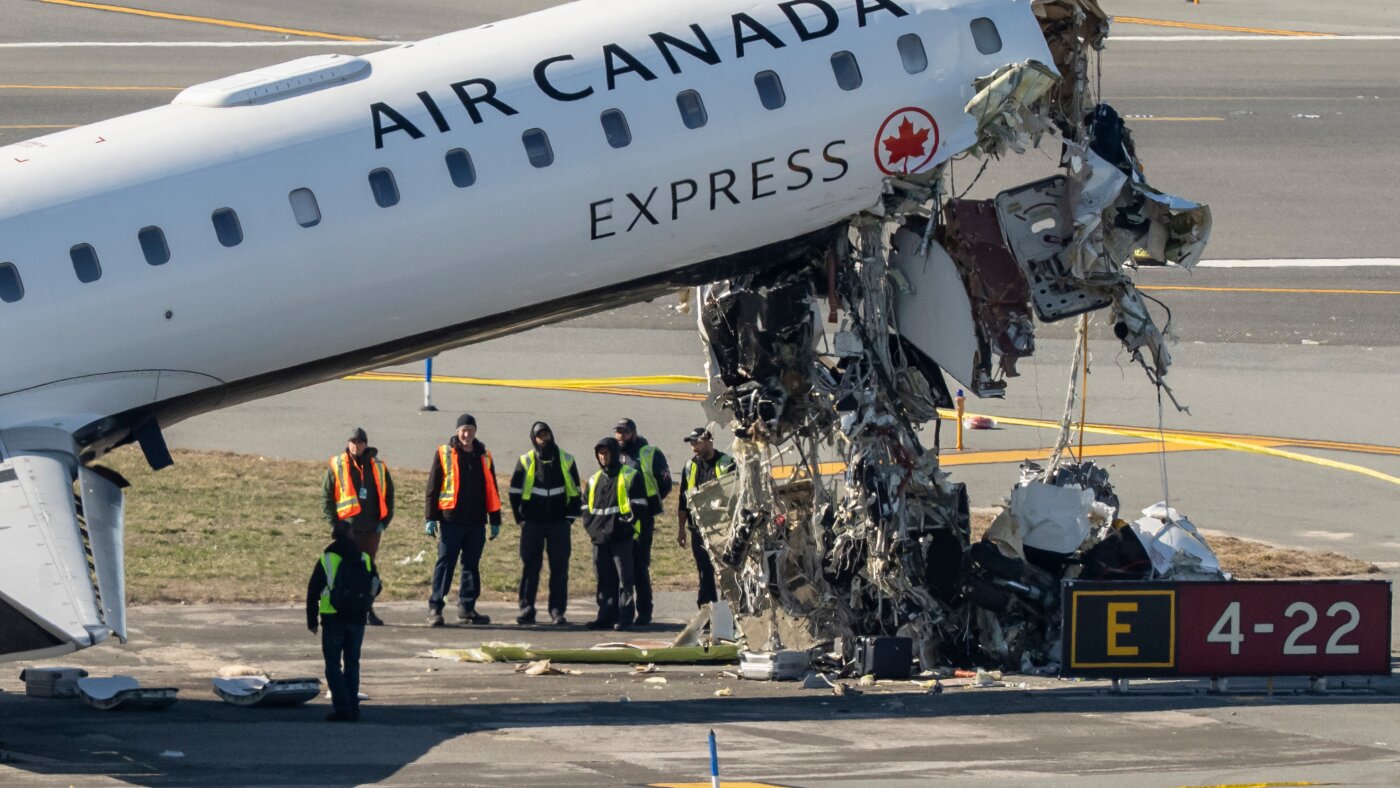
Aircraft maintenance workers inspect the wreckage of an Air Canada Express jet, Tuesday, March 24, 2026, just off the runway where it collided with a Port Authority fire truck Sunday night at LaGuardia Airport in New York.
Yuki Iwamura/AP
hide caption
toggle caption
Yuki Iwamura/AP
The National Transportation Safety Board has raised concerns about staffing procedures related to the plane crash at LaGuardia Airport in New York that left two pilots dead Sunday night.
The NTSB’s investigation has so far revealed there were two air traffic controllers in the tower at the time an Air Canada plane crashed into a fire truck, and at least one of them was doing several jobs, according to NTSB chair Jennifer Homendy. But Homendy focused on systemic issues, rather than individual failings, at a Tuesday press conference.
“I would caution pointing fingers at controllers and saying distraction was involved. This is a heavy workload environment,” she said.
Here’s what else to know.
The NTSB have flagged their concerns several times
Homendy said it is often standard during the midnight shift for two controllers to carry out the duties of several controllers. But, given LaGuardia’s busy airspace, Homendy questioned the use of the practice there.
“That’s certainly something we will look at as part of this investigation: Would that make sense? Why would that make sense at LaGuardia?” she said.
A local controller and a controller in charge were in the tower at the time of the accident.
The local controller is responsible for managing active runways and the airport’s immediate airspace, while the controller in charge oversees all safety operations. However, the controller in charge was also acting as the clearance delivery controller, who gives pilots permission to depart, Homendy said.
Homendy said the NTSB has conflicting information on whether the local controller or the controller in charge was also serving as the ground controller, who manages vehicle activity on taxiways, Homendy said.
“Certainly I can tell you that our air traffic control team has stated this is a concern for them for years,” she said.
Both controllers were working the overnight shift, Homendy noted.
“The midnight shift, as a reminder, is one that we have, many times at the NTSB, raised concerns about, with respect to fatigue,” Homendy said. “We have no indication that was a factor here but it is a shift that we have been focused on in past investigations.”
During a Monday press conference, Transportation Secretary Sean Duffy said LaGuardia’s air traffic control is relatively well staffed. The airport wants 37 controllers working there. Duffy said Monday there were 33 controllers, with seven more in training.
What happened in the final 3 minutes of the cockpit recording
The NTSB recovered the cockpit voice recorder Monday, and sent it to the NTSB’s lab in Washington, D.C. for analysis. NTSB senior aviation accident investigator Doug Brazy summarized what happened in the last three minutes of the recording.
Brazy said as the plane approached the runway, the flight crew had completed their landing checklist and alerts were sent out that the plane was getting closer to the ground.
After the landing checklist was complete, an unknown airport vehicle called into the control tower, but the audio was “stepped on,” or interrupted, by another transmission, Brazy said.
The tower received a transmission from the firefighters that they wanted to cross the runway. The firefighters were responding to reports of fumes coming from a United Airlines plane. The controllers granted the request, Brazy said.
The tower controllers instructed the truck to stop nine seconds before the recording ended. However, there was no transponder, or radio receiver and transmitter, in the truck, Homendy said.
Tower controllers may use an Airport Surface Detection System, Model X (ASDE-X) to track surface movement of planes. However, the system did not send an alert in this instance, Homendy said.
She read the NTSB tech center’s analysis of the failing at the press conference: “ASDE-X did not generate an alert due to the close proximity of vehicles merging and unmerging near the runway, resulting in the inability to create a track of high confidence.”
Eight seconds before the cockpit recording ends, it sounds like the plane lands, Brazy said. Six seconds out, the first officer transferred control of the plane to the captain. Four seconds out, the tower controllers told the firefighters to stop again.
What NTSB still doesn’t know
Homendy has stressed that while the NTSB has a lot of information, it is preliminary and needs to be verified. Some information may also change, she said.

She said the NTSB still does not know who made the radio transmission that was stepped on, why one of the controllers was still on duty after the crash, or if the firefighters heard the directives to stop. Investigators also do not know whether the pilots saw the truck or if there was any confusion in the cockpit.
“We rarely, if ever, investigate a major accident where it was one failure,” Homendy said. “Our aviation system is incredibly safe because there are multiple, multiple layers of defense built in to prevent an accident. So when something goes wrong, that means many, many things went wrong.”

‘Urgent warning:’ DMV scam texts appear more official than before, Giannoulias says

Northside residents brace for 2-way street conversions

See which Iowa lawmakers voted to hike private health insurance taxes

Kansas firefighters rescue chubby cat trapped in massive recliner while trying to hide from the vet

Will Louisiana’s U.S. Senate candidates debate? Bill Cassidy says no to Moon Griffon.

Florida High School Football Rankings: Top 25 teams – Oct. 21

How old is Bo Nix? What to know about Oregon quarterback ahead of 2024 NFL Draft

Cleary's 21 help Le Moyne down Central Connecticut State 69-64 in OT

99th annual Pony Swim held in Virginia

Indiana Members Credit Union announced as new anchor tenant at Bottleworks District

LaGuardia Crash Timeline: Moments Before Air Canada Plane Collided With Fire Truck

Chicago alderwoman apologizes for ‘wrong place at the wrong time’ comment on slain student

Fake Euronews website targets Hungary election with false claims
An air traffic controller was juggling extra roles during the LaGuardia plane crash

Iran War: Pentagon set to send thousands of elite 82nd Airborne troops to region | BBC News
-

 Detroit, MI6 days ago
Drummer Brian Pastoria, longtime Detroit music advocate, dies at 68
-

 Georgia1 week ago
How ICE plans for a detention warehouse pushed a Georgia town to fight back | CNN Politics
-

 Movie Reviews6 days ago
‘Youth’ Twitter review: Ken Karunaas impresses audiences; Suraj Venjaramoodu adds charm; music wins praise | – The Times of India
-

 Education1 week ago
Video: Turning Point USA Clubs Expand to High Schools Across America
-

 Sports4 days ago
IOC addresses execution of 19-year-old Iranian wrestler Saleh Mohammadi
-
 Science1 week ago
Industrial chemicals have reached the middle of the oceans, new study shows
-

 Science1 week ago
How a Melting Glacier in Antarctica Could Affect Tens of Millions Around the Globe
-

 Culture1 week ago
Test Your Memory of Great Lines From Classic Irish Poems