News
Trump gets edge over Biden nationally and across battlegrounds after debate as Democrats’ turnout in question — CBS News poll


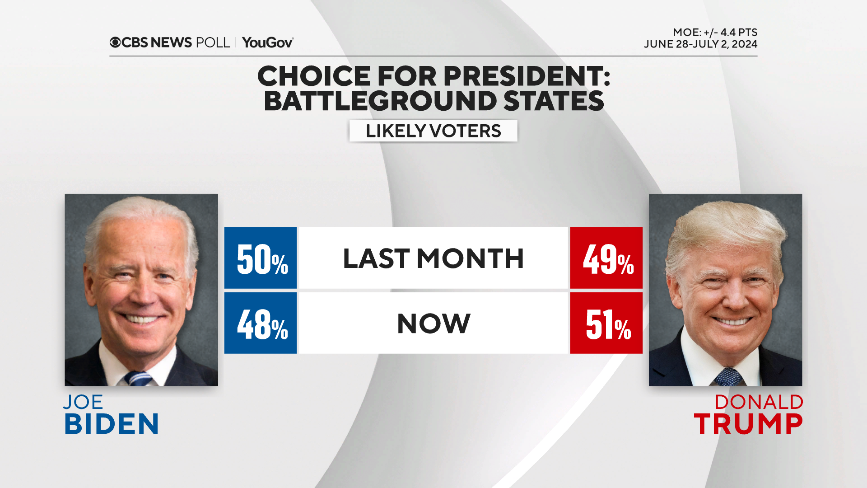
The race for president has shifted in Donald Trump’s direction following the first 2024 presidential debate. Trump now has a 3-point edge over President Biden across the battleground states collectively, and a 2-point edge nationally.
A big factor here is motivation, not just persuasion: Democrats are not as likely as Republicans to say they will “definitely” vote now.
Perhaps befitting a race with two well-known candidates and a heavily partisan electorate, over 90% of both Mr. Biden’s and Trump’s supporters say they would never even consider the other candidate, as was the case before the debate, which helps explain why the race has been fairly stable for months. Recall that Mr. Biden had gained a bit back in June, after Trump was convicted of felonies in New York, but that didn’t dramatically alter the race either.
That said, the preference contest today does imply an Electoral College advantage for Trump.
Meanwhile, half of Mr. Biden’s 2020 voters don’t think he should be running this year — and when they don’t think so, they are less likely to say they’ll turn out in 2024, and also more likely to pick someone else, either Trump or a third-party candidate.
Trump, for his part, finds most Republicans feeling bolstered after the debate, saying it made them more likely to vote. And independents remain tightly contested, with Trump narrowly edging up with them now.
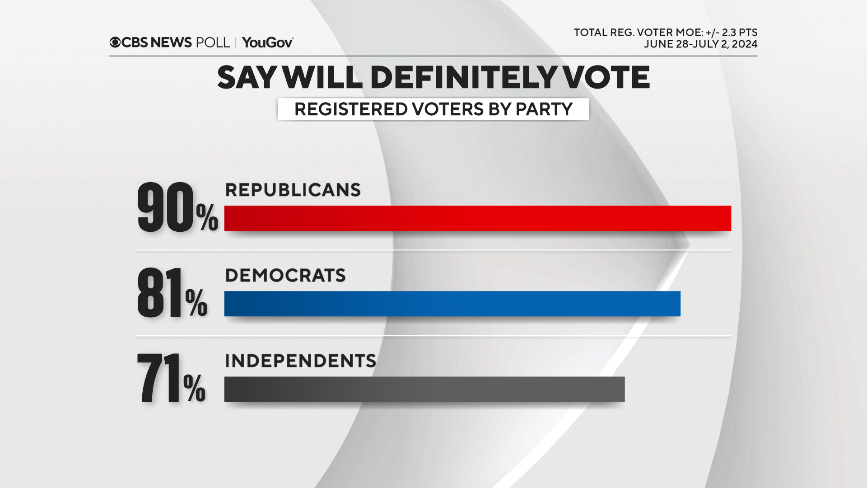
Nationwide, Republicans are more likely than Democrats to say they will definitely turn out in 2024. And Republicans currently have a similarly sized turnout advantage across the battleground states, undergirding Trump’s edge with likely voters there.
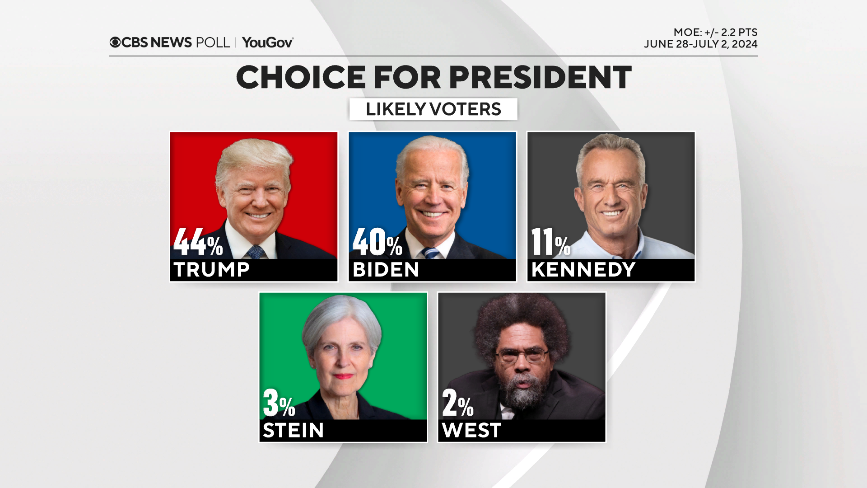
When Robert F. Kennedy Jr., Jill Stein and Cornel West are included in a national ballot test, Trump’s national edge over Mr. Biden expands to four points. Kennedy draws roughly equally from both candidates, but Mr. Biden cedes a little more to Stein and West, bringing down his overall percentage.
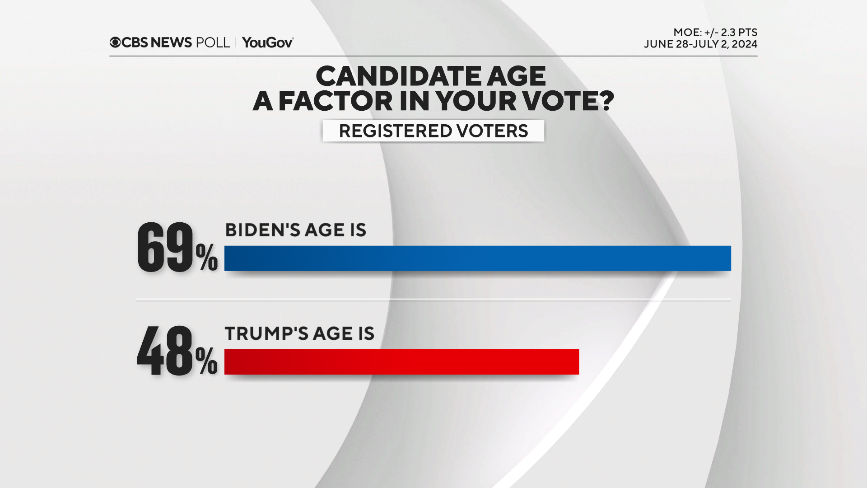
For many voters, both candidates’ ages are a factor, not just Mr. Biden’s. When people see an equivalence there, Mr. Biden benefits: he leads Trump among those who say both.
The trouble for Mr. Biden is that he trails badly among those for whom only his age is a factor.
Immediately following the debate, CBS News’ polling showed increasing numbers of voters believing Mr. Biden did not have the cognitive health for the job and that he should not be running. A large seven in 10 still say he should not be running. (It’s three points fewer now than immediately after the debate, perhaps because the Biden campaign pushed back on the idea, but remains the dominant view among voters, and of a sizable four-in-10 share of Democrats.)
Mr. Biden did not gain any ground on Trump on a number of personal qualities: Trump leads Mr. Biden on being seen as competent, tough, and focused. The president continues to be seen as more compassionate.
CBS News considers the battlegrounds as the states most likely to decide the election in the Electoral College: Arizona, Georgia, Michigan, North Carolina, Nevada, Pennsylvania and Wisconsin.
This CBS News/YouGov survey was conducted with a representative sample of 2,826 registered voters nationwide interviewed between June 28-July 2, 2024. The sample was weighted by gender, age, race, and education, based on the U.S. Census American Community Survey and Current Population Survey, as well as past vote. The margin of error for registered voters is ±2.3 points. Battlegrounds are AZ GA MI NC NV PA WI.
Toplines



By Zolan Kanno-Youngs, Gilad Thaler, Jon Miller, Nikolay Nikolov, June Kim, Paul Abowd and Pierre Kattar
April 14, 2026
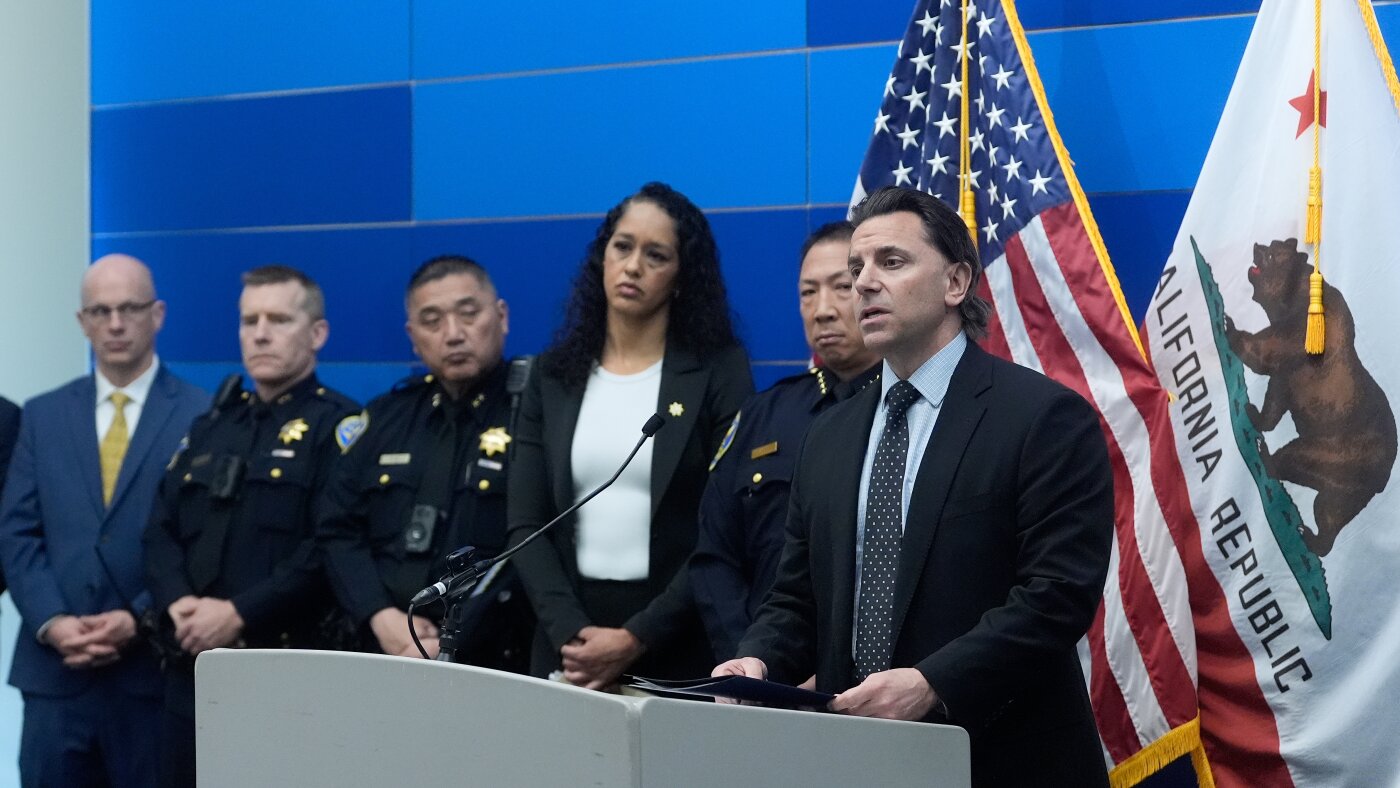
Matt Cobo, F.B.I. San Francisco Acting Special Agent in Charge ( right) speaks next to San Francisco Police Chief Derrick Lew (second from right) and San Francisco District Attorney Brooke Jenkins (third from right) during a news conference Monday, April 13, 2026, in San Francisco.
Jeff Chiu/AP
hide caption
toggle caption
Jeff Chiu/AP
SAN FRANCISCO — The man accused of throwing a Molotov cocktail at OpenAI CEO Sam Altman’s home had written about AI’s purported risk to humanity and traveled from Texas to San Francisco intending to kill Altman, authorities said Monday.
Authorities allege 20-year-old Daniel Moreno-Gama threw the incendiary device about 4 a.m. Friday, setting an exterior gate at Altman’s home alight before fleeing on foot, police said. Less than an hour later, Moreno-Gama allegedly went to OpenAI’s headquarters about 3 miles (4.83 kilometers) away and threatened to burn down the building.
Moreno-Gama is opposed to artificial intelligence, writing about AI’s purported risk to humanity and “our impending extinction,” according to a federal criminal complaint.

“This was not spontaneous. This was planned, targeted and extremely serious,” said FBI San Francisco Acting Special Agent in Charge Matt Cobo during a press conference.
No one was injured at Altman’s home or the company offices, authorities said.
Moreno-Gama faces state and federal charges
Moreno-Gama faces charges including two counts of attempted murder and attempted arson in California state court, San Francisco District Attorney Brooke Jenkins. He tried to kill both Altman and a security guard at Altman’s residence, she alleged. He is set to appear in court Tuesday, and online state court records do not yet show if he has an attorney.
Jenkins said the state charges carry penalties ranging from 19 years to life in prison.
On Monday morning, FBI agents went to Moreno-Gama’s home in Spring, Texas, a suburb of Houston, where they spent several hours before leaving. He has been charged by federal prosecutors with possession of an unregistered firearm and damage and destruction of property by means of explosives. Those charges carry respective penalties of up to 10 years and 20 years in prison.
The federal court documents do not list an attorney for Moreno-Gama, and he has not yet had his first appearance in federal court.
Authorities allege Moreno-Gama traveled from his home in Texas to San Francisco and visited Altman’s home early Friday morning.
Authorities say Moreno-Gama was opposed to artificial intelligence
When Moreno-Gama was arrested Friday, officials found a document on him in which he “identified views opposed to Artificial Intelligence (AI) and the executives of various AI companies,” court documents say. The document discussed AI’s purported risk to humanity and “our impending extinction,” according to the criminal complaint.
Surveillance video images included in the criminal complaint show a person dressed in a dark hoodie and pants that the FBI alleges is Moreno-Gama approaching the driveway of Altman’s home. In various images, the person can be seen tossing the Molotov cocktail, which landed at the top of a metal gate and started a small fire.
Surveillance video images from outside OpenAI’s headquarters allegedly show Moreno-Gama grabbing a chair and using it to hit a set of glass doors. Authorities said Moreno-Gama was approached by the building’s security personnel, who told investigators he “stated in sum and substance” that he came to the headquarters “to burn it down and kill anyone inside,” according to the complaint.
San Francisco police arrested Moreno-Gama and recovered “incendiary devices, a jug of kerosene, a blue lighter, and a document.” Moreno-Gama was being held Monday in the San Francisco County Jail on the state charges, and was expected to appear in court on Tuesday.
U.S. Attorney Craig Missakian said authorities “will treat this as an act of domestic terrorism, and together with our partners, prosecute him to the fullest extent of the law.”
Authorities say Moreno-Gama’s anti-AI document contained threats against Altman
The document in which Moreno-Gama discussed his opposition to AI also made threats against Altman, officials said.
“Also if I am going to advocate for others to kill and commit crimes, then I must lead by example and show that I am fully sincere in my message,” Moreno-Gama is alleged by authorities to have written in the document.
Advocacy groups that have issued grave warnings about AI’s risks to society condemned the violence.
Anthony Aguirre, president and CEO of the Future of Life Institute, said in a written statement Friday that “violence and intimidation of any kind have no place in the conversation about the future of AI.”

Another group, PauseAI, said in a statement that the suspect had no role in the group but joined its forum on the social media platform Discord about two years ago and posted about 34 messages there, none containing explicit calls to violence but one that was flagged as “ambiguous.”
Discord said Monday that it has banned Moreno-Gama for “off-platform behavior.”
Altman addressed the threats in a blog post
Hours after the attack on his house, Altman posted a photo of his husband and their toddler in a blog post addressing the threats against him.
“Normally we try to be pretty private, but in this case I am sharing a photo in the hopes that it might dissuade the next person from throwing a Molotov cocktail at our house, no matter what they think about me,” Altman wrote.
He added that “fear and anxiety about AI is justified” but it was important to “de-escalate the rhetoric and tactics and try to have fewer explosions in fewer homes, figuratively and literally.”
Altman has become a preeminent voice in Silicon Valley on the promise and potential dangers of artificial intelligence. The attack comes days after The New Yorker published an in-depth investigation that touched on concerns some people have about him and the company.
Debate about the impact of AI is growing
The attack came at a time of growing debate about the societal effects of AI assistants like OpenAI’s ChatGPT that millions of people are turning to for information, advice, writing help and to do work on their behalf.
An annual report published Monday by Stanford University called the AI index found that most people believe AI’s benefits outweigh its drawbacks, “but nervousness is growing and trust in institutions to manage the technology remains uneven.”

Greensburg Central Catholic star Erica Gribble changes plans, follows coach from Richmond to Virginia of the ACC

Boys lacrosse: Cold Spring Harbor vs. Port Washington

Powerful storms move through SE Wisconsin

RE-PATH West Virginia announces first grant funding from Hope in the Hills

Wyoming lake’s unnerving rusty-red water persists as experts offer explanations – WyoFile

Florida High School Football Rankings: Top 25 teams – Oct. 21

How old is Bo Nix? What to know about Oregon quarterback ahead of 2024 NFL Draft

Cleary's 21 help Le Moyne down Central Connecticut State 69-64 in OT

99th annual Pony Swim held in Virginia

Indiana Members Credit Union announced as new anchor tenant at Bottleworks District

Dem fundraising giant in the hot seat as GOP lawmakers demand answers over dodged subpoena

Fifth woman accuses former US lawmaker Eric Swalwell of sexual misconduct

Commercial Ships Transit Strait of Hormuz as U.S. Blockades Iran’s Ports

Video: How Stephen Miller Is Adjusting Trump’s Immigration Agenda

Biden DOJ weaponized FACE Act against pro-life Americans, 882-report alleges
-

 Atlanta, GA1 week ago
1 teenage girl killed, another injured in shooting at Piedmont Park, police say
-

 Georgia1 week ago
Georgia House Special Runoff Election 2026 Live Results
-

 Arkansas4 days ago
Arkansas TV meteorologist Melinda Mayo retires after nearly four decades on air
-

 Pennsylvania1 week ago
Parents charged after toddler injured by wolf at Pennsylvania zoo
-
 Milwaukee, WI1 week ago
Potawatomi Casino Hotel evacuated after fire breaks out in rooftop HVAC system
-

 Ohio11 hours ago
‘Little Rascals’ star Bug Hall arrested in Ohio
-

 Austin, TX7 days ago
ABC Kite Fest Returns to Austin for Annual Celebration – Austin Today
-

 World1 week ago
Zelenskyy warns US-Iran war could divert critical aid from Ukraine