Wyoming
Wyoming lake’s unnerving rusty-red water persists as experts offer explanations – WyoFile


When the ice melted in late March, the striking burnt-red color returned to the fringes of the Wind River Range more pronounced than ever.
This seemingly wine-stained water didn’t reveal itself in a melted-out mine tailings pond. It filled Little Soda Lake, a roughly 50-acre former trout fishing hole perched above Pinedale, just a half mile from Fremont Lake. Now, nearly a year and a half after the once-mysterious shade of water started turning heads in Sublette County, water quality officials say they’ve gained some understanding about what’s going on.
The Wyoming Department of Environmental Quality has ruled out harmful cyanobacteria — which have plagued Little Soda Lake — as the cause of the seldom-seen shade of water.
“The red coloration is due to a different type of algae,” said Eric Hargett, Wyoming DEQ’s water quality standards program supervisor. “Specifically, the algae is rhodomonas.”
That’s a type of nontoxic cryptophyte that’s “most likely” the cause, Hargett said. The native microorganism was found in low densities during 2024 and 2025 testing, and it’s associated with red colorations and brackish water.
“It does have the name Little Soda Lake,” Hargett said, “so it’s been known to be highly alkaline and high in salinity.”
Other Wyoming lakes have turned red as a result of cryptophyte rhodomonas blooms, he said. Hargett recalled one in the Laramie Basin that had similar characteristics to outletless Little Soda Lake, and the other lake also changed color during a period of low water.
Low water’s been a problem in the small Soda Lake watershed. Roughly 50-foot-deep Little Soda Lake’s water level fell by 6-8 feet in recent decades, the Wyoming Game and Fish Department reported in 2024. Nearby and larger Soda Lake dropped even more, by 15 feet. The historically warm winter and sparse snowpack Wyoming just endured will likely only exacerbate those trends.
Harmful cyanobacteria blooms are another part of the troubling water quality changes in the lake, 6 miles north of Pinedale. Little Soda Lake had its first known harmful cyanobacteria bloom in November 2024. The following May, it became the first Wyoming waterbody in 2025 listed on the state agency’s cyanobacteria monitoring website with an advisory. Its water, so far, has not tested positive for related toxins.
Non-toxic, but beware
Although the water is red, there are indications that Little Soda Lake in 2026 is not yet experiencing high densities of cyanobacteria, according to Wyoming DEQ’s harmful cyanobacteria coordinator, Rachel Eyres. Two weeks ago, staff at the Bridger-Teton National Forest, the land manager for the lake, conducted a simple “jar test” and conveyed the results.
“Typically, cyanobacteria will float to the top because they adjust their buoyancy,” Eyres said. “Other phytoplankton, such as algae, will not, and what the [Little Soda] jar test showed is that the top 99% of the water was completely clear. There was just some red organic material in the bottom of the jar.”
Later, official tests will occur. Wyoming DEQ and the Bridger-Teton will test Little Soda’s water for cyanobacteria presence and toxins monthly from July through October, Eyres said.
Little Soda Lake is essentially inaccessible right now because of a winter closure on the Soda Lake Wildlife Habitat Management Area, but that lifts on May 1. Once it does, people recreating should use caution.
Little Soda’s red color could even mask some of the telltale signs of harmful cyanobacteria, Eyres said. Those include blue-green or pea-colored water that sometimes forms in scums or mats.
“A [cyanobacteria] bloom can arise at any time, and even before we’re made aware,” Eyres said. “When in doubt, stay out. If you think it looks gross, I would definitely not swim in it and try to keep your dogs out of it.”
Officially, the environmental factors that ultimately enabled the changes in Little Soda Lake remain unknown.
DEQ’s cyanobacteria surveillance has “provided some insight into what the red bloom actually is,” Hargett said. But there’s no broader investigation into the waterbody and it’s not being assessed for a possible “impaired” listing in Wyoming’s biennial Clean Water Act compliance report.
Addressing red water?
Absent an impairment, it’s not DEQ’s role to propose how to address Little Soda Lake.
“It would need to be impaired for us to step in and do any sort of work towards improving a waterbody,” Eyres said.
Some locals have suggestions for next steps.

Joe Meyer is a Pinedale resident and retired University of Wyoming limnologist — that’s a scientist who studies inland aquatic ecosystems. He did his postdoctoral research on eutrophic, nutrient-laden lakes.
A couple years ago, Meyer hiked to Little Soda Lake and walked away with an educated guess about why it was colored like “split pea soup” at the time.
“There were cowpies along the shoreline,” Meyer said. “My first impression was that boy, there’s enough cattle in here to really load up the water with nutrients.”
The following winter, Little Soda Lake first turned red. The color returned in fall 2025, Wyoming Public Radio reported. Aerial photos of the recurrence this spring show perhaps the most stark shade of red yet.

Accumulated nutrients — phosphorus and nitrogen — from cattle feces in Little Soda Lake’s sediment and water are a possible explanation for the bloom that turned the lake red, Meyer said.
“It’s a really nutrient-stressed lake, and this cryptophyte could be a result of that,” Meyer said.
There’s no arguing with tests and data, Meyer said, and cryptophyte rhodomonas sounds like a “plausible” reason why Little Soda Lake’s turned so red. But Wyoming DEQ also can’t rule out oxidized iron or manganese as an explanation without more extensively testing the water, he said.
Those tests could also provide insight about potential underlying causes, like cattle grazing.
“I strongly suggest routine water chemistry [tests],” Meyer said. “They need to know total and dissolved nitrogen and total and dissolved phosphorus concentrations. Those are the minimum things that we’d want to know about a eutrophic lake.”

Wyoming
Wyoming Cultural Trust Fund awards $529K in grants, including several Fremont County projects


CHEYENNE, Wyo. — Wyoming is a state known for cowboys, rodeos, and beautiful plains, but is also known for being the first territory to grant women the right to vote, something historian Jennifer Helton explored in her Suffrage Stories presentation.
Helton was invited to highlight Wyoming’s remarkable role in the fight for women’s suffrage as part of the museum’s special America 250 Discover & Discuss series on Jun 18, but the recorded version was just released. This is a part of Cheyenne Frontier Days Old West Museum’s goal of exploring Cheyenne and the greater state of Wyoming’s history.
Helton’s presentation not only celebrates Wyoming’s role in suffrage, but also how the state’s pioneering women helped shape the future of voting rights across the nation.
Born and raised in Wyoming, Jennifer Helton left the state at age 18 to attend college, “which left a giant, Wyoming-sized hole in my heart,” Helton said, “and the way that I fill that hole is by conducting research on women’s suffrage.”
Upon realizing that most people outside of the state of Wyoming did not know the West’s progressive role in suffrage, she became obsessed with bridging this knowledge gap and researching the history of suffrage.
“My kids would tell you it’s an obsession, not just an interest or a hobby,” Helton said. “They always joke that I have three kids, the two of them and then Esther Morris.”
During her presentation, Helton’s admiration for Esther Morris was apparent due to her trailblazing nature as suffragist, her courage to stand up to torch-bearing mobs, and abolitionist activities.
Interestingly enough, her sons were also instrumental in shaping Wyoming’s history. E.A. Slack is known as the “Father of Frontier Days” and citizens of Wyoming can thank Robert C. Morris for Cheyenne’s public library, as he brought the Carnegie Public Library System to Wyoming.
.
” data-large-file=”https://i0.wp.com/capcity.news/wp-content/uploads/2026/06/image-2.png?fit=780%2C863&ssl=1″ alt=”” class=”wp-image-170117″ style=”aspect-ratio:0.90332473687879;width:464px;height:auto” srcset=”https://i0.wp.com/capcity.news/wp-content/uploads/2026/06/image-2.png?resize=925%2C1024&ssl=1 925w, https://i0.wp.com/capcity.news/wp-content/uploads/2026/06/image-2.png?resize=271%2C300&ssl=1 271w, https://i0.wp.com/capcity.news/wp-content/uploads/2026/06/image-2.png?resize=768%2C850&ssl=1 768w, https://i0.wp.com/capcity.news/wp-content/uploads/2026/06/image-2.png?resize=780%2C864&ssl=1 780w, https://i0.wp.com/capcity.news/wp-content/uploads/2026/06/image-2.png?resize=400%2C443&ssl=1 400w, https://i0.wp.com/capcity.news/wp-content/uploads/2026/06/image-2.png?resize=706%2C782&ssl=1 706w, https://i0.wp.com/capcity.news/wp-content/uploads/2026/06/image-2.png?w=960&ssl=1 960w, https://i0.wp.com/capcity.news/wp-content/uploads/2026/06/image-2-925×1024.png?w=370&ssl=1 370w” sizes=”auto, (max-width: 780px) 100vw, 780px”/><figcaption class=) Photo of Esther Morris, the first female justice of the peace (Cheyenne Frontier Days Old West Museum). Credit: Cheyenne Frontier Days Old West Museum (Jennifer Helton Presentation) / Cheyenne Frontier Days Old West Museum
Photo of Esther Morris, the first female justice of the peace (Cheyenne Frontier Days Old West Museum). Credit: Cheyenne Frontier Days Old West Museum (Jennifer Helton Presentation) / Cheyenne Frontier Days Old West Museum
Throughout the course of her presentation, Helton revealed the results of her research by tracing the course of American history in order to highlight the intersection between Wyoming, women, and winning the right to vote.
The talk also highlighted incredible Black women such as Lucy Phillips and Nancy Phillips, some of the first Black women to vote.
As America celebrates its 250th anniversary, the museum invites visitors to explore the stories of trailblazers like the nation’s first woman justice of the peace Esther Morris, the first woman governor, the first Black women to vote, and many other extraordinary leaders who made history.
The museum is hosting its special America 250 exhibit and allows visitors to discover the stories, artifacts, and moments that connect the community to the nation’s history. The exhibit even features six U.S. presidents who visited Cheyenne or Cheyenne Frontier Days, and is currently running at the museum. For those who cannot attend, lectures such as this are filmed and provided online.
As Helton closed her lecture, she read the words of Esther Morris, “I say do all the good you can while you do live.”
“Because women like Esther Morris, like Theresa Jenkins, had the courage to stand up and do all the good that they could in their lives we are all able to live the lives that we are living today,” Helton said.
“So, we should be grateful to them, and I think we should also be asking ourselves what is it that we need to be doing so that future generations can preserve the same opportunities we have, and perhaps more.”
Watch Jennifer Helton’s full presentation at the link provided here.
To learn more about historian Jennifer Helton visit jenniferhelton.org.
.
” data-large-file=”https://i0.wp.com/capcity.news/wp-content/uploads/2026/06/image-3.png?fit=780%2C519&ssl=1″ alt=”” class=”wp-image-170141″ srcset=”https://i0.wp.com/capcity.news/wp-content/uploads/2026/06/image-3.png?resize=1024%2C681&ssl=1 1024w, https://i0.wp.com/capcity.news/wp-content/uploads/2026/06/image-3.png?resize=300%2C200&ssl=1 300w, https://i0.wp.com/capcity.news/wp-content/uploads/2026/06/image-3.png?resize=768%2C511&ssl=1 768w, https://i0.wp.com/capcity.news/wp-content/uploads/2026/06/image-3.png?resize=1536%2C1022&ssl=1 1536w, https://i0.wp.com/capcity.news/wp-content/uploads/2026/06/image-3.png?resize=1200%2C799&ssl=1 1200w, https://i0.wp.com/capcity.news/wp-content/uploads/2026/06/image-3.png?resize=780%2C519&ssl=1 780w, https://i0.wp.com/capcity.news/wp-content/uploads/2026/06/image-3.png?resize=400%2C266&ssl=1 400w, https://i0.wp.com/capcity.news/wp-content/uploads/2026/06/image-3.png?resize=706%2C470&ssl=1 706w, https://i0.wp.com/capcity.news/wp-content/uploads/2026/06/image-3.png?w=1605&ssl=1 1605w, https://i0.wp.com/capcity.news/wp-content/uploads/2026/06/image-3-1024×681.png?w=370&ssl=1 370w” sizes=”auto, (max-width: 780px) 100vw, 780px”/><figcaption class=) Jennifer Helton’s information (Cheyenne Frontier Days Old West Museum).
Jennifer Helton’s information (Cheyenne Frontier Days Old West Museum).
Related
Wyoming
At 6,000-year-old crossing, Gov. Gordon OKs Wyoming’s first-ever designated pronghorn migration route – WyoFile

SUBLETTE COUNTY—Gov. Mark Gordon heralded Wyoming’s first-ever designation to protect a pronghorn migration corridor — a more than 2 million-acre web of habitat — at Trapper’s Point, which he called a “wonderful passageway.”
“How incredibly valuable it is that you are standing here today,” Gordon told the crowd, “to witness this remarkable moment.”
Gordon commemorated the moment with his feet planted on the narrow bulge of high country that splits the Green and New Fork rivers. Thousands of years ago, the site was a well-used hunting ground for Native Americans — it’s the earliest known killing and processing site for pronghorn in North America. Now it boasts a wildlife overpass.
No pronghorn were to be seen during the especially windy Friday afternoon gathering, which attracted 75 attendees from nearby Pinedale and other western Wyoming communities.
Now Trapper’s Point is officially classified as a “bottleneck” for the Sublette Pronghorn Herd — one of 13 such bottlenecks. That classification is supposed to prevent any surface-disturbing activity, with the intent that pronghorn can keep passing through Trapper’s Point for generations to come.

Protecting the ability of the fleet-footed, tawny-and-white ungulates to migrate is a “key factor” in sustaining their population, Wyoming Game and Fish Director Angi Bruce said.
“This becomes even more important in severe winters or extreme droughts,” Bruce said. “Pronghorn are long overdue for recognition.”
Pronghorn in Sublette, Teton, Sweetwater and Lincoln counties travel a long road — some migrate more than 200 miles to escape harsh winters, trekking south into the lower Green River Basin, a semi-arid sweep of sagebrush steppe between Pinedale and Rock Springs. Then in the spring, they retrace those paths, returning to summer ranges, lush with verdant vegetation, even going as far as Grand Teton National Park.
There was also a long road of bureaucracy to get to this point.
Nearly three decades of effort preceded the formal designation of the migration routes used by the Sublette Pronghorn Herd, which is the farthest-traveling and among the largest pronghorn herds in the West.
Jackson Hole biologists long knew that the valley’s pronghorn left in the winter. But details were hazy on where they went and how they got there until around the turn of the century. Using data from tracking collars, biologists like Joel Berger, Steve Cain, Hall Sawyer and Doug Brimeyer helped delineate the route.

In 2008, a Bridger-Teton National Forest plan amendment established a portion of the path as the nation’s first designated wildlife migration corridor.
Popularized by its branding as the “Path of the Pronghorn,” the route has received press in national publications like High Country News and the New York Times.
But the southern reaches of the migration through the energy-rich Green River Basin have faced major political opposition since the early 2000s. Wyoming first attempted to protect those travel corridors in 2019, under a policy administered by the Wyoming Game and Fish Department. That effort was halted after a coalition of industry trade groups and counties protested.
Then, in early 2020, Gordon revamped the migration policy with an executive order. Still, the Sublette Pronghorn Herd proposal gathered dust, even as development threatened the route.
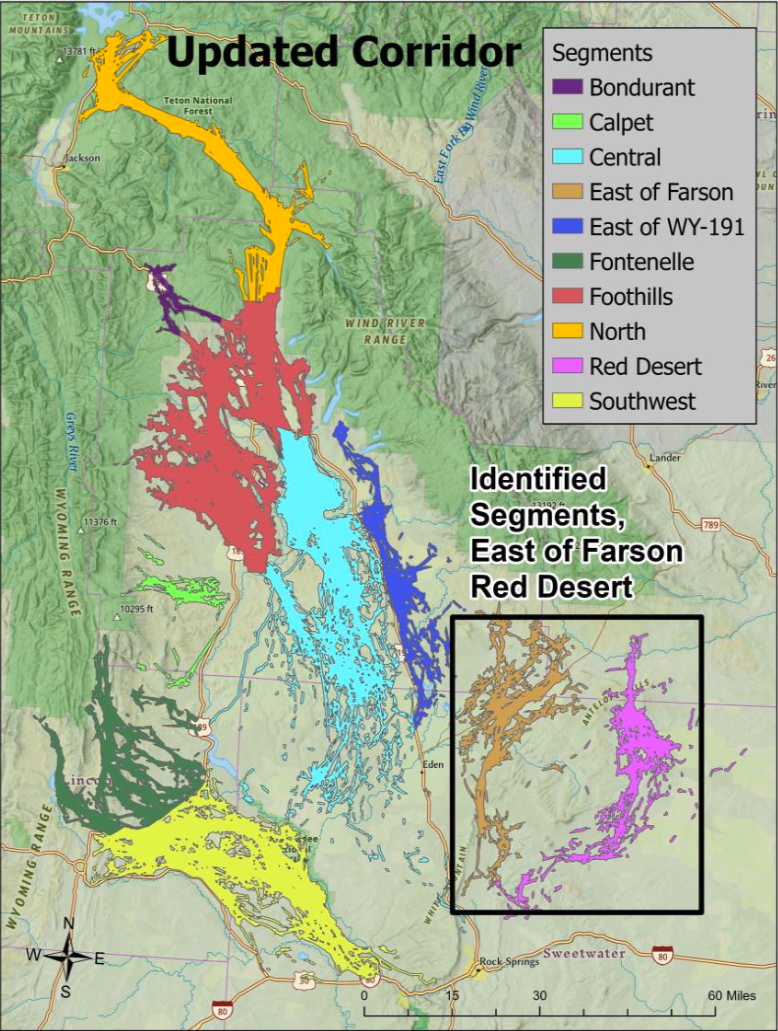
Game and Fish revived efforts to protect the migration in late 2023 and early 2024. Biologists pulled together one of North America’s most comprehensive migration datasets, benefiting from approximately two decades of GPS collar information collected from more than 400 pronghorn.
Some controversy followed the process until near the end. There was a debate about whether to designate the migration’s two easternmost segments, in the Red Desert and east of Farson. The Game and Fish Department proposed excluding the routes, but was overridden by its commission. Then Gordon upended that decision, excluding the two segments.
Vetting the migration corridor through a Gordon-appointed working group was the second-to-last step in the designation process.
“Today’s designation demonstrates that voluntary, locally driven conservation works,” said Robb Slaughter, who chaired the group, during the commemoration at Trapper’s Point.
Time will tell if that’s the case. Wyoming’s migration policy is, by design, permissive of development. Private land is exempt from protections, and designation is not an assurance that new stressors won’t be added to the landscape.

“Today is not the end of the process,” Slaughter said. “It’s the beginning of the next chapter. Continued monitoring, adaptive management, research, and cooperation will ensure these recommendations remain effective as conditions change.”
But Friday was the end of the migration designation process. The governor’s informal OK — no signature was needed — was the last step, said Sara DiRienzo, the governor’s deputy policy advisor.
Wildlife advocates celebrated the moment.
“This is historical,” Bruce said. It’s the first effort to protect the full length of a pronghorn migration corridor in the nation, she said.
-

 Nevada45 seconds ago
Lexicon Bank honors CARE Complex for aiding Southern Nevada families in need
-

 New Hampshire8 minutes ago
Concord Heights Abuse Of Corpse And Falsifying Evidence Case From May 2024 Inches Forward
-

 New Jersey11 minutes ago
The votes are in! Top 10 Jersey beaches for 2026 summer fun
-

 New Mexico16 minutes ago
11 New Mexico Towns With A Slower Pace Of Life
-

 North Dakota26 minutes ago
Bankruptcies for North Dakota and western Minnesota published June 27, 2026
-

 Ohio31 minutes ago
In Springfield, Ohio, Trump’s rhetoric becomes a grim reality
-

 Oklahoma38 minutes ago
Trump nominates former Oklahoma officer Lance Schroyer to lead ICE
-

 Oregon41 minutes ago
OPB’s First Look: Town hall follows power outages

