Movie Reviews
Movie Review – Wasteman (2025)


Wasteman, 2025.
Directed by Cal McMau.
Starring David Jonsson, Tom Blyth, Alex Hassell, Neil Linpow, Paul Hilton, Corin Silva, Layton Blake, Jack Barker, Fred Muthui, Lunga Skosana, Robert Rhodes, Keaton Ancona-Francis, and Cole Martin.
SYNOPSIS:
Follows parolee Taylor whose fresh start hopes are jeopardized by cellmate Dee’s arrival. As Dee takes Taylor under his wing, a vicious attack tests their bond, forcing Taylor to choose between protecting Dee and his own parole chances.

Backing up its intentions and messaging with real spliced-in cell phone footage of rowdy, uncontrollable prison behavior in an understaffed British penitentiary, director Cal McMau’s narrative debut feature Wasteman (from a screenplay by Eoin Doran and Hunter Andrews) is often purposely, effectively disorienting. That’s not merely limited to be incorporated leaked footage (this is a prison that, in some respects, is more of a recreational facility than one for rehabilitation, since the guards are in such low quantity, all while the incarcerated are rather easily smuggling drugs through drone technology while typically unbothered in their jail cells playing video games in between hard partying or fighting one another), but the brutality as well, with claustrophobic, tilted camera angles and a shakiness that lends a visceral grime to that physicality.
The exception to this disorder seems to be rising star David Jonsson’s Taylor, still using drugs but also consistently avoiding any such drama. He is quiet and timid to the point where he not only comes across empathetic, but one wonders how he became locked up alongside an otherwise degenerate bunch. It turns out that due to a new law going into effect, some prisoners will be released on good behavior, which, in Taylor’s case, means that he is far from a problem here despite abusing drugs. Nevertheless, he is nervously excited about the possibility of reconnecting with his teenage son, even if a phone call with his separated ex-partner makes it clear that she is firmly against such a reunion.

There also wouldn’t be a film here without a wrench being thrown into that impending release back into society, which is where the introduction of new cellmate Dee (a manipulative and psychotic Tom Blyth) enters as an inmate more concerned with taking over the in-house drug dealing hierarchy rather than fronting anything remotely close to good behavior. By extension, this jeopardizes Taylor’s chances of being released. That’s also not to say Dee doesn’t have his friendly moments, such as letting Taylor use his phone to reconnect with his son on social media.
Where Wasteman makes up for in familiar plotting is its sense of authenticity, which comes through not only in the previously mentioned cuts to rowdy cell phone footage but also in the decision to work with a charity and round out the rest of the ensemble with formerly incarcerated individuals who are now reformed. One gets a full sense of the microcosmic incarceration society, the pecking order, and just how low on the rung Taylor is, since he isn’t like most of the others. There is also a full-blown riot at one point that parallels and mirrors the clips of authentic footage. It’s scripted, somehow almost feeling as dangerous.

When Wasteman inevitably comes down to a bond tested between Taylor and Dee, that too is less about thrills and more to do with capturing rawness; part of a brawl here contains one character vomiting on another, driving home just how dirty, literally and figuratively, the film gets in its unflinching depictions of life on the inside for this particular penitentiary. It’s fiction with a dash of documentary, each with bracing importance. It’s enough to ensure the film doesn’t go to waste for its minor shortcomings.
Flickering Myth Rating – Film: ★ ★ ★ / Movie: ★ ★ ★
Robert Kojder
https://www.youtube.com/watch?v=embed/playlist


By and large, the zombie subgenre has bitten off more than it can chew in modern times. Between George Romero survival films and camp comedies, the well has become pretty infected. But once in a while, along comes a movie like This Is Not A Test.
Let’s sink our teeth into this new release and see how it stacks up against the classics.
The tone and tenor of this film represent the classic survival movies like Night Of The Living Dead. But the thing that grabs the audience about This Is Not A Test is the trauma of the characters. Holt shines as a withdrawn survivor of an abusive home, trying to cut through the wreckage to reunite with her sister. Each of the main characters have standout traits, and they bathe in strongly acted moments as the stress of the situation changes who they are.
The gore in This Is Not A Test is pretty strong. The attacks spring quickly and when they do, the special effects team does a good job showcasing the battle scars. The camera work is also frenetic in a good way, because the chaos of the chase scenes puts the viewers in a first-person perspective. This film lets you feel like a part of the survivors, so their journeys are interactive.

Longtime fans may say that there’s nothing new in This Is Not A Test, and maybe they’re right. There’s no fresh take on the monsters here, no crazy origin, nothing that we haven’t seen in the past fifty-eight years. But the pacing nails a great balance between getting to know the characters and getting the zombie splatter fest. The mental meltdowns of the characters feel well earned, and the arc of Sloane and her sister brings a lot of heart and investment to the story. Even the most jaded zombie horror fans will find something to appreciate here, even as a background movie.
Adam MacDonald has made another intense hit here, and This Is Not A Test is currently available to stream on Shudder.

- THE ODYSSEY
- Starring: Matt Damon, Tom Holland and Anne Hathaway
- Directed by: Christopher Nolan
- Rated: R
- Running time: 2 hrs 45 mins
- Universal
Our score: 4.5 out of 5
EPIC. If I was asked to describe Christopher Nolan’s latest film, that is the word I would use. He has mounted a film that rivals the greatest achievements of filmmakers like Cecil B. DeMille or David Lean. And, like the films of those mentioned, it’s runs a tad too long.
I was shocked, but pleased, to see that my 12-year-old granddaughter recently did a school paper on King Agamemnon. Thank goodness they’re still teaching History in our schools. Based on Homer’s “The Odyssey,” the film tells the story of King Odysseus (Damon) and his adventures which, if you’ve read “The Odyssey,” include the Trojan Horse, the Cyclops and assorted angry Greek gods. The film covers each of these adventures in great detail, sparing nothing in the production design department. While Odysseus is away – and he’s gone for a l-o-n-g time, his wife Penelope (Hathaway) has to endure a never ending string of “suitors,” men lining up in the hopes of replacing the King should he not return. The men are nothing more then scavengers, taking advantage of the law of Zeus, which decrees no one should be turned away. This angers the Queen’s son, Telemachus (Holland), who must control his temper when the men try to bait him into a fight, the idea being if Telemachus is killed, the new husband would become the King. It’s all very interesting and complicated. And long.
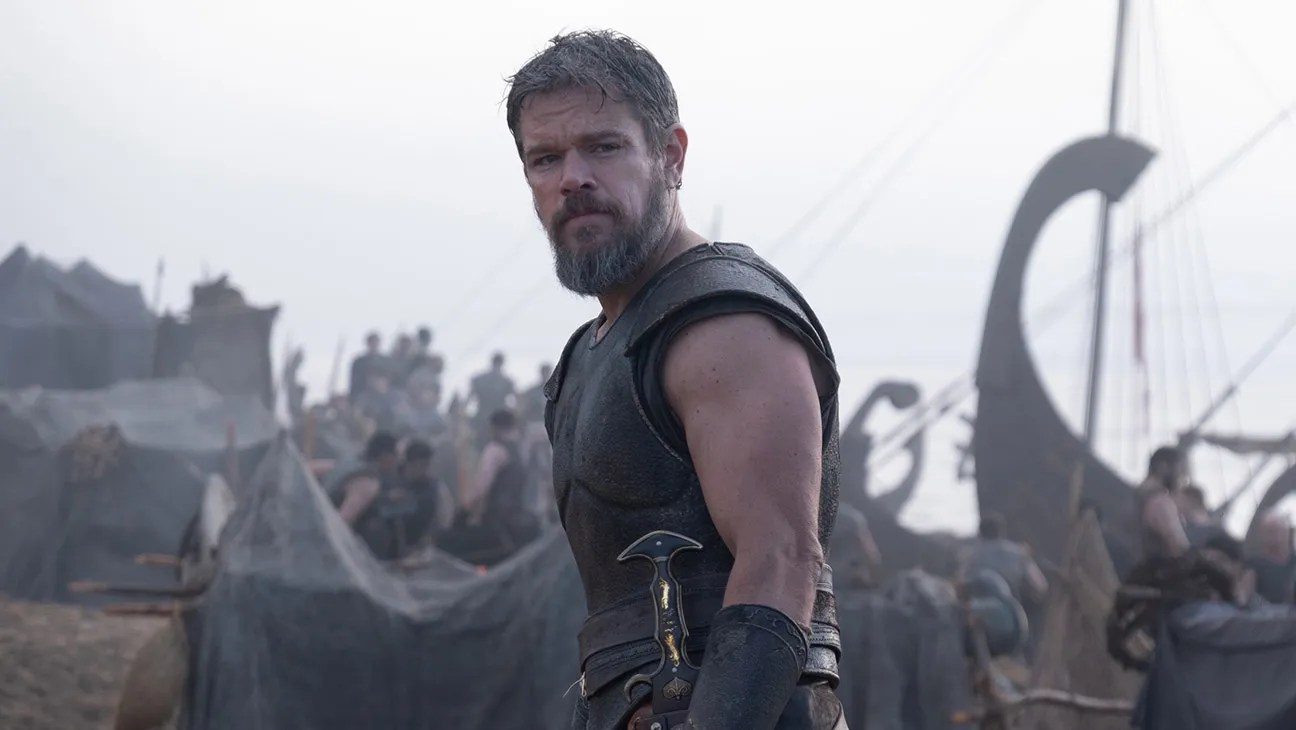
Director Nolan is one of the rare filmmakers who, in my opinion, has never made a bad film. From “Memento” to the “Dark Knight” trilogy to the Oscar-winning “Oppenheimer,” he has proven himself a true master of cinema. “The Odyssey” only adds to that distinguished resume’
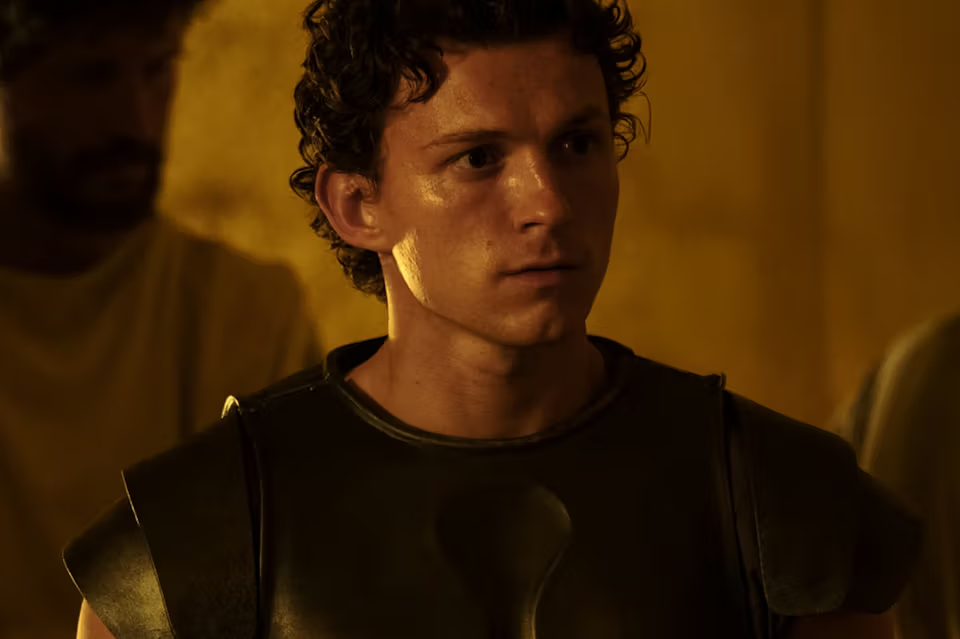
The cast is a tribute to Nolan himself who, like Woody Allen, can pretty much get anyone he wants for his films because, as an actor, why wouldn’t you want a credit in one of his films. Besides the three stars named above, the cast includes Robert Pattinson, John Leguizamo, Zendaya, James Remar, Jon Bernthal, Oscar nominees Samantha Morton and Elliot Page as well as Oscar winners Charlize Theron and Lupita Nyongo. As MGM used to advertise, “more stars than there are in heaven.”
The script and story are pretty faithful to the source material, though for some reason it bothered me whenever Telemacus referred to Odysseus as “dad.” Never father. The weird things you notice. Visual.y the film is stunning and the Trojan Horse and battle of Troy are worth the price of admission alone. I will add that I did see the film in 70 mm and, if that format is playing in your town, I urge you to see it in that format.
On a scale of zero to five, “The Odyssey” receives ★★★★ ½
Movie Reviews
Saari Review: Memory, Betrayal and Identity Converge at River Valley Film Festival – Hollywood Times


Premiering at the 2026 River Valley Film Festival, Saari uses fragmented memories, Finnish landscapes and restrained performances to explore betrayal, identity and reconciliation.
By Valerie Milano
Palm Springs, CA (The Hollywood Times) 7/14/26 – In the visually striking short film Saari—Finnish for “island”, a peaceful family retreat becomes the setting for the slow collapse of a relationship.
Co-written by Justin Seegmueller, Corey L’Esperance and Suvi Härkönen, the film follows Daniel, played by Seegmueller, as he reflects on the choices that damaged his relationship with Liina, portrayed by Ilona Karppanen. Told through fragments of the past, present and future, Saari gradually reveals how secrecy and betrayal can transform a place of safety into one of emotional confinement.
The nonlinear structure was not simply a stylistic choice. The project was developed and filmed over more than a decade, with footage captured in Finland, Boston and the desert. L’Esperance explained that the filmmakers divided the story into “past, present and future,” allowing audiences to experience the relationship from both characters’ perspectives.
Click below for our exclusive interview:
He described Daniel and Liina as two people who are “stuck in these moments in time,” making the fragmented narrative especially appropriate.
Seegmueller said Daniel’s internal struggle is rooted in the questions, “Am I that person? Am I still that person?” His restrained performance captures a man attempting to reconcile his current identity with the damage caused by earlier decisions.
For Seegmueller, the film is fundamentally about choice.
“It’s all about decision-making,” he said. “Are you an accumulation of all your decisions?”
Finland’s lush island scenery contrasts sharply with Daniel’s later isolation in the barren desert. Seegmueller described the progression as “lush and then dead,” a simple but effective visual representation of a relationship moving from intimacy and possibility to emotional aftermath.
For Liina, the island represents family history, comfort and security. By inviting Daniel there, she welcomes him into her sanctuary. His secrets, however, begin to contaminate that protected space.
“You let me into your life,” Seegmueller explained, “and now I’m here almost ruining your sense of security.”

 Because the couple reaches the island by rowboat, the setting also creates a sense of entrapment as suspicion and resentment begin to surface. L’Esperance noted that once they are there, “there’s not really anywhere you can go.”
The film’s cross-cultural perspective was strengthened by the collaboration between American co-director L’Esperance and Finnish co-director Härkönen. Their responsibilities shifted according to which character dominated a scene. L’Esperance generally led sequences centered on Daniel, while Härkönen took a stronger role when Liina’s experience was at the emotional forefront.
That approach helps prevent Liina from existing only as a reaction to Daniel’s behavior. Her journey eventually becomes more compelling than his guilt.
Karppanen traveled to the United States for the first time to film the Boston scenes, which were completed approximately three years after the original Finland footage. Seegmueller said the friendship they developed during production can be seen in the warmth between their characters during the relationship’s happier moments.
The filmmakers deliberately avoid explaining every detail of Daniel’s betrayal. Earlier edits revealed even less, but test audiences needed additional narrative guidance.
“We do need to have some breadcrumbs,” L’Esperance said, explaining that without them, the story became “a little too lost on the audience.”

 The challenge was to provide enough information while maintaining the film’s quiet, interpretive tone. L’Esperance said they wanted to leave room for viewers to “fill in some of the blanks.”
The lengthy production process also changed how the filmmakers viewed Daniel. L’Esperance acknowledged that they initially saw him as “this hero,” but over time recognized that “he is kind of a bad guy in some of these aspects.”
That evolving perspective gives the film greater moral complexity. Daniel is not granted an easy redemption, and his introspection does not erase the harm he caused.
Karppanen brings strength and emotional restraint to Liina, who emerges from the experience as what L’Esperance called “a completely different person.” A final city scene suggests that she is beginning to reclaim her identity and imagine a future beyond Daniel and the relationship that betrayed her.
Subtle, atmospheric and open to interpretation, Saari asks whether people are defined by their worst decisions, and what reconciliation means when the damage cannot simply be undone.
After more than 10 years of work, the film’s world premiere at the River Valley Film Festival is especially meaningful. Both L’Esperance and Seegmueller attended film school in Philadelphia, making the Pennsylvania premiere a return to the state where their filmmaking journeys began.

 Seegmueller hopes the film encourages audiences to examine their own choices and personal histories.
“What does that say about you?” he asked. “What does that say about your story and your own narrative?”
Saari will have its world premiere at the 2026 River Valley Film Festival. Seegmueller will attend the premiere in person, while members of L’Esperance’s family are expected to represent him at the festival.
-

 Wisconsin4 minutes ago
Wisconsin Lottery Powerball, Pick 3 results for July 15, 2026
-

 West Virginia10 minutes ago
Concerned West Virginians speak out against proposed Monongalia County power plant – WV MetroNews
-

 Wyoming16 minutes ago
July 15 recap: Wyoming news you may have missed today
-

 Crypto22 minutes ago
Luno Pushes South Africa to Rewrite Crypto Rules Through Parliament, Not Proclamation
-

 Finance28 minutes ago
SixCap Healthcare Finance Appoints Carroll as Senior Relationship Manager
-

 Fitness34 minutes ago
Sue Barker, 70, keeps fit with cardio, strength training and NEAT exercise – her lifelong fitness formula
-

 Movie Reviews46 minutes ago
Adam MacDonald’s ‘THIS IS NOT A TEST’ (2026) – Movie Review – PopHorror
-

 World58 minutes ago
Getting Down to Business: 4 Takeaways for Argentina vs. Spain

