News
Man accused in Molotov cocktail attack of OpenAI CEO’s home charged with attempted murder

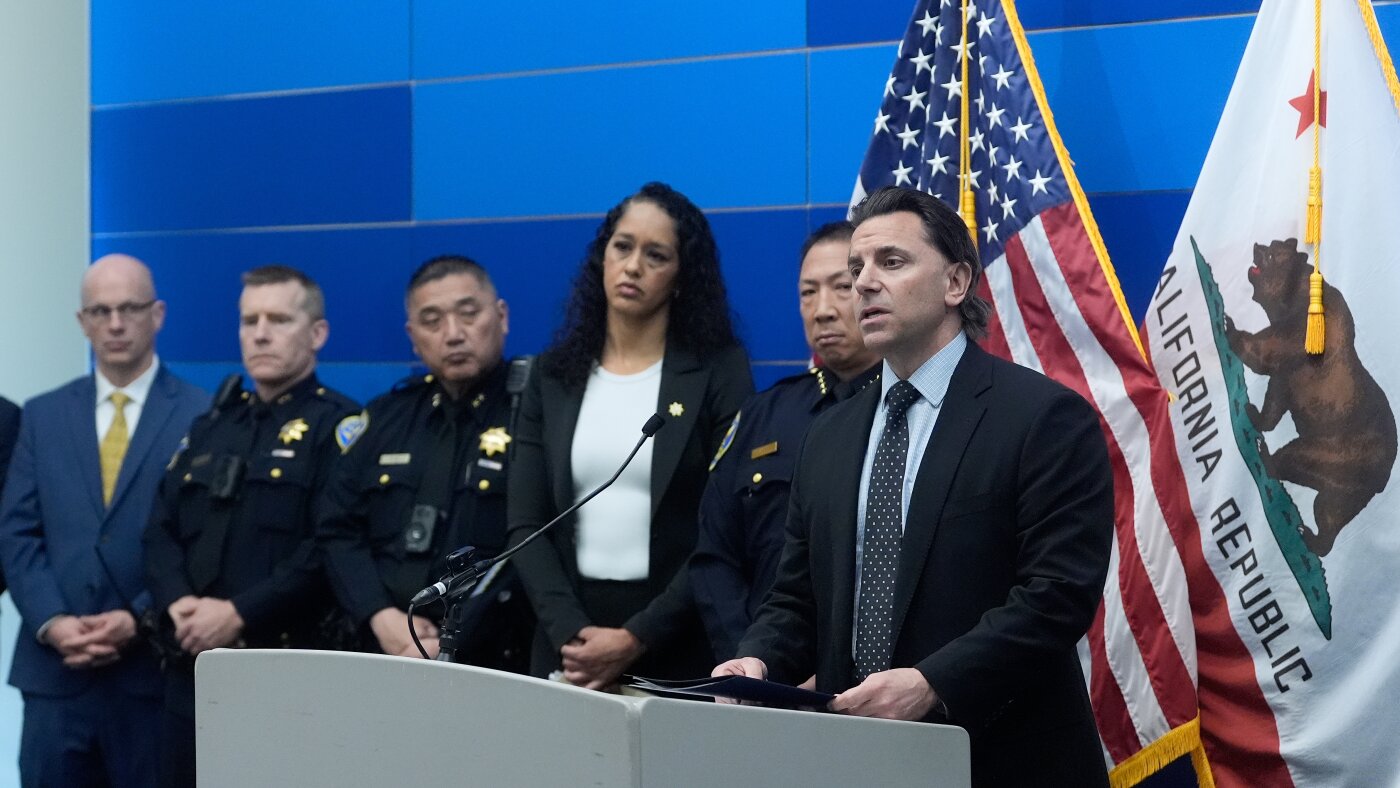
Matt Cobo, F.B.I. San Francisco Acting Special Agent in Charge ( right) speaks next to San Francisco Police Chief Derrick Lew (second from right) and San Francisco District Attorney Brooke Jenkins (third from right) during a news conference Monday, April 13, 2026, in San Francisco.
Jeff Chiu/AP
hide caption
toggle caption
Jeff Chiu/AP
SAN FRANCISCO — The man accused of throwing a Molotov cocktail at OpenAI CEO Sam Altman’s home had written about AI’s purported risk to humanity and traveled from Texas to San Francisco intending to kill Altman, authorities said Monday.
Authorities allege 20-year-old Daniel Moreno-Gama threw the incendiary device about 4 a.m. Friday, setting an exterior gate at Altman’s home alight before fleeing on foot, police said. Less than an hour later, Moreno-Gama allegedly went to OpenAI’s headquarters about 3 miles (4.83 kilometers) away and threatened to burn down the building.
Moreno-Gama is opposed to artificial intelligence, writing about AI’s purported risk to humanity and “our impending extinction,” according to a federal criminal complaint.

“This was not spontaneous. This was planned, targeted and extremely serious,” said FBI San Francisco Acting Special Agent in Charge Matt Cobo during a press conference.
No one was injured at Altman’s home or the company offices, authorities said.
Moreno-Gama faces state and federal charges
Moreno-Gama faces charges including two counts of attempted murder and attempted arson in California state court, San Francisco District Attorney Brooke Jenkins. He tried to kill both Altman and a security guard at Altman’s residence, she alleged. He is set to appear in court Tuesday, and online state court records do not yet show if he has an attorney.
Jenkins said the state charges carry penalties ranging from 19 years to life in prison.
On Monday morning, FBI agents went to Moreno-Gama’s home in Spring, Texas, a suburb of Houston, where they spent several hours before leaving. He has been charged by federal prosecutors with possession of an unregistered firearm and damage and destruction of property by means of explosives. Those charges carry respective penalties of up to 10 years and 20 years in prison.
The federal court documents do not list an attorney for Moreno-Gama, and he has not yet had his first appearance in federal court.
Authorities allege Moreno-Gama traveled from his home in Texas to San Francisco and visited Altman’s home early Friday morning.
Authorities say Moreno-Gama was opposed to artificial intelligence
When Moreno-Gama was arrested Friday, officials found a document on him in which he “identified views opposed to Artificial Intelligence (AI) and the executives of various AI companies,” court documents say. The document discussed AI’s purported risk to humanity and “our impending extinction,” according to the criminal complaint.
Surveillance video images included in the criminal complaint show a person dressed in a dark hoodie and pants that the FBI alleges is Moreno-Gama approaching the driveway of Altman’s home. In various images, the person can be seen tossing the Molotov cocktail, which landed at the top of a metal gate and started a small fire.
Surveillance video images from outside OpenAI’s headquarters allegedly show Moreno-Gama grabbing a chair and using it to hit a set of glass doors. Authorities said Moreno-Gama was approached by the building’s security personnel, who told investigators he “stated in sum and substance” that he came to the headquarters “to burn it down and kill anyone inside,” according to the complaint.
San Francisco police arrested Moreno-Gama and recovered “incendiary devices, a jug of kerosene, a blue lighter, and a document.” Moreno-Gama was being held Monday in the San Francisco County Jail on the state charges, and was expected to appear in court on Tuesday.
U.S. Attorney Craig Missakian said authorities “will treat this as an act of domestic terrorism, and together with our partners, prosecute him to the fullest extent of the law.”
Authorities say Moreno-Gama’s anti-AI document contained threats against Altman
The document in which Moreno-Gama discussed his opposition to AI also made threats against Altman, officials said.
“Also if I am going to advocate for others to kill and commit crimes, then I must lead by example and show that I am fully sincere in my message,” Moreno-Gama is alleged by authorities to have written in the document.
Advocacy groups that have issued grave warnings about AI’s risks to society condemned the violence.
Anthony Aguirre, president and CEO of the Future of Life Institute, said in a written statement Friday that “violence and intimidation of any kind have no place in the conversation about the future of AI.”

Another group, PauseAI, said in a statement that the suspect had no role in the group but joined its forum on the social media platform Discord about two years ago and posted about 34 messages there, none containing explicit calls to violence but one that was flagged as “ambiguous.”
Discord said Monday that it has banned Moreno-Gama for “off-platform behavior.”
Altman addressed the threats in a blog post
Hours after the attack on his house, Altman posted a photo of his husband and their toddler in a blog post addressing the threats against him.
“Normally we try to be pretty private, but in this case I am sharing a photo in the hopes that it might dissuade the next person from throwing a Molotov cocktail at our house, no matter what they think about me,” Altman wrote.
He added that “fear and anxiety about AI is justified” but it was important to “de-escalate the rhetoric and tactics and try to have fewer explosions in fewer homes, figuratively and literally.”
Altman has become a preeminent voice in Silicon Valley on the promise and potential dangers of artificial intelligence. The attack comes days after The New Yorker published an in-depth investigation that touched on concerns some people have about him and the company.
Debate about the impact of AI is growing
The attack came at a time of growing debate about the societal effects of AI assistants like OpenAI’s ChatGPT that millions of people are turning to for information, advice, writing help and to do work on their behalf.
An annual report published Monday by Stanford University called the AI index found that most people believe AI’s benefits outweigh its drawbacks, “but nervousness is growing and trust in institutions to manage the technology remains uneven.”


Rep. Julia Letlow won the Republican primary runoff for Senate in Louisiana, NBC News projects, defeating state Treasurer John Fleming in another victory for President Donald Trump’s slate of preferred candidates.
Trump endorsed Letlow early in the race, which went to a runoff after none of the GOP candidates won a majority of the initial primary vote on May 16. Trump waded into the state in an effort to oust GOP Sen. Bill Cassidy, who voted to convict Trump on impeachment charges following the Jan. 6, 2021, Capitol riot.
See live runoff results here
Letlow was the top vote-getter in the first-round primary, winning 45%, followed by Fleming at 28%. Cassidy won just 25% and did not qualify for the runoff.
Letlow will be in a strong position to win in November in the solidly Republican state, which Trump carried by 22 points in 2024. Democrat Jamie Davis, a farmer, easily won the Democratic Senate nomination Saturday night.
Letlow has pledged to be a strong supporter of the president’s policies.
“I promise you this: When I get to the United States Senate, I will never back down from fighting for your America First agenda,” Letlow told the president during a telerally with Trump on Thursday night.
Letlow framed the race as the choice between “a real conservative fighter in the Senate, or whether we are going to send another career politician who does not want to save our country.” She touted her support for eliminating the Senate filibuster to help pass the Save America Act, a Trump-backed measure to overhaul U.S. election laws.
Fleming also tried to make the case that he was the staunchest Trump ally in the race, taking aim at Letlow’s past support for diversity, equity and inclusion policies and foreign aid. Letlow told NBC News earlier this year that she reversed her position on DEI when she “saw it for what it was” and has since been “fighting against it.”
But Trump’s backing helped boost Letlow, who also had help on the airwaves from allied super PAC.
She also touted endorsements from other top Louisiana Republicans, led by Gov. Jeff Landry. House Majority Leader Steve Scalise and Rep. Clay Higgins also backed Letlow.
Letlow is expected to join the Senate after serving nearly three terms in the House, where she also served on the powerful Appropriations Committee. She first came to Congress in 2021 after winning a special election following the death of her late husband. Luke Letlow, a former congressional aide who won a House election in 2020, died of Covid before he was sworn into office.
News
As Supreme Court expands Trump’s immigration power, experts warn of steeper U.S. population decline

President Trump holds up a bill funding immigration enforcement after signing it in the Oval Office of the White House, Wednesday, June 10, 2026, in Washington.
Julia Demaree Nikhinson/AP
hide caption
toggle caption
Julia Demaree Nikhinson/AP
Even before the Supreme Court ruled Thursday that President Trump has broad power to deport hundreds of thousands of migrants living legally in the U.S. under temporary protected status, David Bier feared the U.S. was slipping toward a demographic cliff.
“We’re destined to be there, in short order, there’s no question,” Bier said. “We’re already seeing a situation where most counties in the United States had more deaths than births.”
An expert on population and immigration at the libertarian Cato Institute, Bier believes the U.S. is beginning to look more like China, Italy and South Korea — nations that face rapid aging and population decline are seen as a crisis.

U.S. birthrates have been declining for decades. There are far too few children born each year to maintain a stable population.
Until last year, high rates of foreign immigration largely offset that trend. But for the first time since the 1930s, during the Great Depression, the U.S. now faces record low birthrates and low numbers of migrants at the same time.
“Our higher birthrates of a century ago are not coming back. There’s no way to have a sustainable fiscal and economic situation that doesn’t involve immigration,” Bier said.
Trump’s legal fight to end temporary protected status for hundreds of thousands of Haitians, Syrians and others living in the U.S. legally is only one part of a wider administration effort to squeeze immigration.
The Supreme Court also ruled this week that the administration has authority to block most asylum seekers from entering the country. Federal agents have also conducted raids in cities across the U.S., to accelerate deportations.
Last month, Trump issued an executive order that could make it harder for many migrants living in the U.S. without full legal status to use banking and financial services.
Many immigration opponents see these changes as progress. In a statement following this week’s Supreme Court decisions. A spokesman for the Federation for Immigration Reform said Trump should have full authority to direct who enters the U.S.
“Our immigration laws are written to be pro-enforcement, not anti-enforcement,” said FAIR’s Christopher Hajec.
But according to Cato’s Bier, Trump’s policies are already reshaping the demographics of communities, meaning there are fewer workers, consumers, taxpayers, and children in schools.
“If you’re not allowing immigration, you’re going to have [an aging and] a declining population and that creates all kinds of problems,” Bier said.
Economists say that without migrants, the number of young workers paying into Social Security will fall more rapidly; schools in many areas will close; and the number of young families having children will decline.
Census data already shows big changes to U.S. population
The immigration decline under Trump is dramatic. In 2024, roughly 2.7 million foreign migrants entered the U.S., according to the Census Bureau. This year, census experts predict that number could drop as low as 300,000. Some demographers believe the U.S. may be reaching a point where more migrants are leaving than entering.

Impacts of this massive shift on America’s wider population are already emerging. Studies by the Census Bureau, the Congressional Budget Office, and the Federal Reserve all point to a more rapidly aging national population under Trump.
Population growth in the U.S. fell by half in 2025 from the previous year, with five states losing population. Census data shows the total number of young Americans, those under age 25, is already falling nationwide.
William Frey, a demographer at the liberal-leaning Brookings Institution, described last week’s Supreme Court rulings as “alarming.” He believes without robust foreign immigration, more states will quickly see their populations stagnate or decline.
“Not just in big immigration states, but in places that have relatively small numbers of immigrants, you know, Iowa, Kansas, Nebraska — those states require immigrants to get any population growth,” Frey said.
Even before Trump’s policies curbed immigration, the U.S. population was expected to decline later this century. Experts say low immigration rates will cause that downward trend to happen much sooner.
According to Frey, the U.S. has time to reverse course. But he believes the Trump administration is committed to lowering both legal and illegal immigration over the long term, a policy he described as dangerous.
“This is as clear as the nose on your face,” he said. “You’ve got to have this growth in the younger population if you’re going to survive. Immigration is a key part of that going forward.”
“America’s doors are closed”

Stephen Miller, White House deputy chief of staff for policy, speaks with reports at the White House, Thursday, June 25, 2026, in Washington.
Jacquelyn Martin/AP
hide caption
toggle caption
Jacquelyn Martin/AP
The Trump administration sees this very differently, describing foreign migrants not as people who sustain state populations and economies, but as a social burden and a threat.
“America’s doors are closed fully to asylum seekers,” Stephen Miller, one of Trump’s top White House policy advisors, said on Thursday.
Speaking with reporters, Miller described the Supreme Court rulings as a victory and said ending birthright citizenship for the children of migrants born in the U.S. is the next step.
“This country doesn’t have a future if we don’t end birthright citizenship,” Miller said. Justices are expected to rule on birthright citizenship as early as next week.
This kind of opposition to both legal and illegal immigration is now widespread among conservatives, said Cato’s David Bier, who worked as a Republican congressional staffer on immigration policy.
He told NPR that when he talks to conservatives about the economic and demographic risks of closing the country’s doors to migrants, many answer with a cultural argument. “[They] would rather have a declining population of ‘true Americans’ than have an economy kept afloat by people who don’t share [their] values,” Bier said.
But if extremely low or zero-level immigration does become the new normal for the U.S., experts say it would swiftly remake the fabric of the country. The Census Bureau estimates that without robust migration in the coming years, total population loss by the end of this century could exceed 107 million people.

UTAH COUNTY, Utah (ABC4) — Utah County has declared a state of emergency.
According to an announcement from the Utah County Commissioner Skyler Beltran, the county is in a dire position due to the extensive wildfires in the area and high fire risk.
The announcement states that declaring the State of Emergency will allow the county to access additional resources, and notes there is no imminent threat to Utah County residents.
“We have utilized a tremendous amount of our resources (very early in the traditional fire season schedule) responding to the Iron Fire and continue to face ongoing recovery concerns,” the statement read. “This was even before the Maple Peak and Cherry fires, which have now merged and are moving toward the Iron Fire.”
The Iron Fire, which started last week, has burned over 40,000 acres. Around 22,830 of those acres were in Utah County. Reportedly, the county has limited resources available to help those who are evacuating from Juab County, including the 600 residents in the Town of Eureka.
Due to the influx in evacuees, the Utah County Commission says that more resources are necessary to help the evacuation shelters in Elberta, Utah. Additionally, due to the Iron Fire and other wildfires, Utah County is facing immense repair needs to avoid future flooding, loss of homes, and disruption to local economies and ecosystems.
There is “imminent threat” to public safety due to the damage.
The commission also asks the public to be vigilant when handling heavy equipment, using campfires or barbecues, and discharging fireworks, to avoid preventing fires.
Their statement added, “Our firefighters are exhausted, our resources are stretched thin and we are in a very vulnerable position.”
-
 Sports2 minutes ago
Kyle Tucker and Dalton Rushing rebound with consecutive homers, Dodgers rout Padres
-

 World14 minutes ago
Serbian Vučić says he will resign in weeks and calls early elections
-

 News37 minutes ago
Trump-backed Rep. Julia Letlow wins Louisiana Senate primary runoff
-

 New York2 hours ago
Metropolitan Diary Challenge Day 1: What Is Your N.Y. Story?
-

 Los Angeles, Ca2 hours ago
LASD releases video of man shot by deputy after allegedly charging them with knife
-

 Detroit, MI2 hours ago
Rick Mahorn returns to coaching Detroit basketball with BIG3 Amps
-

 San Francisco, CA2 hours ago
Suspect arrested after shooting near San Francisco Pride events, police say
-

 Dallas, TX3 hours ago
Dallas shooting injures 2 as police search for suspect

