Lifestyle
In a new monument for South-Central, Lauren Halsey cements her loved ones as landmarks

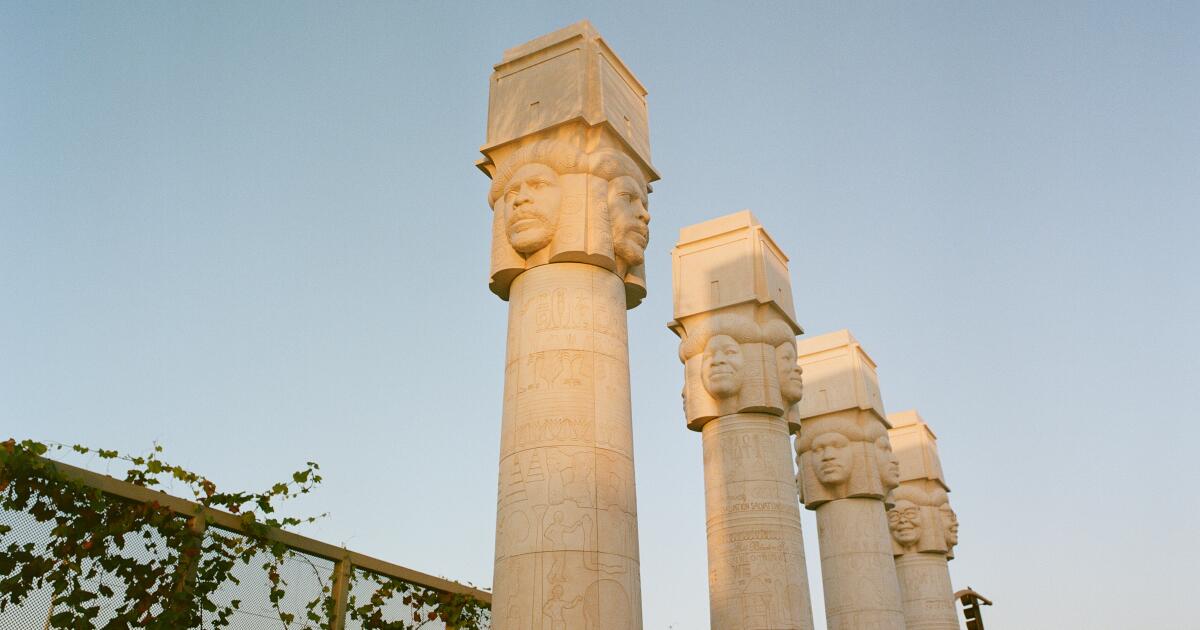
Someone said heaven is on the corner of 76th and Western.
It’s nearly 90 degrees on a Saturday in South-Central and “sister dreamer lauren halsey’s architectural ode to tha surge n splurge of south central los angeles” is gleaming and activated.
Thousands of people fill the streets that surround it in lit, ecstatic union. Parliament-Funkadelic is playing a live show onstage while we stomp the pavement in faithful entrancement. The line forming for fittingly swaggy merch becomes a site for sweet reunions unfolding one after another — some version of “this is crazy, this is amazing, this is L.A.” being thrown back and forth on a loop. On the sidewalk, generations play spades in the shade and the joyful screams of children emanate from a custom bouncy house adorned with an Egyptian pharaoh bust. Across the way, skateboarders do their thing on the Neighbors Skate Shop ramp, flipping and flexing, making sculptures out of their bodies in midair, while others double-dutch or Hula-Hoop in exacting harmony.
This block party — multigenerational, multivibrational — is in celebration of the sand-colored sanctuary and sculpture park that is “sister dreamer,” a direct expression of its spirit and purpose.

From left to right: Andre “Sketch” Hampton, Emmanuel Carter, Lauren Halsey and Kenneth Blackmon.
Artist Lauren Halsey has been dreaming and scheming on this sculpture park for 17 years. (She has the Photobucket receipts to prove it.) The paper trail follows from her third semester studying architecture at El Camino College, when she used to take long bus rides down Western and project her ideas onto empty lots, cutting them together in Photoshop — part-planning, part-manifestation. Variations of these ideas have appeared at the Studio Museum in Harlem, the now-iconic Crenshaw District Hieroglyph Project at the Hammer, the rooftop at the Met and the Venice Biennale. But “sister dreamer” has always been the goal — a way to go beyond only representing or depicting her community and giving back to it in a tangible way.
The location of “sister dreamer” is specific and important — for one, it’s the former site of neighborhood ice cream staple Gwen’s Double Dip, a history honored at the block party through a pop-up parlor created by Halsey’s studio. But it’s also because Halsey grew up around the way and can trace her family history back more than 100 years to this place. She comes from a long line of people who have served their community and taught Halsey to do the same. “sister dreamer” is the culmination. Both a once-in-a-lifetime artwork and a free, public venue where every day, from dawn till dusk, people can live and imagine.
“From the beginning, the conceit was to summon all the types of experiences of Blackness in one place, the project being a vessel or container for all of that expression,” Halsey says. “If I could create spaces that democratize Blackness because they’re gorgeous, they’re inclusive, they pay homage to all of us, that’s just a cool type of unity I want to see. And if I could do that through funk as the language, it would also be fun and playful and attract the energies I’m looking for.”

“From the beginning, the conceit was to summon all the types of experiences of Blackness in one place,” artist Lauren Halsey says about “sister dreamer.”
To see L.A.’s newest architectural monument in effect is to experience people being celebrated. This public artwork and its function — as in, this party and the space’s purpose — feels like a mirror, a temple to self, a shrine to funk, a dedication and invitation to experience what is still so divine and aspirational about the present moment. Writer Douglas Kearney illuminates it strikingly in the curatorial statement etched into a back wall in “sister dreamer”: “… it’s the sacred phenomenon of luxe space that remembers without memorializing, celebrates without eulogizing. An anti-tomb.”
Life in its most beautiful forms — the poetic, artistic range of Black life in South-Central — is on display everywhere you look here.
Standing in the open-air cube that is the oculus of “sister dreamer,” most people have their gaze pointed up, seeing — what else? — themselves. The entire space is dripping in the dense Black L.A.-meets-Egyptology that has become Halsey’s signature. People run their fingers over carved reliefs telling the rich story of a neighborhood, culture and creed, reflecting the folk art that has existed in South-Central since forever. The hand-painted signage and hood graphics are familiar, the mantras and spiritual emblems — “Be Ye Who Ye Is,” a spiral of cornrows wreathed on the back of a head, the comma-curve of an XL nail — are personal. Known legends stare back at us — hi, Sika — and others are finally given agency, including the Black women who were killed at the hands of the Grim Sleeper in the 1980s, their faces framing the entrance of the oculus like guardian angels.
“Lauren Halsey in her work brilliantly represents the range of contributions, resistance and resilience by our communities including the collective work I have been part of demanding payment for all caregiving work, and working for justice, dignity and visibility for the scores of Black women who were victims of serial murders in South L.A. and who were marginalized dehumanized and treated as throwaway women,” says Margaret Prescod, founder of the Black Coalition Fighting Back Serial Murders.
These carved reliefs span dimensions of the Black L.A. experience — there’s so much joy, there’s this overdue reverence too; another, fuller frame. All of this is a result of Halsey’s obsession with the way her community speaks to each other through visual language. There are five infinity fountains, also clad in carvings, punctuating the space while fragrant native plants perfume the warm, dry L.A. air, identified by information cards written in Halsey’s recognizable script. L.A.-based Current Interests served as the project architect, while Phil Davis came in as the landscape designer.
There are eight Hathoric columns and eight sphinxes in “sister dreamer” that honor local heroes, community workers and Halsey’s friends and family. “I love this sort of ceremonial procession as you walk through the sphinxes and columns — these figures who have created safe space for me, literally, conceptually, spiritually,” Halsey says. DaVinci, Bopbop, Barrington, Damien, Janine, Margaret, Susan and Rosie stand 22 feet tall, kissing the sky. While Dominic, Aujunae, Bobby, Monique, Glenda, Robin, Londyn and Antoinette ground us, warm expressions on long sphinx bodies, serving as ultimate anchors.


Michael Towler and Dominique Moody.


“Seeing it in person, yeah, that was different. Compared to the work you’re doing in community, boots on the ground, and then actually seeing your picture, or you know — your face — on something like that, it is something you’ll never imagine,” says Robin Daniels, co-founder of Sisters of Watts, who is depicted as one of the sphinxes in “sister dreamer.”
First debuted in “the eastside of south central los angeles hieroglyph prototype architecture (i)” as part of New York’s skyline, this marks a homecoming for the columns and sphinxes. L.A.’s sons and daughters, mothers and grandmothers, uncles and aunties, leaders and stewards, artists and musicians, holding court on native soil. These are people, Halsey says, “who have summoned a love and care that I’ve admired, both on a micro and macro level.” Those depicted include Halsey’s mother, whom she wanted to put on a physical pedestal for her family, for the neighborhood, for the public “to see her in the light that I experience her in every day,” she says. There’s her little brother, whom she describes as “my BFF … love incarnate,” and her now-teenage cousins, who were kids when Halsey was doing mock-ups in their grandmother’s backyard. “I’m [having] difficulty expressing the words because I’m overwhelmed with emotion. This is not easy work,” says another cousin Damien Goodmon, one of the columns and CEO of Downtown Crenshaw Rising/Liberty Ecosystem. “People see the glamour and all the awards, but it’s hard, and I can only imagine how difficult it is for her to carry this as a person who’s not necessarily always that public. She’s been trying to do this for years — lifting up that tremendous history.”
In creating a new monument for her city, Halsey has made her loved ones landmarks in L.A.’s architectural legacy — cementing them as giants in its rich universe. “When I saw my face I was shocked,” says Rosie Lee Hooks, director of the Watts Towers Arts Center Campus. “It was so personal and me! I am not used to seeing myself so clearly. Lauren is a carrier of the culture. She is a storyteller, a griot. A documentarian, an architect, a dream-catcher. Keeper of our community and world culture. She honors all those who came before her, are here now and those to come. Right on with the right on.”
An opening block party like this one — “the block party of the year,” as one or 100 attendees put it — feels like the only appropriate way to mark the realization of a vision this singular and interconnected. And it’s a living, breathing reminder of a tenant that’s been a part of Halsey’s work from the jump: An architectural monument only becomes truly meaningful when people can see a space for themselves there. Architecture, at its best, is people. “Seeing yourself at that scale makes you feel many ways,” says Barrington Darius, an artist and one of Halsey’s collaborators depicted on a column. “Seen, respected and larger than life.” The party is also a slice of what “sister dreamer” will be home to every day: music, funk, fashion, art, games and space. (The three pillars of Halsey’s nonprofit Summaeverythang Community Center — art, education and wellness — will officially inform the space’s programming, including things like museum visits, film screenings, Kemetic yoga and more.)

From left to right: Cheryl Ward, Kenneth Blackmon, Monique McWilliams, Rosie Lee Hooks, Michael Towler, Dominique Moody, Andre “Sketch” Hampton, Monique Hatter, Christopher Blunt, Robin Daniels, Margaret Prescod, Barrington Darius, Damien Goodmon, Londyn Garrison, Dyani Luckey, Autumn Luckey, Lauren Halsey, Emmanuel Carter.

From left to right: Cheryl Ward, Kenneth Blackmon, Monique McWilliams.
“When I first saw myself as a sculpture in the work, I thought about representation — how it matters and what that image will sow into the fabric of our youth.”
— Monique McWilliams, partner


Autumn Luckey, Emmanuel Carter, Christopher Blunt.
It’s extra in all the best ways. Hosted by Watts Homie Quan, performers like Roc’co Tha Clown, and Divas and Drummers of Compton keep the energy high near the DJ booth. At one point the sound of a preschooler’s voice singing “This Little Light of Mine” belts through the streets. “Let it shine, let it shine, let it shiiiiiiine.” Throughout the day, people can’t seem to stop reaching for means of documentation — their camcorder, digicam, phone, at one point even a palm-size notebook where a young artist from the neighborhood was sketching one of the sphinxes. The desire, or compulsion, to document this moment seems to come from a shared understanding that the opening of “sister dreamer,” all of us here together, is a historic event.
Back in the park, I sit for a while and watch, thinking about how this couldn’t feel more different from a gallery opening. People breathe with the art, they touch it, they feel it, they laugh with it. Goddesses on roller skates glide in buttery figure eights across the glass-fiber-reinforced concrete. Wait, is that Usher dancing with Tiffany Haddish in front of the oculus? Of course it is. Jane Fonda too. Oh, and there’s Kamasi Washington, Maxine Waters, Charles Gaines and Erykah Badu.
An older Black woman saunters down Western, low and slow, holding a watermelon and mango cup in one hand and her cane in the other. She wears a matching Kelly green set and a bedazzled baseball hat that reads, “Relax, God is in control.” Fly, of course, and yet another example of the brilliance and style of Black people on display today, but it also conjures something Halsey said weeks before the “sister dreamer” opening. “People don’t talk about God a lot, but I’m just so grateful that God gave me the endurance to continue and push through despite whatever,” Halsey says. “It’s just a testimony to the power of prayer and ancestors and work ethic and alignment. So, I’m just so tired, but it’s so worth it.”
In line for the merch booth, sweat drips down our backs. Even in the heat, multiple people walk by wearing the “sister dreamer” X Supervsn collab from head to toe or have already pulled on their “sister dreamer” X Come Tees longsleeves they picked up from the shop, its signage reading: “Treat yaself don’t cheat yaself!” An hour passes, but we’re all determined to take a piece of this day home — more than a memento, but proof that we were a part of it. It is that serious.
“I want to see the art last,” a musician standing behind me tells their companion.
“Is it the dessert?” the companion asks in response.
“It’s just the last thing I want to think about. The last thing I want to linger on.”


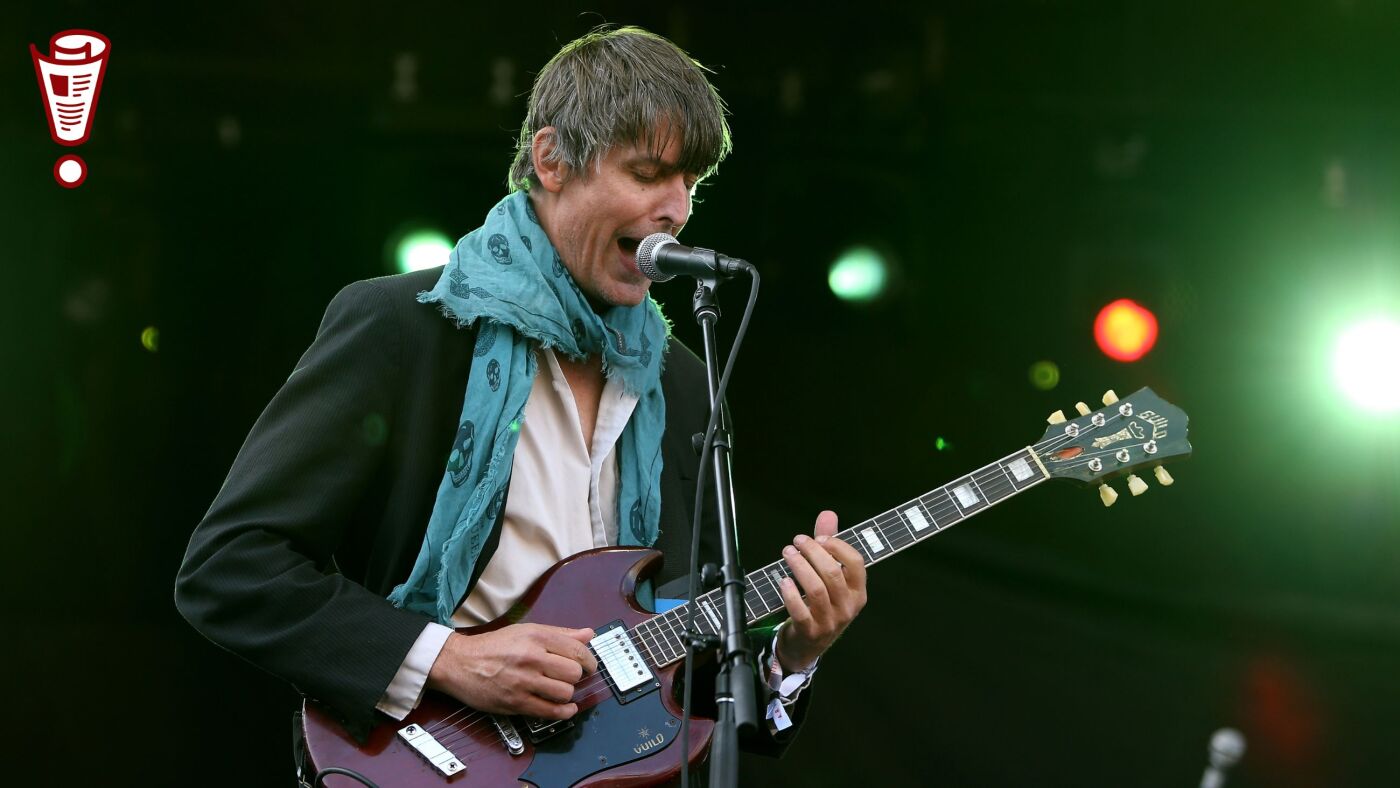
Stephen Malkmus & the Jicks perform onstage during day two of the Boston Calling Music Festival at Boston City Hall Plaza on September 26, 2015 in Boston, Massachusetts. (Photo by Mike Lawrie/Getty Images)
Mike Lawrie/Getty Images
hide caption
toggle caption
Mike Lawrie/Getty Images
This week’s show was recorded in Chicago with host Peter Sagal, judge and scorekeeper Alzo Slade, Not My Job guest Stephen Malkmus and panelists Emmy Blotnick, Joyelle Nicole Johnson, and Gianmarco Soresi. Click the audio link above to hear the whole show.
Who’s Alzo This Time
Pool Problems; Don’t Forget to Hydrate; The Rise of Hot Podium Guy
Panel Questions
TSA Gets A Dressing Down
Bluff The Listener
Our panelists tell three stories about game shows in the news, only one of which is true.
Not My Job: Stephen Malmus, lead singer and guitarist for Pavement, answers our questions about road construction
Indie rock legend and founder of Pavement, Stephen Malkmus, joins us to play a game called, “Pavement repairs are underway!” Three questions about road construction.
Panel Questions
The Battle Over A Home Sale; The Best Three Words To Get Over A Loss and Out of a Meeting?; A New Job in the Dating World
Limericks
Alzo Slade reads three news-related limericks: Good News For Gym Slobs; Cruisin’ For A Tattooin’; Fringe Food Benefits
Lightning Fill In The Blank
All the news we couldn’t fit anywhere else
Predictions
Our panelists predict what will find after the reflecting pool is emptied

When Julio Miranda-Martin began his apartment search, he had one nonnegotiable: He wanted a dedicated dining room to entertain his friends. He was scouring Zillow in 2025 when a listing for a railroad-style, one-bedroom on the edge of West Hollywood came up that included the requisite dining room. It was also walking distance to his part-time job as a marketing coordinator at furniture store Lawson-Fenning. More importantly, at $2,500 a month it was within his budget.
-
Share via
Miranda-Martin met with his landlord the same day he found the listing, who told him he looks like his son. Feeling like finding this 950-square-foot apartment was kismet, Miranda-Martin signed the lease and set about creating a sophisticated and color-saturated sanctuary. Miranda-Martin decided he needed to make two major investments before moving in: painting the walls and changing the lighting. “I was finally able to move into a place that I actually like, not just out of necessity. I was like, let’s make it feel like my own,” says Miranda-Martin, who refers to the space as his “living canvas.”

In this series, we spotlight L.A. rentals with style. From perfect gallery walls to temporary decor hacks, these renters get creative, even in small spaces. And Angelenos need the inspiration: Most are renters.
The apartment is on the second floor of a fourplex, up a windowless staircase. Miranda-Martin embraced the lack of light and painted it a high-gloss crimson. Without natural light, he hard-wired sconces found on Facebook Marketplace that recall ornamental 18th century candlesticks. They cast a dim but moody light throughout the staircase, ending with an ornate mirror at the top. The mirror shows a glimpse of the apartment’s interior in its reflection when Miranda-Martin opens the door. “Every time people walk in, especially at night, it’s such a dramatic entry,” he explains. “It’s very cinematic,” agrees friend and co-worker Kristin Reeder, who is often a guest at his soirees, “like something from ‘Eyes Wide Shut.’ ”
1

2

3

1. Julio Miranda-Martin’s apartment decor starts in the bold staircase that leads to his door. 2. A mirror at the top of the staircase offers extra depth. 3. Julio Miranda-Martin fills the bookshelf in his dining room with books and treasures.
In contrast, the living room offers a calmer palette of sky blues and earthy browns. Miranda-Martin tends to choose paint colors based on the light. The living room, with abundant west-facing windows brings in soft, bright light. Miranda-Martin painted it with Benjamin Moore’s Navajo, a flat white, as a backdrop to the softer hues of the furniture he designed at his furniture and lighting company, Studio MM. “It adds a stillness,” he says.
The room is anchored by a large velvet couch in a rich brown. The modular couch is anchored on each side with Art-Deco influenced side tables, lamps and light blue slipper chairs he designed, setting up a cozy tableau for hosting his friends. Pale pink cushioned ottomans provide additional seating that can easily be moved around the room to accommodate additional guests.

A velvet couch acts as a statement piece in the apartment living room.
(Etienne Laurent/For the Times)
French doors separate the living room from the dining room. The chartreuse-infused dining room returns to a more dramatic colorway. With less natural light, Miranda-Martin wanted to play up the idea of dining-room-as-treehouse, reflecting the second-floor foliage visible from the small windows. Rather than trying to brighten the room, he leaned into the moodiness by buying inexpensive, USB battery-powered spotlights that are mounted on the ceiling with magnets. Taking an alcohol marker, he tinted the lights a soft amber, allowing him to highlight the art in the room without adding harsh overhead lighting.

The dining room is meant to reflect the foliage just outside the window.
(Etienne Laurent/For the Times)
A shell-adorned mirror anchors the wall facing the windows and built-in shelving, making the room feel larger. Miranda-Martin sourced two shell-shaped sconces that flank the mirror at an estate sale in San Francisco. Most of the art and home decor comes from Facebook Marketplace and Craigslist, or is thrifted from local stores. Estate sales are also a source, though Miranda-Martin feels the rising popularity of these sales in Los Angeles has led to an increase in pricing. “They’ve gotten so over the top now in L.A. [They’re] super expensive. You’re not really gonna find a deal,” he laments, citing the armed security checking bags recently at some of the hottest estate sales.
In addition to changing the lighting and painting the walls, Miranda-Martin prioritized the window treatments, with pinch pleat curtains from Ikea. “Drapery can just make a space feel super elevated,” he advises. He prefers a mix of new and vintage decor, balancing both for an eclectic but deeply personal look to his home. He tries not to overthink his aesthetic choices. “I think it’s very instinctual. I’m not really thinking, ‘Is this in good taste or is this going to be weird?,’ ” he says.
Down the hall, the bedroom’s mostly white design theme returns to a more serene composition, providing a quiet sanctuary. Miranda-Martin removed the headboard from his bed, making it seem like it’s floating between the night tables he designed. “Everything feels sort of streamlined and smooth,” says Miranda-Martin. Like the living room, the bedroom is painted the same flat white but the quality of the eastern light filtering into the bedroom casts a buttery glow.
1

2

3

1. Ceramics fill inset shelves in the kitchen. 2. A glass case in the apartment corridor between the dining room and the bedroom. 3. With its lighter decor, the bedroom was meant to be a sanctuary.
The small kitchen retains its midcentury charm, but open shelving above the counter provides an airier, more contemporary cupboard to show off Miranda-Martin’s dish and glassware collection. The easier access comes in handy when he’s entertaining. His apartment is the perfect pre-game space for him and his friends before a night on the town. He tries to make sure he pre-batches cocktails before his guests arrive.
He also likes to host more elaborate dinner parties and game nights. He attributes his love of entertaining to his upbringing as an only child in Downey. “I like hosting because I enjoy being around more people than when I was growing up,” explains Miranda-Martin. His goal, ultimately, is to bring together disparate groups of people from different spheres in a space everyone will feel comfortable in. Dinner parties at Miranda-Martin’s “feel like an event,” says Reeder. “It’s something you’re excited for and you want to get dressed up for.”
“I’m kind of going through a phase right now where I need to be around people,” admits Miranda-Martin. “I think I just hate being alone.”

Ryan Benk and Ryan Ricciardi are married by their friend Cesar Garcia this year.
Christopher Di Ruggiero
hide caption
toggle caption
Christopher Di Ruggiero
Gone is the traditional wedding officiated only by a rabbi, a priest, an imam, a pastor or an archbishop.
In a recent survey by the wedding website The Knot, 67% of couples are getting married by a friend. The share has skyrocketed since 2009, when The Knot started tracking who officiates weddings. That year, 27% of couples used a friend for their ceremony.
“Gen Z culture is really infiltrating the wedding industry, and they just do not do things in a standard, traditional way,” said Esther Lee, The Knot’s editorial director.
“They are scrutinizing every aspect of the wedding day in a sense of ‘How do I make this speak to my story?’” she said.
As people swap traditional vows for more personalized weddings, friends and family are filling many more roles beyond just bridesmaids and groomsmen. The wedding officiant is a really big one.
If you’re asked to perform a wedding for a couple, “take the role seriously,” Lee suggested. “Put a lot of hours and thought into how the ceremony will go.”
An officiant with a close tie to a marrying couple can bring a beautiful intimacy to the ceremony. But Lee warned, “Don’t wing it. You can’t wing it.”
First of all, weddings have a lot of stage directions. And the officiant is in charge of telling everyone in the congregation what to do.
“Part of the proceedings is having everyone be seated at a certain time,” said Shelby Wax, a contributing weddings editor at Vogue. She would know. “I’ve been at a wedding where we have stood up too long because an officiant forgot to say that.”
Wax suggested that officiants keep the proceedings moving without making too many jokes or doing anything to draw attention to themselves and away from the couple.
Ask the couple ahead of time for their vision of the ceremony, and find out some of the special things that draw them together and make them want to commit to marriage. And be sure to find out how long they want the ceremony to last.
You’ll also need to get any necessary credentials for legally officiating a wedding. Some jurisdictions require that wedding officiants be ordained ministers. That can be just a few clicks and is often free. The Universal Life Church ordains ministers online and boasts that it has ordained 20 million people.
“Sometimes you have to register with the state and the county and have all the forms ready to go for them to sign afterwards and mail them afterwards,” Wax said.
If the hassles and the responsibility of planning a ceremony and conducting a wedding are too much, bow out right now. The sooner the better.
But Wax suggested that you consider the invitation carefully. It’s an honor that your loved ones want you to marry them. “You know, if I was asked, I would absolutely make the time to do it,” she said.
Even if weddings have become less traditional, the event is still a joyous milestone and evokes a certain dreaminess in the people who get to witness it.
“I do feel that magic and that hope, similar to a child being born,” said Alisa Allred Mercer, a school board member in Davis County, Utah. She has officiated the weddings of a brother, two nieces, a nephew and many, many others.
If people are willing to give love a try, she said, she is happy to help.
“Each time that I am able to perform a wedding, I think the greatest thing that I’m able to give is to pour out my hope and my faith in their relationship to them,” she said.
Mercer had one final piece of advice: After you pronounce the couple married and tell them to kiss, get out of the picture.
“They do not want you in that photo — they want a photo of the two of them,” she said. “So step out of the way.”
The Knot estimates that more than 2 million couples will get married this year, and we’re not even halfway through wedding season. So if you find yourself sitting at a wedding this summer, maybe offer your silent wishes and prayers not just for the couple, but for the officiant too.
-
 Sports2 minutes ago
Kyle Tucker and Dalton Rushing rebound with consecutive homers, Dodgers rout Padres
-

 World14 minutes ago
Serbian Vučić says he will resign in weeks and calls early elections
-

 News37 minutes ago
Trump-backed Rep. Julia Letlow wins Louisiana Senate primary runoff
-

 New York2 hours ago
Metropolitan Diary Challenge Day 1: What Is Your N.Y. Story?
-

 Los Angeles, Ca2 hours ago
LASD releases video of man shot by deputy after allegedly charging them with knife
-

 Detroit, MI2 hours ago
Rick Mahorn returns to coaching Detroit basketball with BIG3 Amps
-

 San Francisco, CA2 hours ago
Suspect arrested after shooting near San Francisco Pride events, police say
-

 Dallas, TX3 hours ago
Dallas shooting injures 2 as police search for suspect

