



Connect with us

News

The company planning a successor to Concorde makes its first supersonic test

Published

on

The company planning a successor to Concorde makes its first supersonic test

Boom Supersonic’s XB-1 breaks the sound barrier on Jan. 28.

Boom Supersonic


hide caption

toggle caption

Advertisement

Boom Supersonic

A private company aiming to build the first supersonic airliner since the Concorde retired more than two decades ago achieved its first sound-barrier-busting flight over California’s Mojave desert on Tuesday.

Denver-based Boom Supersonic’s XB-1 demonstrator plane, with Chief Test Pilot Tristan “Geppetto” Brandenburg at the controls, hit Mach 1.122, or 750 mph, at an altitude of about 35,000 feet. Brandenburg brought the plane to a successful landing at the end of the approximately 34-minute flight.

Founder and CEO Blake Scholl described the flight as “phenomenal.”

Advertisement

“We’re ready to scale up. We’re ready to build the passenger supersonic jet that will pick up where Concorde left off and ultimately allow the rest of us to fly supersonic,” Scholl said.

The Mach 1 milestone was reached on the 12th test flight of the XB-1. The company says it plans to incorporate what it learns from the XB-1 into a supersonic passenger jet known as Overture that can carry up to 80 passengers. The new passenger plane is designed to maintain a cruising speed of Mach 1.7, or roughly twice as fast as current commercial jet airliners.

According to Boom, United, American and Japan Airlines have all expressed interest in purchasing the Overture. In a statement emailed to NPR, United Airlines said that in 2021, it “reached a conditional, non-binding purchase agreement” with the company to buy 15 of the airliners, with “options for up to an additional 35 aircraft.”

Boom says it expects Overture to be ready for commercial flights by 2030. The plane is expected to be capable of transoceanic flights at altitudes up to 60,000 feet — much higher than conventional jet airlines, “high enough to see the curvature of the earth below,” according to the company. “Flying at supersonic speeds tends to be smoother than subsonic flight because at 60,000 feet, you’re flying above most turbulence,” it says.

Unlike Concorde, which proved uneconomical to operate, Boom says airlines should be able to make a profit selling seats on Overture at fares similar to those for first and business class seats on current commercial airliners.

Advertisement

“The biggest problem with Concorde was it was just simply too expensive to operate,” Scholl said. “So the single most important problem to solve is not to break the sound barrier, but to break the economic barrier.”

Concorde made its first operational flight from London to Washington, D.C., in 1976. Developed jointly by Britain and France, Concorde was operated for nearly three decades by Air France and British Airways.

However, the jet was criticized for its inefficiency. Compared to a Boeing 747, the delta-wing Concorde guzzled four times as much fuel and carried only one-fifth as many passengers — around 100. The plane was also the subject of complaints about noise from its loud turbojet engines and its sonic booms.

Scholl says Concorde had very loud, converted military engines, but Overture will be “dramatically quieter, and that means around an airport, Overture will be no louder than the subsonic airplanes that are flying today.”

In 1996, Concorde set a speed record of just 2 hours, 52 minutes, and 59 seconds between New York and London. In 2000, a Concorde was involved in a fiery crash shortly after takeoff from Paris Charles de Gaulle Airport that killed all 100 passengers and nine crew aboard France Air Flight 4590. The supersonic planes were grounded but eventually returned to service. Always a money-loser, the Concorde was eventually retired in 2003.

Advertisement

News

Trump fires last members of election commission, inciting fears of midterm ‘chaos’

Published

on

Trump fires last members of election commission, inciting fears of midterm ‘chaos’

Donald Trump has terminated the remaining members of the independent, federal commission that assists election administration officials nationwide just a few months before the midterm elections, multiple outlets reported Thursday.

The remaining three commissioners of the four-member bipartisan commission ⁠were forced out on Thursday in different ways. The one Republican appointee resigned and the other ⁠two, Democratic appointees were notified of their terminations via email from ​the White House presidential personnel office.

“On ‌behalf of President ‌Donald J Trump, I am writing to inform you that your position ‌as Commissioner of the Election Assistance Commission is terminated, effective immediately. Thank you for your service,” the email, seen by Reuters, said.

The White House did not immediately respond to a request for comment.

The Election Assistance Commission serves as a “national clearinghouse of information on election ‌administration”, accredits testing laboratories and certifies voting systems, and maintains the national mail-voter registration form developed by the National ​Voter Registration Act of 1993, according to the commission’s website. The terminations follow Trump and top administration officials’ advocacy to change vote-by-mail requirements and investigations into the 2020 election outcome, which Trump lost to Democrat Joe Biden.

Advertisement

“It is ⁠irresponsible and dangerous that this Administration remains dead set on ​causing chaos for ​our election officials across this ​country,” Arizona secretary of state Adrian Fontes said in a ​Thursday statement. “This ‌move undermines the integrity ​of nonpartisan ​election administration.”

The 2002 law that established the commission, the Help America Vote Act, states the president can appoint replacements to the commission.

It is unclear how Trump will move ahead with the commission.

Reuters contributed reporting

Advertisement
Continue Reading

News

Former Olympian pleads not guilty in reflecting pool vandalism charges

Published

on

Former Olympian pleads not guilty in reflecting pool vandalism charges

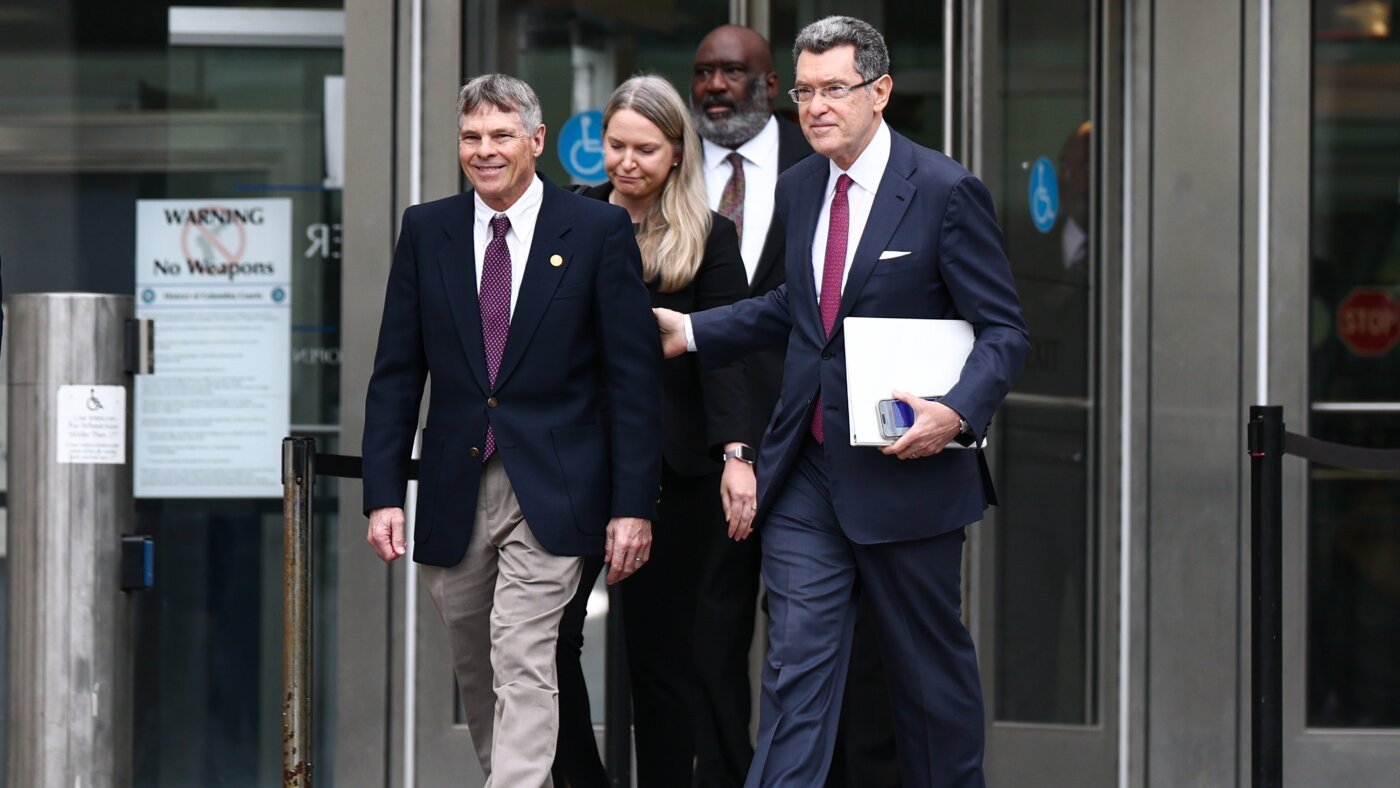
Former U.S. Olympian David Hearn (left) walks with his attorney Norman Eisen to speak to reporters and protesters gathered after his arraignment at the Superior Court of the District of Columbia in Washington, D.C. on Thursday.

Finn Gomez/Getty Images


hide caption


toggle caption

Advertisement

Finn Gomez/Getty Images

Former U.S. Olympic canoeist David Hearn pleaded not guilty to damaging the Lincoln Memorial Reflecting Pool in D.C. Superior Court Thursday morning.

Federal prosecutors charged Hearn with a single count of destruction of property causing more than $1,000 in damage to the pool.

Hearn has previously claimed, which his attorneys repeated during a short press conference outside the court, that he simply touched the water in the pool out of curiosity.

Advertisement

The Trump administration had just completed a $14 million renovation of the pool.

But shortly after the work finished, peeling paint and algae gathered in the water. The remodel has been largely criticized as a massive failure and waste of taxpayer dollars.

Superior Court Judge Carmen McLean released Hearn on his own recognizance. His next hearing is scheduled for Aug. 5.

Norm Eisen, one of Hearn’s attorneys, spoke to reporters outside of court following the hearing. He said the administration is using Hearn as a “scapegoat … for their own failures.”

“It is not a crime to touch the reflecting pool, to touch water in the United States of America,” he said.

Advertisement

Prosecutors say there is a host of evidence against Hearn.

This is a developing story.

Continue Reading

News

Three more people charged with damaging Reflecting Pool after Trump’s multimillion-dollar restoration | CNN Politics

Published

on

Three more people charged with damaging Reflecting Pool after Trump’s multimillion-dollar restoration | CNN Politics

Three more people have been criminally charged with destruction of property at the Lincoln Memorial Reflecting Pool.

Officers say they detained Cameron Thiers, Sophie Dennison-Gibby and Justin Carreno one Saturday afternoon in June and described in court documents witnessing them peeling and removing pieces of blue paint from the Reflecting Pool.

One officer “witnessed Carreno reach down into the reflecting pool and pull up a piece of the blue paint,” according to the court documents.

The officer who detained Dennison-Gibby “found 1 additional piece of the reflecting pool liner” in her purse, the documents said.

All three incidents were recorded on the officers’ body worn cameras, they said in the court documents.

Advertisement

Several “partnering law enforcement agencies assigned to the Reflecting Pool” working with US Park Police were involved in detaining the two men and one woman — including officers from Texas, Oklahoma, Montana and California.

One of the officers said in court documents that Thiers “admitted to removing a piece of blue sealant from the Reflecting Pool and still had it in his hand when I made contact with him.”

The three defendants were arraigned in court Wednesday and pleaded not guilty to the misdemeanor charges of destruction of property with a value less than $1,000. The judge ordered them to stay away from the Reflecting Pool.

Lawyers for Thiers and Dennison-Gibby declined to comment. CNN has reached out to Carreno’s attorney.

If found guilty of destruction of property, the defendants could be fined up to $1,000 and face a maximum of 180 days behind bars.

Advertisement

The New York Times first reported that three additional people had been charged with damaging the Reflecting Pool.

President Donald Trump has repeatedly claimed that vandals caused major damage to the pool by gashing the lining after his administration spent more than $14 million on renovations, though he has not provided evidence to support that claim. The officers who charged Carreno, Thiers and Dennison-Gibby did not accuse them of gashing the lining.

Former Olympic canoeist David Hearn was indicted by a grand jury in Washington, DC, last week for allegedly damaging the Reflecting Pool. Hearn — unlike Carreno, Thiers and Dennison-Gibby – was charged with destruction of property with a value of more than $1,000 which carries a maximum penalty of 10 years in prison, if convicted. He is set to be arraigned in court Thursday.

Crews began draining the Reflecting Pool over the weekend to make repairs, according to Interior Secretary Doug Burgum, for the second time in three months.

The move comes after weeks of problems – algae blooms, green-hued water, a chipping bottom and the administration’s allegations of vandalism – that have plagued the iconic landmark, making its woes the subject of national interest.

Advertisement
Continue Reading
Advertisement

Trending
