News
The cases against Harvey Weinstein: A timeline of allegations and trials


Harvey Weinstein is arraigned in court on September 18, 2024 in New York City, pleading not guilty to a new sex crimes charge.
Jeenah Moon/Getty
hide caption
toggle caption
Jeenah Moon/Getty
This story was originally published in 2020, and has been updated with more recent information on Weinstein’s legal proceedings.
This report includes descriptions of sexual assault.
For much of Harvey Weinstein’s career, dark rumors of sexual assault and harassment tailed the Hollywood megaproducer. Only in recent years did the allegations gather the heft and momentum that culminated in multiple convictions.
While scores of women have accused Weinstein of crimes dating back decades — ranging from intimidation to rape — this timeline focuses on the incidents cited in criminal cases against him in Manhattan and Los Angeles. Though Weinstein’s New York conviction was overturned in spring of 2024, a new trial is underway in Manhattan. Those updates are below.

Timeline
Winter 1993-94: Weinstein allegedly rapes Annabella Sciorra
The actress Annabella Sciorra, perhaps best known for her Emmy-nominated work on The Sopranos, said Weinstein raped her at her Manhattan apartment after an industry dinner. She says the producer dropped her off, only to reappear at her door and force his way inside.
Sciorra’s allegation went on to become the subject of pretrial arguments in Manhattan. While the alleged incident happened too long ago to be prosecuted under state law and Weinstein’s defense team objected to its inclusion, her testimony was heard anyway during the 2020 trial, in support of the charge of predatory sexual assault.
Summer 2004: Weinstein allegedly forces Lucia Evans to perform oral sex
The former aspiring actress Lucia Evans told The New Yorker — in one of a pair of major stories that trained a national spotlight on the allegations against Weinstein — that he had raped her in his office in Manhattan’s Tribeca neighborhood.
“He forced me to perform oral sex on him,” Evans alleged, adding: “I said, over and over, ‘I don’t want to do this, stop, don’t.’ I tried to get away, but maybe I didn’t try hard enough. I didn’t want to kick him or fight him.”
Her account led prosecutors to pursue a criminal sexual act charge against Weinstein, although it was dismissed in 2018.
July 10, 2006: Weinstein allegedly forces himself on Mimi Haley
Mimi Haley, a former production assistant at Weinstein’s now-bankrupt production company, says that after inviting her to his New York City home, the producer ignored her objections, pulled out her tampon and forcibly performed oral sex on her.
“No woman should have to be subjected to this type of unacceptable abuse,” she said in 2017. “Women have the right to say no. A ‘no’ is a ‘no,’ regardless of the circumstances — and I told Harvey ‘no.’ “
Haley’s claim was included in charges against Weinstein filed in 2018 and she went on to testify in his 2020 trial in Manhattan.
Feb. 18-19, 2013: A pair of incidents in Los Angeles
These alleged incidents prompted Los Angeles prosecutors to file four charges against Weinstein in 2020: one felony count each of forcible rape, forcible oral copulation, sexual penetration by use of force and sexual battery by restraint.
“On Feb. 18, 2013, Weinstein allegedly went to a hotel and raped a woman after pushing his way inside her room,” the office of Los Angeles County District Attorney Jackie Lacey explained in 2020. “The next evening, the defendant is accused of sexually assaulting a woman at a hotel suite in Beverly Hills.”
March 18, 2013: Alleged rape in New York City
For a long time, few details had been released about this allegation, which prompted two of the charges Weinstein was tried for in New York in 2020: first- and third-degree rape. Indeed, it was not until the trial’s opening statements that prosecutors released the name of the alleged victim, Jessica Mann, and the details of her story.
Prosecutors said Mann, an aspiring actress, had attended several industry events with Weinstein and endured increasingly aggressive sexual advances — including one incident in which, similar to Mimi Haley’s, Mann says Weinstein forcibly performed oral sex on her.
But it was later, on March 18 — one month after the alleged incidents in Los Angeles — that Mann says she tried to confront Weinstein at a hotel in Midtown Manhattan. There, he allegedly coaxed her up to his room, forced her to disrobe and ordered her onto the bed.
“He got on top of her and he raped her, forcing his penis into her vagina,” Manhattan Assistant District Attorney Meghan Hast told jurors in 2020. “Jessica just laid there. When he finished, he got off of her.
March 2015: New York DA decides not to prosecute allegation
Ambra Battilana Gutierrez, a Filipina-Italian model, reported Weinstein to the New York Police Department for allegedly groping her during a meeting at his Tribeca office in 2015. She says that later, at the urging of police, she wore a recording device for an arranged meetup at a Manhattan hotel. She says it was during that meeting that Weinstein admitted to groping her and sought unsuccessfully to get her to come to his room.
However, the office of then-Manhattan District Attorney Cyrus Vance Jr. decided not to pursue the case, saying at the time that “a criminal charge is not supported.”
Years later, after the publication of a New Yorker piece detailing Gutierrez’s allegations, her story would become a focus of intense criticism leveled at Vance, whose office became responsible for prosecuting the criminal trial. Then-New York Governor Andrew Cuomo requested a review of the DA’s 2015 decision, though it’s not clear whether that was ever completed.
Oct. 5, 2017: The New York Times publishes allegations
While rumors of sexual harassment and assault had long dogged Weinstein — even supplying punchlines at the Oscars — it wasn’t until The New York Times and The New Yorker published exposés that the allegations found serious traction.
The Times’ story, written by investigative journalists Jodi Kantor and Megan Twohey, focused on allegations by a series of assistants and actresses, such as Ashley Judd and Rose McGowan.
Weinstein, in a statement released the same day, pledged to take a leave of absence from his production company and acknowledged that “I have a long way to go.”
Adding, “I so respect all women and regret what happened.” Weinstein did not admit any wrongdoing.
Oct. 10, 2017: The New Yorker‘s website publishes more allegations
Published just days after the The New York Times article, journalist Ronan Farrow’s piece in The New Yorker focused on a slew of other accusations — including the allegation by Lucia Evans that had been added but was later dropped from the list of criminal charges Weinstein faces in New York.

Oct. 14, 2017: Weinstein is expelled from the Academy
In one of the first signs that the reaction to The New York Times and The New Yorker reports represented a sea change, complete with real-world implications for Weinstein, the Hollywood producer was expelled from the Academy of Motion Picture Arts and Sciences, the influential organization responsible for the Oscars.
“We do so not simply to separate ourselves from someone who does not merit the respect of his colleagues,” the Academy’s 54-member Board of Governors explained in a statement after an emergency meeting, “but also to send a message that the era of willful ignorance and shameful complicity in sexually predatory behavior and workplace harassment in our industry is over.”
March 19, 2018: The Weinstein Company files for bankruptcy
Buffeted by months of negative press, the production company that Weinstein founded with his brother, Bob, went belly up. The Weinstein Company declared bankruptcy and sold “substantially all” of its assets to Lantern Capital Partners. It also voided the nondisclosure agreements it had reached with Weinstein’s accusers.
May 25, 2018: Weinstein surrenders to police
The former Hollywood producer arrived at the New York Police Department’s 1st Precinct in Lower Manhattan, where he submitted to arrest with droves of journalists looking on. It was Harvey Weinstein’s first arrest in connection with the sexual assault allegations.
The same day, then-Manhattan District Attorney Cyrus Vance Jr. submitted Weinstein’s initial slate of charges: “The defendant is charged with Rape in the First and Third Degrees, as well as Criminal Sexual Act in the First Degree, for forcible sexual acts against two women in 2013 and 2004, respectively.”
About a week and a half later, Weinstein plead not guilty to the charges, which changed significantly as new information came to light.
July 2, 2018: Additional charges against Weinstein announced
Manhattan District Attorney Vance announced the filing of a superseding grand jury indictment, which added charges connected with a third incident in 2006. The new slate included one count of criminal sexual act in the first degree and two counts of predatory sexual assault, the most serious charges levied against Weinstein by Manhattan prosecutors.
Miriam “Mimi” Haley, who was involved in the alleged 2006 incident, had come forward with her story more than half a year earlier, saying that during her time working at The Weinstein Company, Harvey Weinstein orally forced himself on her inside his New York City home.
Weinstein plead not guilty to the new charges a week after they were announced.
Oct. 11, 2018: One charge against Weinstein is dismissed
Justice James Burke, the judge overseeing the Manhattan trial, dismissed one of the charges against Weinstein after it became clear that investigators didn’t properly present certain information to the grand jury.
Lucia Evans told the grand jury — and The New Yorker — that Weinstein forced her to perform oral sex on him. But an unidentified friend of hers had contradicted that account in an interview with a detective, saying Evans called it a consensual act in exchange for the promise of acting work.
Prosecutors acknowledged later that the detective “failed to inform” them of “important details” of the interview prior to Evans’ grand jury testimony. Weinstein’s legal team pushed to have the criminal sexual act charge dismissed as a result, and prosecutors did not object.

Harvey Weinstein arrives at court for jury selection on Wednesday, Jan. 8, 2020, in New York.
Mark Lennihan/AP
hide caption
toggle caption
Mark Lennihan/AP
Jan. 6, 2020: Trial in New York City begins
Weinstein’s trial formally opened in Manhattan, with more than two weeks devoted to selecting a jury. After roughly a year and a half of pretrial wrangling, the charges Weinstein faced are as follows:
- Two counts of predatory sexual assault
- One count of rape in the first degree (connected to the 2013 incident)
- One count of rape in the third degree (2013 incident)
- One count of criminal sexual act in the first degree (2006 incident)
Jan. 6, 2020: Los Angeles prosecutors announce charges of their own
The same day that his trial opened in Manhattan, Weinstein was hit with new legal woes from the other side of the U.S.: four felony counts of sexual assault, filed by Los Angeles County District Attorney Jackie Lacey. The charges are connected with incidents that allegedly happened at local hotels over two nights in February 2013.
“We believe the evidence will show that the defendant used his power and influence to gain access to his victims,” Lacey says, “and then commit violent crimes against them.”
Feb. 24, 2020: Manhattan jury finds Weinstein guilty in mixed verdict
After about five days of deliberations, jurors convicted the former producer of two of the five counts he faced — third-degree rape and a first-degree criminal sexual act — but acquitted him of the most serious charges.
He did not visibly react as the verdict was read but, according to defense lawyer Arthur Aidala, repeatedly told his attorneys afterward: “I’m innocent. … I didn’t rape anyone.”
Of the two counts that stuck, the criminal sexual act is the more serious, carrying a sentence of at least five years in prison and a maximum of more than two decades.
After the hearing, Weinstein’s path to the Rikers Island, where he was to await his sentencing, was rerouted to a nearby hospital after he experienced chest pains and high blood pressure.
March 11, 2020: Weinstein receives 23-year prison sentence in New York
The sentence handed down in a Manhattan courtroom included 20 years for first-degree criminal sexual act and three years for third-degree rape — nearly the maximum allowed under New York state law.
Weinstein’s victims “refused to be silent, and they were heard,” Manhattan District Attorney Cyrus Vance Jr. said in a statement after the sentencing hearing. “Their words took down a predator and put him behind bars, and gave hope to survivors of sexual violence all across the world.”
Weinstein’s legal team vowed to appeal.
October 2022: Trial in Los Angeles begins
The former movie mogul faced rape and sexual assault charges in front of a jury of nine men and three women at a Los Angeles court house. The former movie mogul was charged with raping and sexually assaulting four women between 2004 to 2013.
December 2022: Weinstein found guilty in mixed verdict in Los Angeles trial
Weinstein was found guilty of rape, forced oral copulation and sexual misconduct – three of seven charges – in his Los Angeles trial.
“It is time for the kingmaker to be brought to justice,” LA County Deputy District Attorney Marlene Martinez said during closing arguments of the trial.
Weinstein’s convictions hinged on allegations from one of four accusers. (The jury ruled Weinstein was not guilty on one of the remaining charges, and couldn’t reach a decision on three others.) Four additional charges were dismissed.
February 23, 2023: Weinstein sentenced in California
Weinstein was sentenced to 16 years behind bars by Los Angeles Superior Court Judge Lisa Lench, to be served consecutively after his 23-year sentence in New York.
April 25, 2024: New York conviction is overturned
Weinstein’s 2020 sex crime conviction was overturned while serving a 23-year sentence in New York. In a 4-3 decision, the New York State Court of Appeals ruled that Weinstein did not receive a fair trial because the proceedings included testimony from women whose allegations were not part of the case. These are otherwise known as Molineux witnesses.
Judge Jenny Rivera wrote: “We conclude that the trial court erroneously admitted testimony of uncharged, alleged prior sexual acts against persons other than the complainants of the underlying crimes because that testimony served no material non-propensity purpose … The only evidence against defendant [Weinstein] was the complainants’ testimony, and the result of the court’s rulings … was to bolster their credibility and diminish defendant’s character before the jury.”
April 28, 2024: Weinstein in and out of the hospital
Weinstein was hospitalized at Bellevue Hospital in Manhattan upon his return to New York. After his 2020 conviction was vacated, Weinstein was turned over to the city’s Department of Correction. According to a state spokesperson Weinstein remains in custody because of his Los Angeles conviction and sentence.
May 1, 2024: Prosecutors plan for a new trial
During a hearing in a New York courtroom, Manhattan District Attorney Alvin Bragg confirmed his office was putting together a new trial — first planned for the fall of 2024, and later delayed to the following spring.
May 29, 2024: New York prosecutors signal potential for new indictment
Manhattan prosecutors informed Judge Curtis Farber that they may seek a new indictment ahead of Weinstein’s upcoming trial. During a court hearing, Manhattan Assistant District Attorney Nicole Blumberg confirmed that additional survivors had come forward with assault claims and may be willing to testify.
June 7, 2024: Weinstein’s lawyers appeal California conviction
Weinstein’s lawyers appealed his California conviction, arguing that evidence was excluded from his trial there, which ended in 2022.
September 12, 2024: Another New York indictment is announced
New York prosecutors announced in a hearing that Weinstein was indicted on additional sex crimes charges. Weinstein is not present in court, after being rushed into emergency heart surgery the weekend prior.
September 18, 2024: Weinstein pleads not guilty to new charge in New York
Prosecutors unsealed the indictment, detailing allegations of sexual assault against Weinstein in 2006. In a New York courtroom, Weinstein plead not guilty.
April 15, 2025: Jury selection begins in Weinstein’s trial in New York
In Harvey Weinstein’s third trial in just over five years, the disgraced film producer is facing assault allegations from three different women, including one whose identity has not yet been revealed.
Ilya Marritz and Clare Lombardo contributed to this timeline.


Supreme Court Justice Amy Coney Barrett speaks at the Reagan Library on Sept. 9, 2025, in Simi Valley, Calif. Barrett discussed and signed copies of her new book, Listening to the Law: Reflections on the Court and Constitution.
Mario Tama/Getty Images
hide caption
toggle caption
Mario Tama/Getty Images
Even as the Supreme Court was handing down one legal thunderbolt after another last week, the justices were quietly releasing their annual financial reports. Justice Samuel Alito was the only sitting justice to request an extension, which he has done for 15 years. The disclosures do not give a complete account of the justices’ total income and wealth, but they give insights into their concertgoing, guest professorships and even their involvement in youth sports.
In addition to their salaries, much of the justices’ reported income came from their book deals. Justice Ketanji Brown Jackson led the pack earning more than $1.1 million last year for a total of roughly $4 million since her memoir, Lovely One, was published in 2024.

Justices Sonia Sotomayor, Neil Gorsuch, Amy Coney Barrett and retired Justice Anthony Kennedy also reported income from published books. Earnings from their books ranged from $849,000 for Barrett, to $300,000 for Gorsuch and $88,000 for Sotomayor, whose books include her 2013 autobiography and five children’s books. Justice Clarence Thomas, who previously earned $1.5 million for his 2007 memoir, listed no publisher payments last year, and Justice Brett Kavanaugh, one of 13 co-authors of a 2016 legal treatise, also received no payments last year. Kavanaugh is said to be working on a memoir but he listed no payments for the anticipated book. Alito does have a book coming out in the fall, but with his financial report still outstanding, there is no data on how much he was paid for the work in 2025.
The only two sitting justices who have not written books are Chief Justice John Roberts and Justice Elena Kagan.
Many justices also earned income from teaching at law schools. Roberts reported income from New England Law, located in Boston, and Gorsuch reported teaching income from George Mason University in Virginia. Thomas taught classes at Catholic University in Washington, D.C., and Barrett and Kavanaugh taught at Notre Dame Law School. Barrett graduated from the school and began teaching there 23 years ago; Kavanaugh has family connections to Notre Dame.
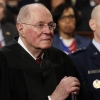
The disclosures also report gifts, travel, food and lodging that the justices received in 2025. Jackson and Sotomayor were the only two to report gifts. Jackson was given a painting for her chambers valued at $2,500, and Sotomayor reported a trip to Kansas City to watch the opening of a musical based on her children’s book, Just Ask.
In addition, she reported receiving free tickets worth $4,333 while on “a private trip to Puerto Rico.” The tickets were from the record label that represents Bad Bunny, and her trip coincided with the artist’s months-long concert series in San Juan. Sotomayor’s parents were from Puerto Rico, and she has spent much time there over the years.
The justices also disclosed significant reimbursements for travel throughout 2025. Thomas’ travel, food and lodging expenses were paid for by the Hoover Institution for speaking at a celebration of conservative economist Thomas Sowell.
Sotomayor, Gorsuch, Barrett and Jackson were reimbursed for international travel, where they gave speeches, spoke about their books or taught. Roberts was the only sitting member of the court not to report any gifts or travel reimbursements.
The annual filings also shed some light on the justices’ activities off the bench. Kavanaugh reported that in addition to his duties as a Supreme Court justice, he serves as a coach to multiple D.C.-area Catholic Youth Organization girls’ basketball teams. Coach K, as he is known by his players, wrote the court’s June decision declaring that states can ban transgender women and girl athletes from playing on women’s and girls’ sports teams.

The justices’ salaries are established by law. The chief justice earns the most, at $320,700 per year. The eight associate justices earn $306,600 per year. While that is a lot of money to most Americans, the justices and even their law clerks could earn more the minute they leave their Supreme Court jobs for large law firms.
Roberts was the only member of the court to report investing in individual stocks. Alito in the past has also owned shares of individual stocks, but his report is not due for three months when his extension runs out. For the most part, the justices do not own individual stocks, but do invest in index funds, mutual funds and other such investment programs in order to both make money and limit potential conflicts of interest that would require their recusal from certain cases.
However — and this is a big however — the financial reporting forms the justices are required to fill out are so unspecific and the reporting ranges for investment earnings are so broad that it is impossible to determine any justice’s overall wealth. In addition, the current value of the justices’ homes isn’t reported. Neither is their spouses’ income, which in the case of the chief justice, for instance, likely far exceeds his take-home pay.

At least two structural columns buckled and failed in a 37-story office tower in Midtown Manhattan on Tuesday, prompting evacuations of nearby streets and buildings. While city officials asserted that the tower was in no danger of collapsing completely, outside engineers said further failures in the structure could not be ruled out.
A pair of columns that failed completely were part of the tower’s existing structure. A New York Times review of images and videos from inside the building has found that several floors were added atop these columns.
City officials said in a news conference on Tuesday that the building was continuing to move, while they simultaneously assured the city that the building would not suffer “total collapse.” “The way this building is constructed, it’s a steel-frame building,” John Esposito, a chief in the Fire Department in New York, said at the afternoon news conference. “So, it would not be a total collapse. It would be more of a localized collapse.” Still, he said, “that remains our concern, that it’s moved.”
Engineers said that the movement itself was cause for concern. In a properly designed steel building, they said, loads should redistribute quickly to surviving structural supports if columns failed.
Joe DiPompeo, a former president of the Structural Engineering Institute at the American Society of Civil Engineers, said that if the structure had been overloaded, he would expect any movement “to happen very quickly,” rather than gradually.
“Generally when a column buckles, it’s a sudden failure,” Mr. DiPompeo said. He said that a full collapse remained unlikely given the redundancies built into the building codes.
Engineers often refer to the most dangerous possibility as a progressive collapse, a process in which structures near the initial failure become overstressed and also fail, potentially bringing down the building if the sequence continues. While unlikely, it cannot be ruled out, Mr. DiPompeo said.
Footage recorded from inside the building shows at least two structural columns appear to have failed completely, Mr. DiPompeo said. Other nonstructural, interior walls — or at least the metal “studs” that were in place to hold them up — also appear to have deformed.
“The only way that really happens is if the floor above them dropped. It looks like the floor above could have dropped a foot or two, which is obviously not a good situation,” Mr. DiPompeo said.
The 37-story building is in the process of being converted from office space into residential units. Four new floors and a large vertical portion were added onto the existing building in recent months. The vertical portion consists of a stack of over a dozen new floors cantilevered out over the existing building below.
Engineers said that there was nothing inherently wrong with adding residential floors or the cantilevered section above the columns that failed, as long as the original structure and the modifications had properly accounted for the added weight and wind loads.
“The cantilever alone doesn’t change anything,” Mr. DiPompeo said, but it does put additional load on the columns underneath — a factor that should have been reflected in the design.
Nathan Berman, managing principal and founder of MetroLoft, the developer overseeing the conversion, said on Tuesday that “this incident is nothing more than a typical construction mishap.”
He said two columns near the northwest corner of the tower had bent under the weight of additions to the building above, most likely because those columns had not been properly reinforced, though he said an investigation would determine the cause. The rest of the columns, he said, “picked up the weight.” He estimated the affected floors above the failed columns had sagged by a maximum of four inches.
Mr. Berman said that he expected the problems to be fixed and the project to be completed with, at most, a slight delay.
On Tuesday evening, installation of temporary shoring was set to begin shortly, in order to help stabilize the 20th and 21st floors of the building.

The Justice Department sent letters warning election officials in all 50 states and the District of Columbia that they could face criminal prosecution over noncitizen voting, a spokesperson for the Justice Department confirmed Tuesday.
The letters, signed by Assistant Attorney General Harmeet Dhillon, who heads up the department’s Civil Rights Division, give states five days to explain how they will comply with federal voter eligibility laws and how they will maintain “clean voter lists.”
“The Department sent these letters to all 50 states and the District of Columbia, asking for voluntary compliance in a timely manner with their obligations under federal law to ensure only citizens vote in federal elections,” a Justice Department spokesperson said in a statement.
Noncitizen voting in federal elections is extremely rare, but Trump and his administration have falsely portrayed it as a widespread issue.
Michigan Secretary of State Jocelyn Benson, Nevada Secretary of State Francisco Aguilar and Utah Lt. Gov. Deidre Henderson are among those who said they received the letters from the Justice Department.
The letters say state election officers “could be criminally prosecuted for aiding and abetting” noncitizen voting. They further specify that any election officer who knowingly retains noncitizens on a statewide voting registration list or who facilitates noncitizens’ receiving and casting ballots could be subject to criminal liability.
“An intentional act that is aimed at diluting the votes of citizens could also constitute a violation” of federal law, the letters said.
Henderson wrote on social media that the threats constitute “truly bizarre behavior.”
“Got another love letter this morning from the DOJ sprinkled throughout with threats of criminal prosecution,” she wrote. “I’m sure I’m not the only chief election officer of a state who is being targeted for following state and federal laws by resisting DOJ’s demands for private voter data that have thus far been ruled illegal by at least a dozen courts.”
The letters are the latest move in the Justice Department’s campaign to assert more federal control over state elections.
While some states have complied with the administration’s demands that they hand over voter roll data, the Justice Department has sued 30 states and Washington, D.C., for resisting. So far, 11 different federal courts have dismissed the Justice Department’s efforts to seize voter rolls.
-

 Maryland6 minutes ago
Maryland man sentenced to 15 years for attempting to join ISIS
-

 Michigan9 minutes ago
Sherrone Moore’s former assistant sues University of Michigan over alleged FOIA violations
-

 Massachusetts14 minutes ago
Max McColgan and Joseph Lenane share stroke play medals at 118th Massachusetts Amateur Championship – The Boston Globe
-

 Minnesota21 minutes ago
Man seriously injured in north Minneapolis shooting; no arrests
-

 Mississippi24 minutes ago
Ben Crump seeks independent autopsy in Nolan Wells death
-

 Missouri29 minutes ago
Missouri politicians champion unity, diversity on America’s 250th
-

 Montana36 minutes ago
Montana signs onto data center energy cost protection pledge
-

 Nebraska39 minutes ago
Gov. Jim Pillen calls for budget cuts, hiring freeze in new memo

