Connect with us

News

Joe Biden set to voice concerns over Nippon Steel takeover of US Steel

Published

on

Joe Biden set to voice concerns over Nippon Steel takeover of US Steel

Joe Biden plans to intervene in Nippon Steel’s proposed purchase of US Steel, a move that could threaten the deal and anger Japan, one of Washington’s closest allies.

Biden will issue a statement expressing serious concern about the Japanese group’s proposed $14.9bn acquisition of the Pennsylvania-headquartered steelmaker before Prime Minister Fumio Kishida arrives for a state visit in Washington on April 10, according to six people familiar with the decision.

US officials and lawyers have drafted the statement and the White House has privately informed the Japanese government of the president’s decision, according to people familiar with the matter. US Steel’s shares fell more than 12 per cent after the Financial Times published details of Biden’s intentions.

The expression of concern will be interpreted as opposition to the takeover and marks the culmination of months of White House debate about how to respond to a deal that has sparked a bipartisan backlash in Washington against the sale of a US manufacturing icon to a foreign group.

Although US law gives the administration the power to block certain foreign acquisitions on national security grounds, Biden will not say outright that the deal should be blocked, according to people familiar with the matter.

Advertisement

Instead, they say he will issue similar comments to remarks made in December by White House national economic adviser Lael Brainard, who said the president believed the deal deserved “serious scrutiny”.

Pennsylvania is a crucial electoral swing state in this year’s presidential election between Biden and Donald Trump. Both men have courted union votes in the state and Trump has already lashed out against Nippon Steel‘s “horrible” deal to buy the Pittsburgh-based American producer.

The United Steelworkers union, also based in Pittsburgh, has opposed the takeover.

Nippon Steel announced the controversial acquisition in December, leading Biden to pick a side between a powerful union and its voters, and a critical American ally. The president has invested heavily in shoring up alliances, particularly with Japan.

The White House asked US ambassador to Japan Rahm Emanuel to make the problem go away, putting him in a tough position after he had publicly welcomed the deal as “historic”. Emanuel did not respond to a request for comment.

Advertisement

One person familiar with the deliberations said it was “embarrassing” for an administration that talks about the importance of allies and particularly the US-Japan alliance to “send a signal of distrust regarding Japanese ownership of US companies” as Kishida prepares to visit.

“The president knows all this, but sadly it looks like election year politics will win out,” the person said.

In a joint statement following publication of the story, Nippon Steel and US Steel said they welcomed the administration’s scrutiny of the deal as an “objective and comprehensive review of this transaction will demonstrate that it strengthens US jobs, competition, and economic and national security”. 

The groups added that Nippon Steel had made clear there would be no job losses, plant closures or transfer of production. They also said they were in ongoing discussions with the United Steelworkers union.

The timing of Biden’s statement is significant because last week Nippon Steel filed its proposal with the Committee on Foreign Investment in the US (Cfius), the inter-agency panel that vets inbound investments for national security risks, according to two people familiar with the move. The company declined to confirm the Cfius filing.

Advertisement

“It is unprecedented for a president to make a substantive comment on a case that is pending before Cfius,” said Ivan Schlager, a partner at Kirkland & Ellis and one of the most prominent Cfius lawyers in the US.

“While Cfius is ordinarily immune to political pressure this case involves an iconic asset with unique capabilities coupled with an administration who has made protecting manufacturing and middle-class jobs the foundation of its foreign policy.”

The White House declined to comment on whether the president would intervene. The Japanese prime minister’s office also declined to comment.

News of Biden’s planned statement comes as he tours swing states such as Pennsylvania in a bid to shore up votes ahead of the election in November.

United Steelworkers president David McCall said last month that his union had “received personal assurances that Biden has our backs” in relation to the deal. Trump has also vowed to block the deal if he beats Biden in November.

Advertisement

Nippon Steel has hired US lobbying firm Akin Gump, focusing its energy to win the backing of the United Steelworkers.

But citing confidentiality reasons, the Japanese group was not in touch with the union before announcing the deal and it was only in late February that it signed a non-disclosure agreement with the group, which represents 850,000 US manufacturing workers. Experts in Washington said the company had made a serious mistake by not striking a deal with the union before announcing the deal.

Following talks with Nippon Steel last week, the United Steelworkers said the meeting yielded “no progress”. “We remain convinced that the company does not fully understand its obligations to steelworkers, retirees and our communities,” it said in a letter to its members.

Nippon Steel said in response that it would continue its talks with the union. “We provided the USW with specific commitments which we believe address each of the union’s concerns that have been raised,” it said.

A person with knowledge of Nippon Steel’s thinking said the company does not plan to give up its bid for US Steel even if Biden publicly expresses opposition to the takeover.

Advertisement

An executive told analysts in an earnings briefing last month the group did not expect any political intervention once a Cfius review had been launched.

Japan’s business community has been shocked by the strong reaction in Washington to the deal, especially since the US remains the most attractive mergers and acquisitions market for Japanese companies.

Nancy McLernon, head of the Global Business Alliance, a trade group that represents foreign multinationals in the US, said there was a “big risk” in blocking the acquisition on anything other than national security grounds. 

“It would have a material impact on the relationship with a critical ally. It’s worth noting that Japan is the largest foreign investor in the United States, directly employing nearly a million American workers. Blocking the deal under such pretence would certainly make for an awkward state dinner in April.”

Advertisement

News

Argentina is back in the World Cup final after a thrilling semifinal win over England

Published

on

Argentina is back in the World Cup final after a thrilling semifinal win over England

Argentina’s Lionel Messi celebrates the team’s second goal by Lautaro Martínez during their World Cup semifinal against England on Wednesday in Atlanta. Argentina defeated the English 2-1 to advance to Sunday’s final against Spain.

Shaun Botterill/Getty Images


hide caption


toggle caption

Advertisement

Shaun Botterill/Getty Images

ATLANTA — Argentina, the death-defying defending World Cup champion, will play for a second consecutive title after scoring two late goals to beat England in the semifinal, 2-1.

For a fourth straight knockout game, Argentina survived a heart-stoppingly close call. First was Cape Verde, the African island nation underdog, who took the champions to extra time. Then was the furious miracle comeback after Egypt took a 2-0 lead. Then, in the quarterfinal, a shorthanded Switzerland squad forced extra time despite a 72nd-minute red card.

This gutsy Argentina squad prevailed in all three games, and Wednesday, they pulled it off yet again. In the 55th minute, England took a 1-0 lead when forward Anthony Gordon tapped in a cross.

Advertisement

But, as the clock ticked up, Argentina turned up the intensity. A relentless onslaught yielded near miss after near miss before finally midfielder Enzo Fernández scored off a rocket from outside the penalty area to equalize the game at 1-1 in the 85th minute.

Then, in stoppage time, forward Lautaro Martínez sent the Argentina crowd into delirium with a header off a cross from 39-year-old superstar Lionel Messi, who assisted on both goals.

“I think that this team plays the best when we are facing a difficult situation, with adversity, ” said Argentina coach Lionel Scaloni afterward. “We had a challenging game, a challenging situation. There was blood in the water, and we went for it.”

In Sunday’s final they will face Spain, which defeated France on Tuesday 2-0 to contend for their second-ever title.

England's Anthony Gordon celebrates scoring his team's first goal during the World Cup semifinal against Argentina on Wednesday in Atlanta.

England’s Anthony Gordon celebrates scoring his team’s first goal during the World Cup semifinal against Argentina on Wednesday in Atlanta.

Justin Setterfield/Getty Images

Advertisement


hide caption


toggle caption

Justin Setterfield/Getty Images

Advertisement

Wednesday’s game, the sixth meeting between these two teams at the men’s World Cup, was the newest chapter in their storied rivalry. That history includes the infamous “Hand of God” goal scored by Diego Maradona in the 1986 World Cup, four years after a war between the two countries over the Falkland Islands. The British won the war, but the sovereignty of the territory is still under dispute.

Continue Reading

News

ICE should do traffic stops despite recent shootings, Trump says, seeming to oppose new suspension

Published

on

ICE should do traffic stops despite recent shootings, Trump says, seeming to oppose new suspension

WASHINGTON (AP) — The Immigration and Customs Enforcement agency should continue vehicle stops after recent fatal shootings, President Donald Trump said on Wednesday, seeming to oppose a new suspension of the practice used as part of his immigration crackdown.

ICE is “doing a GREAT job, one that has to be done,” Trump wrote on his social media site.

The Republican president said that to remove criminals he claims were let into the country under the previous Democratic administration “we must be strong, tough, and smart, and we CANNOT give up one of ICE’s most important and effective Crime Fighting tools, THE TRAFFIC STOP!” Trump said, “Once we do, we are playing right into the criminal’s hands.”

Trump administration officials have told Immigration and Customs Enforcement officers to suspend most vehicle stops after two deadly shootings within a week, people familiar with the decision said Tuesday.

The suspension was ordered after an ICE officer shot and killed a Colombian driver Monday in Maine and a week after another officer shot and killed a motorist in Houston, renewing criticism of the agency’s enforcement tactics that were widely condemned last winter after the killings of Alex Pretti and Renee Good in Minnesota.

Advertisement

In Florida on Tuesday, a third man in roughly a week died during an encounter with immigration officers. This time, a 28-year-old man was killed after he was hit by a tractor trailer while running from immigration and other federal officers, authorities said.

It’s a narrative that has been repeated again and again since the Trump administration’s immigration crackdown began, with federal officers confronting drivers and then saying they opened fire when the drivers’ vehicles became a danger. That’s despite decades of warnings from policing experts that shooting into moving cars presents a danger of its own and should almost always be avoided.

There have been at least 10 deaths involving encounters with immigration agents since Trump launched his deportation campaign. At least four of those deaths involved people in vehicles, including the one last week in Houston, a trend so troubling that U.S. Sen. Susan Collins, R-Maine, said Tuesday that she had urged Department of Homeland Security Secretary Markwayne Mullin “to cease all non-urgent vehicle stops.”

John Sandweg, who was acting director at ICE, which is part of DHS, during President Barack Obama’s Democratic administration, estimated recently that there have been roughly 18 traffic stop shootings during the Trump immigration crackdown.

The office of Maine Sen. Angus King, an independent who caucuses with Democrats, was told by DHS that ICE was suspending traffic stops, office spokesperson Matthew Felling said.

Advertisement

ICE, which has been under pressure to beef up arrest and deportation numbers, often says people it’s trying to arrest are increasingly resistant to leaving their homes. ICE officers blame immigration advocates who advise immigrants to stay in their homes unless ICE produces a warrant signed by an independent judge instead of the administrative warrants the agency generally uses that are signed by another ICE officer. So, ICE officers say, they’re forced to find other areas in which to make arrests.

Shooting angers Maine

Hundreds of people in Maine protested Tuesday over the fatal shooting of Johan Sebastián Durán Guerrero, a 25-year-old Colombian national. Advocacy groups said Guerrero, who had a wife and a young daughter, was authorized to work in the United States.

DHS said Monday that an officer, “fearing for public safety,” shot and killed Durán Guerrero while officers were watching the home of someone they believed was in the U.S. illegally and facing a final order of removal from the country. It said in a post on X that when ICE tried to stop a car driven by someone who came from the home, the person attempted to flee in the vehicle and the officer fired.

That was a shift from how King earlier described the encounter, when he said Mullin told him the officer opened fire after the man tried to use his vehicle as a weapon. King said Mullin told him the officers were trying to serve an arrest warrant but not for the man who was shot.

In a scathing post on X, outgoing Colombian President Gustavo Petro called the shooting a targeted killing “at the hands of the U.S. government.”

Advertisement

Petro, who has openly quarreled with Trump, urged Trump to provide an explanation and accused ICE officers of treating Durán Guerrero as “an inferior being without rights.”

In Wednesday’s social media post, Trump told ICE to be “judicious, fair and smart, and go back and do your very important job.”

Maine’s congressional delegation on Tuesday demanded a “comprehensive, transparent, and expedited investigation.”

Questions surround the shooting

Photos showed bullet holes in Durán Guerrero’s car windshield, but the officers involved in the shooting didn’t have body cameras, leaving many questions. Among them are how close the officer was to the vehicle when shooting, whether officers told Durán Guerrero to stop and why ICE believes he had put the public in danger.

Border czar Tom Homan told reporters Tuesday that the investigation needs to play out and that officers will be held accountable if they are found to have acted inappropriately or illegally.

Advertisement

Maine’s attorney general’s office, which said it is working with federal agencies to investigate, said initial statements suggest the driver was trying to flee in the direction of the officer, whose name hasn’t been released and who was placed on leave.

Collins said Mullin told her the DHS inspector general is investigating in cooperation with the FBI.

Democrats seeking to unseat Collins in November have sought to connect her with ICE’s methods, which have drawn public scrutiny and derision. Collins later said in a statement that although ICE needs to improve, eliminating the agency would make the nation less safe.

Maine Secretary of State Shenna Bellows, a Democrat who is vying for Collins’ seat, called the ICE officers at the shooting “thugs” during a vigil Tuesday in Lewiston.

___

Advertisement

Whittle contributed from Biddeford, Maine; Brook from New Orleans; and Sisak from New York.

Continue Reading

News

Supreme Court Justices give chilling accounts of threats to their safety

Published

on

Supreme Court Justices give chilling accounts of threats to their safety

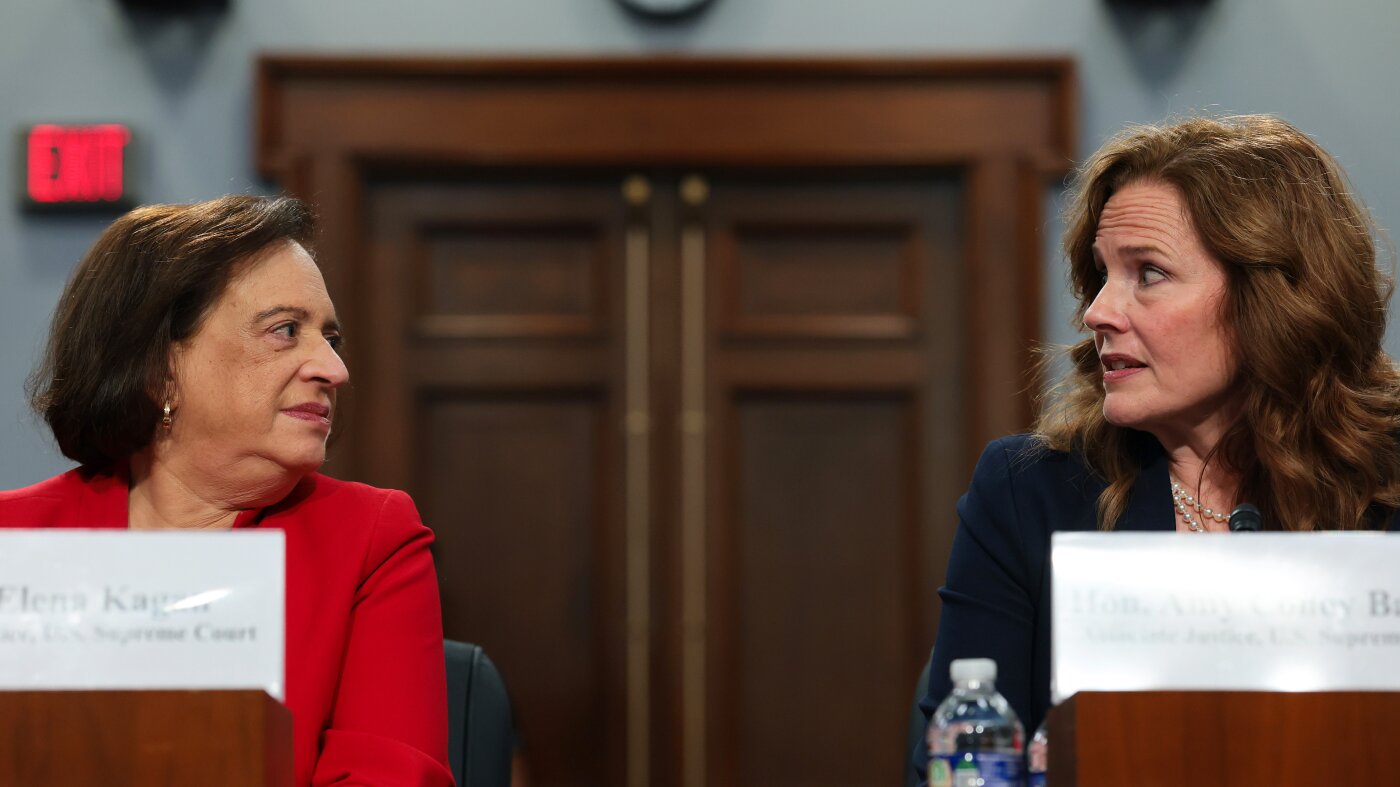
Supreme Court Justices Elena Kagan and Amy Coney Barrett testify before the House Appropriations Committee on Capitol Hill on July 14, 2026 in Washington, D.C.

Anna Moneymaker/Getty Images


hide caption


toggle caption

Advertisement

Anna Moneymaker/Getty Images

The Supreme Court did something Tuesday that it has not done in seven years. It sent two of the justices to Capitol Hill to testify about the court’s budget request for the coming year. The budget has grown dramatically in recent years because of the equally dramatic rise in the number and intensity of threats to the justices’ safety.

Designated as the court’s representatives were Justice Elena Kagan, appointed by President Obama, and Justice Amy Coney Barrett, appointed by President Trump.

As Kagan pointed out in her testimony, it was Republican Darrell Issa and Democrat Elijah Cummings who insisted that the court beef up its security ten years ago after Justice Antonin Scalia died in his sleep on a hunting trip, with no security anywhere nearby to respond quickly.  

Advertisement

“They said, kind of like, we think you’re crazy, you know, that that you have less security than director of the Office of Personnel Management does,” she recounted the Congressmen as telling the Court, “and we think that you have to do better.”

Before that, the justices basically had little to no security. They drove their own cars to work; went to the movies and shopped at supermarkets unaccompanied, and did their private travel on their own. And frankly, they liked it that way, because having security is personally invasive.

In recent years, however, the court has undertaken major changes, including continually expanding the court police force to protect the justices and their homes at all times, and funding additional cybersecurity measures.

And yet, as Justice Kagan pointed out, the Court’s $207 million budget request is less than one tenth of one percent of the entire federal budget.

The justices spoke at length Tuesday about how rising threats impacted their lives. Justice Barrett came prepared with two harrowing stories. First was the day she brought home a bullet-proof vest. 

Advertisement

“My 12-year-old son was standing in the doorway of my bedroom and he wanted to know what it was,” she testified, “and I didn’t know how to respond. I didn’t expect that performing this service was going to put me in the position of explaining to my children what a bulletproof vest was and why I had to wear one.”

Continue Reading
Advertisement

Trending