Federal immigration authorities arrested a Tufts University doctoral student from Turkey on Tuesday night, the latest in a string of arrests targeting international students for their Palestinian advocacy.
Rumeysa Ozturk, a PhD student in the graduate school of arts and sciences at the Massachusetts university, was arrested by Immigration and Customs Enforcement officers outside her off-campus apartment on her way to an Iftar dinner with friends, according to her attorney and activists.
In an email to the Tufts community, university president Sunil Kumar said the school was told that federal authorities terminated her visa status, “and we seek to confirm whether that information is true.”
The Independent has requested comment from ICE.
Advertisement
Ozturk, who is in the United States on a non-immigrant F-1 visa for international students, was meeting with friends to break her Ramadan fast when she was detained near her home in Somerville, attorney Mahsa Khanbabai said in a statement to The Independent.
“We are unaware of her whereabouts and have not been able to contact her,” she said.
Surveillance footage of the arrest shows plainclothes agents approaching her from the street. One officer, whose head is covered by sweatshirt hood, appears to approach her without identifying himself and then grabs her arm. Another officer approaches and takes her phone while she is placed in handcuffs. Three officers cover their faces with neck gaiters.
Tufts did not have any prior knowledge of the arrest “and did not share any information with federal authorities prior to the event,” Kumar wrote.
Kumar issued a reminder that the university has a protocol for how to respond to federal agents making “unannounced visits” on or off campus.
Advertisement
Tufts University doctoral student Rumeysa Ozturk was arrested by ICE officers on March 25, according to the school (REUTERS)
Ozturk’s attorney has filed a petition of habeas corpus challenging her arrest and detention. Massachusetts District Judge Indira Talwani is giving federal officials until Friday to respond to the complaint, and Ozturk cannot be moved outside the state without at least 48 hours of advance notice to the court, according to Talwani’s order.
Ozturk is a student at the university’s doctoral program for Child Study and Human Development, and graduated with a master’s degree from the Teachers College at Columbia University, according to her LinkedIn.
“I am passionate about researching children’s and adolescents’ digital media and technologies for caring, kind, and compassionate media environments,” she writes. “As an interdisciplinary media researcher and developmental scientist in training, I research children’s and adolescents’ positive development in a media-embedded, globalized, and connected world.”
Last year, in response to Israel’s ongoing devastation of Gaza, Ozturk co-authored an op-ed in The Tufts Daily newspaper calling on Kumar to “acknowledge the Palestinian genocide” and for the university to divest from companies with direct or indirect ties to Israel.
Advertisement
Ozturk is among dozens of students and professors identified by Canary Mission, a pro-Israel campaign that maintains a database intended to blacklist and intimidate activists the group accuses of promoting “hatred of the USA, Israel and Jews.”
“Efforts to deport students based on their speech or protected activism undermine America’s commitment to free expression,” Tyler Coward, lead counsel for government affairs for the Foundation for Individual Rights and Expression, told The Independent. “If ICE detained Ozturk based on her op-ed or activism, it’s a worrying escalation in an already fraught environment for college students here on student visas.”
Her arrest follows similar actions from federal authorities targeting student activists and students who have merely spoken in support of Palestine, none of whom have been accused of committing any crime. Donald Trump’s administration has zeroed in on campus activism at prestigious universities, where Israel’s war in Gaza has provoked a wave of demonstrations and protest encampments demanding an end to U.S. support for Israel’s devastation.
Students have been accused of supporting terrorism and violating the president’s executive orders directing federal agencies investigate and potentially remove non-citizens who “bear hostile attitudes toward its citizens, culture, government, institutions, or founding principles” and “advocate for, aid, or support designated foreign terrorists and other threats to our national security.”
Advertisement
Demonstrations across the country have (EPA)
On Tuesday, university professors and academic organizations from across the country filed a lawsuit accusing the Trump administration of violating the First Amendment through a “climate of fear and repression” on college campuses.
“Out of fear that they might be arrested and deported for lawful expression and association, some noncitizen students and faculty have stopped attending public protests or resigned from campus groups that engage in political advocacy,” according to the lawsuit.
“Others have declined opportunities to publish commentary and scholarship, stopped contributing to classroom discussions, or deleted past work from online databases and websites,” attorneys wrote. “Many now hesitate to address political issues on social media, or even in private texts. The [policy], in other words, is accomplishing its purpose: it is terrorizing students and faculty for their exercise of First Amendment rights in the past, intimidating them from exercising those rights now, and silencing political viewpoints that the government disfavor.”
On Tuesday, a federal judge in Manhattan blocked the Trump administration from deporting Yunseo Chung, a Columbia University student and lawful permanent resident who was the victim of the government’s “shocking overreach,” vilifying her political views and constitutionally protected right to protest, according to her attorneys.
Columbia graduate Mahmoud Khalil, a lawful permanent resident and prominent student activist accused of organizing “pro-Hamas” attacks on campus, is currently battling his removal from the United States after his shocking arrest in front of his wife, a U.S. citizen who is eight months pregnant, earlier this month. He is currently detained in Louisiana as his case moves jurisdictions to a federal court in New Jersey.
Three more people have been criminally charged with destruction of property at the Lincoln Memorial Reflecting Pool.
Officers say they detained Cameron Thiers, Sophie Dennison-Gibby and Justin Carreno one Saturday afternoon in June and described in court documents witnessing them peeling and removing pieces of blue paint from the Reflecting Pool.
One officer “witnessed Carreno reach down into the reflecting pool and pull up a piece of the blue paint,” according to the court documents.
The officer who detained Dennison-Gibby “found 1 additional piece of the reflecting pool liner” in her purse, the documents said.
All three incidents were recorded on the officers’ body worn cameras, they said in the court documents.
Advertisement
Several “partnering law enforcement agencies assigned to the Reflecting Pool” working with US Park Police were involved in detaining the two men and one woman — including officers from Texas, Oklahoma, Montana and California.
One of the officers said in court documents that Thiers “admitted to removing a piece of blue sealant from the Reflecting Pool and still had it in his hand when I made contact with him.”
The three defendants were arraigned in court Wednesday and pleaded not guilty to the misdemeanor charges of destruction of property with a value less than $1,000. The judge ordered them to stay away from the Reflecting Pool.
Lawyers for Thiers and Dennison-Gibby declined to comment. CNN has reached out to Carreno’s attorney.
If found guilty of destruction of property, the defendants could be fined up to $1,000 and face a maximum of 180 days behind bars.
Advertisement
The New York Times first reported that three additional people had been charged with damaging the Reflecting Pool.
President Donald Trump has repeatedly claimed that vandals caused major damage to the pool by gashing the lining after his administration spent more than $14 million on renovations, though he has not provided evidence to support that claim. The officers who charged Carreno, Thiers and Dennison-Gibby did not accuse them of gashing the lining.
Former Olympic canoeist David Hearn was indicted by a grand jury in Washington, DC, last week for allegedly damaging the Reflecting Pool. Hearn — unlike Carreno, Thiers and Dennison-Gibby – was charged with destruction of property with a value of more than $1,000 which carries a maximum penalty of 10 years in prison, if convicted. He is set to be arraigned in court Thursday.
Crews began draining the Reflecting Pool over the weekend to make repairs, according to Interior Secretary Doug Burgum, for the second time in three months.
The move comes after weeks of problems – algae blooms, green-hued water, a chipping bottom and the administration’s allegations of vandalism – that have plagued the iconic landmark, making its woes the subject of national interest.
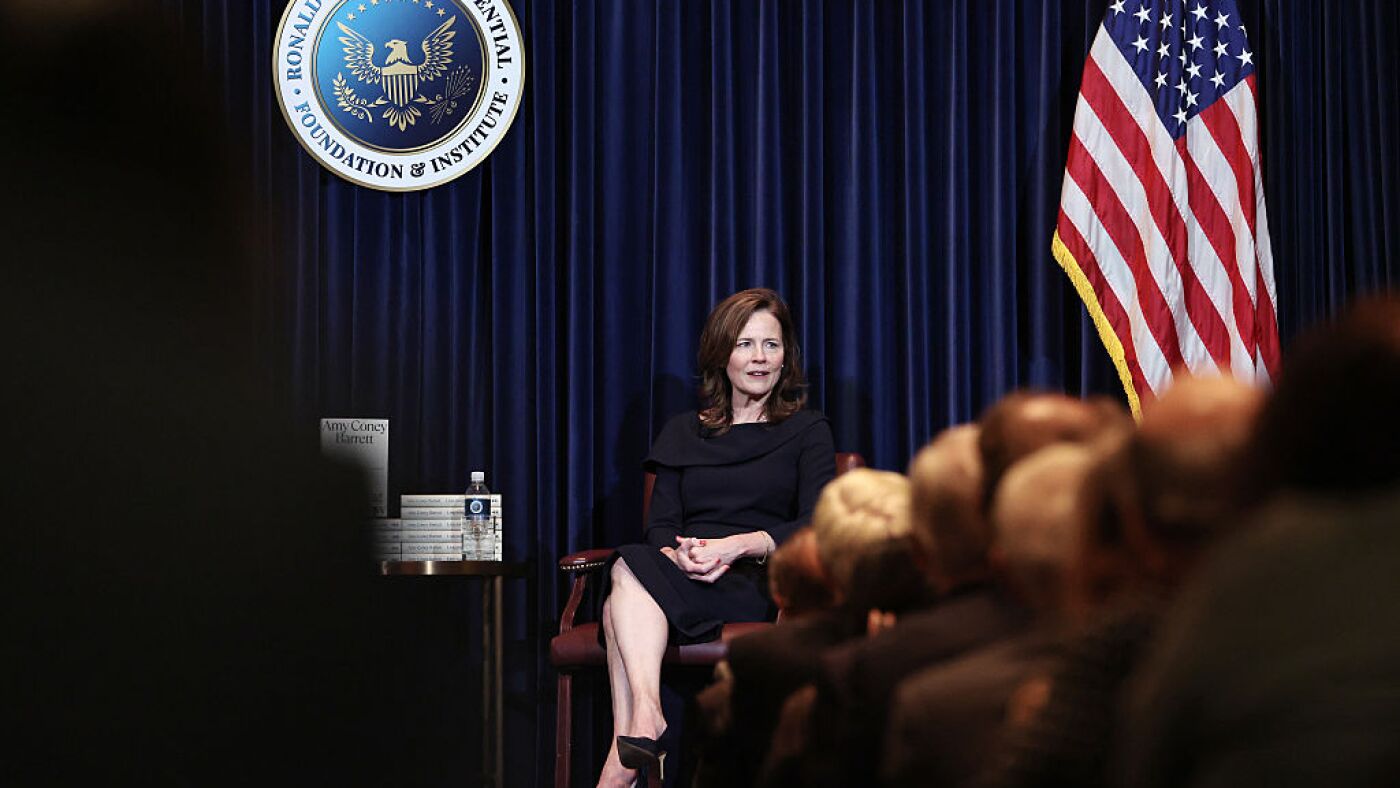
Supreme Court Justice Amy Coney Barrett speaks at the Reagan Library on Sept. 9, 2025, in Simi Valley, Calif. Barrett discussed and signed copies of her new book, Listening to the Law: Reflections on the Court and Constitution.
Mario Tama/Getty Images
hide caption
toggle caption
Advertisement
Mario Tama/Getty Images
Even as the Supreme Court was handing down one legal thunderbolt after another last week, the justices were quietly releasing their annual financial reports. Justice Samuel Alito was the only sitting justice to request an extension, which he has done for 15 years. The disclosures do not give a complete account of the justices’ total income and wealth, but they give insights into their concertgoing, guest professorships and even their involvement in youth sports.
In addition to their salaries, much of the justices’ reported income came from their book deals. Justice Ketanji Brown Jackson led the pack earning more than $1.1 million last year for a total of roughly $4 million since her memoir, Lovely One, was published in 2024.
Justices Sonia Sotomayor, Neil Gorsuch, Amy Coney Barrett and retired Justice Anthony Kennedy also reported income from published books. Earnings from their books ranged from $849,000 for Barrett, to $300,000 for Gorsuch and $88,000 for Sotomayor, whose books include her 2013 autobiography and five children’s books. Justice Clarence Thomas, who previously earned $1.5 million for his 2007 memoir, listed no publisher payments last year, and Justice Brett Kavanaugh, one of 13 co-authors of a 2016 legal treatise, also received no payments last year. Kavanaugh is said to be working on a memoir but he listed no payments for the anticipated book. Alito does have a book coming out in the fall, but with his financial report still outstanding, there is no data on how much he was paid for the work in 2025.
Advertisement
The only two sitting justices who have not written books are Chief Justice John Roberts and Justice Elena Kagan.
Many justices also earned income from teaching at law schools. Roberts reported income from New England Law, located in Boston, and Gorsuch reported teaching income from George Mason University in Virginia. Thomas taught classes at Catholic University in Washington, D.C., and Barrett and Kavanaugh taught at Notre Dame Law School. Barrett graduated from the school and began teaching there 23 years ago; Kavanaugh has family connections to Notre Dame.
The disclosures also report gifts, travel, food and lodging that the justices received in 2025. Jackson and Sotomayor were the only two to report gifts. Jackson was given a painting for her chambers valued at $2,500, and Sotomayor reported a trip to Kansas City to watch the opening of a musical based on her children’s book, Just Ask.
In addition, she reported receiving free tickets worth $4,333 while on “a private trip to Puerto Rico.” The tickets were from the record label that represents Bad Bunny, and her trip coincided with the artist’s months-long concert series in San Juan. Sotomayor’s parents were from Puerto Rico, and she has spent much time there over the years.
Advertisement
The justices also disclosed significant reimbursements for travel throughout 2025. Thomas’ travel, food and lodging expenses were paid for by the Hoover Institution for speaking at a celebration of conservative economist Thomas Sowell.
Sotomayor, Gorsuch, Barrett and Jackson were reimbursed for international travel, where they gave speeches, spoke about their books or taught. Roberts was the only sitting member of the court not to report any gifts or travel reimbursements.
The annual filings also shed some light on the justices’ activities off the bench. Kavanaugh reported that in addition to his duties as a Supreme Court justice, he serves as a coach to multiple D.C.-area Catholic Youth Organization girls’ basketball teams. Coach K, as he is known by his players, wrote the court’s June decision declaring that states can ban transgender women and girl athletes from playing on women’s and girls’ sports teams.
The justices’ salaries are established by law. The chief justice earns the most, at $320,700 per year. The eight associate justices earn $306,600 per year. While that is a lot of money to most Americans, the justices and even their law clerks could earn more the minute they leave their Supreme Court jobs for large law firms.
Roberts was the only member of the court to report investing in individual stocks. Alito in the past has also owned shares of individual stocks, but his report is not due for three months when his extension runs out. For the most part, the justices do not own individual stocks, but do invest in index funds, mutual funds and other such investment programs in order to both make money and limit potential conflicts of interest that would require their recusal from certain cases.
Advertisement
However — and this is a big however — the financial reporting forms the justices are required to fill out are so unspecific and the reporting ranges for investment earnings are so broad that it is impossible to determine any justice’s overall wealth. In addition, the current value of the justices’ homes isn’t reported. Neither is their spouses’ income, which in the case of the chief justice, for instance, likely far exceeds his take-home pay.
At least two structural columns buckled and failed in a 37-story office tower in Midtown Manhattan on Tuesday, prompting evacuations of nearby streets and buildings. While city officials asserted that the tower was in no danger of collapsing completely, outside engineers said further failures in the structure could not be ruled out.
A pair of columns that failed completely were part of the tower’s existing structure. A New York Times review of images and videos from inside the building has found that several floors were added atop these columns.
Advertisement
City officials said in a news conference on Tuesday that the building was continuing to move, while they simultaneously assured the city that the building would not suffer “total collapse.” “The way this building is constructed, it’s a steel-frame building,” John Esposito, a chief in the Fire Department in New York, said at the afternoon news conference. “So, it would not be a total collapse. It would be more of a localized collapse.” Still, he said, “that remains our concern, that it’s moved.”
Advertisement
Engineers said that the movement itself was cause for concern. In a properly designed steel building, they said, loads should redistribute quickly to surviving structural supports if columns failed.
Joe DiPompeo, a former president of the Structural Engineering Institute at the American Society of Civil Engineers, said that if the structure had been overloaded, he would expect any movement “to happen very quickly,” rather than gradually.
“Generally when a column buckles, it’s a sudden failure,” Mr. DiPompeo said. He said that a full collapse remained unlikely given the redundancies built into the building codes.
Advertisement
Engineers often refer to the most dangerous possibility as a progressive collapse, a process in which structures near the initial failure become overstressed and also fail, potentially bringing down the building if the sequence continues. While unlikely, it cannot be ruled out, Mr. DiPompeo said.
Footage recorded from inside the building shows at least two structural columns appear to have failed completely, Mr. DiPompeo said. Other nonstructural, interior walls — or at least the metal “studs” that were in place to hold them up — also appear to have deformed.
Advertisement
“The only way that really happens is if the floor above them dropped. It looks like the floor above could have dropped a foot or two, which is obviously not a good situation,” Mr. DiPompeo said.
@fernando40tiktok.commarc via Storyful
Advertisement
Advertisement
Image from @fernando40tiktok.commarc via Storyful
Advertisement
Image from @Bogs4NY via X
Advertisement
The 37-story building is in the process of being converted from office space into residential units. Four new floors and a large vertical portion were added onto the existing building in recent months. The vertical portion consists of a stack of over a dozen new floors cantilevered out over the existing building below.
Engineers said that there was nothing inherently wrong with adding residential floors or the cantilevered section above the columns that failed, as long as the original structure and the modifications had properly accounted for the added weight and wind loads.
“The cantilever alone doesn’t change anything,” Mr. DiPompeo said, but it does put additional load on the columns underneath — a factor that should have been reflected in the design.
Advertisement
Nathan Berman, managing principal and founder of MetroLoft, the developer overseeing the conversion, said on Tuesday that “this incident is nothing more than a typical construction mishap.”
He said two columns near the northwest corner of the tower had bent under the weight of additions to the building above, most likely because those columns had not been properly reinforced, though he said an investigation would determine the cause. The rest of the columns, he said, “picked up the weight.” He estimated the affected floors above the failed columns had sagged by a maximum of four inches.
Advertisement
Mr. Berman said that he expected the problems to be fixed and the project to be completed with, at most, a slight delay.
On Tuesday evening, installation of temporary shoring was set to begin shortly, in order to help stabilize the 20th and 21st floors of the building.