
Connect with us

News

Heat wave continues to boil the Midwest and East Coast while storms brew behind it

Published

on

Heat wave continues to boil the Midwest and East Coast while storms brew behind it

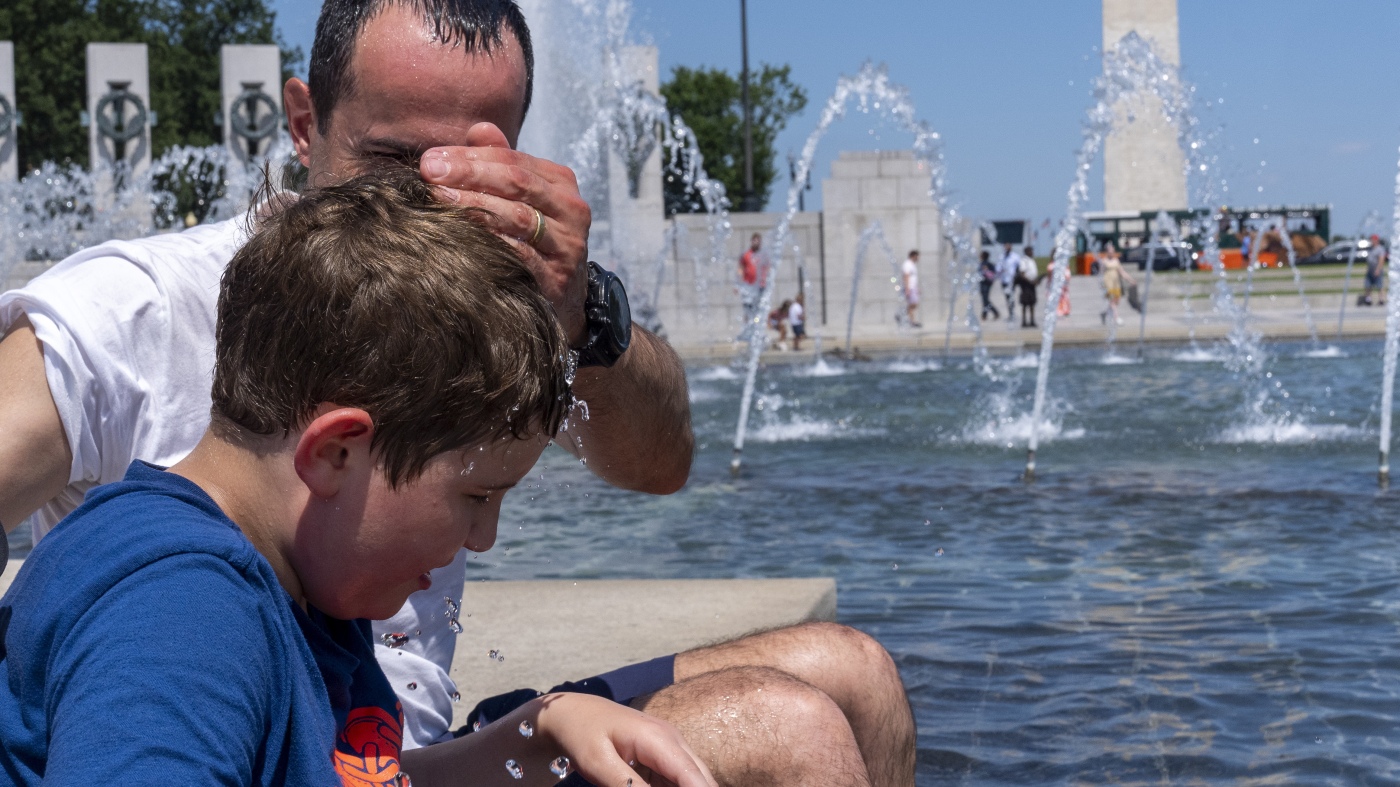
Rafael Fontana, 8, gets cooled off by his father Carlos Fontana, both from Chicago, at the Rainbow Pool at the World War II Memorial in Washington, D.C., on Friday, June 21, 2024.

Alex Brandon/AP


hide caption

toggle caption

Advertisement

Alex Brandon/AP

A major heat wave has blanketed much of the U.S. in scorching temperatures for about a week — and in many places the hot spell is far from over.

As of Saturday morning, more that 100 million people in the U.S. were under heat alerts, including large swaths of Ohio, Pennsylvania, Delaware, New Jersey, Connecticut, Indiana, Michigan, West Virginia, Virginia, New York and Maryland.

The Midwest is expected to see some relief from the heat after Saturday. But temperatures are expected to peak this weekend from Washington, D.C., to New York. In the South, the hottest weather — which is forecast to be well into the triple digits — is expected to arrive early next week.

Advertisement

On top of the hot spell, widespread showers and thunderstorms will threaten parts of the Northeast and Midwest. Southern Wisconsin and northeast Iowa are at risk of flash flooding Saturday, according to the National Weather Service.

The extreme temperatures are caused by a heat dome — a high pressure system that pushes hot air down and traps it — that is becoming more common and intense as a result of climate change.

Northeast heat will feel like triple digits this weekend

Much of the Northeast will be hot and humid this weekend, with some of the highest temperatures hitting New Jersey.

The heat index in Trenton — what the weather actually feels like when you account for both the temperature and humidity — is forecast to reach 107 degrees Saturday. In Newark, the heat index could go as high as 106 degrees, while New Brunswick could climb to 105 degrees.

The heat wave will also bake New York, though temperatures will likely not reach triple digits, according toNWS New York.

Advertisement

In Pittsburgh and the surrounding area, the heat index was expected to climb to 105 degrees Saturday. NWS advised to stay indoors and warned not to leave children or pets in unattended vehicles, where the heat could reach “lethal temperatures in a matter of minutes.”

Temperatures in the region are forecast to cool down on Sunday as a cold front moves in. At the same time, intense thunderstorms will begin to form — possibly leading to tornadoes in western Pennsylvania.

“Some storms will be severe with winds being the main threat. A tornado or two can’t be ruled out,” NWS Pittsburg advised.

In Philadelphia, the peak of the city’s heat wave will occur this weekend, with the heat index reaching 105 degrees on Sunday. The City of Brotherly Love will also could some intense showers at the end of the weekend.

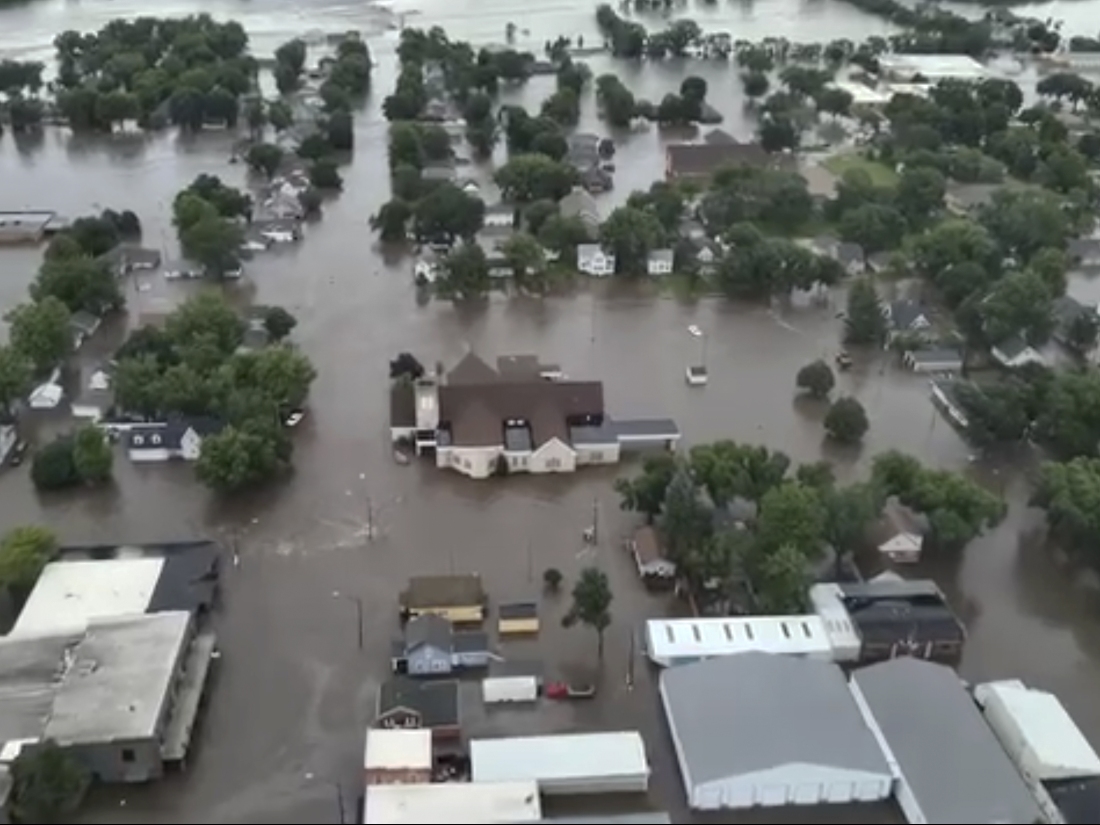
This image provided by Sioux County Sheriff shows City of Rock Valley, Iowa on Saturday, June 22, 2024. Gov. Kim Reynolds sent helicopters to the small town to evacuate people from flooded homes Saturday, the result of weeks of rain, while much of the United States longed for relief from yet another round of extraordinary heat.(Sioux County Sheriff via AP)

This image provided by Sioux County Sheriff shows City of Rock Valley, Iowa on Saturday, June 22, 2024.

AP/Sioux County Sheriff

Advertisement


hide caption

toggle caption

AP/Sioux County Sheriff

Advertisement

Parts of Iowa and Wisconsin are under flood watch

In Wisconsin, a flood watch has been issued for the lower half of the state, from Wausau to Janesville. So far, Milwaukee is not under a flood warning. About 1 to 3 inches of rain is expected Saturday, with some areas forecast to receive 3 to 5 inches.

Parts of northern and central Iowa, including Fort Dodge and Waterloo, are already experiencing severe flooding.

In Rock Valley, about an hour north of Sioux City, some residents were ordered to evacuate on Friday due to floodwaters. On Saturday, dive teams and swift boat crews searched for any remaining residents in the town. Local officials added that the city was without running water.

On Saturday morning, Iowa Gov. Kim Reynolds issued a disaster proclamation in the northwest part of the state, including Rock Valley and Sioux County.

The heat wave is sending many to emergency rooms

Hospital data from across the country show an uptick of emergency room visits related to heat illness or heat stroke.

Advertisement

Heat stresses people’s hearts, which could lead to heart attacks. It also worsens air quality, triggering more cases of respiratory issues. Those heat risks are compounded by the humidity.

Dr. George Chiampas, an emergency medicine specialist at Northwestern Memorial Hospital in Chicago, said the real danger is the humidity.

“It’s like putting Saran Wrap over you, and you can’t basically dissipate or push the heat out into a cooler environment,” Chiampas told NPR’s Morning Edition on Friday. “So that humidity, quite frankly, is the most burdensome of what we’re dealing with.”

Over the last five years, emergency rooms in the Midwest, including those in Michigan and Wisconsin, saw on average about 350 heat patients for every 100,000 admissions, according to the Centers for Disease Control and Prevention. In recent days, that number was nearly double.

Emergency calls have also increased in New Hampshire, Vermont and Maine.

Advertisement

NPR’s Alejandra Borunda contributed reporting.

News

Supreme Court blocks redrawing of New York congressional map, dealing a win for GOP

Published

on

Supreme Court blocks redrawing of New York congressional map, dealing a win for GOP

The Supreme Court

Win McNamee/Getty Images


hide caption

toggle caption

Advertisement

Win McNamee/Getty Images

The Supreme Court on Monday intervened in New York’s redistricting process, blocking a lower court decision that would likely have flipped a Republican congressional district into a Democratic district.    
  
At issue is the midterm redrawing of New York’s 11th congressional district, including Staten Island and a small part of Brooklyn. The district is currently held by a Republican, but on Jan. 21, a state Supreme Court judge ruled that the current district dilutes the power of Black and Latino voters in violation of the state constitution.  
  
GOP Rep. Nicole Malliotakis, who represents the district, and the Republican co-chair of the state Board of Elections promptly appealed to the U.S. Supreme Court, asking the justices to block the redrawing as an unconstitutional “racial gerrymander.” New York’s congressional election cycle was set to officially begin Feb. 24, the opening day for candidates to seek placement on the ballot.  
  
As in this year’s prior mid-decade redistricting fights — in Texas and California — the Trump administration backed the Republicans.   
 
Voters and the State of New York contended it’s too soon for the Supreme Court to wade into this dispute. New York’s highest state court has not issued a final judgment, so the voters asserted that if the Supreme Court grants relief now “future stay applicants will see little purpose in waiting for state court rulings before coming to this Court” and “be rewarded for such gamesmanship.” The state argues this is an issue for “New York courts, not federal courts” to resolve, and there is sufficient time for the dispute to be resolved on the merits. 
  
The court majority explained the decision to intervene in 101 words, which the three dissenting liberal justices  summarized as “Rules for thee, but not for me.” 
 
The unsigned majority order does not explain the Court’s rationale. It says only how long the stay will last, until the case moves through the New York State appeals courts. If, however, the losing party petitions and the court agrees to hear the challenge, the stay extends until the final opinion is announced. 
 
Dissenting from the decision were Justices Sonia Sotomayor, Elena Kagan, and Ketanji Brown Jackson. Writing for the three, Sotomayor  said that  if nonfinal decisions of a state trial court can be brought to highest court, “then every decision from any court is now fair game.” More immediately, she noted, “By granting these applications, the Court thrusts itself into the middle of every election-law dispute around the country, even as many States redraw their congressional maps ahead of the 2026 election.” 

Monday’s Supreme Court action deviates from the court’s hands-off pattern in these mid-term redistricting fights this year. In two previous cases — from Texas and California — the court refused to intervene, allowing newly drawn maps to stay in effect.  
  
Requests for Supreme Court intervention on redistricting issues has been a recurring theme this term, a trend that is likely to grow.  Earlier last month  the high court allowed California to use a voter-approved, Democratic-friendly map.  California’s redistricting came in response to a GOP-friendly redistricting plan in Texas that the Supreme Court also permitted to move forward. These redistricting efforts are expected to offset one another.     
   
But the high court itself has yet to rule on a challenge to Louisiana’s voting map, which was drawn by the state legislature after the decennial census in order to create a second majority-Black district.  Since the drawing of that second majority-black district, the state has backed away from that map, hoping to return to a plan that provides for only one majority-minority district.    
     
The Supreme Court’s consideration of the Louisiana case has stretched across two terms. The justices failed to resolve the case last term and chose to order a second round of arguments this term adding a new question: Does the state’s intentional creation of a second majority-minority district violate the constitution’s Fourteenth and Fifteenth Amendments’ guarantee of the right to vote and the authority of Congress to enforce that mandate?    
Following the addition of the new question, the state of Louisiana flipped positions to oppose the map it had just drawn and defended in court. Whether the Supreme Court follows suit remains to be seen. But the tone of the October argument suggested that the court’s conservative supermajority is likely to continue undercutting the 1965 Voting Rights Act.   

Advertisement
Continue Reading

News

Map: Earthquake Shakes Central California

Published

on

Map: Earthquake Shakes Central California

Note: Map shows the area with a shake intensity of 3 or greater, which U.S.G.S. defines as “weak,” though the earthquake may be felt outside the areas shown.  All times on the map are Pacific time. The New York Times

A minor earthquake with a preliminary magnitude of 3.5 struck in Central California on Monday, according to the United States Geological Survey.

The temblor happened at 7:17 a.m. Pacific time about 6 miles northwest of Pinnacles, Calif., data from the agency shows.

As seismologists review available data, they may revise the earthquake’s reported magnitude. Additional information collected about the earthquake may also prompt U.S.G.S. scientists to update the shake-severity map.

Source: United States Geological Survey | Notes: Shaking categories are based on the Modified Mercalli Intensity scale. When aftershock data is available, the corresponding maps and charts include earthquakes within 100 miles and seven days of the initial quake. All times above are Pacific time. Shake data is as of Monday, March 2 at 10:20 a.m. Eastern. Aftershocks data is as of Monday, March 2 at 11:18 a.m. Eastern.

Advertisement
Continue Reading

News

US says Kuwait accidentally shot down 3 American jets

Published

on

US says Kuwait accidentally shot down 3 American jets

The U.S. and Israel have been conducting strikes against targets in Iran since Saturday morning, with the aim of toppling Tehran’s clerical regime. Iran has fired back, with retaliatory assaults featuring missiles and drones targeting several Gulf countries and American bases in the Middle East.

“All six aircrew ejected safely, have been safely recovered, and are in stable condition. Kuwait has acknowledged this incident, and we are grateful for the efforts of the Kuwaiti defense forces and their support in this ongoing operation,” Central Command said.

“The cause of the incident is under investigation. Additional information will be released as it becomes available,” it added.

In a separate statement later Monday, Central Command said that American forces had been killed during combat since the strikes began.

“As of 7:30 am ET, March 2, four U.S. service members have been killed in action. The fourth service member, who was seriously wounded during Iran’s initial attacks, eventually succumbed to their injuries,” it said.

Advertisement

Major combat operations continue and our response effort is ongoing. The identities of the fallen are being withheld until 24 hours after next of kin notification,” Central Command added.

This story has been updated.

Continue Reading

Trending