News
Greenland: JD Vance takes ominous message to Danish territory
ReutersA green shimmer, like a curtain of light being drawn across the night sky, formed beside the impossibly bright stars above Nuuk late on Friday evening.
The appearance of the spectacular northern lights – a common wonder in these parts – seemed to mark the end of a hugely significant day in the arctic, one that brought icebound Greenland’s hopes and challenges into the sharpest relief.
It was a day in which an acquisitive foreign power had sent an uninvited delegation to the world’s largest island with an uncomfortable message.
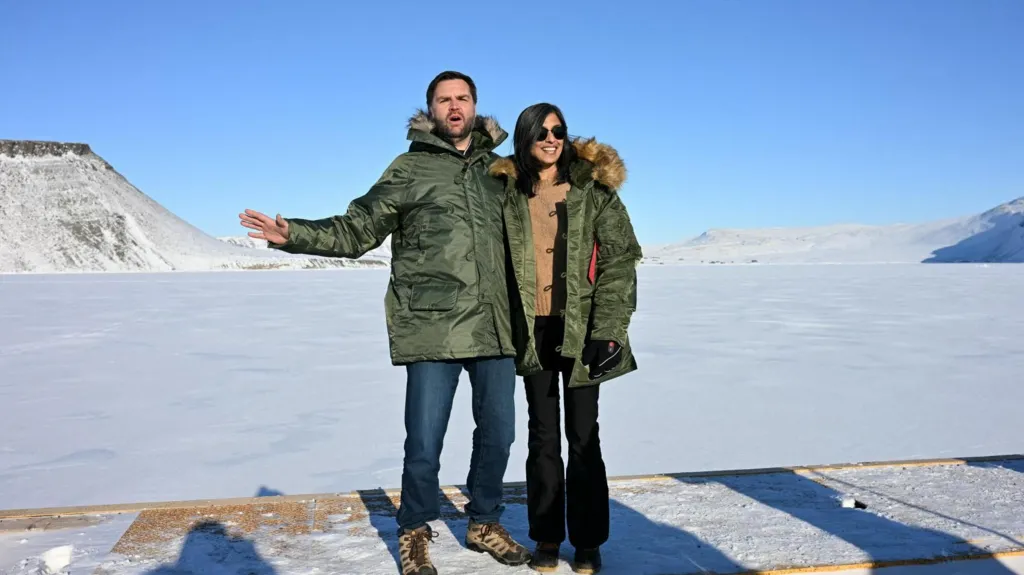
On a brief visit to a remote US military base in the far north of Greenland, US Vice-President JD Vance may have tried at times to soften his boss’s stated aim of simply annexing the autonomous Danish territory.
“We do not think that military force is ever going to be necessary,” Vance said, perhaps attempting to sound reassuring.
But the vice-president’s overarching message remained stark and intimidating: the world, the climate, and the Arctic region are changing fast, and Greenland needs to wake up to threats posed by an expansionist China; long-standing Western security partnerships have run their course; the only way the island can protect itself, its values and its mineral wealth is by abandoning weak and miserly Danish overlords and turning instead to the muscular and protective embrace of the US.
“We need to wake up from a failed, 40-year consensus that said that we could ignore the encroachment of powerful countries as they expand their ambitions.
“We can’t just bury our head in the sand – or, in Greenland, bury our head in the snow – and pretend that the Chinese are not interested in this very large landmass,” Vance told US troops at the Pituffik base.
If you look at a map of the world that has the north pole at its centre, rather than the equator, it is easy to see how Greenland suddenly switches from being a bland, easily overlooked smudge of uninhabited territory and into a key strategic landmass at the heart of what many analysts now accept as an emerging power struggle between China, the US, and Russia, for control of the arctic, its minerals and its shipping lanes.
But the speed and contempt with which the Trump White House has rejected its traditional reliance on Western allies – Nato in particular – has left its partners bewildered.
“Not justifiable,” was the bristling response of Danish Prime Minister Mette Frederiksen after hearing Vance attack her government as he stood on its sovereign territory.
‘Like a threat’
But 1,500km (930 miles) south of America’s Pituffik base, in Greenland’s capital, Nuuk, the American story vied for attention with a very different local event on Friday.
“We will prevail,” a smiling crowd sang, at a ceremony to celebrate the formation of a new coalition government for Greenland.
The mood felt mostly joyful and communal, with people locking arms and swaying gently as a band played inside the town’s house of culture.
It was a powerful reminder of the shared values that bind Greenland’s tiny, and overwhelmingly native Inuit population together – the need for consensus and co-operation in an often hostile natural climate, the desire to protect and celebrate Inuit culture and the wish to be respected by outsiders, be they from familiar but distant Denmark or marginally closer America.
“There are many ways to say things. But I think the way [Trump] is saying it is not the way. It’s like a threat,” said Lisbeth Karline Poulsen, 43, a local artist attending the ceremony.
Her reaction appeared to capture the broader mood here – a recent poll showed just 6% of the population support the idea of being part of the US.
The journey to independence
Under its new government, and with overwhelming public support, Greenland is beginning a slow, very cautious move towards full independence from Denmark.
It’s a process that will likely take many years, and which will involve lengthy dialogue with both Copenhagen and with Washington.
After all, Greenlanders well understand that their economy needs to be far more developed if their bid for independence is to stand any realistic chance of success.
But they need to balance that development against realistic fears of exploitation by powerful outside commercial forces.
Which brings us to the fundamental confusion, in Greenland and beyond, about the Trump administration’s approach towards their territory.
What does America want?
On his visit, Vance mentioned Greenland’s aspirations for independence, and implied that America’s real intention was not a sudden annexation of the island, but something far more patient and long-term.
“Our message is very simple, yes, the people of Greenland are going to have self-determination. We hope that they choose to partner with the United States, because we’re the only nation on earth that will respect their sovereignty and respect their security.”
If that is genuinely the American pitch – Mr Trump’s messaging remains more aggressive than Mr Vance’s – then Greenlanders can surely relax a little and take their time.
There are still large reserves of goodwill towards the US here, and a keen interest in doing more business with American companies.
On the security front, a 74-year-old treaty with Denmark permitting the US to increase its military presence in Greenland at any time – from new bases to submarine harbours – should surely take care of Washington’s concerns about countering the threat from China, just as it did during the Cold War years.
What remains puzzling is Donald Trump’s impatience – the same impatience he’s displayed in attempting to negotiate an end to the war in Ukraine.
Short of owning Greenland, America could get everything it desires and needs from this vast island without much difficulty. Instead, many people in Nuuk feel they’re being bullied.
It’s a deeply counterproductive approach, which has already forced Washington into one humiliating climbdown – cancelling a planned cultural tour by Vance’s wife, Usha, to Nuuk and another town in the face of planned local protests.
A slower, more respectful, behind-the-scenes sort of engagement would, surely, make more sense.
But that’s not to every politician’s taste.
News
Pentagon says Navy secretary is leaving, the latest departure of a top defense leader
Secretary of the Navy John Phelan speaks, as President Trump listens, at Trump’s Mar-a-Lago club on Dec. 22 in Palm Beach, Fla.
Alex Brandon/AP
hide caption
toggle caption
Alex Brandon/AP
WASHINGTON — Navy Secretary John Phelan is leaving his job, the Pentagon abruptly announced Wednesday, the first head of a military service to depart during President Trump’s second term but just the latest top defense leader to step down or be ousted.
No reason was given for the unexpected departure of the Navy’s top civilian official, coming as the sea service has imposed a blockade of Iranian ports and is targeting ships linked to Tehran around the world during a tenuous ceasefire in the war. Another Trump loyalist is taking over as acting head of the Navy: Undersecretary Hung Cao, a 25-year Navy combat veteran who ran unsuccessful campaigns for the U.S. Senate and House in Virginia.


Phelan’s departure is the latest in a series of shakeups of top leadership at the Pentagon, coming just weeks after Defense Secretary Pete Hegseth fired the Army’s top uniformed officer, Gen. Randy George. Hegseth also has fired several other top generals, admirals and defense leaders since taking office last year.
The firings began in February 2025, when Hegseth removed military leaders, including Adm. Lisa Franchetti, the Navy’s top uniformed officer, and Gen. Jim Slife, the No. 2 leader at the Air Force. Trump also fired Gen. Charles “CQ” Brown Jr. as chairman of the Joint Chiefs of Staff.
Showing how sudden the latest move was, Phelan had addressed a large crowd of sailors and industry professionals on Tuesday at the Navy’s annual conference in Washington and spoke with reporters about his agenda. He also hosted the leaders of the House Armed Services Committee to discuss the Navy’s budget request and efforts to build more ships, according to a social media post from his office.
Pentagon spokesman Sean Parnell said in a post on X that Phelan was “departing the administration, effective immediately.”
Phelan had been a major Trump donor
Phelan had not served in the military or had a civilian leadership role in the service before Trump nominated him for secretary in late 2024. He was seen as an outsider being brought in to shake up the Navy.
Hung Cao speaks during the Republican National Convention on July 16, 2024, in Milwaukee.
Matt Rourke/AP
hide caption
toggle caption
Matt Rourke/AP
Phelan was a major donor to Trump’s campaign and had founded the private investment firm Rugger Management LLC. According to his biography, Phelan’s primary exposure to the military came from an advisory position he held on the Spirit of America, a nonprofit that supported the defense of Ukraine and the defense of Taiwan.
The Associated Press could not immediately reach Phelan’s office for comment. The White House did not answer questions and instead responded by sending a link to Parnell’s statement.
Phelan is leaving during a busy time for the Navy. It has three aircraft carriers deployed in or heading to the Middle East, while the Trump administration says all the armed forces are poised to resume combat operations against Iran should the ceasefire expire.
The Navy also has maintained a heavy presence in the Caribbean, where it has been part of a campaign of strikes against alleged drug boats. It also played a major role in the capture of Venezuelan leader Nicolás Maduro in January.
New acting Navy secretary ran unsuccessful bids for Congress
Taking over as acting secretary is Cao, who ran a failed U.S. Senate bid in Virginia to try to unseat Democratic Sen. Tim Kaine in 2024. He had Trump’s endorsement in the crowded Republican primary and gave a speech at the 2024 Republican National Convention.
Cao’s biography includes fleeing Vietnam with his family as a child in the 1970s. In a campaign video for his Senate bid, he compared Vietnam’s communist regime during the Cold War to the administration of Democratic President Joe Biden.
During his one debate with Kaine, Cao criticized COVID-19 vaccine mandates for service members as well as the military’s diversity, equity and inclusion efforts.
“When you’re using a drag queen to recruit for the Navy, that’s not the people we want,” Cao said from the debate stage. “What we need is alpha males and alpha females who are going to rip out their own guts, eat them and ask for seconds. Those are the young men and women that are going to win wars.”
Trump and Hegseth have railed against DEI in the military, banning the efforts and firing people accused of supporting such programs.
When he ran for Congress in Virginia in 2022, Cao expressed opposition to aid for Ukraine during a debate against his Democratic opponent.
“My heart goes out to the Ukrainian people. … But right now we’re borrowing $55 billion from China to pay for the war in Ukraine. Not only that, we’re depleting our national strategic reserves,” Cao said.
Cao graduated from the prestigious Thomas Jefferson High School for Science and Technology in Alexandria, Virginia, before attending the U.S. Naval Academy.
He was commissioned as a special operations officer and went on to serve with SEAL teams and special forces in Iraq, Afghanistan and Somalia before retiring at the rank of captain, according to his Senate campaign biography.
Cao also earned a master’s degree in physics and had fellowships at the Massachusetts Institute of Technology and Harvard University.
Since becoming Navy undersecretary, Cao has championed returning to duty service members that refused a Biden-era mandate to take the COVID-19 vaccine.
News
California Candidates to Appear in First Major Debate After Swalwell
Candidates in California’s volatile race for governor will meet Wednesday night for the first televised debate since Eric Swalwell dropped out, each looking to seize momentum in the tight contest.
The debate, being held at the television studio of KRON4 in San Francisco, will include four Democrats and two Republicans who are tightly bunched in recent polls, with many voters still undecided less than six weeks before the June 2 primary.
Mr. Swalwell, a Democrat, had just begun to emerge as a Democratic front-runner when his campaign swiftly collapsed after he was accused of sexual assault in news reports on April 10.
Candidates have taken relatively few risks so far in debates around the state, but every candidate is now eyeing a chance to jump to the front of the pack.
“Even though we have seen some movement in the last couple of weeks, it continues to be a fairly crowded, fractured field,” said Sara Sadhwani, an assistant professor of politics at Pomona College. “So candidates need to be able to grab attention in a debate like this.”
The debate comes as Xavier Becerra, a Democrat and former California attorney general, has enjoyed a surge of support in polls since Mr. Swalwell dropped out of the race.
Mr. Becerra and Matt Mahan, the mayor of San Jose, did not originally meet the threshold to participate in Wednesday’s debate when Mr. Swalwell was running. But they both qualified after receiving enough support in a follow-up poll that debate organizers commissioned once Mr. Swalwell had dropped out.
The other Democrats scheduled to participate are Tom Steyer, a former hedge fund manager, and Katie Porter, a former congresswoman, each of whom have been polling near the top of the Democratic field for several weeks. The Republicans in the debate are Steve Hilton, a former Fox News host who has been endorsed by President Trump, and Chad Bianco, the sheriff of Riverside County.
All candidates run on the same ballot in California’s nonpartisan primary, with the two who receive the most votes advancing to the general election, regardless of their party affiliation. The large number of Democratic candidates has created fear among state party leaders that their voters could splinter, potentially allowing two Republicans to sweep the primary in this heavily Democratic state.
The odds of that happening have decreased since Mr. Swalwell dropped out and another Democrat, Betty Yee, withdrew on Monday. But Rusty Hicks, the chairman of the California Democratic Party, still believes there are too many Democrats in the race and has urged those lagging in polls to end their campaigns. (The actual ballot will include 61 candidates for governor, most of whom are completely unknown to voters.)
The messy race to succeed Gov. Gavin Newsom, who cannot run for re-election because of term limits, has played out as the most unpredictable contest California has seen in a generation. It has attracted a sprawling field but no one with the star power of former Gov. Arnold Schwarzenegger or the political might of Mr. Newsom or former Gov. Jerry Brown.
Much of California’s Democratic establishment is still figuring out whom to back in the turbulent race.
Mr. Newsom has not endorsed anyone, saying he trusts voters to elect someone “who reflects the values and direction Californians believe in.” Representative Nancy Pelosi, the influential former House speaker from San Francisco, and Senator Alex Padilla also have not announced their favorites. Senator Adam Schiff endorsed Mr. Swalwell earlier this year but quickly withdrew his support after the accusations against him were published.
On Tuesday, Ms. Yee endorsed Mr. Steyer, praising his work to fight climate change and engage young voters. Mr. Steyer has swamped his competitors with a raft of advertising by pouring $134 million from his personal fortune into his campaign.
Also on Tuesday, Mr. Becerra, whose campaign had appeared to be flailing until Mr. Swalwell dropped out, received the endorsement of Robert Rivas, the Democratic speaker of the California State Assembly. Mr. Rivas said he had encouraged Mr. Becerra to run for governor because he was impressed by his work as California’s attorney general during President Trump’s first term.
“He understands both the policy and the politics,” Mr. Rivas said in an interview. “And he has a track record, in my opinion, of delivering results under pressure.”
The 90-minute debate on Wednesday begins at 7 p.m. PT and will be broadcast and streamed by KRON and other California stations.
News
Here’s What the New Virginia House Map Looks Like
Virginians approved a new congressional map on Tuesday that would aggressively gerrymander the state in the Democrats’ favor, giving the party as many as four more U.S. House seats.
The new map draws eight safely Democratic districts and two competitive districts that lean Democratic, according to a New York Times analysis of 2024 presidential results. It leaves just one safe Republican seat, compared with the five seats the G.O.P. holds on the current map.
The proposed map was drawn by Democratic state legislators and approved by Gov. Abigail Spanberger, a Democrat. It eliminates three Republican-held seats in part by slicing the densely populated suburbs in Arlington and Fairfax Counties and reallocating their overwhelmingly Democratic voters into five congressional districts, some stretching more than a hundred miles into Republican areas.
Perhaps the most extreme new district is the Seventh, which begins at the Potomac River and stretches to the west and south in a manner that resembles a pair of lobster claws. Several well-known Virginia Democrats have already announced their candidacies and begun campaigning in the district.
Reid J. Epstein contributed reporting.
-
Culture2 minutes agoPoetry Challenge Day 4: What The Stars Can Teach Us About Love
-
Lifestyle8 minutes agoThe Japanese Designers Changing Men’s Wear
-
Education14 minutes agoOpinion | Yale Has Come Up With a Surefire Way to Make a Terrible Situation Worse
-
Technology20 minutes agoThe Iranian women Trump ‘saved’ from execution are simultaneously real and AI-manipulated
-
World26 minutes agoFormer Mexican beauty queen found shot dead as investigators examine possible family involvement: reports
-
Politics32 minutes agoManhattan DA’s office employee charged with sexual abuse after alleged incident on Queens subway
-
Health38 minutes agoRed hair may be increasing as study points to surprising evolution trend
-
Sports44 minutes agoTrump envoy asks FIFA to replace Iran with Italy in 2026 World Cup: report