Starlink, the satellite internet service controlled by billionaire Elon Musk and his rocket company SpaceX, is expanding its footprint in the federal government weeks after the billionaire began slashing the federal workforce and agency budgets under President Donald Trump’s direction.
Multiple federal agencies are exploring the idea of adopting SpaceX’s Starlink for internet access — and at least one agency, the General Services Administration (GSA), has done so at the request of Musk’s staff, according to someone who worked at the GSA last month and is familiar with its network operations — despite a vow by Musk and Trump to slash the overall federal budget.
Starlink’s expansion is sparking outcry among congressional Democrats because of Musk’s dual positions: He is the founder and CEO of SpaceX, which owns Starlink, and a senior adviser to Trump with an expansive portfolio across the government. As a shareholder in SpaceX, he could gain financially if Starlink is granted additional business.
A Starlink satellite dish.NBC News
Starlink, which routes internet traffic through low-orbit satellites, has gained popularity in rural areas and disaster zones because it doesn’t require fiber cables or cellular towers. Users say the Starlink terminals have real advantages in terms of how easy they are to set up and how mobile they are. One downside, though, is that Starlink satellites have an expected lifespan of five years, so the company must replenish them.
The growth of Starlink has also given Musk unusual influence in the U.S. and abroad, as he can unilaterally decide to deploy or withhold internet service during moments of disaster, war or other crises.
Advertisement
At least seven federal offices including the Defense and Commerce departments were already established customers of Starlink when Trump took office in January, according to a federal government database of awarded contracts. The database lists $4.1 million in federal contracts in 2022 and $1.9 million in 2023. The existing spending includes a test at sea by the National Oceanic and Atmospheric Administration.
Now, the number of customers appears set to grow.
According to a person who worked at GSA last month and is familiar with its network operations, the agency had installed Starlink by mid-February. The service was being used by staff members of Musk’s Department of Government Efficiency, this person said. NBC News also saw internal correspondence confirming it had been installed at the GSA’s offices in Washington at 1800 F Street NW. Starlink was installed within days of the DOGE team’s request, the person said, while a more typical process should take weeks or months for reviews concerning security, procurement, business needs and more. A separate person working at GSA showed NBC News documentation indicating that a Starlink network was available for use at the facility.
The GSA did not immediately respond to a request for comment.
One of the agencies deliberating a contract with Starlink burst into public debate last week: the Federal Aviation Administration, which for years has been looking to upgrade the infrastructure underlying its communications systems. The FAA awarded a $2.4 billion contract to Verizon in 2023, and although the contract is due to run for 15 years, Musk posted on X that he wants to pivot to a rival Starlink system. He said on X that Starlink was sending terminals at “no cost to the taxpayer.”
Advertisement
It’s not clear exactly when the FAA began considering the use of Starlink. Musk approved a shipment of 4,000 Starlink terminals to the FAA last month, Bloomberg News reported.
A second agency is Customs and Border Protection, which has issued internal paperwork to authorize an evaluation of Starlink to help monitor the U.S. border, a spokesperson told FedScoop, a news site that covers the federal government. CBP’s interest in Starlink goes back at least to 2023, before Trump returned to office, according to a Department of Homeland Security document reported by FedScoop. CBP and DHS did not immediately respond to requests for comment.
And officials at a third federal agency are comparing Starlink to Verizon as a tool for communicating during a catastrophe, according to one person involved in the discussions who asked that their agency not be named in order to avoid reprisal. That process was initiated in February and appears to be under consideration as part of a normal process, the person said.
It’s unclear whether the agencies are coordinating their contract talks, and what dollar value any of the potential contracts may have. None of the three agencies appears to have made a final decision.
The White House, in response to written questions from NBC News, pledged to comply with ethics rules.
Advertisement
“President Trump and his entire administration is committed to executing a head to toe assessment of every contract the American people are funding with their taxpayer dollars,” White House spokesperson Harrison Fields said in a statement.
“Any contracts connected to Elon Musk’s very successful companies will comply with every government ethics rule as it pertains to potential conflicts of interests,” he said.
The White House did not immediately respond to a follow-up question on whether Starlink was in use at GSA.
Musk has publicly called for other federal agencies to adopt Starlink or award grant money to Starlink, including the Department of Agriculture and the Federal Communications Commission. In January, Musk said he was using Starlink from Trump’s Mar-a-Lago resort in Florida.
The possible deals for SpaceX’s Starlink are one of the tangible ways that Musk and his companies could benefit from the turnover in presidential administrations. The Trump administration has also ended at least two investigations into Musk companies that predated Trump’s return to power: a Justice Department probe into SpaceX hiring, and a Labor Department inquiry into alleged workplace discrimination at Tesla.
Advertisement
Musk’s statements about Starlink and the federal government have attracted some scrutiny.
Sen. Maria Cantwell, D-Wash., the ranking member on the Senate Commerce Committee, said Musk appeared to be trying to interfere in an already-awarded, 15-year federal contract with his statements about the FAA.
Musk’s posts on X “sure seem to raise serious red flags,” she said in a statement.
Cantwell said federal law requires procurements be competitive and made with public notice.
“We need answers now about how the Administration will enforce these laws to ensure aviation safety takes precedence over private gain,” she said.
Advertisement
The FAA has been close to canceling its existing Verizon contract, The Washington Post reported.
On Wednesday, SpaceX said media reports were false and that it was not trying to take over existing government contracts at the FAA.
“Starlink is a possible partial fix to an aging system,” SpaceX said in a post on X. The company said it was working with the FAA “to identify instances where Starlink could serve as a long-term infrastructure upgrade for aviation safety.”
Musk did not respond to requests for comment.
Verizon has said it’s not backing down from its FAA contract.
Advertisement
“Our Company is working on building the next generation system for the FAA which will support the Agency’s mission for safe and secure air travel,” Verizon said in a statement last week.
“We are at the beginning of a multi-year contract to replace antiquated, legacy systems. Our teams have been working with the FAA’s technology teams and our solution stands ready to be deployed. We continue to partner with the FAA on achieving its modernization objectives.”
Verizon said it had no further comment beyond the statement.
In a statement, the FAA did not directly address the Verizon contract but said: “To update our air traffic control system, it will require multiple companies and multiple technologies. That is why we are testing multiple communication technologies, including satellites, fiber and wireless to ensure the safety of the national airspace system. Beyond that, no decisions for other deployments have been made. Those decisions will be made by the FAA Administrator.”
Sales to government agencies are only one part of Starlink’s business. Other customers include United Airlines and the three biggest cruise ship operators. During the Super Bowl, T-Mobile broadcast an ad touting its partnership with Starlink to improve service in rural areas. More than 5 million people are using Starlink globally across 125 countries and territories, according to SpaceX.
Advertisement
For home use, Starlink advertises its service at $120 a month with a one-time $149 setup fee. It also advertises a “low usage” option for $80 a month.
Musk said in an X post in November that Starlink revenue “is how we are paying for humanity to get to Mars,” although SpaceX generally does not disclose the profitability or revenue from its Starlink division. In 2022, Musk said Starlink was losing money.
Starlink’s business with the federal government grew during the Biden administration, despite the sour relationship between Musk and then-President Joe Biden. In 2023, SpaceX won a Pentagon contract to develop a military version of Starlink called Starshield.
The Navy has been testing out Starlink on its warships but hasn’t made a large deployment yet. In 2023, senior crew on one ship broke Navy rules when they acquired a Starlink setup and used it while deployed at sea, leading to the court-martialing of at least one senior crew member, Navy Times reported.
Other satellite companies are racing to develop competitors to Starlink. Eutelsat, a European company, said Tuesday it was in talks with the E.U. to supply internet access to Ukraine with its OneWeb service. Amazon has been developing a low-orbit satellite internet service called Project Kuiper.
Advertisement
The Trump administration is also reviewing a proposed merger of two satellite operators — SES and Intelsat — whose combination would create a more powerful competitor to Starlink.
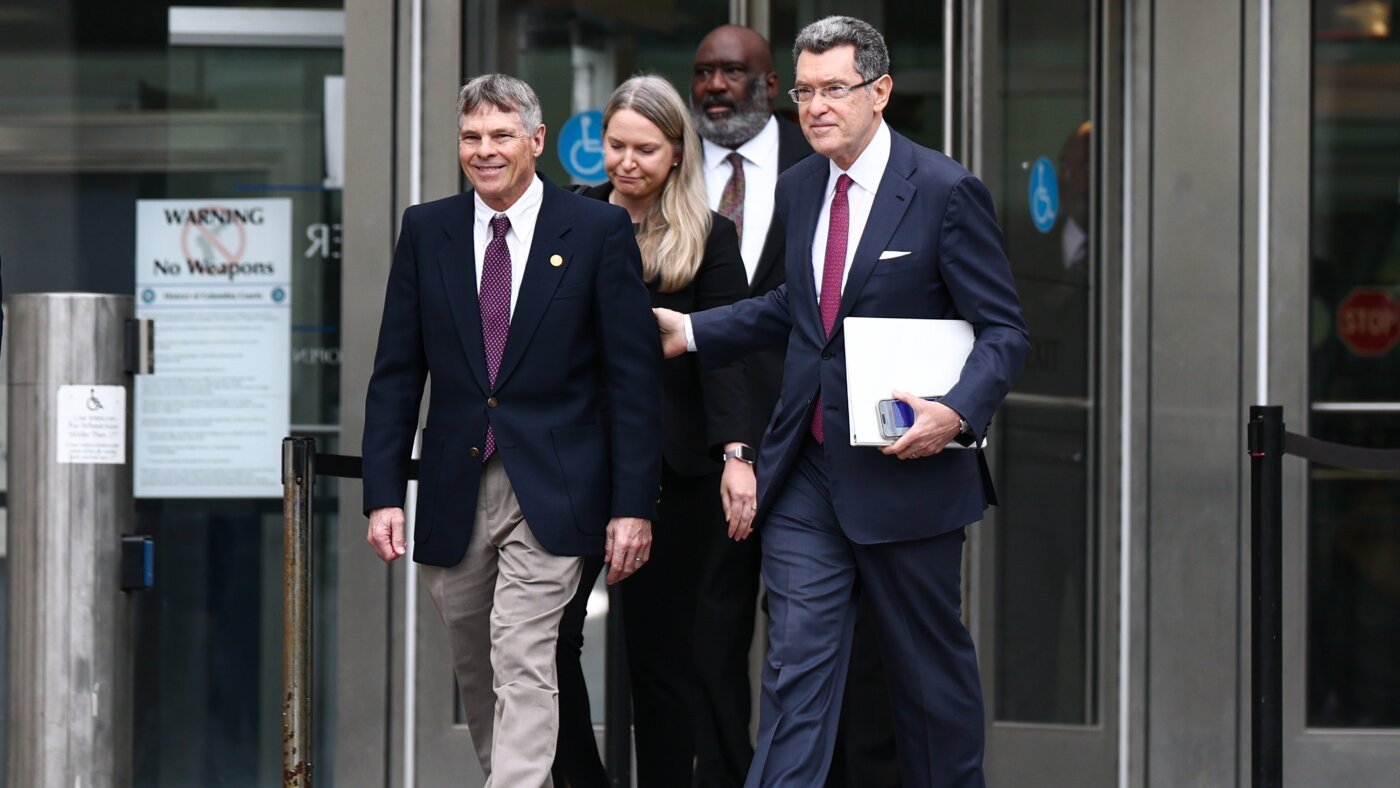
Former U.S. Olympian David Hearn (left) walks with his attorney Norman Eisen to speak to reporters and protesters gathered after his arraignment at the Superior Court of the District of Columbia in Washington, D.C. on Thursday.
Finn Gomez/Getty Images
hide caption
toggle caption
Advertisement
Finn Gomez/Getty Images
Former U.S. Olympic canoeist David Hearn pleaded not guilty to damaging the Lincoln Memorial Reflecting Pool in D.C. Superior Court Thursday morning.
Federal prosecutors charged Hearn with a single count of destruction of property causing more than $1,000 in damage to the pool.
Hearn has previously claimed, which his attorneys repeated during a short press conference outside the court, that he simply touched the water in the pool out of curiosity.
Advertisement
The Trump administration had just completed a $14 million renovation of the pool.
But shortly after the work finished, peeling paint and algae gathered in the water. The remodel has been largely criticized as a massive failure and waste of taxpayer dollars.
Superior Court Judge Carmen McLean released Hearn on his own recognizance. His next hearing is scheduled for Aug. 5.
Norm Eisen, one of Hearn’s attorneys, spoke to reporters outside of court following the hearing. He said the administration is using Hearn as a “scapegoat … for their own failures.”
“It is not a crime to touch the reflecting pool, to touch water in the United States of America,” he said.
Advertisement
Prosecutors say there is a host of evidence against Hearn.
Three more people have been criminally charged with destruction of property at the Lincoln Memorial Reflecting Pool.
Officers say they detained Cameron Thiers, Sophie Dennison-Gibby and Justin Carreno one Saturday afternoon in June and described in court documents witnessing them peeling and removing pieces of blue paint from the Reflecting Pool.
One officer “witnessed Carreno reach down into the reflecting pool and pull up a piece of the blue paint,” according to the court documents.
The officer who detained Dennison-Gibby “found 1 additional piece of the reflecting pool liner” in her purse, the documents said.
All three incidents were recorded on the officers’ body worn cameras, they said in the court documents.
Advertisement
Several “partnering law enforcement agencies assigned to the Reflecting Pool” working with US Park Police were involved in detaining the two men and one woman — including officers from Texas, Oklahoma, Montana and California.
One of the officers said in court documents that Thiers “admitted to removing a piece of blue sealant from the Reflecting Pool and still had it in his hand when I made contact with him.”
The three defendants were arraigned in court Wednesday and pleaded not guilty to the misdemeanor charges of destruction of property with a value less than $1,000. The judge ordered them to stay away from the Reflecting Pool.
Lawyers for Thiers and Dennison-Gibby declined to comment. CNN has reached out to Carreno’s attorney.
If found guilty of destruction of property, the defendants could be fined up to $1,000 and face a maximum of 180 days behind bars.
Advertisement
The New York Times first reported that three additional people had been charged with damaging the Reflecting Pool.
President Donald Trump has repeatedly claimed that vandals caused major damage to the pool by gashing the lining after his administration spent more than $14 million on renovations, though he has not provided evidence to support that claim. The officers who charged Carreno, Thiers and Dennison-Gibby did not accuse them of gashing the lining.
Former Olympic canoeist David Hearn was indicted by a grand jury in Washington, DC, last week for allegedly damaging the Reflecting Pool. Hearn — unlike Carreno, Thiers and Dennison-Gibby – was charged with destruction of property with a value of more than $1,000 which carries a maximum penalty of 10 years in prison, if convicted. He is set to be arraigned in court Thursday.
Crews began draining the Reflecting Pool over the weekend to make repairs, according to Interior Secretary Doug Burgum, for the second time in three months.
The move comes after weeks of problems – algae blooms, green-hued water, a chipping bottom and the administration’s allegations of vandalism – that have plagued the iconic landmark, making its woes the subject of national interest.
Supreme Court Justice Amy Coney Barrett speaks at the Reagan Library on Sept. 9, 2025, in Simi Valley, Calif. Barrett discussed and signed copies of her new book, Listening to the Law: Reflections on the Court and Constitution.
Mario Tama/Getty Images
hide caption
toggle caption
Advertisement
Mario Tama/Getty Images
Even as the Supreme Court was handing down one legal thunderbolt after another last week, the justices were quietly releasing their annual financial reports. Justice Samuel Alito was the only sitting justice to request an extension, which he has done for 15 years. The disclosures do not give a complete account of the justices’ total income and wealth, but they give insights into their concertgoing, guest professorships and even their involvement in youth sports.
In addition to their salaries, much of the justices’ reported income came from their book deals. Justice Ketanji Brown Jackson led the pack earning more than $1.1 million last year for a total of roughly $4 million since her memoir, Lovely One, was published in 2024.
Justices Sonia Sotomayor, Neil Gorsuch, Amy Coney Barrett and retired Justice Anthony Kennedy also reported income from published books. Earnings from their books ranged from $849,000 for Barrett, to $300,000 for Gorsuch and $88,000 for Sotomayor, whose books include her 2013 autobiography and five children’s books. Justice Clarence Thomas, who previously earned $1.5 million for his 2007 memoir, listed no publisher payments last year, and Justice Brett Kavanaugh, one of 13 co-authors of a 2016 legal treatise, also received no payments last year. Kavanaugh is said to be working on a memoir but he listed no payments for the anticipated book. Alito does have a book coming out in the fall, but with his financial report still outstanding, there is no data on how much he was paid for the work in 2025.
Advertisement
The only two sitting justices who have not written books are Chief Justice John Roberts and Justice Elena Kagan.
Many justices also earned income from teaching at law schools. Roberts reported income from New England Law, located in Boston, and Gorsuch reported teaching income from George Mason University in Virginia. Thomas taught classes at Catholic University in Washington, D.C., and Barrett and Kavanaugh taught at Notre Dame Law School. Barrett graduated from the school and began teaching there 23 years ago; Kavanaugh has family connections to Notre Dame.
The disclosures also report gifts, travel, food and lodging that the justices received in 2025. Jackson and Sotomayor were the only two to report gifts. Jackson was given a painting for her chambers valued at $2,500, and Sotomayor reported a trip to Kansas City to watch the opening of a musical based on her children’s book, Just Ask.
In addition, she reported receiving free tickets worth $4,333 while on “a private trip to Puerto Rico.” The tickets were from the record label that represents Bad Bunny, and her trip coincided with the artist’s months-long concert series in San Juan. Sotomayor’s parents were from Puerto Rico, and she has spent much time there over the years.
Advertisement
The justices also disclosed significant reimbursements for travel throughout 2025. Thomas’ travel, food and lodging expenses were paid for by the Hoover Institution for speaking at a celebration of conservative economist Thomas Sowell.
Sotomayor, Gorsuch, Barrett and Jackson were reimbursed for international travel, where they gave speeches, spoke about their books or taught. Roberts was the only sitting member of the court not to report any gifts or travel reimbursements.
The annual filings also shed some light on the justices’ activities off the bench. Kavanaugh reported that in addition to his duties as a Supreme Court justice, he serves as a coach to multiple D.C.-area Catholic Youth Organization girls’ basketball teams. Coach K, as he is known by his players, wrote the court’s June decision declaring that states can ban transgender women and girl athletes from playing on women’s and girls’ sports teams.
The justices’ salaries are established by law. The chief justice earns the most, at $320,700 per year. The eight associate justices earn $306,600 per year. While that is a lot of money to most Americans, the justices and even their law clerks could earn more the minute they leave their Supreme Court jobs for large law firms.
Roberts was the only member of the court to report investing in individual stocks. Alito in the past has also owned shares of individual stocks, but his report is not due for three months when his extension runs out. For the most part, the justices do not own individual stocks, but do invest in index funds, mutual funds and other such investment programs in order to both make money and limit potential conflicts of interest that would require their recusal from certain cases.
Advertisement
However — and this is a big however — the financial reporting forms the justices are required to fill out are so unspecific and the reporting ranges for investment earnings are so broad that it is impossible to determine any justice’s overall wealth. In addition, the current value of the justices’ homes isn’t reported. Neither is their spouses’ income, which in the case of the chief justice, for instance, likely far exceeds his take-home pay.