News
Death, guns and ‘corrupt cop’ claims: saga that gripped New Orleans reaches its end


Ever since the New Orleans tow-truck company owner Cardell Hayes shot the retired local pro-football champion Will Smith to death and wounded the former athlete’s wife on a city street late on the night of 9 April 2016, people on all sides of the case have made it as complicated as possible in their fight for what they consider to be justice.
It is a case that has gripped south-eastern Louisiana – where football players are huge celebrities – and also involved dark, if unsupported, allegations of another deep south staple: police corruption. Competing theories and narratives have vied for supremacy, with almost as many different ideas of what happened as people willing to voice them.
But all the evidence available at two separate trials – including one that concluded early Saturday with a second manslaughter conviction for Hayes – points to a simpler, senseless tragedy that maybe could have only happened in a country plagued with an excess of short tempers, easily accessible guns and laws that make people believe it’s relatively safe in many situations, legally speaking, to fire those weapons.
Perhaps the best guess at what happened on the night Smith’s and Hayes’s lives collided with deadly consequences is what follows, based on accounts from key observers who initially had no idea precisely who was involved and therefore had no loyalty to either the shooter or the slain.
Smith spent the day attending a street festival as well as dining and drinking with his wife, Racquel, and friends in New Orleans, home to his family and the NFL’s Saints, a team that won its first and so far only Super Bowl title with his defensive help just six years earlier.
The 34-year-old Smith was driving Racquel and two of their companions in his Mercedes-Benz SUV to a hotel bar to continue the revelry when he lightly struck the back of a Hummer being driven by Hayes, who had braked as he approached traffic at a red light. With a friend in the passenger seat, and having no idea who hit his rear bumper, Hayes pulled over – but then began pursuing Smith after he drove away.
Hayes then hit the rear of Smith’s SUV, and the six people in both cars got out, leading to a confrontation that by all accounts was heated.
At that point, a patron at a nearby bar heard one of the men near the crash warn that he had a gun. A second man answered that he had a gun, too, before he was shot in the back and killed.
Investigators later arrived to find Smith with eight bullet wounds – seven to his back – slumped over his front seat, inches away from a pistol that was tucked in between the seat and the center console. Racquel, who recounted being at her husband’s side during his encounter with Hayes, was shot twice in one of her legs and badly wounded.
An off-duty police officer who was on a date at the same bar as the other patron later said he approached the scene after hearing the gunfire, and he was told by Hayes that he used a pistol he had on him to shoot Smith after hearing that Smith was going back for his own gun.
That off-duty officer reported Hayes telling him: “What was I supposed to do?” There was also a recording of a 911 call that night which captured Hayes in the background saying he had shot a man who announced his intention of getting a gun from his car.
Smith’s funeral service was held days later in a theater full of mourners, after a viewing open to the public at the Saints’ practice facility.
Despite his claims that he killed Smith legally in self-defense, Hayes was charged with murder, twice facing judgment in the killing.
The prosecution and the defense have since spent countless hours arguing that one man was clearly to blame and the other was not in the shooting that led to Smith’s death, his wife’s injuries and Hayes’s criminal trials. The local and national news media’s duty to vet all aspects of the case in a collective quest for the truth about what occurred that night in a way has added to the obfuscation.
But the truth is neither prosecutors’ nor defense attorneys’ versions of Smith’s fatal shooting are supported by the neutral, credible accounts relayed in the immediate aftermath.
State prosecutors maintained at both trials that Racquel Smith talked her husband into walking away from the face-off that erupted after the second car collision. She did that because Hayes – a former semi-professional football player – was, improbably, even more physically imposing than her husband. She also testified that she implored her husband to remember their three children, who were being babysat at home, and said the violence “is not worth it”.
Then, she says, Hayes deliberately pumped two bullets into one of her legs and shot her husband dead – in cold blood, and without provocation, before he was taunted with the phrase: “Look at you now.”
“My worst nightmare happened for no reason,” Racquel Smith has said under oath.
Her account was twice bolstered with testimony from her husband’s former Saints teammate and fellow Super Bowl XLIV champion Pierre Thomas, who has described riding in a separate car ahead of the second collision and getting out to see Smith’s killing.
Hayes, when first tried, testified and suggested Smith actually got a gun other than the one found in his center console, fired at Hayes first and accidentally shot Racquel in the process. Hayes has testified it was only then that he fired at Smith, whose blood-alcohol level was later determined to be three times over the legal driving limit.
At one point, Hayes’s legal team publicly suggested that a retired police captain who was friends with Smith stormed on to the scene and – to burnish memories of the fallen ex-football pro – whisked that gun away before investigators could recover it.
Media briefly seized on the insinuation for a couple of reasons. That retired captain had dined with Smith shortly before the player’s death. And, in a chilling coincidence, Hayes’s father had tried to stab that policeman before being shot dead by other officers in the months after Hurricane Katrina struck New Orleans 11 years earlier, according to authorities. Police said the elder Hayes had a mental health emergency on the day officers shot him dead.
The Hayes legal team’s “corrupt cop” angle relied on the well-documented history of a New Orleans police department that had violated the public’s civil rights so many times that it entered into an agreement with the federal government in 2012 to implement what was then an unprecedented number of agency-wide reforms. But that theory suffered a blow after prosecutors established that the officer alleged to have engaged in a cover-up for the sake of Smith’s legacy was waiting for Smith miles away at the hotel bar where his group was headed before he was killed – though the defendant’s attorneys never ruled out that another officer who resembled the accused retired captain could have taken the gun fired at Hayes.
All told, what neutral bystanders saw and heard conflicted markedly with Racquel Smith’s testimony that her husband was calmly walking away from escalating violence when he was callously murdered and she was shot in the leg.
And Hayes’s version of events wasn’t supported either by those same recollections or ballistics evidence recovered from the scene, which showed only he shot a gun. Even testimony from Hayes’s friend and passenger – who drew his own gun but did not fire it the night of Smith’s death – failed to say that Smith had ever fired at Hayes.
Prosecutors always have the obligation to prove their assertions definitively while the defense can succeed simply by introducing reasonable doubt about the state’s case in jurors’ minds. Nonetheless, it’s likely that the gaps between the impartial observers and their partial counterparts explain the mixed outcome of Hayes’s first trial.
Some of the Saints’ most renowned figures at the time – whom New Orleanians treated like royalty – were in attendance throughout the trial to support Smith’s family. Yet jurors did not hand up the ideal outcome desired by those dignitaries, many of whom had won New Orleans’s only major professional sports championship alongside Smith.
Jurors acquitted Hayes of intentionally ramming Smith’s car in the moments before the shooting, which prosecutors had wanted to prove he had done to establish that he was the aggressor in the deadly showdown that ensued. Jurors also rejected that Hayes had willfully murdered Smith or attempted to murder Racquel, which would have landed him a mandatory sentence of life in prison.
The jury instead found Hayes guilty of manslaughter and attempted manslaughter, finding that he unintentionally but still illicitly killed Will Smith and wounded his wife in the heat of an argument.
Hayes – who has spoken about cheering Smith and his Saints compatriots as they pursued on-field glory as well as dreaming of being able to join them in the trenches – received a 25-year prison sentence that would take him away from the son he was raising.
But only 10 of 12 jurors voted to convict Hayes of the lesser charges at the end of that week-long trial, arguably the highest profile case at New Orleans’s criminal courthouse since the 1969 acquittal of a local businessman charged with helping plot the assassination of President John F Kennedy.
And when the US supreme court later ruled that such non-unanimous jury verdicts were unconstitutional, the stage was set for Hayes to be released from prison in 2021 and retried on the reduced charges of which he had once been convicted.
Hayes did not testify at his second trial, where his courtroom supporters included renowned bounce musician Big Freedia, a relative. The second jury never heard Hayes’s unsubstantiated tale that he gave from the witness box the first time around.
But Hayes’s choice against taking the witness stand in his retrial made little difference for him. Though jurors made the puzzling decision to acquit him of Racquel Smith’s attempted manslaughter, they found him guilty of manslaughter in Will Smith’s shooting death – unanimously this time.
That verdict once again leaves Hayes faced with serving a lengthy prison sentence.
Ultimately, nothing in the second trial – which ran for five days beginning on 22 January – substantially changed the picture that the first trial painted of Smith’s final night.
Three men in two separate cars that crashed had three pistols among them. With tempers flaring over what could have been handled with misdemeanor citations, insurance companies and civil litigation if necessary, two of the men declared to each other that they had guns with them.
One father was shot dead moments after that dual declaration. The other at least survived and, at 36, has lived longer than did the man whose life he ended. But he already spent some of his prime years in prison, is returning there for a long time, and will be best known to many in his city as simply a killer.
As Thomas reportedly put it while on the witness stand more recently: “This whole situation sucks … This whole situation is unfortunate. It could have played out different.”



By Zolan Kanno-Youngs, Gilad Thaler, Jon Miller, Nikolay Nikolov, June Kim, Paul Abowd and Pierre Kattar
April 14, 2026
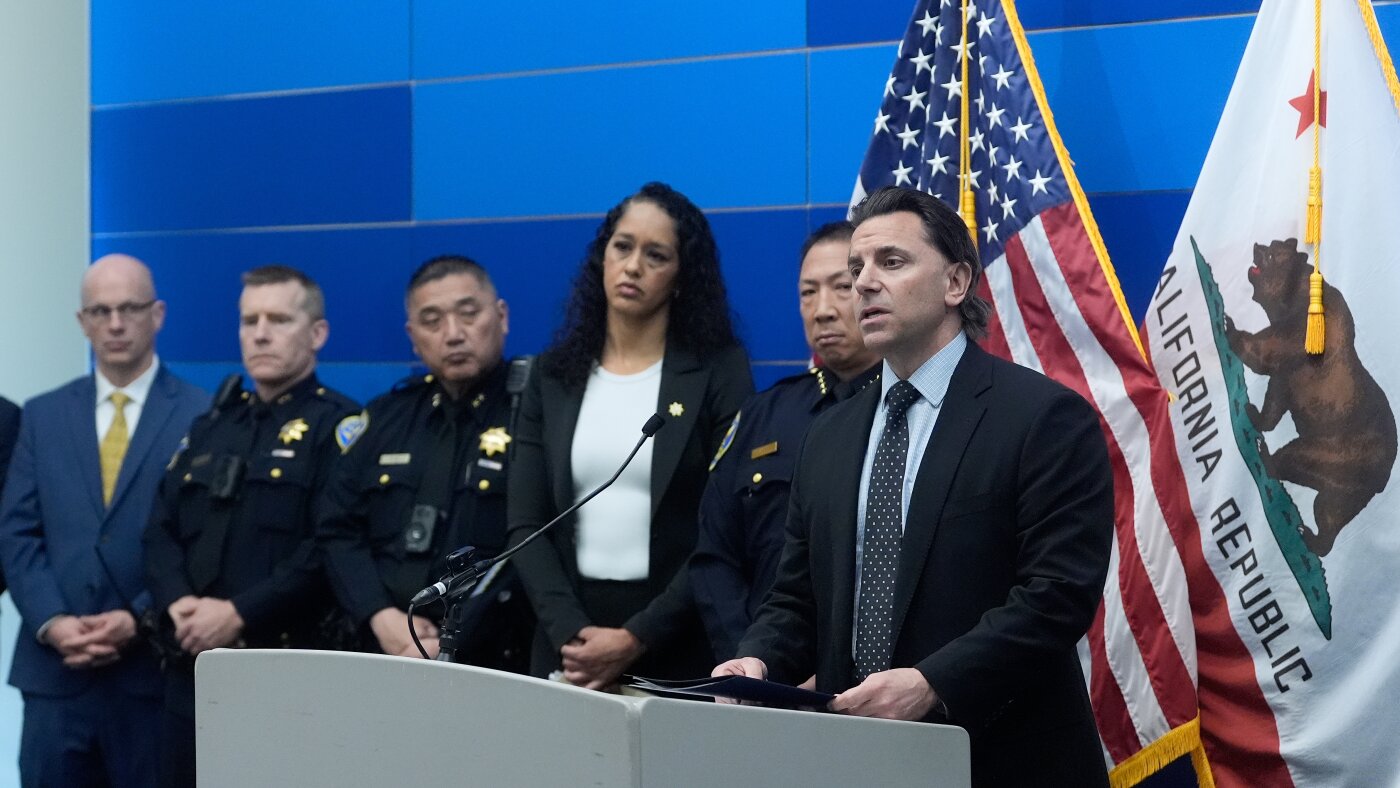
Matt Cobo, F.B.I. San Francisco Acting Special Agent in Charge ( right) speaks next to San Francisco Police Chief Derrick Lew (second from right) and San Francisco District Attorney Brooke Jenkins (third from right) during a news conference Monday, April 13, 2026, in San Francisco.
Jeff Chiu/AP
hide caption
toggle caption
Jeff Chiu/AP
SAN FRANCISCO — The man accused of throwing a Molotov cocktail at OpenAI CEO Sam Altman’s home had written about AI’s purported risk to humanity and traveled from Texas to San Francisco intending to kill Altman, authorities said Monday.
Authorities allege 20-year-old Daniel Moreno-Gama threw the incendiary device about 4 a.m. Friday, setting an exterior gate at Altman’s home alight before fleeing on foot, police said. Less than an hour later, Moreno-Gama allegedly went to OpenAI’s headquarters about 3 miles (4.83 kilometers) away and threatened to burn down the building.
Moreno-Gama is opposed to artificial intelligence, writing about AI’s purported risk to humanity and “our impending extinction,” according to a federal criminal complaint.
“This was not spontaneous. This was planned, targeted and extremely serious,” said FBI San Francisco Acting Special Agent in Charge Matt Cobo during a press conference.
No one was injured at Altman’s home or the company offices, authorities said.
Moreno-Gama faces state and federal charges
Moreno-Gama faces charges including two counts of attempted murder and attempted arson in California state court, San Francisco District Attorney Brooke Jenkins. He tried to kill both Altman and a security guard at Altman’s residence, she alleged. He is set to appear in court Tuesday, and online state court records do not yet show if he has an attorney.
Jenkins said the state charges carry penalties ranging from 19 years to life in prison.
On Monday morning, FBI agents went to Moreno-Gama’s home in Spring, Texas, a suburb of Houston, where they spent several hours before leaving. He has been charged by federal prosecutors with possession of an unregistered firearm and damage and destruction of property by means of explosives. Those charges carry respective penalties of up to 10 years and 20 years in prison.
The federal court documents do not list an attorney for Moreno-Gama, and he has not yet had his first appearance in federal court.
Authorities allege Moreno-Gama traveled from his home in Texas to San Francisco and visited Altman’s home early Friday morning.
Authorities say Moreno-Gama was opposed to artificial intelligence
When Moreno-Gama was arrested Friday, officials found a document on him in which he “identified views opposed to Artificial Intelligence (AI) and the executives of various AI companies,” court documents say. The document discussed AI’s purported risk to humanity and “our impending extinction,” according to the criminal complaint.
Surveillance video images included in the criminal complaint show a person dressed in a dark hoodie and pants that the FBI alleges is Moreno-Gama approaching the driveway of Altman’s home. In various images, the person can be seen tossing the Molotov cocktail, which landed at the top of a metal gate and started a small fire.
Surveillance video images from outside OpenAI’s headquarters allegedly show Moreno-Gama grabbing a chair and using it to hit a set of glass doors. Authorities said Moreno-Gama was approached by the building’s security personnel, who told investigators he “stated in sum and substance” that he came to the headquarters “to burn it down and kill anyone inside,” according to the complaint.
San Francisco police arrested Moreno-Gama and recovered “incendiary devices, a jug of kerosene, a blue lighter, and a document.” Moreno-Gama was being held Monday in the San Francisco County Jail on the state charges, and was expected to appear in court on Tuesday.
U.S. Attorney Craig Missakian said authorities “will treat this as an act of domestic terrorism, and together with our partners, prosecute him to the fullest extent of the law.”
Authorities say Moreno-Gama’s anti-AI document contained threats against Altman
The document in which Moreno-Gama discussed his opposition to AI also made threats against Altman, officials said.
“Also if I am going to advocate for others to kill and commit crimes, then I must lead by example and show that I am fully sincere in my message,” Moreno-Gama is alleged by authorities to have written in the document.
Advocacy groups that have issued grave warnings about AI’s risks to society condemned the violence.
Anthony Aguirre, president and CEO of the Future of Life Institute, said in a written statement Friday that “violence and intimidation of any kind have no place in the conversation about the future of AI.”

Another group, PauseAI, said in a statement that the suspect had no role in the group but joined its forum on the social media platform Discord about two years ago and posted about 34 messages there, none containing explicit calls to violence but one that was flagged as “ambiguous.”
Discord said Monday that it has banned Moreno-Gama for “off-platform behavior.”
Altman addressed the threats in a blog post
Hours after the attack on his house, Altman posted a photo of his husband and their toddler in a blog post addressing the threats against him.
“Normally we try to be pretty private, but in this case I am sharing a photo in the hopes that it might dissuade the next person from throwing a Molotov cocktail at our house, no matter what they think about me,” Altman wrote.
He added that “fear and anxiety about AI is justified” but it was important to “de-escalate the rhetoric and tactics and try to have fewer explosions in fewer homes, figuratively and literally.”
Altman has become a preeminent voice in Silicon Valley on the promise and potential dangers of artificial intelligence. The attack comes days after The New Yorker published an in-depth investigation that touched on concerns some people have about him and the company.
Debate about the impact of AI is growing
The attack came at a time of growing debate about the societal effects of AI assistants like OpenAI’s ChatGPT that millions of people are turning to for information, advice, writing help and to do work on their behalf.
An annual report published Monday by Stanford University called the AI index found that most people believe AI’s benefits outweigh its drawbacks, “but nervousness is growing and trust in institutions to manage the technology remains uneven.”

RE-PATH West Virginia announces first grant funding from Hope in the Hills

Wyoming lake’s unnerving rusty-red water persists as experts offer explanations – WyoFile

Iran’s Cryptocurrency Toll System Emerges In The Strait Of Hormuz, Posing Economic Chalenges : Analysis | Crowdfund Insider

Morgan Stanley has a blunt message on S&P 500

‘I’m a pelvic floor PT – this simple core move works better than dead bugs’

Florida High School Football Rankings: Top 25 teams – Oct. 21

How old is Bo Nix? What to know about Oregon quarterback ahead of 2024 NFL Draft

Cleary's 21 help Le Moyne down Central Connecticut State 69-64 in OT

99th annual Pony Swim held in Virginia

Indiana Members Credit Union announced as new anchor tenant at Bottleworks District

Dem fundraising giant in the hot seat as GOP lawmakers demand answers over dodged subpoena

Fifth woman accuses former US lawmaker Eric Swalwell of sexual misconduct

Commercial Ships Transit Strait of Hormuz as U.S. Blockades Iran’s Ports

Video: How Stephen Miller Is Adjusting Trump’s Immigration Agenda

Biden DOJ weaponized FACE Act against pro-life Americans, 882-report alleges
-

 Atlanta, GA1 week ago
1 teenage girl killed, another injured in shooting at Piedmont Park, police say
-

 Georgia1 week ago
Georgia House Special Runoff Election 2026 Live Results
-

 Arkansas4 days ago
Arkansas TV meteorologist Melinda Mayo retires after nearly four decades on air
-

 Pennsylvania1 week ago
Parents charged after toddler injured by wolf at Pennsylvania zoo
-
 Milwaukee, WI1 week ago
Potawatomi Casino Hotel evacuated after fire breaks out in rooftop HVAC system
-

 Ohio11 hours ago
‘Little Rascals’ star Bug Hall arrested in Ohio
-

 Austin, TX7 days ago
ABC Kite Fest Returns to Austin for Annual Celebration – Austin Today
-

 World1 week ago
Zelenskyy warns US-Iran war could divert critical aid from Ukraine