Midwest
When anti-ICE clashes trigger federal intervention: Experts explain the constitutional breaking point

NEWYou can now listen to Fox News articles!
Anti-ICE protesters have surrounded federal agents, Democratic leaders have denounced enforcement operations and tensions in Minneapolis have boiled over, but experts say none of it crosses the line into a constitutional breakdown or would justify the use of federal emergency powers by President Donald Trump.
Legal analysts say the unrest, while volatile, does not inhibit the federal government’s constitutional authority to enforce immigration law. That threshold would only be crossed if state officials themselves moved to block or materially obstruct federal agents, raising supremacy clause concerns.
Ilya Somin, a George Mason University law professor, told Fox News Digital that agitators hindering federal agents’ work, even aggressively, does not rise to that level.
“There is no general principle of law which says that anything that makes the work of federal agents more difficult in any way somehow violates the Constitution,” Somin said.
FEDS SHIFT TO TARGETED IMMIGRATION ENFORCEMENT IN MINNEAPOLIS UNDER HOMAN
Protesters clash with law enforcement after a federal agent shot and killed a man Jan. 24, the second federal-involved shooting in the city during the month, deepening tensions over enforcement operations in Minneapolis. (Arthur Maiorella/Anadolu via Getty Images)
Protesters have taken to the streets of Minneapolis in recent weeks to confront immigration officers during Operation Metro Surge, a federal enforcement effort that has deployed thousands of ICE and Customs and Border Protection agents to Minnesota.
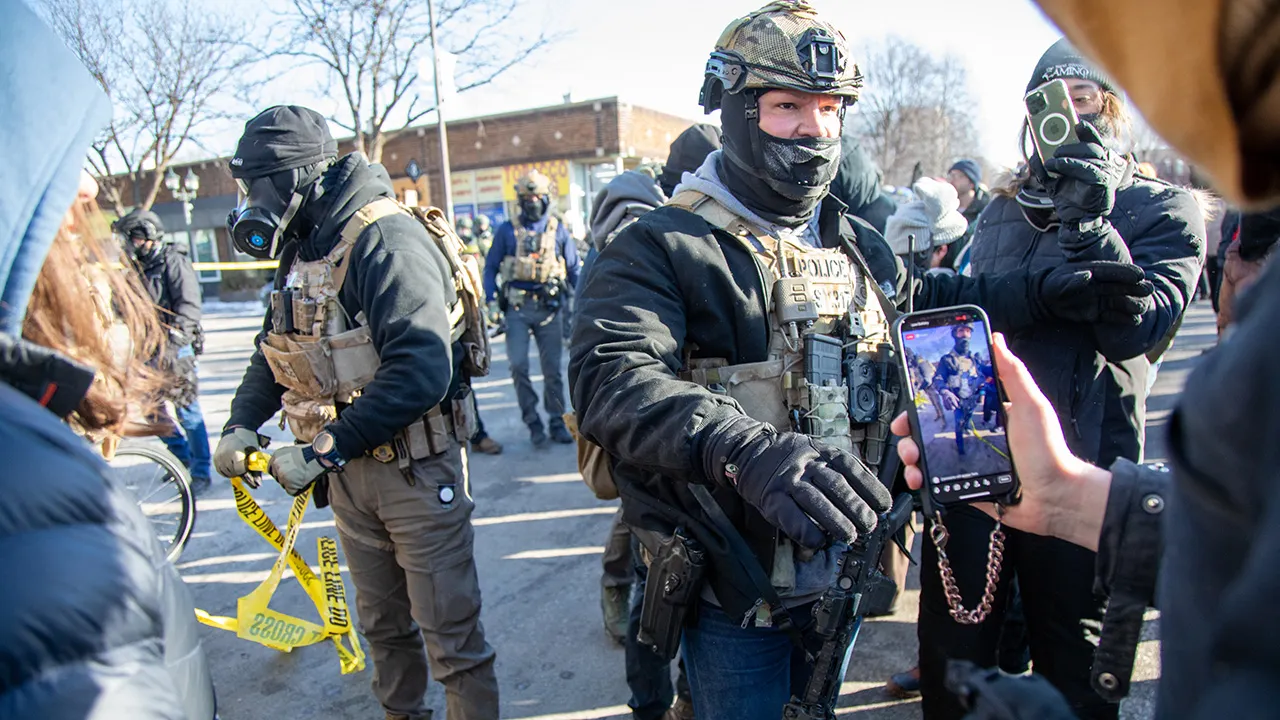
During enforcement actions, protesters have at times surrounded ICE agents with shouting, whistles, filming and unruly crowds, creating a tense mix of peaceful demonstrators and coordinated agitators that has occasionally escalated into blockades or violence.
The dynamics at play have centered on two legal principles. On one hand, the anti-commandeering doctrine prevents the federal government from forcing state and local officials to enforce federal law. On the other, obstruction of federal law enforcement is unlawful and could violate the supremacy clause, which says federal law trumps state law when the two are in conflict.
If the state were to pass laws that obstruct federal law enforcement from performing its job duties, that would trigger supremacy clause concerns, Somin said, but he noted that such conditions are not present in Minnesota.
Operation Metro Surge began in December, sending 3,000 immigration agents to Minneapolis and St. Paul. The effort has led to thousands of arrests, but it has spurred resistance from residents and resulted in two high-profile deaths of U.S. citizens at the hands of immigration agents, which fueled further public outrage. The FBI is now investigating those incidents.
Minnesota Gov. Tim Walz met with Trump border czar Tom Homan as the administration reshuffled federal immigration leadership in the state. (Chip Somodevilla/Getty Images)
Democratic state leaders, meanwhile, have widely criticized the operation and drawn blame from Republicans for exacerbating tension with their rhetoric. At one point, Democratic Minnesota Gov. Tim Walz compared ICE’s presence to the Civil War.
“I mean, is this a Fort Sumter?” Walz told The Atlantic. “It’s a physical assault. It’s an armed force that’s assaulting, that’s killing my constituents, my citizens.”
Asked whether the resistant nature of Minnesota’s Democratic leaders could amount to “nullification,” Somin rejected the idea.
“Nullification is when the state officials themselves resist the enforcement of federal law. If they merely fail to help the feds against private parties, that is something that’s protected by the anti-commandeering principles of the Tenth Amendment,” Somin said.
That hands-off approach has extended beyond rhetoric. Walz has welcomed a reduction in federal personnel but urged a faster drawdown, while Minneapolis Mayor Jacob Frey has said the city would not assist with immigration enforcement.
“We were never going to agree, and we have not agreed, to enforce federal immigration law. Why? It’s not our job,” Frey said in a New York Times interview.
As state and local leaders have declined to intervene, opposition to the ICE operation has increasingly taken shape on the ground. Activists have mobilized to confront and monitor federal immigration agents, activity that legal experts distinguish from unlawful, state-led obstruction.
Central to that resistance is Defend the 612, a network of private citizens that has coordinated what activists describe as “ICE watching,” using encrypted messaging apps to track enforcement activity and share information about agents’ movements, according to reporting by the conservative City Journal.
In addition to street confrontations, activists have staged protests at sensitive locations, including a disruption of a church service in St. Paul, where the pastor is also an ICE field director. Several participants, including former CNN anchor Don Lemon, were arrested and charged under a federal statute typically used to protect abortion clinics and pregnancy counseling centers.
TRUMP’S IMMIGRATION VICTORY IN A MINNESOTA COURT IS A WIN FOR ALL LAW-ABIDING CITIZENS
Don Lemon has told Fox News Digital he stands by his reporting. (Don Lemon/YouTube)
Federal authorities have moved to arrest individuals accused of directly impeding immigration enforcement. Attorney General Pam Bondi announced charges against 16 agitators accused of obstructing agents and assaulting officers, while the Justice Department also charged a Minneapolis man, a self-described Antifa member, with cyberstalking after he allegedly called for attacks on ICE and doxxed a pro-ICE individual.
Even so, legal experts stress that, so far, all the anti-ICE activity falls short of a collapse of federal authority. Hans von Spakovsky, a senior legal fellow at Advancing American Freedom, said existing laws already prohibit “mob” violence and obstruction, adding that Minnesota leaders’ approach has been “irresponsible” but not illegal.
The DOJ in January subpoenaed Walz, Frey and three others for information on whether they conspired to interfere with ICE’s work. A DOJ spokesman did not respond to a request for comment on the status of that probe.
Should unrest intensify, the Trump administration has floated the Insurrection Act, a rarely used provision that allows the president to respond to unlawful obstructions of federal authority. The president has said that while it remains an option, it is not currently necessary.
Trump’s border czar, Tom Homan, who is leading immigration operations in Minneapolis, likewise downplayed the impact of anti-ICE agitators.
“You’re not going to stop ICE. You’re not going to stop Border Patrol,” Homan said. “These roadblocks they’re putting up? It’s a joke. It’s not going to work, and it’s only going to get you arrested.”
Ilan Wurman, a University of Minnesota law professor, said in a podcast that while Trump “probably” could invoke the Insurrection Act, by constitutional standards a president should only call upon the military to enforce federal law as a “last resort.”
Fox News contributor Jonathan Turley spelled out when the Insurrection Act could be appropriate, noting it was deferential to the president.
“The establishment of roadblocks and direct interference with the enforcement of federal laws can support such an invocation,” Turley said. “During the Civil Rights period, opposition to and obstruction of civil rights laws justified the use of military force.”
Still, Turley and others emphasize that the Minnesota protests, as intense and at times chaotic as they have been, do not yet meet the criteria for such drastic federal action.
“The promise of some Democratic leaders to arrest and prosecute ICE agents is likely to fail. Roadblocks to bar federal agents would also constitute obstruction and, if supported by the state, would violate the constitutional authority of the federal government,” Turley said.
Read the full article from Here



Driving through the winding roads of Callaway County, often visible in the distance is a massive, 553-foot-tall concrete structure emitting what looks like white clouds.
“A lot of people think that’s smoke coming out of the top; it is not. That is water vapor,” said Travis Hart, manager of the Callaway nuclear power plant that produces 15% of Missouri’s electricity.
“The next structure that you see, this big rounded dome … that is the reactor building itself,” Hart said.
The single nuclear reactor near Fulton was built in the late 1970s and began generating electricity in 1984. Initially, the site was designed with two reactors in mind. But Hart said plans for a second unit came to a halt in the early ’80s due to decreasing electricity demand and rising costs.
Now, more than 40 years later, energy demand is growing due to increased manufacturing, adoption of electric vehicles and the development of AI data centers.
In a scramble for more power, tech companies and utilities are restarting formerly shuttered nuclear power plants, such as Three Mile Island in Pennsylvania. In states like Missouri, politicians are eager to find ways to build new ones and expand existing plants like the one in Callaway County.
Debates about how to pay for the multibillion dollar projects resurfaced in the Missouri legislature this spring. While cost is the first hurdle to creating a new fleet of nuclear power plants in America, the actual construction of the facilities is the second.
Early this year, Missouri Gov. Mike Kehoe signed an executive order that creates the Advanced Nuclear Energy Task Force to “evaluate and guide” the state’s “strategic approach to nuclear energy development.”
Lost skills
The majority of the nuclear power plants in America were built between the 1960s and 1980s. Construction slowed in response to energy demand leveling out, increased safety regulations and public perception of nuclear power souring after the Three Mile Island accident.
Speaking at the University of Missouri in May, Director-General of the federal Nuclear Energy Agency William Magwood said building nuclear power plants is a skill, and America has gotten rusty.
“We used to be really good at building plants back in the ’60s and ’70s. How do we reconstruct that? That’s going to be a real challenge,” Magwood said.
The only new nuclear power facilities built in America in recent decades are the third and fourth reactors at the Vogtle electric plant near Waynesboro, Georgia. While the reactors came online in 2023 and 2024 and produce more than 1,000 megawatts of power each, the project was billions of dollars over budget and years behind schedule.
Magwood said a lot of what boggled the Vogtle construction was the lack of institutional knowledge about building nuclear power plants.
“We just didn’t know what we were doing,” he said. “We hadn’t built a nuclear plant in a generation. We didn’t have people who knew how to do it. We didn’t have the infrastructure. We didn’t have the supply chain. The regulator didn’t know what the hell they were doing. I was there, so I know.”
In South Carolina, efforts to construct a new nuclear power plant were abandoned after billions were spent and the company behind the project went bankrupt.
Kurt Schaefer is tasked with ensuring Missouri can avoid similar blunders.
The longtime politician and public servant has been dubbed “the leader of Missouri’s nuclear power renaissance” by UM System President Mun Choi, who has been enthusiastic about advancing nuclear power by hosting national energy leaders on campus in recent years.
In May, Kehoe appointed Schaefer as head of the state’s new nuclear power task force, a group of representatives from utility companies, higher education institutions, politicians, state utility regulators and trades workers all charged with finding a way to make new nuclear power a reality.
Schaefer said the first step to establishing more nuclear power in the state is finding the cash.
“It’s all about money,” he said. “It is expensive up front to build a plant and unless the federal government steps up, I just don’t see it happening.”
In June, the federal Department of Energy announced $17.5 billion in loans for utilities and energy companies to build 10 large-scale commercial nuclear reactors.
Schaefer wants one of those reactors to be in Missouri, ideally near the existing nuclear plant in Callaway County.
“We are really behind the eight ball here in the United States on nuclear power, but you’re seeing a big effort, particularly from the federal government, to move us in that direction,” he said.
As electricity demand continues to climb, Schaefer believes nuclear power is the best way for Missouri to meet that demand. The zero-carbon plants can generate energy around the clock, unlike solar and wind power that need the right conditions to produce power.
Plus, given the longevity of nuclear power facilities, Schafer sees them as a good investment. To him, a robust power supply means a booming economy.
“This is our future, this is what we have to do to keep Missouri economically viable and that’s what we’re gonna do,” Schaefer said.
Who goes first?
The ballooning costs of nuclear power plants isn’t a new issue.
“Any project that big takes years to complete and things may change in the meantime,” said Victor McFarland, University of Missouri energy historian. “The costs of your supplies might go up, the cost of labor might go up.”
Decades ago, when many of America’s atomic energy centers were built, inflation was high and budgets stretched beyond initial figures.
“So the original estimates for the construction of these plants that were true, say, in 1970, they weren’t true anymore in 1975 or 1980,” McFarland said. “There were big cost overruns.”
Now, as the world turns away from fossil fuels, Magwood said nuclear capacity needs to triple to meet the net zero by 2050 goals. Currently, the nuclear power industry does not benefit from economies of scale. Because new nuclear projects are rare, costs are high and supply chains aren’t fully developed, adding to the overall risk of the endeavor.
“One of the big problems is nobody wants to be first … everybody wants to go fourth,” Magwood said. “Believe it or not, that doesn’t work very well. Somebody has to bite the bullet. Somebody has to take the risk. And what I think the industry would really like would be if the government somehow put a safety net under the first projects.”
Ameren Missouri has been clear about its goals to develop additional nuclear power. The company is planning to add 1,500 megawatts of atomic energy to its portfolio by 2045.
Callaway nuclear plant manager Travis Hart is an electrician by trade and first set foot at the facility 25 years ago when he was hired to work on the refueling crew. He said that’s when he fell in love with the place.
“When I walked in here and saw the equipment, how it fits together, how it works, how the design was, it was just extremely interesting to me,” Hart said.
There are a number of reasons the Callaway site is suited for expansion, Hart said. The location has access to the power grid, water from the nearby Missouri River, and a largely supportive local community that fills the plant’s roughly 750 permanent jobs while the company pays $9.8 million in annual property taxes to Callaway County.
The Callaway Energy Center’s current operating license extends through 2044, and Hart is confident the company will receive approval to operate beyond that date.
“I tell my people here all the time, … ‘this is important, so we got to get it right, and we got to do a good job of it, and it’s okay to be proud of it, because it makes a difference,’” Hart said.
In the coming years, the state’s new nuclear power task force will assess Missouri’s readiness to provide the workforce, policies and supply chain needed to create the “nuclear power renaissance.”
This story was originally published by KBIA and shared through the Missouri News Network.

A pair of Nebraska basketball players were honored by the Big Ten Conference on Thursday. Rienk Mast and Callin Hake were chosen as Nebraska’s Outstanding Sportsmanship winners.
The Big Ten honored 36 players with the Outstanding Sportsmanship Award for the 2025-26 year. One member of each varsity sports team is nominated, and two winners are selected from each institution.
Mast averaged 13.3 points, 5.8 rebounds and 3.1 assists per game in 2025-26 and helped Nebraska to the Sweet 16 for the first time in school history. He is working out with the Indiana Pacers during the NBA Summer League.
Hake averaged 7.2 points, 3.6 assists, 2.5 rebounds and 1.3 steals per game while drawing a single-season school-record 33 charges. She is also the first Husker to be a two-time Outstanding Sportsmanship Award winner across all sports after earning her first award in 2024-25.
Contact/Follow us @CornhuskersWire on X (formerly Twitter) and like our page on Facebook to follow ongoing coverage of Nebraska news, notes and opinions.

The Bison are in the game. For real, this time.
When EA Sports brought back its College Football title in 2024 after a decade-plus hiatus, FCS teams were not included. That’s still the case as the game moves into the third year of its revival, but, of course, North Dakota State has moved up to the FBS level, as members of the Mountain West.
And one of the perks of that move is inclusion in the popular sports simulation. Participating players get $1,500 plus a free copy of this year’s game, College Football 27.
Not bad, huh?
I can only imagine how cool it is for a kid like Abraham Myers, a tight end from Sioux Falls Washington High School, to see himself as a playable character on a millions-selling PlayStation game, but it’s cool for fans, too.
If you’re a Bison fan, it’s all right there. The Fargodome (sorta, EA didn’t bother to include the name, calling it ‘North Dakota State Stadium’), Tim Polasek, the Bison mascot — OK, that’s really about all the detail they went into, and Polasek’s likeness leaves a bit to be desired. Then again, they still haven’t made much effort to make Kalen DeBeoer look like Kalen DeBoer, so whatever, I guess.
In the past you could still play as NDSU, or SDSU, or USD, or Augustana, or Roosevelt High School, or St. Mother Theresa’s Middle School for the Deaf, or any other team, real or imagined, because of the game’s “Create a team” engine, and that’s still there on this year’s game. There are already a few Jackrabbit teams up on the servers that you can download if you’re an SDSU fan and want to play as the Jacks.
Screenshot
But Bison fans (and Sac State fans, and Missouri State fans, etc., etc.) don’t have to do that. Their team is in the game, with their actual stadium and their actual coach and their actual players, and when I fired up the game on Thursday just an hour after it officially launched, I’ll admit it, the first thing I did was start a game in Fargo, pitting New Mexico against the Bison in the Fargodome for a Mountain West clash that sent former SDSU assistant Jason Eck up against his old Dakota Marker nemesis.
The game started up and there they were: Nathan Hayes under center for the Bison, with DJ Scott carrying the ball, Jackson Williams running free over the middle and Myers teaming with Reis Kessel at tight end to create problems in the red zone.

Screenshot
I went right down the field and scored on the opening drive, with Hayes finding Williams on a drag route for the touchdown.
Despite the best efforts of New Mexico’s star linebacker and former Brookings Bobcat Jaxton Eck (Jason’s son), I had no trouble dispatching the Lobos 31-10.
Later I played around with some other fun matchups.
I brought Nebraska into the Dome, and while we all know the Huskers stink now, for someone like me who’s old enough to remember their Glory Days, it was fun to see the iconic Nebraska uniforms on the Fargo turf, and wonder if someday that could actually happen now that NDSU is in the FBS.

Screenshot
Later I played a game at the Big House in Ann Arbor, sending the Bison up against the Wolverines. Michigan got the ball first and after a holding penalty pinned them deep in their own territory, Keenan Wilson’s strip-sack of Bryce Underwood gave the Bison first and goal, and with the Miaze and Blue crowd of over 100,000 roaring, I quickly turned it into a short touchdown pass from Hayes to Myers.
Ultimately I couldn’t keep that up against the Wolverines, falling 31-21.
I played around with some other teams, mostly the ones with familiar faces. Jimmy Rogers and Iowa State, Matt Entz at Fresno State, Missouri State, Kennesaw State, Sac State, Delaware and other former FCS powers.

Screenshot
I also played a few series of the Tennessee vs. Alabama rivalry game to get an early glimpse of what kind of teams South Dakota’s two favorite SEC sons (DeBoer and Josh Heupel) might have in store for 2026.
Much has been made of trying to predict how successful the Bison will be in year one at the FBS level. Some have already anointed them a favorite to grab a G6 playoff spot. Others think they’ll at least win the Mountain West, while few seem to think they’ll finish much lower than third or fourth.
What does EA think?

Screenshot
The Bison are given an overall team rating of 75 (99 is the highest possible), which is higher than many if not most G6 teams. James Madison, for one, gets a 77.
The other Mountain West teams earned the following ratings:
Air Force – 74
Hawaii – 76
Nevada – 73
New Mexico – 76
Northern Illinois – 70
San Jose State – 72
UNLV – 78
UTEP – 72
Wyoming – 73

Screenshot
As for the NDSU players, here are their top rated personnel:
Griffin Empey (LG): 87
DJ Scott (RB): 83
Keenan Wilson (DT): 80
Darius Glance (SS): 79
Myles Mitchell (RB): 78
Josh Magin (RT): 78
Donovan Woolen (LB): 78
Keith Williams (LB): 78
Logan Larson (DT): 77
Jackson Williams (WR): 76
Matthew Stenbroten (DE): 76
Zach Vanderpool (DT): 76
Alijah Wayne (DT): 76
Jaylin Crumby (FS): 75
Kelton McCaslin (DE): 75
Reis Kessel (TE): 75
Nathan Hayes (QB): 74
Nate Tastad (RG): 74
Taylen Eady (FS): 73
Ryan Babatz (LT): 73
Alex Jenkins (LT): 73
DJ Volts (CB): 72
Mekhi Collins (WR): 71
Jack Liwienski (OG): 71
EJ Davis (CB): 71
Will Steil (FS): 70
Drew Klein (K): 70
Makes you wonder how players like Chase Mason and Charles Pierre would measure up. Maybe someday the Jacks, Coyotes and Fighting Hawks will be in the game and we’ll find out.

Screenshot

Screenshot

Screenshot

Screenshot

Screenshot

Screenshot

Screenshot

Screenshot

Screenshot

Screenshot

Matt Zimmer is a Sioux Falls native and longtime sports writer. He graduated from Washington High School where he played football, legion baseball and developed his lifelong love of the Minnesota Twins and Vikings. After graduating from St. Cloud State University, he returned to Sioux Falls, and began a long career in amateur baseball and sports reporting. Email Matt at mzimmer@siouxfallslive.com.
-

 Missouri5 minutes ago
Missouri pushes for more nuclear energy to power the future
-
Montana8 minutes ago
Montana Lottery Mega Millions, Big Sky Bonus results for July 10, 2026
-

 Nebraska13 minutes ago
Nebraska has two players honored by the Big Ten Conference on Thursday
-

 Nevada20 minutes ago
Planetary parade this weekend — when to see it in Northern Nevada
-

 New Hampshire23 minutes ago
9 Most Hospitable Towns In New Hampshire
-

 New Jersey28 minutes ago
Husband of slain New Jersey mom begs for help in newly released 911 call | Fox News Video
-

 New Mexico35 minutes ago
NM Delegation Demands Answers On Reports Of DEA Declining To Seize Massive Fentanyl Shipments, Calls For Immediate Reforms
-
North Carolina35 minutes ago
Brunswick County wildfire grows to 300 acres


