Midwest
Missouri K-9 officer dies after being left inside hot car overnight: 'Tremendous loss'

Rescued German Shepherd mix becomes K9 officer
Fort Worth Police Department K9 handlers Officer Kris Thompson and Sgt. Chuck Hubbard join ‘Fox & Friends Weekend’ to discuss the ‘high energy’ dog, Rock, who helps authorities fight the fentanyl crisis.
A beloved Missouri K-9 officer died after reportedly being left in a hot car overnight following the end of his shift in Savannah.
The Savannah Police Department confirmed to Fox News Digital that K-9 Horus died on Thursday after completing his overnight shift.
“On Thursday, June 20, the Savannah Police Department and the entire community suffered a tremendous loss,” Police Chief David Vincent said in a statement.
K-9 Horus had served as a member of the Savannah Police Department for over three years, according to FOX 4.
HERO SOUTH CAROLINA POLICE K-9 DIES SAVING HUMAN TEAMMATES IN SHOOTOUT WITH FUGITIVE SUSPECT, AUTHORITIES SAY
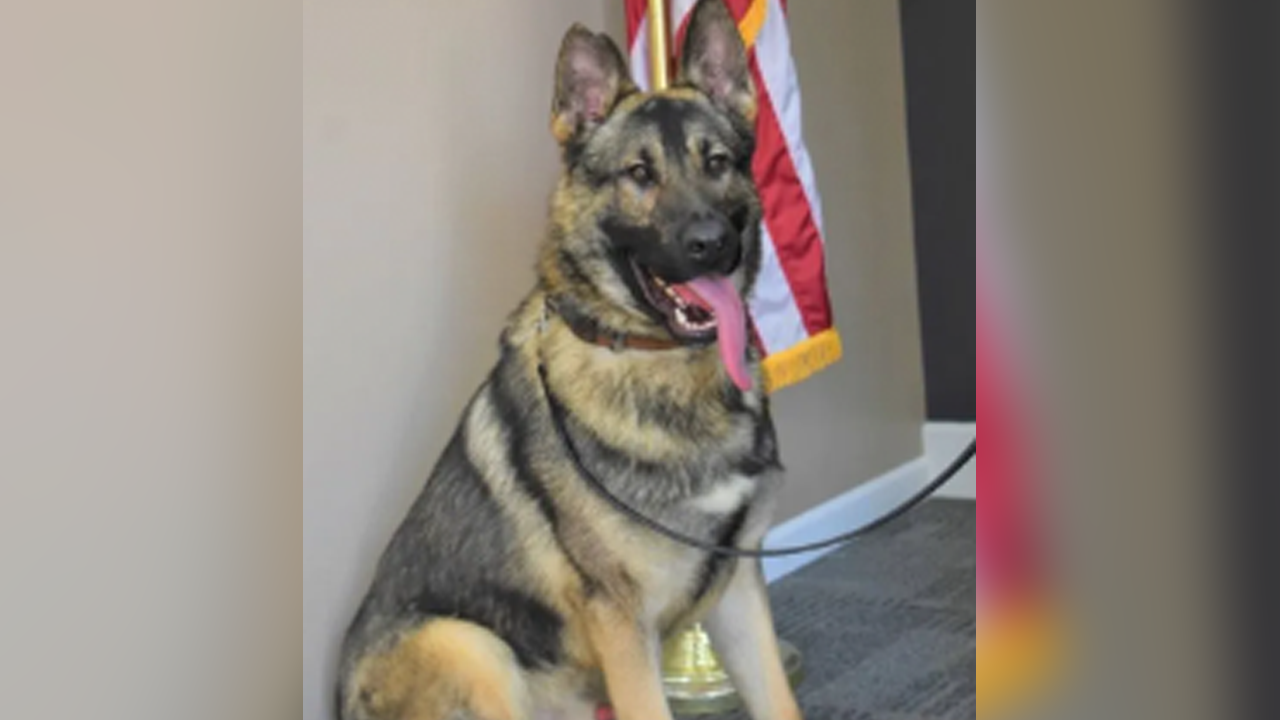
Officers in a small Missouri town in Andrew County are mourning the death of their K-9 companion, Horus. (FOX 4/Savannah Missouri Police Department )
“Horus’s death is currently being investigated,” Savannah Chief of Police David Vincent said in a statement to Fox News Digital. “Due to this being an open investigation, there will be no further information released until the investigation is completed. The entire department would appreciate your thoughts and prayers, as we deal with the loss of our partner, Horus.”
Andrew County Prosecuting Attorney Monica J. Morrey told Fox News Digital that their office is currently investigating this case.
“The Andrew County Prosecuting Attorney’s Office is deeply saddened to learn of K-9 Horus’ passing. We are grateful to him for his service to our community. I have requested a special investigation through the Missouri State Highway Patrol. I will await the results of this investigation prior to making any determination of necessary action,” Morrey said.
The name of the law enforcement officer responsible for K-9 Horus’ death has not been released as it is an ongoing investigation.
YOUNGKIN MOURNS K-9 DOG STABBED TO DEATH BY ‘BARBARIC’ MS-13 GANG MEMBERS: ‘WILL BE HELD ACCOUNTABLE’
The Savannah Police Chief confirmed the death of K-9 officer as an investigation into his death continues. (Savannah Missouri Police Department)
It is also not known what consequences the caretaker of K-9 Horus will face or if the death will be ruled intentional or an accident.
FOX 4 reported that the maximum temperature on Thursday was 90 degrees, with the low being 70 degrees outside.
According to the American Veterinary Medical Association, research indicates that the temperature inside a vehicle can go over 100 degrees in a half-hour, even if it’s only 70 degrees outside.
In May, Republican state Sen. Tony Luetkemeyer’s Bill 754, also referred to as “Max’s Law” passed the Missouri House of Representatives. The bill increases penalties for injuring and killing animals in law enforcement.
FLORIDA K-9 DIES AFTER BEING SHOT WHILE PROTECTING DEPUTIES FROM ‘ARMED CRIMINAL’: SHERIFF
Sen. Tony Luetkemeyer listens in 2023 as St. Joseph Police Officer Lucas Winder testifies in support of Max’s Law. Officer Winder was Max’s K-9 handler when the police dog was killed in the line of duty. (Senate.mo.gov)
“I am happy to see this priority legislation make it across the finish line,” Luetkemeyer said when the bill passed. “This bill protects our diligent K-9 officers and the public they help protect.”
If signed by Governor Parson, Luetkemeyer said he hopes for Max’s Law to go into effect within the next few months.
CLICK HERE FOR THE FOX NEWS APP
“These heroic animals put their lives on the line every day to protect the public and their human partners,” Luetkemeyer said in a previous statement. “The law should protect them.”
It is unclear if this law would come into play in the case of K-9 Horus’ death.
Read the full article from Here


DETROIT (WXYZ) — Human remains were found in a furnace of an home on Detroit’s west side, the Detroit Police Department tells us.
The remains was found by an individual working on the home in the 5200 block of S Clarendon just after 11 a.m.
Anyone with information can call 313-596-2260 or CrimeStoppers at 1-800-SpeakUp.
Stay with WXYZ.com for updates on this developing story.

MILWAUKEE — Former Milwaukee County Judge Hannah Dugan won’t serve prison time or probation and has been fined $5,000, a judge determined on Wednesday during her sentencing hearing.
It comes after a jury found her guilty of obstruction last year for helping an immigrant evade federal agents.
During the hearing, Dugan’s defense team called two character witnesses to the stand to speak on her behalf, including Rev. Gregory J. O’Meara, who is also a Marquette University Law School faculty member, and Janine Geske, the retired director of the Andrew Center for Restorative Justice and a law professor at Marquette.
“Hannah models what it means to be a Christian,” O’Meara said.
Dugan herself also spoke for the first time since the case against her began.
She told U.S. District Judge Lynn Adelman that she tried to “maintain a courtroom with the decorum and safety the public deserves.”
Dugan added her actions on April 18, 2025, when the incident occurred, were “not done with any malicious intent or to advance any personal interest.”
Wrapping up her remarks, Dugan said to the court she has been cast as a scofflaw and a hero, but considers herself neither of those things.
“I am a public servant who’s just trying to do my job,” Dugan said, adding that she has had to retire from public life due to threats against her and her family.
A prosecutor then acknowledged that “she has experienced collateral damage because of her conduct,” but said “judges can’t choose to disregard the law.”
Prosecutors argued that Dugan’s actions amounted to an “abuse of trust” and asked the court’s sentence to reflect that.
Adelman then spoke, saying Dugan made a bad decision and that he doesn’t believe prison is necessary.
“This is a few minutes of conduct for someone who has dedicated her life to public service,” the judge said. “It’s a marked deviation from an otherwise law-abiding life.”
He also noted that Dugan’s actions didn’t stop the ICE agents from arresting the defendant outside the courthouse.
In April of last year, federal agents showed up at the Milwaukee County Courthouse to arrest Eduardo Flores-Ruiz, who had reentered the country illegally. On that particular day, he was appearing before Dugan’s courtroom for a state battery case.
Dugan confronted the federal agents in a hallway outside the courtroom and directed them to the chief judge’s office. Following that, she helped Flores-Ruiz and his attorney out a private jury door. Agents eventually caught up to him outside the courthouse.
Dugan was later arrested and charged for her part in the incident, and she was found guilty of obstruction last December; she was acquitted on her concealment charge.
Her lawyers argued during her trial that President Donald Trump’s administration sought to “crush” Dugan in an effort to ensure judicial compliance with the ICE strategy of targeting immigrants as they showed up for court hearings.
Dugan resigned the Milwaukee County circuit judgeship she had held for nine years in January amid threats of impeachment from Republican state lawmakers who labeled her an activist judge. In her resignation letter, she said her prosecution threatened “the independence of our judiciary.”
Republican U.S. Rep. Tom Tiffany, who has the backing of Trump in his race for governor, urged authorities to “lock her up” in a social media post following her conviction.

-

 Politics2 minutes ago
WATCH: Dana White drops 2028 hints while raving about his favorite Trump cabinet secretary
-

 Health7 minutes ago
Katie Couric couldn’t remember the year or the president during frightening brain episode
-

 Sports14 minutes ago
Justin Verlander announces he will retire after this season: ‘I’ve realized that time has come’
-

 Technology16 minutes ago
Apple AI security update proves hackers move fast
-
 Business22 minutes ago
Fire-damaged Pacific Palisades shopping center sets reopening date
-
 Entertainment29 minutes ago
Rhea Seehorn celebrates her ‘Pluribus’ Emmy nomination as she waits to hear about Carol and the atom bomb
-

 Lifestyle32 minutes ago
Urban Jürgensen: Introducing Elite Watchmaking to New Audiences
-
 Politics37 minutes ago
Commentary: On Skid Row, it’s been decades of frustration. Will the next mayor have a plan?

