Michigan
Michigan football lands 3 players in top 15 of ESPN’s early 2025 NFL mock draft


Debating Michigan football’s starting QB candidates on ‘Hail Yes!’ podcast
Michigan football will have a new starting QB, but will it be Alex Orji, Jack Tuttle or Davis Warren? The “Hail Yes!” show debates that and more, May 22, 2024. Subscribe wherever you listen to podcasts.
As the kids say, it’s mock draft SZN (season).
Okay, technically the bulk of mock draft season happens in the 100 or so days between the end of a college football season in mid-January and the NFL draft in late April. But that has never stopped early speculation before.
With the college football season fast approaching, it’s never too early to take a look at what the next crop of prospects will look like. The good news for Michigan football is ESPN’s Matt Miller released his first mock draft ahead of the 2025 NFL draft (which will be held in Green Bay, Wisconsin) earlier this week, and the Wolverines were well represented, with three picks mocked in the first half of the first round.
The first U-M star off the board? Cornerback Will Johnson at No. 3 to the Denver Broncos, which comes as no surprise. After his freshman season, Johnson appeared in the top 10 of some mocks that were drafting the best athletes available, not just those who were draft-eligible.
In the meantime, Johnson has developed into one of the most NFL-ready cornerback prospects of the past decade and could be a clear fit for Denver, which Miller said could well be in “best player available” territory.
“Johnson’s tape from his first two seasons at Michigan is some of the best cornerback tape I’ve seen,” Miller wrote. “The 6-foot-2 playmaker’s closest comparison as a college prospect is Pat Surtain II, whom he’d be lined up opposite in this scenario.”
BACK ON TRACK: Sherrone Moore preached patience. A month later, U-M’s 2025 class is rounding into form.
Johnson, a former five-star product from Grosse Pointe South, was named an All-American as a sophomore and was a consensus All-Big Ten first-teamer. With 25 games played (16 starts), Johnson was named defensive MVP of the January’s College Football Playoff title game, finishing his second year with 27 tackles (including one for loss), four interceptions (including one returned for a touchdown).
If this holds, it would make Johnson the highest-drafted Wolverine since Aidan Hutchinson went No. 2 to the Lions in the 2022 draft and the highest-drafted U-M cornerback since Charles Woodson came off his Heisman Trophy campaign during the 1997 national championship season and was selected No. 4 overall (Oakland Raiders) in 1998.
According to Miller, U-M won’t have to wait all that long to hear its next name called. Mason Graham, the star defensive tackle who former Michigan coach Jim Harbaugh called “a gift from the football gods” upon his arrival in Ann Arbor, was pegged to go No. 7 and reunite with J.J. McCarthy on the Minnesota Vikings.
“The interior of the defensive line should get a big look next year, and Graham is a legitimate contender for the class’ top overall prospect,” Miller wrote. “His stats won’t blow you away, thanks to Michigan’s defensive line rotation and assignments — he had three sacks in 2023 — but Graham’s explosion and power jump off the tape.”
BIG TEN INSIDER: A changing Michigan State-Michigan football dynamic? New QBs show ‘loud and clear’ change
At 6 feet 3 and 318 pounds, the Anaheim, California, product was named a second-team All-American last season after he appeared in 13 games (13 starts) and recorded 36 tackles, which included 7½ for loss, and three sacks to go with three quarterback hurries, one pass breakup, one forced fumble and one fumble recovery.
The final U-M prospect mocked in the first round was not Graham’s running mate in Kenneth Grant, nor was it running back (and cover athlete of EA Sports College Football 25) Donovan Edwards or safety Rod Moore, who was pegged as a late first-rounder before he suffered a knee injury in the spring.
Instead, it was Colston Loveland, perhaps Michigan’s top offensive weapon this season. Miller had him going No. 14 overall to the Indianapolis Colts. Loveland is widely regarded as the nation’s top tight end as he comes off a monster sophomore season that saw him catch 45 passes for 649 yards (14.4 yards per reception) and four touchdowns.
Loveland had 10 games with at least three receptions and seven games with at least 55 receiving yards, despite playing in a run-first offense that had the most decorated running back the program has ever seen, as well as two receivers who were taken in the NFL draft.
“Who could resist the temptation to give Anthony Richardson more playmakers?” Miller wrote. “Tight end remains one of the team’s few offensive question marks and Loveland will be a top-10 player on my preseason board thanks to his ability as a receiver and expert run blocking.
ON THE HARDWOOD: Michigan basketball might have found new leader in transfer Tre Donaldson
“The 6-5 junior has elite agility and speed in the open field as a receiving option.”
Though it’s a stretch, given he will be working with a new quarterback, Loveland is now just 763 yards away from passing Jake Butt’s Michigan record (1,646 yards) for career receiving yards by a tight end.
Although the Wolverines set a program record this past spring with 13 NFL draft picks — second-most by one program in a single draft — it came with just one first-round pick, in McCarthy. Baring something unforeseen, Michigan can expect to have at least a trio of first-rounders next spring — and possibly more.



LANSING, Mich. — Convenience stores, smoke shops and even drug stores across Michigan often offer a wall of tobacco products behind the counter. Michigan is one of only eight states where retailers aren’t required to obtain a license to sell the items, and now lawmakers want to change that.
A package of House bills making its way through committee would strengthen regulations, seeking to protect minors.
“We know how potentially dangerous tobacco usage is, and that we need to prevent teens from starting in the first place, helping them to avoid a lifelong health challenges that are caused by smoking and vaping,” Rep. Bradley Slagh (R-Zeeland) said.
The package, a version of which already passed the state Senate, would require retailers to obtain a license to sell tobacco or nicotine products.
It would also penalize those who sell to minors, from the cashier to the store’s owner.
“We license people that might give me a bad haircut, but we’re not going to license people selling tobacco, and increasingly more to our youth,” Jeff Griffith, of The Youth Connection, said.
The bills would further remove penalties for minors that obtain or attempt to buy tobacco products.
“There is no evidence demonstrating that these laws are effective in reducing youth initiation, use of or addiction to tobacco products,” Rep. Helena Scott (D-Detroit) said. “Research shows that African American and Hispanic youth were more likely to receive these citations. We do not want to increase interactions between young people of color and law enforcement.”
The 2023 Michigan Youth Tobacco survey found 29% of minors got their products through retailers.
Only 9% of respondents reported that retailers refused to sell cigarettes to them because of age, and only 5% said the same for vapes.
According to Food and Drug Administration (FDA) data, within just the past five years, more than 3,100 enforcement actions have been taken against retailers for selling to minors.
Among them, five violations since 2022 at just one store, Deering’s Market in Traverse City. Last year, the FDA even sought a 30-day ban on tobacco sales at the store.
Under the bills, Deering’s would have been fined $10,000 and their license would have been revoked.
Two other stores, one in Ann Arbor and the other in Detroit, also received those orders.
“They continue to operate and profit in the State of Michigan, while, as it was pointed out, the kids pay the price for the laws that criminalize them,” Jodi Radke, regional director for Campaign for Tobacco-Free Kids, said. “Today, Michigan kids are counting on you to place accountability where it belongs.”
Critics note mistakes are made and welcome regulation, but call the effort as a cash grab, with its $500 license fee.
They also point out the bills fail to address the 64% of minors who got their tobacco elsewhere, citing the 2023 survey.
“Quite frankly, we have little faith that based on our past experience with regulation enforcement and all these investigations we’ve seen that this is going to solve the problem of mom and dad and aunt and uncle giving smokes to kids,” Mark Griffin, president of the Michigan Association of Convenience Stores, said.
Supporters acknowledge the bills won’t completely solve the issue, but believe it shows Michigan is serious on the matter.

Paula Wethington is a digital producer at CBS Detroit. She previously held digital content roles at NEWSnet, Gannett/USA Today network and The Monroe News in Michigan. She is a graduate of the University of South Carolina.
Read Full Bio
Southeast Michigan will see an increasingly severe weather threat from Monday night into Tuesday, starting with warming temperatures in the 60s and 70s across the area.
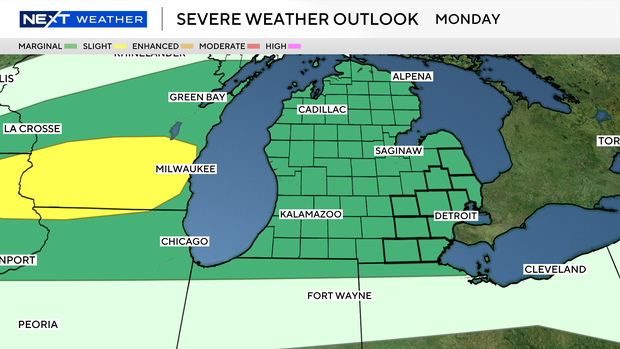
Monday’s weather
A marginal risk (level 1/5) is in place for Monday night, meaning only isolated severe storms are expected, mainly after 7 p.m. through midnight. The primary threats will be hail around 1 inch and a few localized damaging wind gusts, with storms moving quickly west to east, with storm coverage remaining limited.
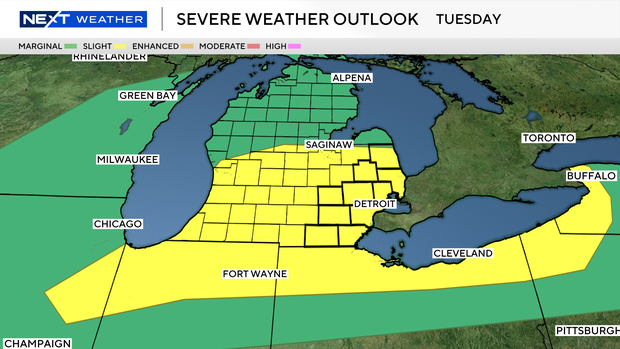
Tuesday’s weather
By contrast, Tuesday brings a Weather Alert Day with a slight risk (level 2/5), indicating a higher chance of more organized and scattered severe storms through the day as a cold front moves through.
On Tuesday, all severe weather hazards are possible, including damaging winds (potentially 60+ mph), large hail, heavy rainfall, and even a low risk of tornadoes, with damaging winds expected to be the main concern.
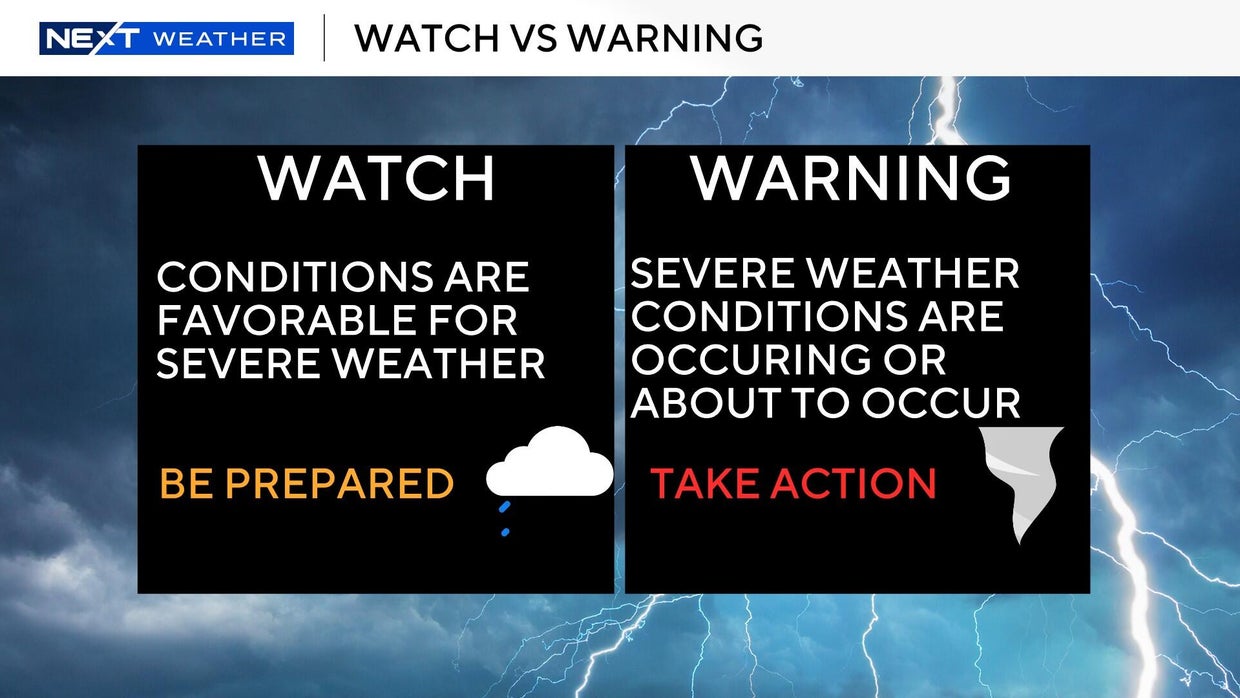
Watch vs. warning
The National Weather Service says a severe weather watch means “be prepared.” It is possible that the weather will reach severe levels during the time frame specified.
A severe weather warning means “take action,” that severe weather conditions have been reported by spotters or can be detected on radar. People are asked to take shelter indoors, away from windows.
It is possible for a tornado warning to be issued without a tornado watch already in effect. This is the scenario that happened in Southwest Michigan on March 6, 2026.

Jim Harding has landed his first commitment on the recruiting trail as offensive line coach in Ann Arbor, as 2027 four-star Sidney Rouleau announced on Sunday night that he will be playing college football for at Michigan.
Rouleau — a native of Canada but now playing high school football at The Brook Hill School in Bullard, Texas — is coming off an unofficial visit to Michigan this weekend. That was his third time in Ann Arbor, as he also visited for the Purdue game last fall and another time a couple summers ago.
Understandably so, Rouleau had great things to say after his most recent trip.
“My visit to Michigan was awesome,” Rouleau told Rivals’ Steve Wiltfong ($). “The energy around the program is contagious, and I really connected with the coaches and players. What excites me most about playing for coach (Kyle) Whittingham and the Wolverines is the chance to be part of building something special. Their vision for the future, combined with the tradition and passion of the fanbase, makes it an opportunity I couldn’t pass up. I’m excited to contribute to their success and also being able to play for coach Harding!”
Rouleau is listed at 6-foot-5 and 240 pounds, per Rivals, but 247Sports has him listed at 6-foot-7 and 269 pounds, so he may be a bit bigger than Rivals’ last update on him. Regardless, the expectation is that he will eventually play one of the tackle positions at Michigan.
Other than the Wolverines, Rouleau also earned offers from Ohio State, Clemson, Penn State, Oregon, Georgia, USC, Wisconsin, Texas, Alabama, Oklahoma Miami, Washington, Florida, Florida State and many others.
Michigan is now up to six total commitments in the 2027 recruiting class, and three of them are offensive linemen — Rouleau, and three-stars Louis Esposito and Tristan Dare. Rouleau also joins four-star edge rusher Recarder Kitchen, four-star safety Darrell Mattison and three-star safety Maxwell Miles in the class.
Rouleau is ranked No. 300 overall on the Rivals Industry Ranking. Check out some of his junior year highlights down below.

Depleted Detroit Pistons drag West-best Thunder into OT before falling

SF Supervisor Jackie Fielder on leave due to mental health condition; her staff set to take over

3 things to know about Stars-Bruins: Dallas wraps East Coast road trip looking to turn things around

Trump shares renderings of his presidential library — a massive skyscraper in Miami

Red Sox offseason pitching additions clobbered by Astros in 2026 debuts

Florida High School Football Rankings: Top 25 teams – Oct. 21

How old is Bo Nix? What to know about Oregon quarterback ahead of 2024 NFL Draft

Cleary's 21 help Le Moyne down Central Connecticut State 69-64 in OT

99th annual Pony Swim held in Virginia

Indiana Members Credit Union announced as new anchor tenant at Bottleworks District

Emanuel pushes back on ‘straight White man’ question, says ideas matter most in 2028

French police make two more arrests over foiled attack on Bank of America

‘What’s going on?’: US judge calls aspects of new Pentagon press policy ‘weird’

Video: Iran to Allow More Oil Ships Through Strait of Hormuz, Trump Says

Dem senator warns deportation could let Virginia woman’s illegal immigrant killer ‘escape accountability’
-

 Sports1 week ago
IOC addresses execution of 19-year-old Iranian wrestler Saleh Mohammadi
-

 Miami, FL5 days ago
Jannik Sinner’s Girlfriend Laila Hasanovic Stuns in Ab-Revealing Post Amid Miami Open
-

 South-Carolina2 days ago
South Carolina vs TCU predictions for Elite Eight game in March Madness
-

 New Mexico1 week ago
Clovis shooting leaves one dead, four injured
-

 Politics1 week ago
Schumer gambit fails as DHS shutdown hits 36 days and airport lines grow
-

 Minneapolis, MN5 days ago
Boy who shielded classmate during school shooting receives Medal of Honor
-

 Tennessee1 week ago
Tennessee Police Investigating Alleged Assault Involving ‘Reacher’ Star Alan Ritchson
-

 Science1 week ago
Record Heat Meets a Major Snow Drought Across the West