Lifestyle
He swapped his lawn for native plants after asking, ‘What was meant to be here?’

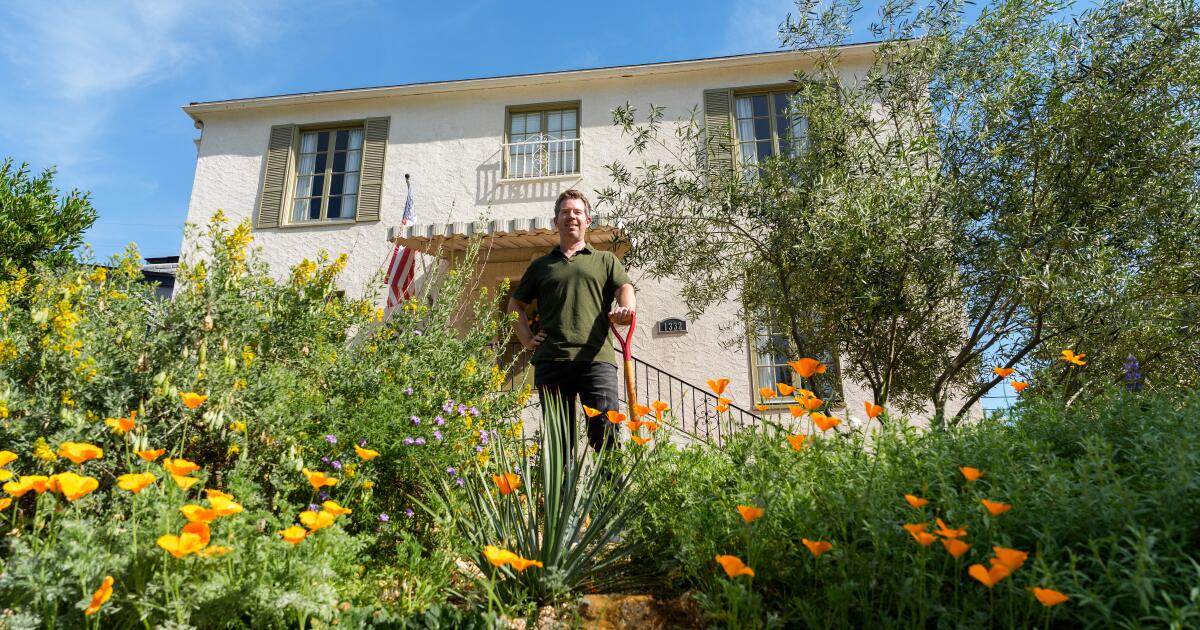
Water-hungry lawns are symbols of Los Angeles’ past. In this series, we spotlight yards with alternative, low-water landscaping built for the future.
When Christopher Smee welcomes visitors to his Glendale garden, he enjoys giving what his friends jokingly call “the botanical tour.”
“Would you like to walk through the native chaparral?” he asks, pointing out the California native plants in his front yard: a multi-trunk toyon, bright orange California poppies (Eschscholzia californica), lantern-shaped Bladderpod (Cleomella arborea) with yellow flowers that bloom most of the year, purple Arroyo lupines (Lupinus succulentus), fragrant Allen Chickering Sage (Salvia ‘Allen Chickering’), and tall, silvery white sage (Salvia apiana) at the center.
“I love the majesty and structure of the white sage,” he says, pointing out the dried branches he leaves for the birds. “I love the color, and when I learned about its importance to the Indigenous community, I felt it should be at the center of the garden.”
Before: Christopher Smee’s Glendale home when it had Bermuda grass and nonnative plants.
(Christopher Smee)

After: Smee’s garden today.
Like many newcomers to Los Angeles, Smee, a 45-year-old former flight attendant, was fascinated by the city’s landscape and its famous palm trees when he first moved from England.
As he spent more time hiking outdoors in Los Angeles, on the Mount Thom trail in the Verdugo Mountains and the Pacific Crest Trail in the San Bernardino Mountains, Smee started to appreciate the native plants that thrive in Southern California’s dry climate.
So when Smee and his husband, Ryan Tish, bought a 1925 French-style home in the Rossmoyne Historic District, he knew he wanted to redesign the traditional front yard.
“There was a privet hedge, a lonely juniper, a hibiscus, a large bird of paradise and a camellia bush,” he says. “The lawn was mostly dirt. In fact, it had been colored green with CGI in the online real estate listing.”

The new patio, or “wine terrace,” overlooks the garden.
A native of Newcastle Upon Tyne, where English gardens are as beloved as football teams, Smee found the Glendale front yard’s layout off-putting. “You couldn’t get into the garden because the plants were a barrier,” he says. “You had to climb over things to get to the garden. In the U.K., my family had a long front garden that we actually used, so having a front garden and not using it seemed silly to me.”
Even though Smee had never gardened before, he decided to remove the tropical plants and Bermuda grass lawn in 2021 and plant a native garden to honor the California plants that grew there before the homes were built.
“I asked myself the question, ‘What was meant to be here?’ ” he says, standing in his yard as birds, bees and butterflies floated through the landscape. “That was the key question. All these plants I see in gardens — are they original? My husband grew up in L.A., and he couldn’t answer the question himself. I learned that generally they are not. I wanted to make things right, so I went on a journey to find what was here originally.”

The only nonnative in the yard, a multi-trunked olive tree, pays homage to the Glendale neighborhood, which was once an olive grove.
He began by visiting the Theodore Payne Foundation’s demonstration garden in Sun Valley, where people can see native plants growing in their natural habitat. “They sell flash cards that are like the Farrow & Ball paint chips you get for home improvement projects,” he says. He also visited local nurseries such as Plant Material, Artemisisa Nursery and Hahamongna Native Plant Nursery, which offer native species.
Wanting a garden that was easy to use and colorful year-round, Smee contacted landscape designer Guillaume Lemoine of Picture This Land to help design a formal French garden using California native plants.
“I always had a vision of walking down the porch steps, turning straight into the garden, and being able to walk to the wine terrace,” Smee says. “You want to get some usage and joy out of your garden. Not just something to look at when you drive by.”
Like many design projects, the plan changed over time. “The French garden didn’t happen,” Smee says. “But one day I will do it.” Still, the cottage-style garden has a French-inspired look composed of four quadrants with a water fountain in the center.

Smee’s Glendale lawn before it was removed.
(Christopher Smee)

Prolific self-seeding California poppies, lupine and Common Tiny Tips grow in the front yard.
(Kit Karzen / For The Times)
Before planting, Smee and his husband applied for a turf removal rebate from Glendale Water and Power, which gives homeowners $3 per square foot for replacing turf with drought-tolerant and native plants and for installing irrigation and a rainwater capture system. After the work was completed, they received a $1,596 rebate for removing 798 square feet of turf in the 2,000-square-foot yard. Smee estimates they spent about $20,000 in total on design fees, plants, removal and installation before the rebate.
Next, they hired Roger Ridlehoover and Maria Maturano of the Land Design Project to remove the lawn and plant climate-appropriate plants. The team started by cutting the Bermuda grass, turning it over and letting it sit to kill the roots. Then they added cardboard and a thick layer of mulch, using a no-dig gardening method called sheet mulching. “It worked,” Smee says. “We had a few strands of Bermuda grass come back, but that was it.”

Smee is backed by white sage, which he wanted to be the center of the garden. Note: This photo was taken with a 360-degree camera.
After setting up movable micro-emitters for irrigation, they planted native species that fit the site, soil and climate, focusing on their role in supporting a diverse ecosystem.
Because of a delay with their retaining wall, they ended up planting the garden in July 2021, which is usually the hardest time of year to start a new garden.
But the delay proved that you can plant in the summer, Smee says, at least if you use native plants.
“We only lost a few plants,” he says. “Of course, fall is the best time to plant before it gets too hot, but if you are working with a good landscape designer, it is not out of the realm of possibility. “
From the street, you can see the garden’s silver and green leaves shimmering, with bright bursts of California lilac (Ceanothus Yankee Point) spilling over the front wall. Toyon brings red berries in winter and white flowers in spring, while California sagebrush and Cleveland sage fill the air with an intoxicating perfume. There is now a new patio that looks out over the garden, just as Smee wanted. All the plants are native, except for an olive tree he planted to remember the neighborhood’s past when olive groves filled the area before homes were built in the 1920s.

Bladderpod (Cleomella arborea) flowers most of the year.

California poppies bloom in the spring.
“We wanted to honor the history of the area and the theme of the streets,” Smee says about the low-fruit olive tree, which is less messy than other varieties that often leave oily stains on streets and sidewalks. Smee thought about planting an oak tree instead but worried that a large tree might be too heavy for the retaining wall along the sidewalk, so he decided against it. “It’s still a lingering regret,” he says.
“I love seeing the deep, rich green of the toyon next to the pale green of the sage, dudleyas, sagebrush and the olive tree,” Smee says. “I wanted to make sure that even in the hottest part of summer, my garden wouldn’t turn brown.”
After years of working in his garden, the former novice has figured out what grows well in his yard’s different spots. California Wax Myrtle (Morella californica) couldn’t handle the summer heat. Salvia clevelandii ‘Winifred Gilman’ didn’t do as well as the other sages and was too aromatic for his taste. He also tried showy penstemons, but they didn’t like the shade near the house.
“Native plants are often described at nurseries with their sun preferences: ‘full sun’, ‘partial sun’, ‘shade,’ etc.,” he says. “But full sun in Glendale is very different from full sun in coastal Brentwood. Trying out different plants has helped me learn what ‘full sun’ means in my own garden, so now I can choose plants more confidently.”

An overhead view of the garden.
Smee learned a few things about himself along the way too. “I’ve always thought water fountains were a bit twee,” he says with a smile, but now he loves his. He found the clean-lined water fountain at Reseda Discount Pottery & Fountains, which he calls an “Aladdin’s cave” with hundreds of fountains running at once.
“It’s like in ‘Indiana Jones and the Last Crusade’ where he has to choose the goblet,” he says, laughing. The birds and bees love it too, he adds. “The ravens have left Cheez-Its for us.”
Five years later, Smee’s dream is now a reality. He strolls along a stepping-stone path through dry chaparral and coastal sage scrub, with Mexican gold onyx boulders on either side, leading to the patio where he and his husband like to host friends during the summer.

Smee didn’t think he wanted to install a water fountain, but now he’s glad he did because it attracts wildlife.
Last year, he welcomed more than 300 visitors during the Theodore Payne Native Plant Garden Tour and had to set up a one-way path through the garden to help manage the crowd.
For maintenance, Smee says he prunes once each season, four times a year. He doesn’t have a gardener and rarely waters the plants. “There is a lot of ebb and flow in the garden,” he says. “I cut it back a lot every year to make space for wildflowers in the spring. I get sad when the wildflowers die, but then I chop them back and save the seeds, and before I know it, the California Fuchsia (Epilobium canum) blooms, adding red to the garden.”
After the first year, while he was getting the garden established, he saw a big drop in the couple’s water use. “When it gets hot in the summer, I turn on the water once a month,” he says. He tried not watering at all, but when he saw the California fuchsia, also called ‘hummingbird fuchsia’ because the birds love it, struggling, he turned the water back on.
“I’m not in the wild,” he says. “It’s still a garden, and I want to enjoy it.”

“It’s really been a joy to reunite the soil with the plants that belong here,” Smee says of removing his lawn and planting California natives.
Now that he has finished creating a native habitat at home, Smee looks forward to using what he has learned by volunteering at the Sunshine Preserve, a 3½-acre site owned by the nonprofit Arroyos & Foothills Conservancy on the eastern edge of the Verdugo Mountains in Glendale.
Working with other volunteers, Smee has helped remove invasive plants and plant native species, including 30 oak trees that attract local wildlife like the endangered monarch butterfly, mountain lions and bobcats. Smee and his group have planted 40 or 50 white sages to help rebuild the local population.
“At the preserve, I’m learning how things grow in the wild,” he says. “The ground is natural dirt, untouched by gardeners. Woolly bluecurls can be tricky for home gardeners, but at the preserve, it thrives because it’s in the right place. We’ve probably planted hundreds of native plants over the last three years. Come back in 30 years, and you’ll see what we’re working toward.”
Smee admits he knew little about California plants and soil at first, but he says he has since become more connected to the land. In the process, he learned there is real joy in bringing native plants back to the soil where they belong.
“I hope people can see that a California native garden can be joyful, colorful and full of life — that’s it not just about conserving water, but about enriching life through the biodiversity that the native plants attract to the garden,” he says. “Thoughtful plant selection can ensure a native garden has something of interest at all times of the year and doesn’t have to go brown in the summer.”
Many people can make a difference on the planet even with a small garden, says Smee. “Having a native garden brings a unique level of joy because you discover you’re doing something for the native wildlife that no other type of garden can do,” he says. “It’s a really special thing.”

PLANT LIST
Bladderpod, Cleomella arborea
Blue grama grass, Bouteloua gracilis
Blue grama grass ‘Blonde Ambition’, Bouteloua gracilis ‘Blonde Ambition’
Bright green dudleya, Dudleya virens ssp. hassei
Britton’s Dudleya, Dudleya brittonii
California Laurel, Umbellularia californica
California Buckwheat, Eriogonum fasciculatum
California Fuchsia, Epilobium canum
California Goldenrod, Solidago velutina ssp. californica
Canyon Gray Sagebrush, Artemisia californica ‘Canyon Gray’
Canyon Dudleya, Dudleya cymosa
Yankee Point Carmel Ceanothus, Ceanothus thyrsiflorus var. griseus ‘Yankee Point’
Cedros Island liveforever, Dudleya pachyphytum
Chaparral nolina, Nolina cismontana
Chaparral Yucca, Hesperoyucca whipplei
Allen Chickering Sage, Salvia ‘Allen Chickering’
Mound San Bruno California Coffeeberry, Frangula californica ‘Mound San Bruno’
Conejo Buckwheat, Eriogonum crocatum
Desert Agave, Agave deserti
Desert marigold, Baileya multiradiata
Eastwood Manzanita, Arctostaphylos glandulosa ssp. glandulosa
Fingertips, Dudleya edulis
Giant Chain Fern, Woodwardia fimbriata
Lanceleaf Liveforever, Dudleya lanceolata
Lemonade berry, Rhus integrifolia
Emerald Carpet Manzanita, Arctostaphylos ‘Emerald Carpet’
Howard McMinn Manzanita, Arctostaphylos ‘Howard McMinn’
Vibrant Red Monkeyflower, Diplacus ‘Vibrant Red’
Narrow Leaf Milkweed, Asclepias fascicularis
Wilson’s olive, Olea europaea ‘Wilson Fruitless’
Tall Oregon Grape, Berberis aquifolium
Palmer’s Dudleya, Dudleya palmeri
Margarita BOP Penstemon, Penstemon heterophyllus ‘Margarita BOP’
Red-flowered Buckwheat,Eriogonum grande var. rubescens
David’s Choice Sagebrush, Artemisia pycnocephala ‘David’s Choice’
San Quintín liveforever, Dudleya anthonyi
Tecate Cypress, Hesperocyparis forbesii
Toyon, Heteromeles arbutifolia
De La Mina Verbena, Verbena lilacina ‘De La Mina’
White Sage, Salvia apiana
Woolly Bluecurls, Trichostema lanatum
WILDFLOWERS
Blue-eyed Grass, Sisyrinchium bellum
Arroyo lupine, Lupinus succulentus
California Poppy, Eschscholzia californica
Common Tidy Tips, Layia platyglossa
California Goldfields, Lasthenia californica


Could you see your life just as easily with children as without?
What if you’re not cut out for parenthood? What if you grow lonely in your old age? Or what if you have a loving partner, but you disagree on this choice? Deciding between parenthood and a child-free life requires clarity about your fears and deepest desires — no easy task. This episode, psychotherapist and author of the book, The Baby Decision, Merle Bombardieri, helps us get clear. She discusses minimizing regret, normalizing feeling ‘stuck’ and why waiting to have a baby at 38 may be best.
Want more about the decision to have kids?
Many women don’t want kids. And for good reason.
Why are people freaking out about the birth rate?
Support Public Media. Join NPR Plus.
Follow Brittany on Instagram: @bmluse
For handpicked podcast recommendations every week, subscribe to NPR’s Pod Club newsletter at npr.org/podclub.
Additional support for this episode came from Alexis Williams. It was edited by Neena Pathak. Our Supervising Producer is Cher Vincent. Our Executive Producer is Barton Girdwood. Our VP of Programming is Yolanda Sangweni.

“E Pluribus Unum,” or “Out of many, one.”
That phrase, engraved on some quarters photographer Blaise Hayward was counting in his New York City kitchen in July 2023, intrigued him. They were marks of the 50 State Quarters, a series of coins issued by the U.S. Mint from 1999 to 2008 for which each coin featured a symbol representing one of the 50 states.
With Hayward’s growing concern about the vitriolic condition of American politics, the phrase felt resonant.
Blaise Hayward looks over printed works of his “Quarters of Confederation” series, highlighting Canadian coins.
(Blake Ogden)
That moment sparked his photo series, “America ~ The Statehood Quarters,” and sent him on a quest to the bank to find every coin. Now a collection of 50 images, one for each state’s quarter, the series explores American unity, shared history and constant exchange.
“My goal was to gather these coins and present them in a cohesive, inclusive manner. Every state is represented,” Hayward said. “Everybody’s equal. It’s about equality, representation.”
Those interested can find his photos on his website, where he sells editioned images of the coins, ranging from $1,200 to $5,000.
Ahead of the United States’ 250th anniversary on Saturday, Hayward reflects on the series and its relevance today.
This interview has been edited and condensed for clarity.
Your photographs remind me of portraits. As large close-ups, each quarter has a unique character. Tell me about your approach to capturing them.
I started my career in the 1980s, and I was an analog photographer. I was late to digital. These are all captured digitally, as is most of my work now, but the most important aspect to my work is that it has an analog feel to it.
My goal was to present it as realistically and honestly as possible. I photographed them as they are, and I also do that with my portraiture. I’m a portrait photographer at heart, and portraiture is my first love. But I’ve found with my fine art career that unless they’re famous people, people aren’t drawn to buying portraits and hanging them in their house. But they are drawn to still life, so a lot of my artwork now is centered on still life. My portrait background probably played a subconscious role in how I presented the quarters.

The California state quarter.
(Blaise Hayward)
In your photographs, the quarters are old and tarnished, not shiny and new. Why?
That was important to me. If you go onto Wikipedia and type in “Statehood Quarters,” they photographed all 50 of them. They’re bright, shiny, right out of the Mint. I made a conscious decision to photograph them in circulation. I wanted them to emulate the hands they’ve passed through and illustrate the history of the country and the state.
How do you think about the people who held these quarters in relation to the project as a whole?
I think it tells the story of commerce and the story of exchange. I imagine there are a couple in there where people saved up some quarters and bought something personal. Some of these quarters could’ve been collected by children, and then they could’ve gone out and bought their first candy bar. Or they could’ve put the quarters in the soda fountain machine and got a Coca-Cola and been so excited.
I’m very attached to coins and bills. I see the artistry in it. It’s unfortunate that we’re going toward a society where we won’t have that tactile feeling anymore. There’s a difference between holding a handful of money and paying for a good than pulling your phone out and tapping.

The Delaware state quarter.
(Blaise Hayward)
You’re originally from Toronto, and have lived in New York for the last 30 years. How has living in the U.S. as an immigrant shaped the way you perceive America and represent it in this series?
It allows me to be an outsider looking in. I love the fact that I’m Canadian. It’s a badge of honor for me. It allows me to have a more sympathetic, wider and different understanding of what it’s like to live in the States.
With the “Statehood Quarters,” I don’t know if it influenced me when I photographed the project. I was just in awe of the history. If you start reading about the States and how the whole country came together, all of the people that made that journey were immigrants. Unless you’re Native American, we’re all immigrants here. I thought about that a couple of times because I was reading about the people that started it all.
Your series centers unity in a time of extreme divisiveness in American politics, whether it’s surrounding the federal crackdown on immigration or LGBTQ+ rights, among other issues. What does “unity” look like to you in this context? What do you feel Americans should be united on?
Americans could stand to be united on what a great country this is, even though at this present moment it’s not feeling like that for everybody. America is a great country. It’s been a beacon of democracy since its founding, and countries all over the world have held it in such high esteem.
Without giving away my political leanings — I don’t even mean to go there — sadly, in this present moment, I don’t think the country is showing its best self. We could stand to take a step back and reflect on the history and unity of the country. We could stand some compassion. We could stand some understanding. We could stand to be better listeners.
We don’t always have to agree. It’s just vitriol out there. It’s tearing the country apart. I think it will be a collective effort on both sides of the aisle for us to come together and dial the heat down.
I’m hoping that on this 250th anniversary, people put their political leanings aside and celebrate America. It’s got so much potential to be that beacon again, that leader in the world. At the end of the day, why can’t we just embrace “E Pluribus Unum”? Out of many, we are one. We are one nation.
For many people, America’s 250th anniversary will be a time of celebration and patriotism. For many others, it will be a time of criticism and protest. How do you feel your series engages each of these attitudes?
I hope that people look at the series and look at the country in a broader stroke, and say, “Wow. What an amazing collection. This ‘Statehood Quarters’ collection is so inclusive and symbolic of this great nation. Look at all these beautiful coins from these beautiful states.”
Kansas is one of my favorite coins. I’ve never been to Kansas, but the coin in the collection made me appreciate the state. It has gotten me thinking I’d like to visit every state and meet the people and have a meal and see what they’re like and see the landscape. I hope this collection inspires people to celebrate the country as a whole rather than looking at it state to state.

The Kansas Statehood Quarter.
(Blaise Hayward)
What does it mean to “celebrate the country”?
I’m an outdoor person and a nature person. For me, it means celebrating the land, and with that, celebrating the people in that land.
I was listening to somebody on the radio who was here for the World Cup. They were from Morocco, and they said every person they’ve met in New York has been so nice.
It’s time for this country to start being nicer to each other. I hope this project helps people be a little bit more kind to each other, a little bit more tolerant, a little bit more understanding, a little bit more loving and a little bit more hospitable.
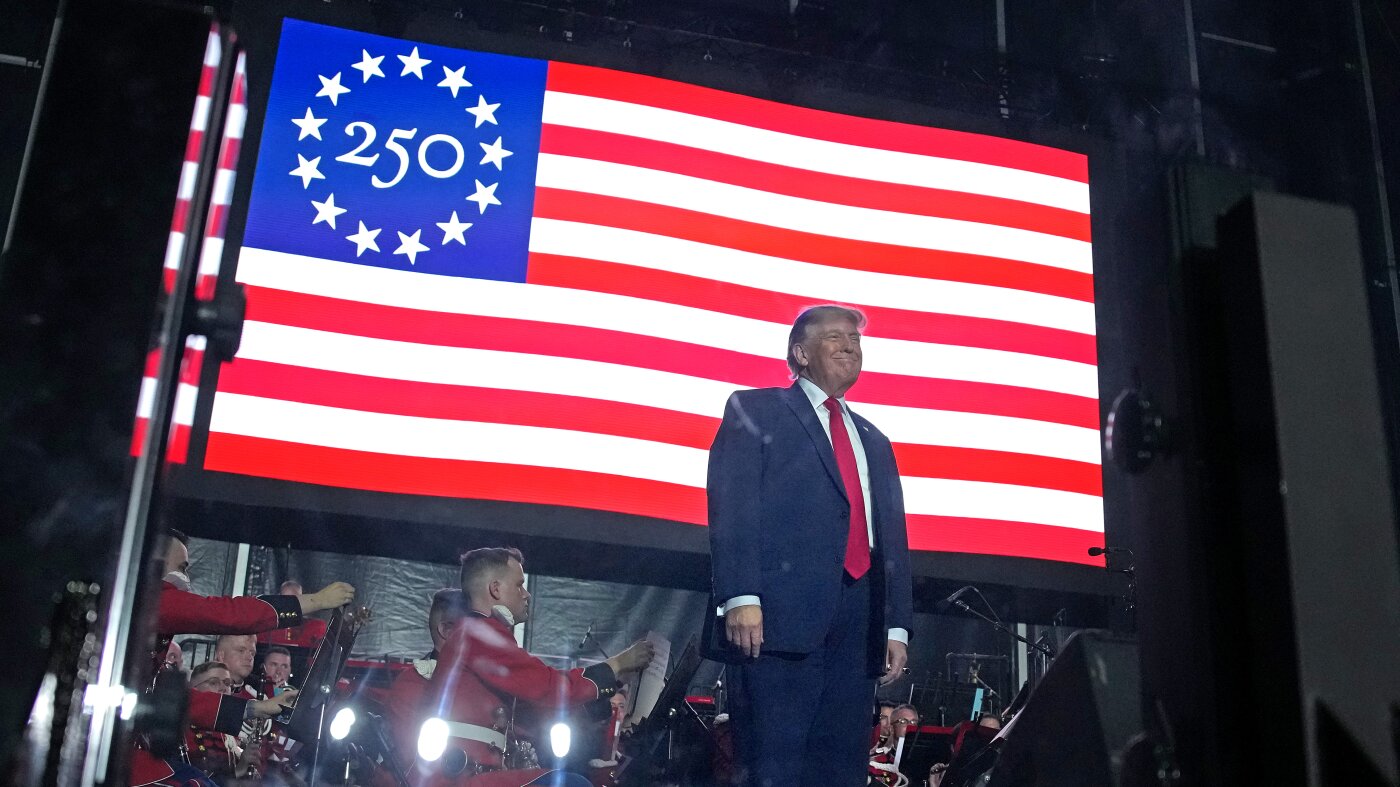
President Trump speaks at a rally kicking off the Great American State Fair last week, part of the anniversary celebrations organized by White House-backed group Freedom 250.
Andrew Harnik/Getty Images
hide caption
toggle caption
Andrew Harnik/Getty Images
As America’s birthday celebrations kick into high gear, so too do criticisms of the preeminent national group organizing them, Freedom 250.
Democrats on the House Natural Resources Committee published a 55-page report Thursday accusing the group of aiding President Trump in turning America’s milestone into a “hotbed of corruption and self-enrichment” through tactics that potentially amount to criminal fraud.
It’s titled “From Vanity to Insanity: How the White House Cheated the American People out of their 250th Birthday.”

Rep. Jared Huffman of California, the ranking Democrat on the committee, told NPR that the report was months in the making. It is based on interviews with unnamed whistleblowers, sworn Congressional testimony, internal Freedom 250 documents and other written responses.
“We put it all together to really tell the story … of how Donald Trump hijacked what should have been a unifying national celebration and repurposed it for his own interests,” Huffman said in a Zoom interview. “This was a team of operatives using the Freedom 250 shell company, but it was also Donald Trump himself telling them what to do.”
The White House referred a request for comment to Freedom 250, though Freedom 250 told NPR that it does not speak for the White House.
Freedom 250 is the public-private partnership behind some of the summer’s most high-profile anniversary events, including a UFC fight outside the White House in June, a controversial state fair on the National Mall, a July Fourth fireworks show opening with a Trump rally, and the “Patriot Games,” a high school athletic competition scheduled for August.
It was created via executive order last year, and describes itself as “the national, non-partisan organization leading the celebration of our Nation’s 250th birthday.” But it’s not the only one: Congress had created a nonpartisan commission called America250 for this same purpose in 2016.
Democratic critics and watchdog groups say Trump decided to forge ahead with his own group after unsuccessful attempts to pack America 250 with his allies. Freedom 250 was incorporated as an LLC in October 2025 under the National Park Foundation, the nonprofit arm of the National Park Service, whose board now includes a number of Trump loyalists, including Chris LaCivita, senior adviser on his 2024 campaign.

Visitors can buy Freedom 250 merchandise at the state fair on the National Mall.
Al Drago/Getty Images
hide caption
toggle caption
Al Drago/Getty Images
Thursday’s report describes Freedom 250 as “a shadow organization capable of infiltrating the celebrations and injecting America’s 250th with Trump’s extreme, partisan agenda.”
Several of its events, like the “Great American State Fair” and a prayer gathering on the National Mall, have been criticized for their sanitized presentation of history and overtly Christian bent. The report accuses the group of funding its programming through opaque and questionable avenues, including soliciting foreign funds, misleading donors and selling access to the president.
“Once you siphon off the funds and supplant the real bipartisan commission with this new entity and you declare it the main platform for our nation’s celebration, and you award all these shady contracts to your friends, you can do anything you want,” Huffman said. “And what these folks chose to do was to push a very divisive, very extreme and explicitly sectarian religious agenda into all these materials in our name, using our taxpayer dollars.”
Some of the accusations, if true, could be found to violate federal law. For example, the report alleges that the deception of donors who thought they were supporting America250 — but were actually given banking information for Freedom 250 — could constitute wire fraud.

Freedom 250 spokesperson Danielle Alvarez denied the report’s claims as “categorically false,” calling it a “partisan smear.”
“Congressional members should be ashamed they are spending countless hours fabricating a report instead of joining Americans in creating an absolutely beautiful celebration,” Alvarez wrote in a statement shared with NPR.
The report has not been adopted by the Natural Resources Committee, so does not reflect its official view. Republicans on the committee have so far refused to conduct any oversight on the issue, despite Democrats raising concerns at previous hearings. Republican ranking member Rep. Bruce Westerman did not respond to NPR’s request for comment.
Huffman said his team had tried for nearly a year to get information from Freedom 250, but faced “resistance and obstruction every step of the way.”
“I would hope that Freedom 250, if they claim that … there’s nothing to see here, open up your books,” he said. “Give us the documents that we’ve asked for, and the information we’ve asked for.”
Huffman said his investigation will continue well past July Fourth, especially if Democrats reclaim the House in this fall’s midterm elections. In that case, he didn’t rule out the possibility of subpoenas or criminal referrals if applicable.
Regardless, he believes more information and witnesses will come to light — and says a full accounting is critical to prevent such a playbook from being used again.
“We may not be able to undo the damage they’ve done to us and the national celebration,” Huffman said. “But we can do something very patriotic by reminding everyone that our government belongs to all of us, not to Donald Trump.”
What the report alleges
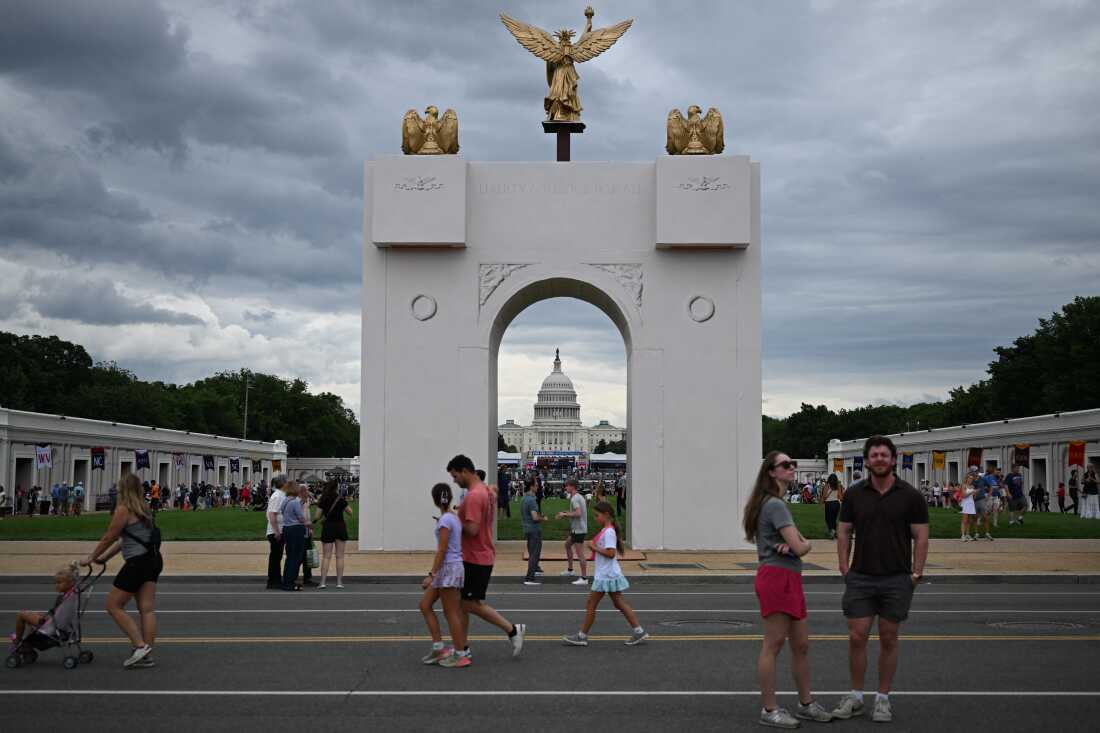
Trump also wants to commemorate the anniversary by building a 250-foot arch, a replica of which stands at the state fair.
Alex Wroblewski/AFP via Getty Images
hide caption
toggle caption
Alex Wroblewski/AFP via Getty Images
The report accuses Trump of long wanting to place himself at the center of the anniversary agenda. It points to events held on his birthdays — last year’s Army 250th parade and this year’s White House UFC fight — and longer-term projects like his plans to build a 250-foot-tall triumphal arch.
It alleges that when America250 resisted that vision, the Trump administration turned the National Park Foundation from a “beloved nonprofit into a presidential shell” by standing up Freedom 250 under its auspices.

It is not clear where that directive came from: Secretary of the Interior Doug Burgum, who serves as ex officio director of the foundation’s board, testified before Congress in May that he was “not aware of the final decision maker on Freedom 250.” That same month, he told CNN the organization is “run out of the White House.”
In any case, Freedom 250 emerged with more visibility and more federal funding than America250.
Alvarez, of Freedom 250, says it “stepped in to rescue our nation’s 250th birthday from years of wasted time, wasted money, and failed planning.” But the report argues it supplanted America250 “through a series of diversions and misrepresentations that drained the chartered Commission of the resources it needed to function.”
The report says Congress allocated $150 million in federal funds last year to the Interior Department for events celebrating the 250th anniversary, with the “understanding” that $100 million of that would go to America250. The group has only received $25 million, it says, citing unnamed sources.
A statement from Freedom 250 says no funds were specifically earmarked for one entity over the other, so “claims that federal funds were ‘diverted’ from America250 to Freedom250 are baseless.”
When asked for comment, America250 Chair Rosie Rios — who served as U.S. treasurer under President Obama — did not address the report. She said the organization “will continue to focus on the values-based programming approved by our bipartisan Commission” and is “supportive” of organizations planning events for the 250th.

The America250 logo is seen on a White House Christmas tree skirt in December. That group is less visible than Freedom 250, but is planning many community-based anniversary events and a concert in Los Angeles.
Anna Moneymaker/Getty Images
hide caption
toggle caption
Anna Moneymaker/Getty Images
The report alleges that Freedom 250 was advertised as an addition to America250 rather than as its replacement, creating confusion. For example, many of the performers who withdrew from a scheduled concert last month said they had falsely believed the event was nonpartisan (it was later rebranded as a Trump rally).
The report alleges that Freedom 250 capitalized on donors’ confusion in a way that potentially amounts to fraud.
“Donors who intended to support America250 were misled and apparently provided with Freedom 250’s banking information, meaning contributions solicited in the name of the nation’s nonpartisan birthday foundation were routed instead to the President’s substitute entity,” it reads.
Freedom 250 said in a statement that “every major sponsor received documentation identifying Freedom 250 as the recipient’s organization before funds were transferred, and donors were free to decline.”
Alan Zibel, a researcher with the progressive consumer advocacy nonprofit Public Citizen, called those allegations “very troubling.” He applauded House Democrats for looking into them, even though they don’t have subpoena power at the moment.
“They’ve given House Democrats, should they take the majority next year, months and months of investigative work to do,” he said. “And there are some pretty rich target opportunities.”
Many questions remain
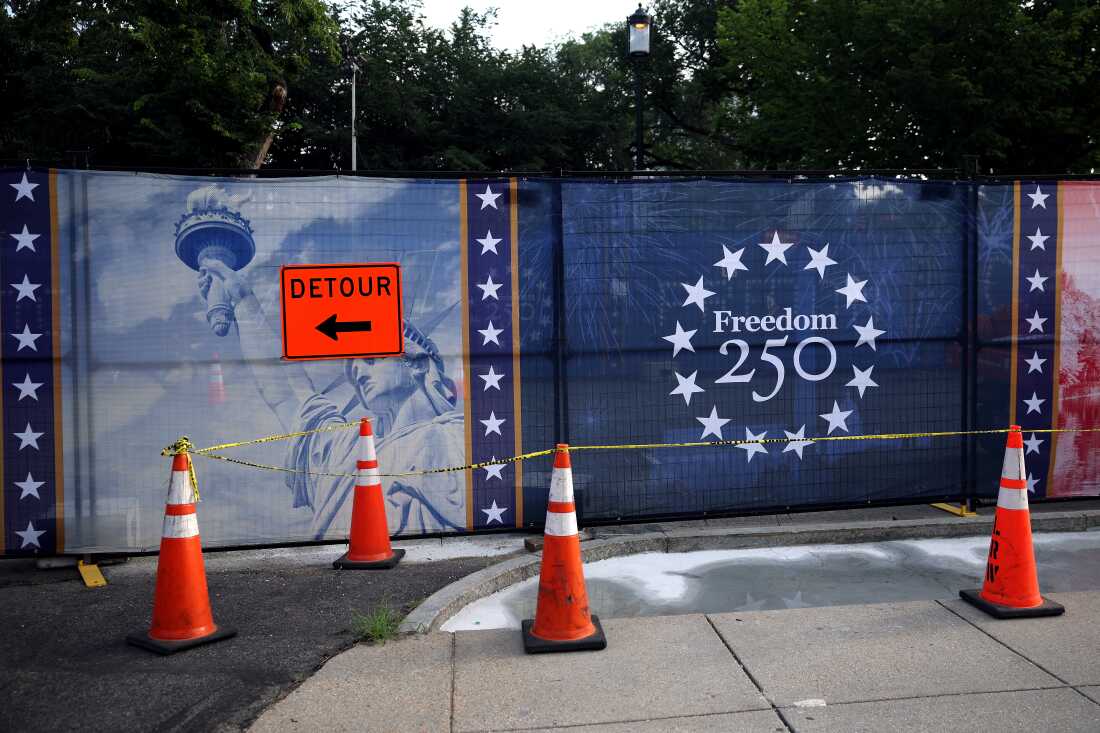
The Freedom 250 logo is visible on fencing around the National Mall on Thursday.
Kevin Dietsch/Getty Images
hide caption
toggle caption
Kevin Dietsch/Getty Images
The bigger-picture problem, critics say, is the lack of transparency throughout the entire process.
“All of these things have been so thoroughly conducted outside of public view,” said Toni Aguilar Rosenthal, a program director at the nonprofit Revolving Door Project. “But I think the House Dems’ report is an excellent extension of those sort of remaining questions that continue to plague just the entire situation and Freedom 250 organizationally.”
Aguilar Rosenthal co-authored a separate report on Freedom 250’s contracts and tactics, along with Zibel from Public Citizen.
Based on their analysis, Aguilar Rosenthal said of the more than $120 million in public funds funneled toward the anniversary celebrations, over $100 million has been “funneled” directly to projects, events and entities with ties to the Trump administration.
Some of those public contracts raise particular alarm among watchdogs. Federal contracts have directed tens of millions of dollars to a company called Event Strategies, Inc., which helped organize Trump’s infamous rally outside the U.S. Capitol on Jan. 6, 2021.
“They had a chance to do this in a bipartisan way or a way that wouldn’t enrich cronies, but they pretty clearly didn’t do that,” said Zibel. “I think that this is a follow-the-money situation that needs to be explored.”
Zibel says many companies — including major defense contractors and tech firms — that have donated to the 250th celebrations also rely on the government for contracts, funding and regulatory oversight. The report mentions that Freedom 250 circulated sponsorship packages culminating in a photo op with Trump, effectively selling access to the president.
Both reports raised questions about potential foreign influence. Alvarez, of Freedom 250, says it does not accept foreign donations.
But Keith Krach, a former Trump administration official who is the CEO of Freedom 250, appeared to solicit just that while speaking at the World Economic Forum in Davos, Switzerland, earlier this year, offering “toolkits for countries, states, companies, all of that.”
“What could be funner than marketing America, or really marketing freedom,” Krach said.
There is little visibility into the origins and destinations of donations in general, Aguilar Rosenthal says. Best case, they are still being used for some of America250’s original goals, she says. Worst case, she says, “public dollars and funds that have been earmarked for semiquincentennial celebrations are being used as a slush fund” for the administration and its political allies.
The report says the National Park Foundation’s donor structure “conceals the identities of those who give and the benefits they may be promised in return.” And at a congressional hearing in February, the foundation’s president and CEO, Jeff Reinbold, promised anonymity for any Freedom 250 donors who requested it (but said donations would otherwise be disclosed in the regular reporting process).
Huffman conceded that any anniversary celebration of this scale would merit scrutiny over spending and contracts. But he said if this had been organized by the bipartisan commission that Congress authorized — with representation from both parties to ask questions and do oversight — it would have been more transparent.
“There would have been public reporting,” he said, “because a publicly-created commission from Congress can’t hide behind the cloak of secrecy of an LLC.”
-

 San Francisco, CA8 minutes ago
Marina braces for Golden Gate Bridge fireworks show, massive crowds
-

 Dallas, TX11 minutes ago
Maradona’s ‘Hand of God’ ball heads to auction in Dallas
-

 Miami, FL16 minutes ago
Miami-Dade sheriff urges residents to celebrate Fourth of July safely
-

 Boston, MA23 minutes ago
Jaylen Brown says Celtics showed ‘lack of respect’ after trade to 76ers – The Boston Globe
-

 Denver, CO26 minutes ago
Who are the Top 5 offensive linemen in Denver Broncos history?
-

 Seattle, WA31 minutes ago
Seattle’s Lake Union to light up with big July 4 fireworks show for America’s 250th
-

 San Diego, CA38 minutes ago
New training program grants tribal members access to reservation land during emergencies
-
Milwaukee, WI41 minutes ago
Leaders of ‘United for Venezuela Emergency Relief Campaign’ grateful for support


