Midwest
Meet the American who created highway rest areas, Allan Williams, small-town engineer

The Motor City ignited the roar of the 1920s.
Chrysler, Ford and General Motors, each in Detroit, Michigan, emerged as the world’s three biggest automakers early in the Roaring ’20s. Customers needed somewhere to go to make their engines purr – and a safe, convenient way to get there.
The job fell upon the shoulders of small-town Michigan visionaries who paved the way for the automobile to leave the city and become synonymous with the open American highway.
Allan Williams, the first-ever highway engineer in rural Ionia County, proved perhaps the most influential among them.
MEET THE AMERICAN WHO STITCHED TOGETHER THE STARS & STRIPES, BETSY ROSS, REPUTED WARTIME SEDUCTRESS
He conceived and created America’s first roadside rest area in 1929. The idea took off faster than a big-block Motown muscle car 40 years later.
The highway rest stop, however, was only the most visible of the many contributions Williams made to the speed, safety and convenience of the American highway system we all benefit from today.
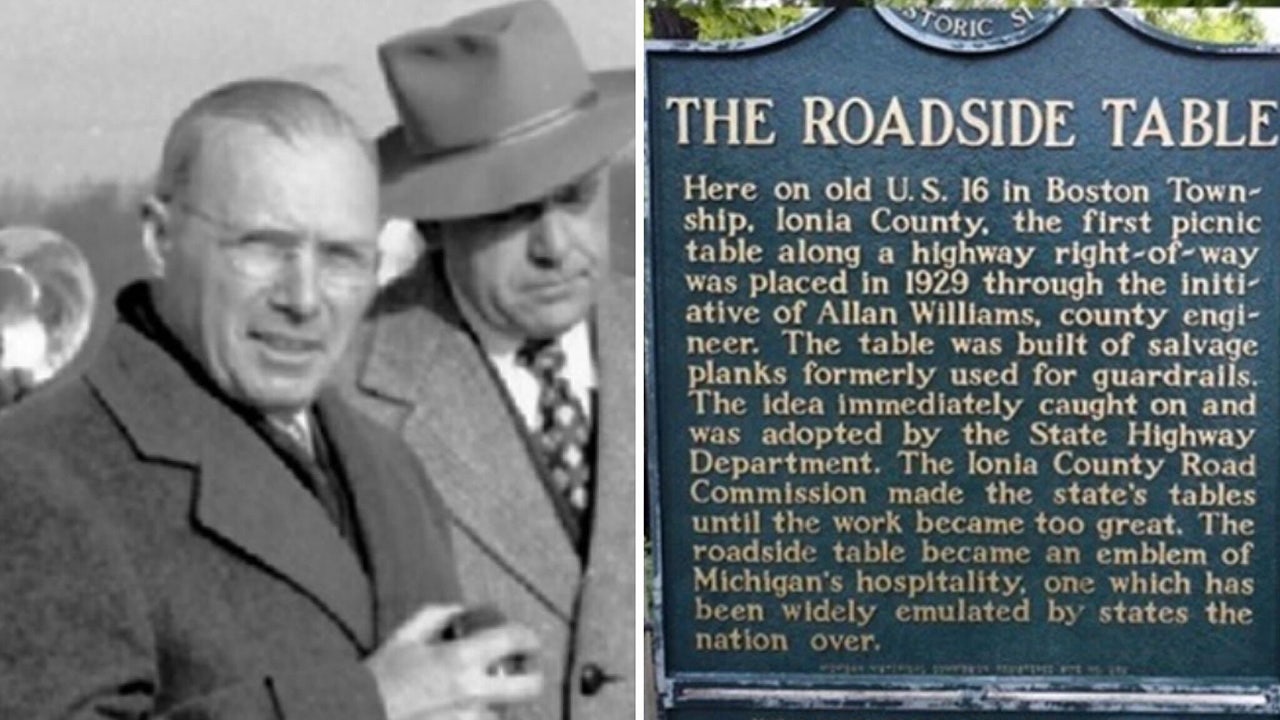
Allan Williams, standing, of the Ionia County Road Commission speaking at a City of Ionia, Michigan, bridge dedication luncheon. (Michigan Department of Transportation)
“He was living at a time when he had the ability to really do some big things and make some big changes in Michigan, but also actually in our nationwide history,” Sigrid Bergland, a historian with the Michigan Department of Transportation, told Fox News Digital.
Highway road maps, road signs and even snow plows were all influenced by his curiosity, intellect, varied skills and vision.
“He really was a Renaissance man.”
Williams also proved a civic leader in both peacetime and wartime.
He helped improve the roads less traveled in his small-town life.
“He was really an interesting Michelangelo-type of all-around interesting guy who did a lot of different things over his lifetime and who just happened to be a transportation engineer,” said Bergland. “He really was a Renaissance man.”
Fun, freedom and ‘automobiling’
Allan Mackenzie Williams was born on Jan. 26, 1892 in Ludington, Michigan, to Joseph and Isabelle (Cogswell) Williams.
The future American roadmaster apparently inherited his varied interests and natural gifts for fixing things from his father.
Roadside picnic on the way to Wisconsin, 1917. Mary E. Smith is seated with a friend on a white blanket with thermoses and a picnic basket. Their automobile is parked on the side of the road next to a fence. (Historical Society/Getty Images)
The elder Williams jumped from a career as a camp cook to one as an electrical engineer, according to the Michigan DOT.
“He opened and ran an electrical shop,” the state agency notes, “and went on to wire the first home in Ludington with electricity.”
MEET THE AMERICAN WHO INVENTED THE GAS-POWERED TRACTOR, ENTREPRENEUR JOHN FROELICH, HELPED FEED THE WORLD
The younger Williams studied engineering at the University of Michigan in Ann Arbor before transferring to Kalamazoo College, in Kalamazoo.
He found his life’s calling in 1919, still only in his 20s, when he was hired as county engineer for the Ionia County Road Commission.
Few roads were even paved at that point, notes Bergland of Michigan DOT.
Chuck “The Viking” Hayden, publisher of the travel blog restles-viking.com, at the first American highway rest stop: Route 16, Ionia County, Michigan. (Martha and Chuck Hayden/restless-viking.com)
But automobiles built 130 miles east in Detroit were getting more affordable, growing in popularity and spilling out across the American countryside.
“The elite chauffeur-driven crowd was about to be surpassed by a general public that wanted the fun and freedom that came with ‘automobiling,’” auto journalist Nick Kurczewski wrote in 2016.
The “public … wanted the fun and freedom that came with ‘automobiling.’”
Michigan highway engineers were the first people in a position to witness, then shape the future of automobile travel. Convenience was an early need.
Williams, apparently before the winter of 1928, “saw a family trying to eat a picnic lunch from a big tree stump alongside their parked automobile on one of the roads under county jurisdiction,” American Road Builder magazine reported in 1957.
Detroit, Michigan: Ford family and friends out for a drive on Detroit street in the 1906 Model K-6 cylinder auto. Left to right: Henry Ford, Leroy Pelletier, Clara Ford, Edsel Ford, and a telephone operator. (Getty Images)
“[They] had an appetizing snack spread out on a white cloth on the stump, but they couldn’t really enjoy the food because they couldn’t sit around their makeshift table, and had to content themselves with standing around or sitting on rocks or bare ground to eat their food.”
MEET THE AMERICAN WHO MAPPED THE US-MEXICO BORDER, GEN. WILLIAM EMORY, SHAPED NATION IN WAR AND IN PEACE
Williams had some extra wood lying around the Ionia Country Road Commission garage – and a vision.
‘Thought he was going to get a bawlin’’
The automobile first became a major part of the American landscape in the 1920s.
The number of cars registered in Michigan alone more than quadrupled during the decade, from 326,000 in 1919 to 1.4 million in 1919.
Williams witnessed similar scenes of travelers eating on the side of the road with increasing frequency.
A General Motors assembly line showing an early engine drop, circa 1920. (Fotosearch/Getty Images)
“An outdoorsman himself, he decided that people should have better facilities for resting and refreshing themselves along the highways,” according to the American Road Builder account.
“During the winter months, when some of his snowplowing crews were standing by at the county garage waiting for an expected storm, he put them to work knocking together picnic tables from odd lengths of 2×4 scrap lumber.”
For more Lifestyle articles, visit www.foxnews.com/lifestyle
He used “leftover guardrail wood or other surplus timber” according to Michigan DOT, while the tables “probably had plenty of splinters sticking out,” notes Bergland.
Allan Williams, the county engineer for the Ionia County (Michigan) Road Commission, created the first highway rest area in the U.S. on Route 16 in Michigan in 1929. (Michigan Department of Transportation)
The tables were painted green and placed on Route 16, three miles south of the Village of Saranac.
“My dad thought he was going to get a bawlin’ out for using that planking,” the engineer’s son, Colin Williams, then 84, said in a 2011 interview with MLive.com.
William’s roadside rest area, in today’s terms, went viral.
The “bawlin’” never came.
Instead, acclaim came from far and wide. Williams’ roadside rest area, in today’s terms, went viral.
MEET THE AMERICAN WHO PAVED THE WAY FOR THE INTERSTATE, GEN. LUCIUS CLAY, MASTER PLANNER, HERE OF TWO NATIONS
“The state highway department received more than 500 pieces of written feedback at table locations, from motorists as far away as Washington, Florida and Texas,” according to the MLive.com account.
Williams’s vision for highway respite spread about as fast as construction crews could pour the concrete for new roads.
A sign on Route 16 in Ionia County, Michigan, marks the site of the first highway rest stop in the United States. (Martha and Chuck Hayden/restless-viking.com)
Nearly 1,500 picnic tables had been placed around Michigan by 1937, many of the earliest built by Williams’ staff in Ionia County.
The state eventually took over the responsibility. The roadside picnic table total in Michigan reached 2,500 by 1947.
There are 1,400 full-service highway rest areas just along U.S. Interstate highways today, according to InsterstateRestAreas.com.
They offer countless picnic tables and seats among them.
‘Just some guy in small-town Michigan!’
Allan Williams passed away on June 3, 1979.
He was 87 years old and is buried in Lakeview Cemetery in his hometown of Ludington.
Allan Williams, far left, at M-66 bridge dedication ribbon cutting ceremonies in Ionia, Michigan. (Michigan Department of Transportation)
“Michigan was definitely the location of many ‘firsts’ in transportation — and especially highway — history,” Chris Bessert, the publisher of MichiganHighways.org, wrote in an email to Fox News Digital.
Williams, he writes, was at the center of it all.
“He designed and issued the first state highway road map … He championed the construction of highways on rights-of-way wider than the standard 66-foot space used to that point, he designed Michigan’s state highway route marker and widened its use, and a variety of other firsts.”
“The state highway department received more than 500 pieces of written feedback at table locations.”
William’s impact was also felt close to home.
“He left a legacy in Ionia County,” traveler bloggers Martha and Chuck “The Viking” Hayden write on restless-viking.com.
He served for many years as president of the Ionia County Free Fair, still one of the largest in the state, helped engineer Ionia County Airport, and was chairman of the county hospital board.
The first highway rest stop in 1929 consisted of a few roadside picnic tables on Route 16 in Michigan. They quickly became an American phenomenon. South of the Border in Dillon, South Carolina, is one of the nation’s gaudiest roadside attractions. John Margolies Roadside America Photograph Archive, 1986. (Universal History Archive/Universal Images Group via Getty Images)
When the United States entered World War II, Williams oversaw Ionia County’s efforts to turn scrap metal into munitions.
“He was very civically minded, very interested in helping people and finding different ways to give back to people and to contribute to his community,” said Bergland of Michigan DOT. “He was a big-picture guy.”
Gov. William Milliken honored Williams with a Michigan Tourism Award in 1976, recognizing the contributions the engineer’s work made to encouraging visitors to the state.
There is some dispute, however, over the Williams rest-area origin story.
“Some documentation indicates that Connecticut established its first site in 1928,” reports RestAreaHistory.org. “More solid evidence, however, points to Michigan and a site created in 1929.”
Other evidence suggests that Herbert Larson, a road commissioner in Iron County, on Michigan’s Upper Peninsula, erected roadside picnic tables as early as 1919.
Allan Williams, far left, was the first engineer for the Ionia County (Michigan) Road Commission when he conceived the first U.S. highway rest area in 1929. A sign marks the American roadside landmark today on Route 16 in Michigan. (Michigan Department of Transportation; Martha and Chuck Hayden/restless-viking.com)
But Larson’s was a standalone occurrence, according to Bessert, while Williams created what became a state and then national phenomenon.
“Williams’ role in the early development of Michigan’s highway system was copied and duplicated around the world,” writes Bessert.
“It’s something that shouldn’t be minimized. And this was just some guy in small-town Michigan!”
To read more stories in this unique “Meet the American Who…” series from Fox News Digital, click here.
Read the full article from Here


YORKTOWN, Va (WAVY) — A 31-year-old Illinois man has been sentenced after pleading guilty to exploiting a York County child online.
According to the York County Commonwealth’s Attorney’s Office, Andres Arreola pleaded guilty to enticing a minor to perform child sexual abuse acts and using a communication system to facilitate certain offenses involving a child.
The case began in April 2025 after the parent of a 9-year-old child called the York-Poquoson Sheriff’s Office about inappropriate messages they found from Arreola to the child on an online chat platform.
Investigators determined Arreola sent sexually explicit messages and images to the child and persuaded the child to send explicit images in return, knowing the victim was a 9-year-old.
Detectives were able to identify Arreola in Illinois, where he was taken into custody. He was then extradited him to York County where he remained behind bars without bond. Detectives also recovered electronic evidence supporting the charges.
A judge ultimately sentenced Arreola to 40 years in prison, suspending 31 years and six months, leaving him with an active prison sentence of eight years and six months.
After his release, Arreola will serve 20 years of supervised probation. He cannot have unsupervised contact with minors and will be required to register with Virginia’s Sex Offender and Crimes against Minors Registry.
“The exploitation of children—whether in person or online—will not be tolerated in York County,” said Commonwealth’s Attorney Krystyn Reid in a statement.
Reid goes on to praise the investigators, prosecutors and the “the young victim and the victim’s family throughout this case. Anyone who seeks to harm a child, regardless of where they are located, should expect to be identified, brought before the court, prosecuted, and held accountable.”


Alyssa Thomas unhappy with WNBA following Caitlin Clark incident
USAT’s Cydney Henderson asks Mercury’s Alyssa Thomas about how the WNBA has remained silent following the on-the-court incident with Caitlin Clark.
Sports Seriously
The WNBA on NBC will kick off “Sunday Night Basketball” on July 12, when the defending-champion Las Vegas Aces face the league’s top television attraction, the Indiana Fever. (9 p.m. ET, NBC/Peacock).
The star power is loaded for both teams, with league MVP A’ja Wilson and All-WNBA performer Jackie Young for Las Vegas, and Caitlin Clark, Aliyah Boston and Kelsey Mitchell headlining the Fever.
Both teams have injury issues as Clark sat out against the Mercury on July 9 with lingering back issues. Boston returned in that victory after dealing with a leg injury.
Wilson returned to the lineup on July 9 after sitting out three games with a right ankle injury. She had 32 points against the Toronto Tempo.
What time is Las Vegas Aces vs. Indiana Fever?
- Date: Sunday, July 12
- Time: 9 p.m. ET (6 p.m. PT)
- Location: Michelob ULTRA Arena
The Aces and Fever play at 9 p.m. ET on Sunday, July 12, at Michelob ULTRA Arena in Las Vegas.
What TV channel is Las Vegas Aces vs Indiana Fever on today?
TV: NBC
Stream: Peacock

Jamie Pollard to step down after 22 years
Iowa State AD Jamie Pollard to retire after 22 years; leaving by June 30, 2027 after 24 Big 12 titles, $400M+ projects.
When Jamie Pollard was first introduced as Iowa State’s athletics director on Sept. 19, 2005, he quickly marked his — or rather, the Cyclones’ — territory.
After unranked Iowa State football upset then-ranked No. 3 Iowa, 23-3, in that season’s Cy-Hawk game, Pollard commissioned a billboard in Hawkeye territory over in Cedar Rapids that read, “It’s a Cyclone state.”
It was bold, unique and different. It was also indicative of what to expect from Pollard, who is unafraid to express himself, passionate about the Cyclones and from the outset had a vision for Iowa State athletics, which had long been deemed little brother to its rival in the eastern half of the state.
The billboard riled up those with Cyclone and Hawkeye allegiances. The initiative is still discussed years later and occasionally referenced.
Pollard is still around, too, although his time as an athletics director is coming to a close.
On July 10, he announced his retirement, which will be effective on June 30, 2027, or whenever Iowa State has hired his successor — whichever comes first.
“My wife, Ellen, and I look forward to the next chapter in our life’s journey and it is important to us that we transition now, while we are both healthy and young, so we can fully enjoy our retirement years,” stated Pollard. “I am grateful to President (David) Cook for allowing me to share this news now and hopefully it will allow the university plenty of time to properly transition new leadership to our department during a transformational time in college athletics.
“When we moved to Ames in 2005, we did not anticipate the impact being a Cyclone would have on our family. The personal and professional opportunities our family has experienced during the past 21 years have been truly amazing.”
Pollard is entering his 22nd year as athletic director at Iowa State, is the longest-tenured athletic director in school history and the longest-tenured active power-conference AD in the country.
The Oshkosh, Wisconsin, native first arrived in Ames after serving as associate and deputy athletics director roles at Wisconsin from 1998-2005. He also had administrative roles at Saint Louis and Maryland.
The nationwide search for a new athletics director is expected to begin this fall. Until then, Pollard plans on making sure his successor will be in good standing going forward.
“A big thing for Ellen and me, is there is a ‘next,’ and we want to physically and mentally be able to enjoy ‘next,’ but, at the same time, I want to make sure when that day comes, that we hand it off in as good a spot as can be,” Pollard told the Register in June. “… At some point in time, you have to transition it to whatever comes next and unfortunately, our industry, the ground’s changing under our feet as we talk. We’re going to have to figure out how to deal with that part of it, and I think a big part for Iowa State is just making sure our financial situation is as solid as it can be. It’s not clearly what it once was, but we’re never going back to those days, either.”
From upgraded facilities, key coaching hires, to recent athletics success, Cyclone and Hawkeye fans will continue the endless debate about superiority with or without the infamous billboard. But there’s no doubting the growth and change across Iowa State athletics throughout Pollard’s time as AD.
Iowa holds the edge in the all-time series records for the Cy-Hawk rivalry, but recent years have shown that the Cyclones now have a seat at the big-boy table nationally.
“I’ve been witnessing all the stuff that he’s done and I think — I don’t know technically who is going to be on the Mount Rushmore of Iowa State athletics, but I think he’s got to be there because of what he’s done for all of us,” longtime Iowa State women’s basketball coach Bill Fennelly said. “You embrace who you are, you don’t apologize for what you’re not and I think he learned quickly like, ‘Hey, we can’t change the weather here, we can’t change the population.’ We have to change our facilities, we have to make Iowa State fans really proud of who we are and what we’re about. How do we do that? He really did a great job of it.
“You don’t stay in a job like that this long without being really good at it, but at the same time, being respected within the building.”
Iowa State athletic director Jamie Pollard gives Cy-Hawk game update
Iowa State athletic director Jamie Pollard gives a Cy-Hawk game update.
While former athletics directors Gene Smith and Bruce Van De Velde began fundraising efforts at Iowa State, Pollard exponentially accelerated and revolutionized the Cyclones’ fundraising success.
Athletics fundraising increased from $9 million the year prior to his arrival to $53 million during the 2025-26 academic year.
The administration invested more than $400 million in new facilities and building upgrades. Some of the most impactful completed projects include the construction of the Stark Performance Center, the Sukup Basketball Complex and the pedestrian bridge, as well as renovations to the Bergstrom Football Complex, Jack Trice Stadium and the south end zone project.
“You step foot in the facilities now, and there’s nothing to laugh at anymore,” said Dan McCarney, who coached Iowa State football from 1995-2006. “… When I walk in those facilities over there right now, I can’t tell you how many times I’ve said to my former assistant coaches I would have just loved one day, just one month, I would have loved to bring recruits and their families, former players and fans into those facilities now that have been built under Jamie’s leadership.
“There’s commitment, it is big-time. Is it the best in America? I don’t know and I don’t care. I just know it’s the best in the history of Iowa State athletics and that doesn’t just happen. You got to have vision, you got to be a dreamer and then you got to have a path and a plan to get you there, and I think that’s what will be a big part of Jamie’s legacy.”
Iowa State athletic director Jamie Pollard on potential CFP expansion
Should the College Football Playoff expand to 24 teams? Iowa State AD Jamie Pollard shares his thoughts on the potential idea.
Pollard made integral coaching hires, such as football coach Matt Campbell, who became the winningest coach in program history and established consistency over his decade-long run with the Cyclones before departing for Penn State.
In men’s basketball, Pollard hired hometown legend Fred Hoiberg, whose banner was hung in the rafters of Hilton Coliseum in 2010. “The Mayor” returned to coach his alma mater despite not having any prior coaching experience. Hoiberg broke a 14-year drought by leading the Cyclones to their first Big 12 Tournament title and Sweet 16 appearance in 2014. His team followed up with another Big 12 Tournament crown the following year, Hoiberg’s last before leaving for the Chicago Bulls.
Pollard made another instrumental basketball coaching hire by bringing in former assistant T.J. Otzelberger to become head coach. Otzelberger inherited a 2-22 team and restored the Cyclones into the national spotlight. The Cyclones have made the NCAA Tournament each year and reached three Sweet 16s under his watch.
Women’s basketball has been a frequent NCAA Tournament participant and won a Big 12 Tournament title in 2023.
There has also been success in Olympic sports. Wrestling also returned to national relevance with the hiring of Kevin Dresser and is now in the midst of a transition period with new head coach Brent Metcalf and the introduction of women’s wrestling. Iowa State continues to be a power in cross country and track and field. Women’s golf won its first Big 12 team title in 2026.
Throughout Pollard’s two decades in Ames, the Cyclones have won 24 Big 12 team championships across eight different sports. They’ve registered all-time program-best finishes in nine different sports and crowned 24 NCAA individual champions. Iowa State has won four of the last five Cy-Hawk Series and 11 titles overall.
Pollard earned Division I FBS athletics director of the year honors from NACDA in 2019 and 2023.
“Excited for him, but it’s hard to see him go because it’s all I’ve ever really known is him working in college sports and especially Iowa State,” said his eldest son Thomas Pollard, the Cyclones men’s basketball director of recruiting. “Knowing how much Iowa State means to him and everything he’s put into this place, it’s hard to put it all into words.”
Iowa State athletic director Jamie Pollard on 76-team NCAA Tournament
Iowa State athletic director Jamie Pollard on 76-team NCAA Tournament expansion.
There were some tough times and challenges that came during the climb to improve Iowa State athletics.
Financial struggles, uncertainty surrounding conference realignment, the COVID-19 pandemic, adapting to the new age of college athletics with NIL, transfer portal and revenue share, the elimination of the gymnastics program, and the inability to retain successful coaches such as Campbell, Hoiberg, former wrestling coach and alumnus Cael Sanderson, and former gymnastics coach K.J. Kindler, who became an eight-time national champion at Oklahoma.
Some financial issues remain. Last year, Iowa State athletics projected a $147 million budget deficit through 2031, which the school said was due to the House settlement that allowed for revenue sharing with student-athletes.
However, Pollard told the Register in June that through internal decisions and alterations, Iowa State has been able to cut that deficit to approximately $75 million over the next five years.
Regardless of the obstacles, Pollard has persisted. A 22-year run as a power-conference athletics director stands out in an ever-changing college landscape, from systems to personnel.
His retirement wasn’t a surprise to those close to him. Pollard’s ability to stay for as long as he did didn’t shock them, either.
“Number one, Jamie’s very smart,” Dresser said. “Number two, he’s very driven. And number three, I think you’ve got to have this — he’s not afraid to make hard decisions that are going to upset people. He sees the big picture and he’s got a vision. Any time you’re in charge, you’re going to hurt feelings and step on toes, and he accepted that part of his job and he might not have liked it all the time, but he did the things he had to do to make Iowa State continue to progress.”
Eugene Rapay covers Iowa State athletics for the Des Moines Register. Contact Eugene at erapay@gannett.com. Follow him on Twitter at @erapay5.
-

 Austin, TX5 minutes ago
Suspect killed in officer-involved shooting in downtown Austin
-

 Alabama12 minutes ago
Cullman’s Alabama Strawberry Festival adds another statewide award
-
 Alaska14 minutes ago
Commentary: What’s in a name? A confounding U.S. Senate race
-

 Arizona19 minutes ago
Arizona firefighter killed in wildfire remembered as brainy, ‘goofy’
-

 Arkansas27 minutes ago
Bentonville’s Dave Peel Park to become new downtown entertainment space | Arkansas Democrat Gazette
-
 California29 minutes ago
Cowboys, margaritas and toxic trash: Some sour on lawyers in lucrative L.A. landfill cases
-

 Colorado35 minutes ago
Spending topped $67 million in key Colorado primary races. But big money didn’t always win.
-

 Connecticut42 minutes ago
Milford business celebrating 50th anniversary

