Midwest
Kansas man allegedly stole rare, historic 800-pound cannon from park for drug money: report

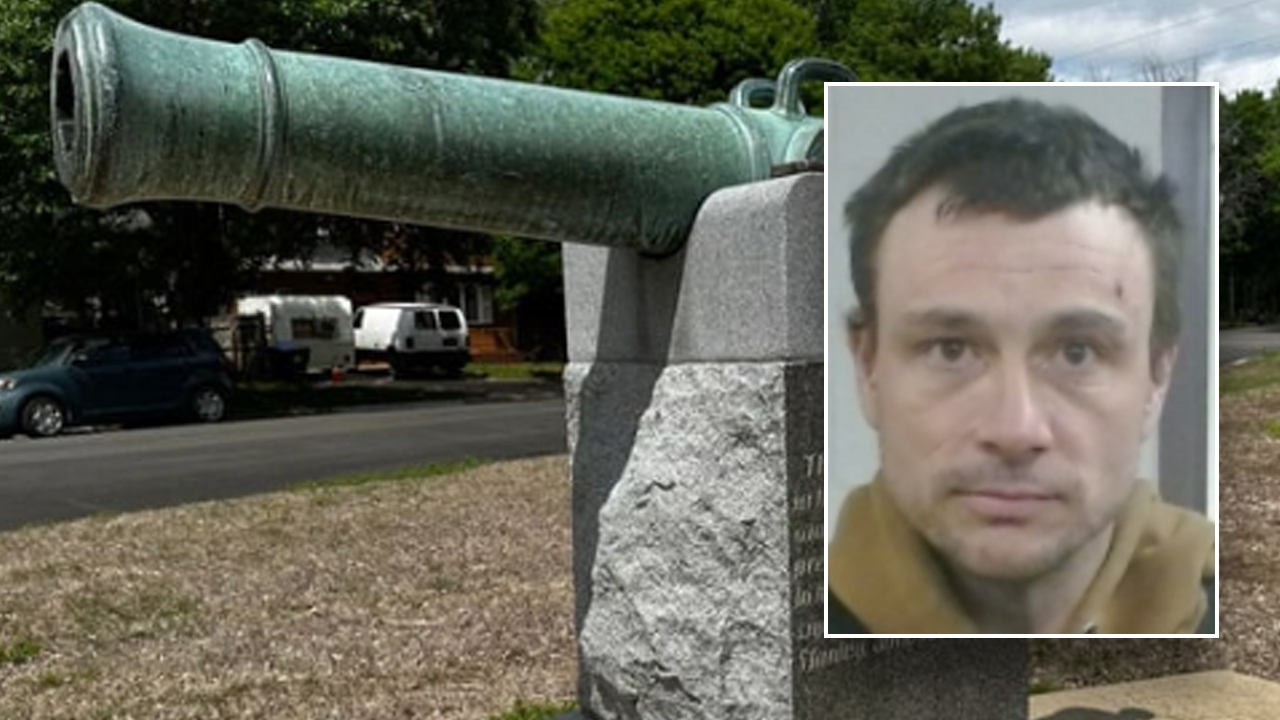
A Kansas man reportedly stole an 800-pound historic cannon from a local park for drug money, according to newly released court documents.
An arrest affidavit, obtained by KAKE News, states that Gordon Pierce III, 37, told Wichita police officers that he believed his life was in danger after a drug dealer claimed that Pierce owed him money, leading him to steal the cannon for money.
The report states that Pierce told police he went searching for copper statues to steal to make money to pay back the dealer and found the 800-pound cannon on the morning of April 2.
Pierce allegedly told the officers he had been a meth user for 20 years and went to his drug dealer who gave him a pound of meth, but he was not comfortable with that amount because he would not be able to sell it.
MISSISSIPPI DELIVERY DRIVER ACCUSED OF TRYING TO STEAL RETIRED DEPUTY’S ORDER
Newly released court documents shed light on why a rare Spanish-American War cannon was stolen from a Wichita park and cut into pieces last month. (Sedgwick County Jail/KAKE News)
He told police that someone attacked him and stole the meth, but the dealer did not believe him and wanted $20,000 or “he would shoot him and his family.”
Pierce told police he saw a homeless man at a nearby pavilion and offered the man meth and a pipe in exchange for helping him chain the cannon, the outlet reported. The homeless man agreed to help Pierce and then the two smoked meth together at the park before attempting to steal the cannon, the report reads.
Due to the weight of the cannon, Pierce told police that he and the homeless man were unable to load the cannon into his Chevrolet Tahoe, according to the report. Pierce also told police he tried to pull the cannon with his SUV, but the chain kept snapping.
Pierce then left the cannon and drove to a nearby friend’s house to borrow a new chain, according to the report. His friend declined to help him move the cannon, but Pierce was able to drag it to his friend’s house and store it inside his garage.
FLORIDA MAN OFFERS POLICE BOOZE DURING CAR CHASE: ‘DON’T KNOW IF HE WAS EXPECTING US TO JUST SAY ‘CHEERS”
Newly released court documents indicate that a Wichita man who stole an 800-pound historic cannon from a local park did so for drug money. (KAKE News)
Pierce reportedly told police that over the next several hours he used a Sawzall to cut the cannon into four to five pieces, which he placed in his Tahoe, leaving the largest piece of the cannon in his friend’s garage.
The affidavit states that Pierce told police he took the cannon pieces to his drug dealer to show him he was trying to get him the money he owed. But the drug dealer called Pierce “stupid,” telling him he is going to “bring heat to his house” and to “get out.”
The drug dealer also reportedly told Pierce he was going to “shoot him in the head next time he saw him.”
Pierce told police the threat made him feel “helpless” and he went to his mother’s house to explain what happened.
TEXAS MAN CALLS 911 AFTER INJURING HIMSELF DURING ALLEGED CAR DEALERSHIP BREAK-IN
The Wichita Police Department said several weapons were recovered from the scene. (Wichita Police Department)
He allegedly told police he chose the cannon because it was in a dark area; a detective said Pierce did not have a specific plan to sell the cannon pieces since he did not have an ID, which is typically required to sell scrap materials.
Police said they followed indentations in the road that were allegedly caused by Pierce dragging the cannon to his friend’s house, where he told officers where to find him.
Officers allegedly found a clear baggie of a white crystal-like substance on Pierce during his arrest, which he told police was methamphetamine.
He remains in the Sedgwick County Jail on charges of theft of property, aggravated criminal damage to property and possession of drug paraphernalia. His bond is set at $200,000. Pierce also waived his preliminary hearing and is set for arraignment on May 22.
Historians told KSN the cannon is “irreplaceable.”
“This cannon was gifted to the City in 1900 and is a priceless fixture in our community,” Wichita police said in an update on the department’s Facebook page.
“This swift investigation shows our dedication to holding individuals responsible when they victimize our community.”
Stepheny Price is a writer for Fox News Digital and Fox Business. She covers topics including missing persons, homicides, national crime cases, illegal immigration, and more. Story tips and ideas can be sent to stepheny.price@fox.com
Read the full article from Here


INDIANAPOLIS (WISH) — The month of May begins with “the greatest spectacle in running.”
Runners from all over gear up for the 500 Festival Mini-Marathon, with the first race starting at 7:35 a.m. Saturday.
At the Indiana Convention Center on Friday, participants were prepping. They picked out shoes and running gear, and checked out the course map. Organizers estimated over 20,000 runners for the big race day. There’s the 5K run and, of course, the half-marathon that runs through Indianapolis Motor Speedway.
This year marks the 50th annual Mini-Marathon. Organizer Linday Labas of the 500 Festival said, “We have five Indy alumni who have done this race all 50 years, so they just keep coming back. They like the other part of the month of May, celebrating and tackling it. I know it looks different now than it was 50 years ago, but they keep coming back, because they love the celebration around Indy Mini.”
Cecilio Martinez has marathon tattoos for all the times he’s run. He ran the Chicago, Berlin, Honolulu and New York City marathons. But, he only has one half-marathon inked on his calf, and that’s Indy’s Mini-Marathon with the 50th anniversary medal. He said this isn’t the first time he’s run the Indy Mini. “I like the course. I like the people. I love Indy Mini.”
Runner Karina McDougle said, “Unlike 2025, the race is going to be chilly with temperatures as low as 39 degrees. “Honestly, because I’ve been running in so much cold weather, I’m pretty used to that, and I would prefer that. I do overheat a lot. It’s great for me, I’m looking for a cool day.”
There are also lots of first-timers running the half-marathon, including Wabash Middle-High School wrestler James Day. “We’re just excited about the experience. They actually talked me into it. I didn’t want to do it originally. I ran one day this week. We’ll see how this goes. I just came back from a wrestling season, though, so I should be in a decent shape.”
At the end of the 13.1 miles, runners will receive a golden medal to mark their accomplishment.
Cleveland, OH
Francine Esther Nshimirimana Obituary April 24, 2026 – Slone and Co. Funeral Directors

Francine Esther Nshimirimana, age 47, passed away on April 24, 2026.
Family and friends are welcome on Saturday, May 2, 2026, from 11 a.m. until time of Service at 12 p.m., at Slone & Co. Life Celebration Center 3556 W. 130th St. Cleveland, OH 44111. Interment West Park Cemetery.

Editor’s note: This story is part of the Monitor’s summerlong series following old U.S. Route 66 from Chicago to Santa Monica, California.
Just a few blocks from the Old Joliet Prison, Johnny Williams is standing outside a tire shop, waiting for a repair.
He’s a lifelong resident of the Joliet area, a father of six and grandfather of 10, and he remembers back in the day when the prison was part of the economic engine that made Joliet run.
Why We Wrote This
Route 66 courses through American cities that once flourished before their economies faded or were forced to change. The story of Joliet, Illinois, reflects the high times, the hardships and the reinvention found along the century-old road.
“I remember when people used to sit out there visiting their people — on the buses, you know?” Mr. Williams says. “I have plenty of people whose parents and uncles worked there.” He gestures toward the 25-foot limestone walls, still topped with razor wire. “And as a child, I would always wonder — what’s behind that wall?”
So, he still marvels at how the once imposing former state penitentiary has been transformed over the past decade. Today, the people walking through its front gate are not prisoners or staff, but tourists and Americana-lovers there to have fun and celebrate the centennial of Route 66. The iconic roadway, noted in hundreds of anthems about America, passed right by the prison until 1940, when it was rerouted a few blocks away.
The prison once housed such infamous criminals as Richard Speck, James Earl Ray, and John Wayne Gacy. But since its closing in 2002, it has become a site for concerts, film viewings, and today, an event dubbed “The Big House Ballgame.”
People wondered about the prison for decades, said Quinn Adamowski, board president of the Joliet Area Historical Museum, which now runs the prison, before the game. “This site defined Joliet in many ways.”
After the prison closed, it was largely abandoned, becoming a liability, Mr. Adamowski said, especially in this neighborhood. “In 2017, 160 years after the first inmates arrived, we had the opportunity to wonder what this site could be,” he added. “It was our time – Joliet’s time – to define the prison.”
The Big House Ballgame on April 30, which is the 100th anniversary of the naming of Route 66, featured the Joliet Slammers, a Frontier League baseball team co-owned by actor Bill Murray. It was one of the featured events of an official five-city kickoff of events commemorating America’s “Mother Road.”
Baseball was also part of the prison’s history. In the early 20th century, inmates formed teams and played games against one another and against outside clubs, part of a broader effort to impose order and routine within the prison. The Big House Ballgame today is, in part, an attempt to revive that history — to connect the present moment to something that had once taken place on the same ground.
What happened to Joliet over the past century and a half happened, in some version, to nearly every city and town along Route 66. The collapse of jobs, travel routes, and movement west – and then a slow, uncertain reinvention.
The roadway passed through working America, and then through America after the work was gone. The centennial is, among other things, a celebration of the survival of places that kept going when the economies that made them no longer existed.
***
Curt Herron, like Mr. Williams, has lived in this part of Will County his whole life, growing up in Lockport, a small city just north of Joliet, before spending 45 years as a sports reporter covering high schools, the Slammers, and nearly every sporting event in between. Today, he’s an assistant at the historical museum.

Harry Bruinius/The Christian Science Monitor
“Joliet was always a real working-class city,” he says, pausing in the shadow of a guard tower as a group of tourists photographs the cellblock windows above him. “The second biggest steel city in the country after Pittsburgh. And then, on top of that, a prison city — two prisons within a few miles of each other, running simultaneously for 75 years. Almost nowhere in America can say that,” he says, noting that the area’s other prison, Stateville Correctional Center in Crest Hill, is still in operation.
The steel came first. In 1869, the Joliet Iron and Steel Works opened along the Des Plaines River, drawing on the region’s coal deposits and its limestone – the same blue-gray stone that built the prison walls, the same stone quarried from just beneath the city’s surface – to become one of the great industrial enterprises of the Gilded Age. At its height, it employed thousands of men and produced the railroad rails that stitched together the American West.
Joliet drew immigrant workers in successive waves: first, the Irish who dug the Illinois and Michigan Canal in the 1840s; then Poles, Lithuanians, and Eastern Europeans; then African Americans and Mexican migrants during the First World War. Joliet became, in the language of the era, a city of stone and steel – proud of its grit and defined by its labor, built on the conviction that hard work in a hard place was its own kind of American story.
Then, the steel left. By the early 1980s, the mill was gone, and the unemployment rate in Joliet climbed to 26% – among the highest of any city in the United States at the time. The limestone ruins of the ironworks sat empty along the river for decades, overgrown with vegetation, before the Forest Preserve District turned them into a heritage trail.
A wound, converted in time into a park.
“We were known for being a hardscrabble place,” Mr. Herron says. “Because of the prisons and the steel industry and a lot of working-class people. But that’s not a bad thing. It’s also led to a real competitive area – a lot of great athletes have come from here, a lot of people who’ve gone on to do remarkable things.” These include actors Nick Offerman and Melissa McCarthy, two Super Bowl-winning football players, and a WNBA champion.
But transportation has been, and remains, a major driver of Joliet’s economic engine. The Illinois and Michigan Canal and the railroads that followed in the 19th and 20th centuries once spurred its growth. Today, vast inland port complexes make Joliet one of the major freight hubs in North America.
And then, Route 66, which ran directly through downtown, across the Des Plaines River at the Ruby Street Bridge, helped make Joliet a destination for travelers.
The state is betting that Route 66 travel will continue to help the local economy, said Catie Sheehan, the Illinois deputy director of tourism and a Route 66 Centennial commissioner. “Joliet is one of nearly 100 communities along the Illinois stretch of the Mother Road. These towns bring Route 66 to life in so many different ways.”
Her tourism office has funded a suite of new roadside attractions for the centennial: a 20-foot “Tire Tower” for Joliet’s Chicagoland Speedway, a 12-foot penny for Lincoln, Illinois, and a 14-foot statue of Abraham Lincoln for Granite City.
“A lot of Midwestern industrial towns have fallen by the wayside and haven’t recovered,” Mr. Herron says. “Transportation saved the day – it’s always been about roads and waterways here.”
***
Dan Goedert is sitting in the stands at The Big House Ballgame, dressed as a prisoner with a black and white striped shirt.
Harry Bruinius/The Christian Science Monitor
A retired emergency room nurse, Mr. Goedert has posed for a few pictures already. “I just read about this yesterday,” he says. “So, I just came to have a little fun today.”
The group Billy Branch and the Sons of Blues have been playing in the old prison yard, along with local blues singer Sheryl Youngblood. They do a spirited version of “(Get Your Kicks on) Route 66.”
But the old prison, like Route 66, has a legendary pop cultural connection. “We like history, and we’re old, so we remember the ‘Blues Brothers,’” says Sue Bradley, a special education teacher sitting on the grass before the game with her husband John, who works in finance. She gestures toward people wearing fedoras and black suits and ties. “You’ll see people dressed like them everywhere here today. This is the prison they got out of at the beginning of the movie.”
It’s a movie that few people in Chicago have forgotten. In the opening scene of the 1980 film, a paroled convict played by the late Chicago native John Belushi – “Joliet” Jake Blues – walks out of the same prison gate here to meet his brother Elwood, also a small-time criminal, played by Dan Aykroyd.
Jake and Elwood set off on a road trip that is, at its heart, a story about the open road as salvation. It made the prison famous in a way that, at the time, 144 years of incarcerating murderers and gangsters had not.
And it made Route 66 — the road that once passed this gate and ran all the way to the Pacific – feel, to generations of viewers and travelers alike, like a road of freedom.
-

 Indianapolis, IN4 minutes ago
Runners are revving their engines for chilly 500 Festival Mini-Marathon
-

 Pittsburg, PA10 minutes ago
Who has the Best NFL City in America? Voting now underway until May 11
-

 Augusta, GA16 minutes ago
Burger King employee dispute ends in shooting near Augusta Mall
-

 Washington, D.C22 minutes ago
Confirmed case of measles in DC as country faces significant resurgence – WTOP News
-
Cleveland, OH28 minutes ago
Francine Esther Nshimirimana Obituary April 24, 2026 – Slone and Co. Funeral Directors
-

 Austin, TX34 minutes ago
5 killed in small plane crash near Austin, Texas
-

 Alabama40 minutes ago
Incoming Alabama basketball transfer confirms commitment amid ‘false rumors’
-

 Alaska46 minutes ago
Environmental groups ask judge to pause Alaska’s bear cull program scheduled for this month

