Illinois
For Bielema, Illinois win over U-M extra special


CHAMPAIGN, Ill. — When Illinois coach Bret Bielema stood before his team last Sunday, ahead of a highly anticipated home game against Michigan, he knew he would “battle some demons.”
The last time Illinois had faced Michigan, in 2022, Bielema’s mother, Marilyn, had died two days before the game. As an Iowa defensive lineman in 1990, Bielema learned about the accidental death of his sister, Betsy, hours after the Hawkeyes beat Michigan in Ann Arbor.
As he spoke to his team last Sunday, the emotions poured out.
“This game has always had a lot of things around it that have been tugging on my heart all week, so thank you to my wife, my family, to have this moment,” Bielema said Saturday. “This is what I came here for, right? I thought we could build Illinois into something that is sustainable, and this is a very big step in that direction for our fan base to have them get rewarded.”
Bielema cried happy tears late Saturday afternoon after No. 22 Illinois finished off a 21-7 win against No. 24 Michigan, the team’s first against the Wolverines since 2009 and its first against a ranked Wolverines team since 1983. Donning throwback uniforms and customized leather-style helmets designed for Memorial Stadium’s 100-year rededication game, the Illini controlled the line of scrimmage in a performance befitting Bielema’s best teams. The Illini recorded their third win against an AP-ranked opponent, tying their most since 1950.
Quarterback Luke Altmyer, who had a passing touchdown and a rushing touchdown in the win, was among the players unfamiliar with Bielema’s deeply personal history in facing Michigan. But after hearing his coach speak, Altmyer felt an even stronger connection.
“He tends to keep a lot of things like that away from us,” Altmyer said. “I don’t think he planned to go there, but just such a man of love and passion heart for his family, obviously, and his program, these individuals that are in this building. I don’t know if a lot of other you know a lot of people in that meeting got emotional, but I was feeling out for him and knew this meant the world to him.”
Altmyer made sure to find Bielema after Saturday’s win, even after a portion of the sellout crowd had rushed the field to celebrate. Illinois built its 5-1 record largely on Altmyer, a dynamic passing game and a defense that shined in the back end. Illinois entered the game ranked 87th nationally in rushing but ran for 187 yards on 38 carries — the most Michigan has given up in the regular season since 2021 against Michigan State.
The Illini defensive front seven also rose up against a bumbling Wolverines offense, as outside linebacker Gabe Jacas and defensive lineman TeRah Edwards combined for 4.5 sacks and two forced fumbles. The Illini finished with five sacks, seven tackles for loss and three takeaways, while committing none.
Illinois also excelled on special teams, executing a fake punt in the third quarter when tight end Tanner Arkin gained 26 yards, setting up its third and final touchdown.
“Momentum is a big thing and calling that fake was huge,” Arkin said. “One of our keys for offense was controlling the tempo of the game, and I think we did a pretty good job of that.”
Bielema quoted his mentor and former Wisconsin coach Barry Alvarez, whom he replaced with the Badgers, in saying that beating Michigan requires preparation “365 days a year.” Illinois lost narrowly in 2022 to the Wolverines, who went on to win the Big Ten, but had not competed well against them in previous years.
Bielema said the win and the environment should be the standard for Illinois, which remains very much alive in the Big Ten race as it visits No. 2 Oregon next week.
“Our success certainly didn’t happen because of a week of preparation,” Altmyer said. “It came from last year’s failures, it came from training throughout the offseason.”
Added linebacker Dylan Rosiek: “This has been a steady crescendo that we’re trying to keep building on.”
When Bielema spoke to the team six days earlier, he knew that “half that room” didn’t know his personal history with facing Michigan. By Saturday night, they had added a new, happier chapter.
“To come full circle, I know she’s smiling right now,” he said of his mother. “There’s a lot of people that make this day happen, but to have the love and support of the people around me in this place, in this building … is really, really cool.”


A number of Taco Bell locations have posted signs announcing they are “currently unable to sell Lettuce, Cilantro Onion, Pico de Gallo, and Guacamole due to a nationwide recall,” according to Detroit-area news radio outlet WWJ.
Taco Bell told the Post it would keep monitoring the situation and follow authorities’ guidance.
Taco Bell Lettuce Linked To Growing MI Parasite Outbreak: FDA
“Public health officials have not confirmed a link to Taco Bell or any specific ingredient, supplier, restaurant or retailer,” the company told the Post. “While authorities continue their broader review, Taco Bell has voluntarily and temporarily removed limited ingredients at select restaurants as a precautionary measure.”
In Michigan, where cases have been concentrated, media reports said notices were posted at some Detroit-area Taco Bell restaurants last week telling customers the chain was “currently unable to sell Lettuce, Cilantro-Onion, Pico de Gallo, and Guacamole due to a nationwide recall.”

The Illinois Republican Party filed its quarterly campaign finance report on the July 15 deadline. The party reported having just $223K in the bank. The next day, the party sent a letter to the Illinois State Board of Elections saying they were “reconciling” their records after a leadership change, and then noted that their actual end balance was $101K higher than it had reported the day before.
But that bit of found money was basically the end of the “good news” for the GOP last week.
Republicans no longer have a pet billionaire. Bruce Rauner and Ken Griffin have fled the state. The legions of wealthy business titans who once contributed and raised money have either retired to sunnier climes or passed away. Several prominent party members have publicly shunned labor unions and their hefty political war chests, although the state GOP legislative leaders have at least tried to rebuild ties to trade unions and even the Illinois Education Association. But the heavily gerrymandered legislative map combined with the current political climate means they’ll mostly receive scraps.
And, yes, the House Democrats are struggling this month with scandals, including a state representative who resigned under pressure and another who was indicted. I’m not trying to downplay that at all. But Democrats have the national political environment, the local infrastructure and tons of cash behind them. The Republicans have little to none of that.
The GOP’s gubernatorial candidate, Darren Bailey, raised $1.3 million in the second quarter, which ended June 30. That sounds like a lot, but he spent almost all of that on direct mail fundraising costs. The huge expenditures do give him a prospect list for future fundraising, but he ended the quarter with a mere $128K in the bank. That was still a whole lot more than the rest of the statewide ticket.
Attorney General nominee Bob Fioretti, a perennial candidate, raised $31K, spent $39K and had $28K on hand at the end of the quarter along with almost $15K in recent debt. Secretary of State candidate Diane Harris raised $6K, spent a bit over $4K and had a paltry $1,816.42 in the bank. Treasurer candidate Max Solomon, who ran as a write-in during the primary because the party failed to recruit anyone, raised less than $3K, reported no spending and ended the quarter with less than $8K. Comptroller candidate Bryan Drew raised $30K and received $47K in in-kind contributions from a company owned, ironically, by independent gubernatorial candidate Collin Corbett, spent less than $3K, ended with $54K and had $25K in debt from earlier this year.
Man, that’s just downright pathetic.
But I suppose it doesn’t really matter anyway unless we see a massive sea-change in national opinion in the coming months or the federal government finds a way to not certify certain election results. Regardless of where individual candidates are at this moment, they’ll have the money to compete. Unlike the Republicans, the Dems do have a pet billionaire (JB Pritzker) and, I assume eventually for most of them, organized labor.
The Republican legislative leaders have tried to scrape and claw as much as they can, but they’re vastly outgunned. Senate Republican Leader John Curran raised just $75K in the second quarter. He spent $71K and reported having a bit more than $3 million in the bank. His caucus committee reported having $160K in the bank.
Leader Curran has three Republican-held districts to defend in the Chicago media market that have all trended Democratic in the last three cycles. Depending how bad things get, he could be defending a couple, two or three more.
The Senate Democrats have a ton of money to do whatever they want. Senate President Don Harmon has about $20 million in his personal campaign account and $1.7 million in his caucus account.
Over in the House, Republican Leader Tony McCombie has at least four Democratic-trending or swingy districts to defend and just $1.3 million in her personal campaign account and another $363K in her caucus account so far.
In contrast, House Speaker Chris Welch had $11.4 million in his personal account and $1.2 million in his caucus account. Like Senate President Harmon, he has more than enough money already, but more is never enough when there’s so much out there, so those numbers will likely rise by November.
Rich Miller also publishes Capitol Fax, a daily political newsletter, and CapitolFax.com.

BLOOMINGTON — Springfield’s Alex Eickhoff nearly had a magical Thursday as he tied for second place in the 95th annual Illinois State Amateur Championship at Crestwicke Country Club.
Eickhoff, a 2020 Hillsboro High School graduate and former standout on the Southern Illinois University Edwardsville’s men’s golf team, shot a 4-under-par 68 in Thursday’s third round and followed that with an even-par 71 to finish the three-day, four-round event 1-over 285. He tied for second with Bloomington’s Logan Stauffer.
Eickhoff briefly took the lead through nine holes of his fourth round when he sat at 1-under par. Chicago’s Charlie Kulwin finished both of Thursday’s rounds under par and finished 2-under 282. He was the lone golfer to finish under par for the tournament.
Eickhoff was The State Journal-Register’s Small School Boys Golfer of the year twice in his high school career: once as a freshman in 2016-17 and again as a senior in 2019-20. After high school, he golfed for the University of Minnesota for two years before transferring to SIUE.
He began the tournament with a 3-over 74 on Tuesday and shaved off a stroke Wednesday with a 2-over 73. He closed out the event with an even-par 71 in Thursday’s final round.
Other area golfers who made the cut were Springfield’s Charles Hoogland (7-over 291, tied for 20th) and Jacksonville’s Brady Kaufmann (8-over 292, 25th).
The last golfer from The State Journal-Register’s coverage area to win the Illinois State Amateur was Jay Davis. Davis, a Jacksonville Routt graduate, won the 1991 and ‘92 tournaments.
Contact Ryan Mahan: 788-1546, ryan.mahan@sj-r.com, Twitter.com/RyanMahanSJR.
-

 Hawaii5 minutes ago
Hilo Orchid Show returns – West Hawaii Today
-

 Idaho11 minutes ago
Idaho mom charged with murder says vaccines killed her twins. Doctors say it’s not possible
-

 Illinois17 minutes ago
Produce Recall Issued In Parasite Outbreak Hitting IL
-
Indiana23 minutes ago
Where to watch New York Liberty vs Indiana Fever on July 18: TV channel, start time and streaming
-

 Iowa29 minutes ago
Cubs Minor League Wrap: Owen Ayers debuts in Iowa
-

 Kentucky41 minutes ago
Two-vehicle crash injures one in Pike County, Kentucky, troopers say
-
 Louisiana47 minutes ago
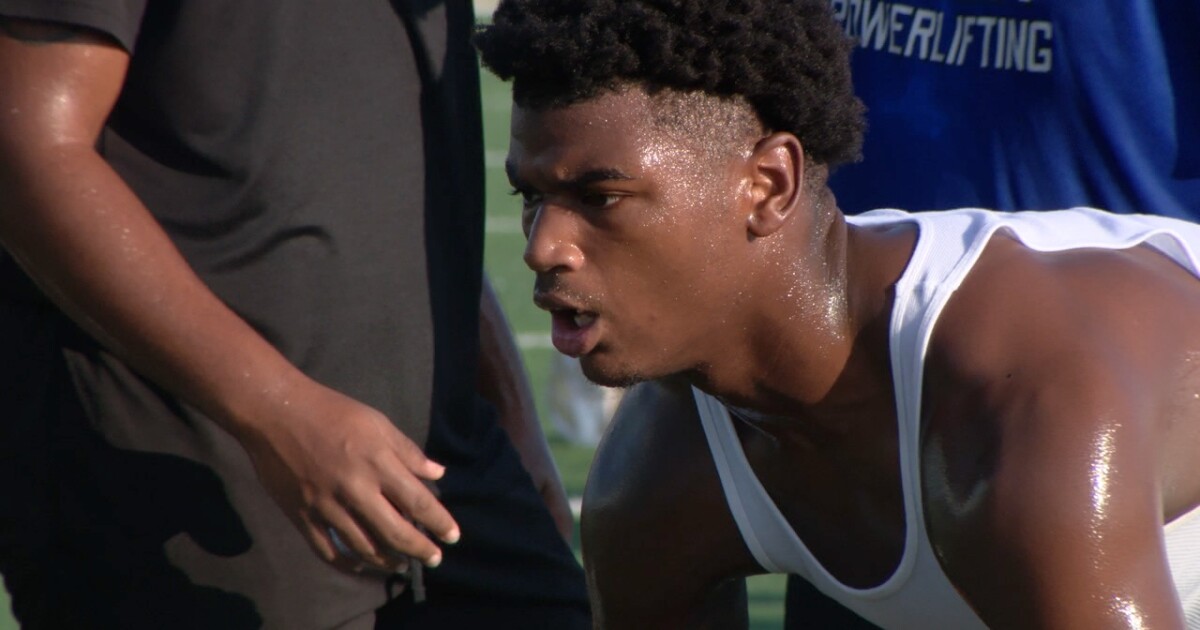
Lafayette Renaissance edge rusher Ansinneo Charles commits to Louisiana
-

 Maine53 minutes ago
Maine Trust announces 2 hires in Augusta, Waterville

