Connect with us

Lifestyle

Why bananas may become one of the first casualties of the dockworkers strike

Published

on

Why bananas may become one of the first casualties of the dockworkers strike

Most bananas imported to the U.S. come through ports affected by the dockworkers’ strike. And the fruit’s limited shelf life made it hard to stockpile in advance.

Jewel Samad/AFP/Getty Images


hide caption

toggle caption

Advertisement

Jewel Samad/AFP/Getty Images

If you enjoy sliced bananas with your cereal or drinking a banana smoothie, you might want to savor it while you can. Fresh bananas could be one of the first casualties of the dockworkers’ strike.

The strike, now in its third day, has halted traffic at ports along the east coast and the gulf coast which handle an estimated three-quarters of all banana imports.

That includes the port of Wilmington, Del., which is the number one gateway for bananas coming into the U.S.

Advertisement

Ships from Dole and Chiquita — two of the world’s biggest banana producers — ferry more than 1.5 million tons of bananas to Wilmington every year from Central and South America.

Many of those bananas are then trucked to M. Levin & Co. in Philadelphia — which has been trading bananas in the region for four generations.

“The bananas are on the water for about seven days,” says Tracie Levin, who helps to oversee daily operations at the firm. “They come through the ports here. We pick them up. We ripen them in the ripening rooms for a few days, and then they go out to their stores and that’s how they get to consumers in the area.”

M. Levin & Co. in

M. Levin & Company typically handles about 35,000 cartons of bananas in its Philadelphia ripening rooms every week. The wholesaler supplies big box stores and corner markets as far west as Chicago.

courtesy M. Levin & Co.


hide caption

Advertisement

toggle caption

courtesy M. Levin & Co.

That normally smooth and largely invisible process is one of many that have been interrupted by the dockworkers’ strike, which has halted shipments of everything from auto parts to wine.

Advertisement

Levin is hoping for a quick resolution.

“We want a fair deal for everyone, from the ports to the workers,” she says. “Our country relies very heavily on our ports so this is definitely going to have a ripple-down effect if it doesn’t come to an end soon.”

In the banana business for over a century

Of all the goods now treading water in shipping containers, few are more sensitive to the passage of time than fresh fruit. Auto parts and wine generally don’t spoil if they’re stuck in transit for a little while. But for bananas, the clock is ticking.

“These bananas do have a shelf life, even when they’re sitting in the refrigerated containers,” Levin says. “If they sit too long they will dry out. They will not ripen properly. It’s really important that they get unloaded before they end up sitting out there too long and just become trash.”

Tracie Levin's great-grandfather began ripening bananas on Dock Street in Philadelphia in 1906. One of his original wagons is still on display in the company's warehouse.

Tracie Levin’s great-grandfather began ripening bananas on Dock Street in Philadelphia in 1906. One of his original wagons is still on display in the company’s warehouse.

courtesy M. Levin & Co.

Advertisement


hide caption

toggle caption

courtesy M. Levin & Co.

Advertisement

It’s something Levin knows very well, since her family has been in the banana business for over a century.

“My great-grandfather in 1906 started ripening bananas on Dock Street in Philadelphia in the cellar,” she says.

In those early days, bananas arrived by the boatload still attached to giant stalks. Today the fruit comes in cardboard boxes, stacked in refrigerated shipping containers. Levin’s company handles about 35,000 of those 40-pound cartons every week, supplying big box stores and corner retailers as far west as Chicago.
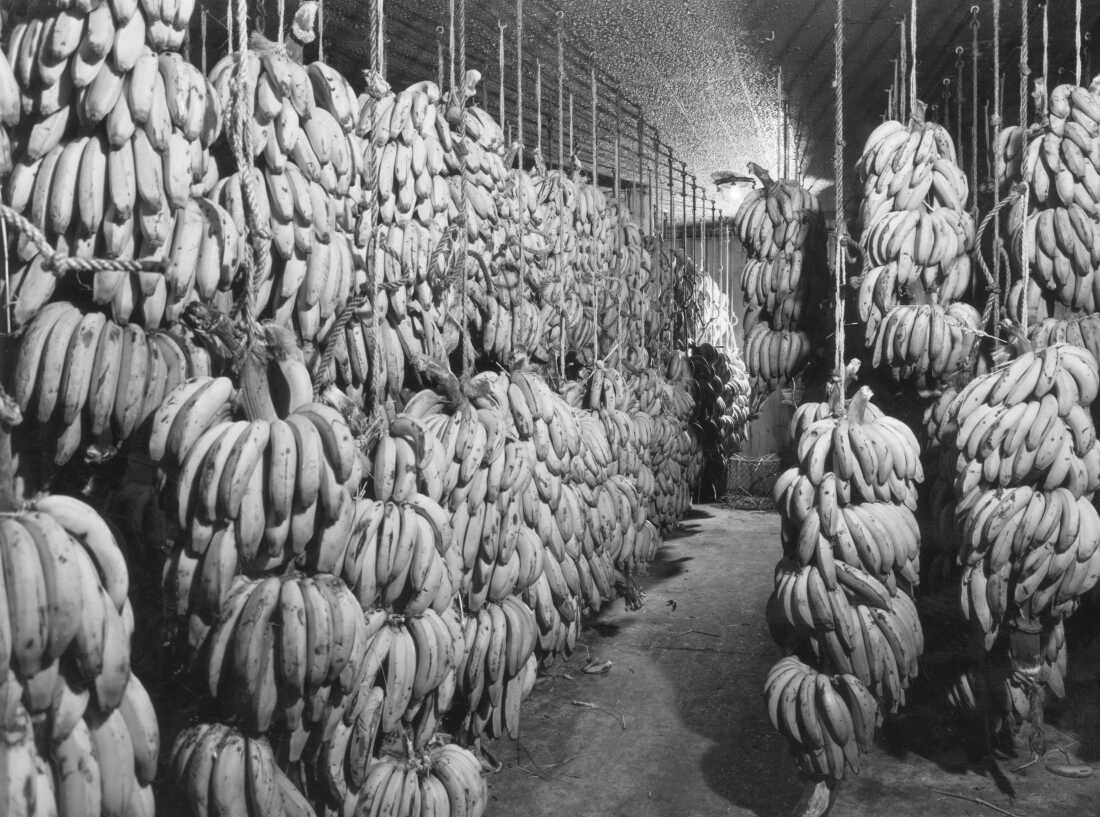
Bananas are ripening in a warehouse in Kingston-upon-Thames, England, on February 1954.

Bananas are ripening in a warehouse in Kingston-upon-Thames, England, on February 1954.

Fox Photos/Getty Images/Hulton Archive


hide caption

Advertisement

toggle caption

Fox Photos/Getty Images/Hulton Archive

People may soon go bananas

Levin’s company stockpiled extra truckloads of green bananas before the strike, and they do have some ability to slow the ripening process — but only for so long.

Advertisement

The wholesaler has enough fruit on hand to last a week or so, but after that, look out.

“Our banana supply will be dwindling if the ships aren’t getting the fruit off,” Levin says. “The consumer may see a banana shortage at their local grocery stores very soon.”

For now, grocery shoppers might want to pick up a few extra bananas, just in case. But of course, those won’t stay fresh long either.

Lifestyle

Mundane, magic, maybe both — a new book explores ‘The Writer’s Room’

Published

on

Mundane, magic, maybe both — a new book explores ‘The Writer’s Room’

There’s a three-story house in Baltimore that looks a bit imposing. You walk up the stone steps before even getting up to the porch, and then you enter the door and you’re greeted with a glass case of literary awards. It’s The Clifton House, formerly home of Lucille Clifton.

The National Book Award-winning poet lived there with her husband, Fred, starting in 1967 until the bank foreclosed on the house in 1980. Clifton’s daughter, Sidney Clifton, has since revived the house and turned it into a cultural hub, hosting artists, readings, workshops and more. But even during a February visit, in the mid-afternoon with no organized events on, the house feels full.

The corner of Lucille Clifton's bedroom, where she would wake up and write in the mornings

The corner of Lucille Clifton’s bedroom, where she would wake up and write in the mornings

Andrew Limbong/NPR


hide caption

Advertisement

toggle caption

Andrew Limbong/NPR

“There’s a presence here,” Clifton House Executive Director Joël Díaz told me. “There’s a presence here that sits at attention.”

Advertisement

Sometimes, rooms where famous writers worked can be places of ineffable magic. Other times, they can just be rooms.

The Writer’s Room: The Hidden Worlds That Shape the Books We Love

Princeton University Press

Katie da Cunha Lewin is the author of the new book, The Writer’s Room: The Hidden Worlds That Shape the Books We Love, which explores the appeal of these rooms. Lewin is a big Virginia Woolf fan, and the very first place Lewin visited working on the book was Monk’s House — Woolf’s summer home in Sussex, England. On the way there, there were dreams of seeing Woolf’s desk, of retracing Woolf’s steps and imagining what her creative process would feel like. It turned out to be a bit of a disappointment for Lewin — everything interesting was behind glass, she said. Still, in the book Lewin writes about how she took a picture of the room and saved it on her phone, going back to check it and re-check it, “in the hope it would allow me some of its magic.”

Let’s be real, writing is a little boring. Unlike a band on fire in the recording studio, or a painter possessed in their studio, the visual image of a writer sitting at a desk click-clacking away at a keyboard or scribbling on a piece of paper isn’t particularly exciting. And yet, the myth of the writer’s room continues to enrapture us. You can head to Massachusetts to see where Louisa May Alcott wrote Little Women. Or go down to Florida to visit the home of Zora Neale Hurston. Or book a stay at the Scott & Zelda Fitzgerald Museum in Alabama, where the famous couple lived for a time. But what, exactly, is the draw?

Advertisement

Lewin said in an interview that whenever she was at a book event or an author reading, an audience question about the writer’s writing space came up. And yes, some of this is basic fan-driven curiosity. But also “it started to occur to me that it was a central mystery about writing, as if writing is a magic thing that just happens rather than actually labor,” she said.

In a lot of ways, the book is a debunking of the myths we’re presented about writers in their rooms. She writes about the types of writers who couldn’t lock themselves in an office for hours on end, and instead had to find moments in-between to work on their art. She covers the writers who make a big show of their rooms, as a way to seem more writerly. She writes about writers who have had their homes and rooms preserved, versus the ones whose rooms have been lost to time and new real estate developments. The central argument of the book is that there is no magic formula to writing — that there is no daily to-do list to follow, no just-right office chair to buy in order to become a writer. You just have to write.

Continue Reading

Lifestyle

Bruce Johnston Retiring From The Beach Boys After 61 Years

Published

on

Bruce Johnston Retiring From The Beach Boys After 61 Years

Bruce Johnston
I’m Riding My Last Wave With The Beach Boys

Published

Advertisement

Advertisement

Advertisement

Advertisement

Continue Reading

Lifestyle

On the brink of death, a woman is saved by a stranger and his family

Published

on

On the brink of death, a woman is saved by a stranger and his family

In 1982, Jean Muenchrath was injured in a mountaineering accident and on the brink of death when a stranger and his family went out of their way to save her life.

Jean Muenchrath


hide caption

toggle caption

Advertisement

Jean Muenchrath

In early May 1982, Jean Muenchrath and her boyfriend set out on a mountaineering trip in the Sierra Nevada, a mountain range in California. They had done many backcountry trips in the area before, so the terrain was somewhat familiar to both of them. But after they reached one of the summits, a violent storm swept in. It began to snow heavily, and soon the pair was engulfed in a blizzard, with thunder and lightning reverberating around them.

“Getting struck and killed by lightning was a real possibility since we were the highest thing around for miles and lightning was striking all around us,” Muenchrath said.

To reach safer ground, they decided to abandon their plan of taking a trail back. Instead, using their ice axes, they climbed down the face of the mountain through steep and icy snow chutes.

Advertisement

They were both skilled at this type of descent, but at one particularly difficult part of the route, Muenchrath slipped and tumbled over 100 feet down the rocky mountain face. She barely survived the fall and suffered life-threatening injuries.

This was before cellular or satellite phones, so calling for help wasn’t an option. The couple was forced to hike through deep snow back to the trailhead. Once they arrived, Muenchrath collapsed in the parking lot. It had been five days since she’d fallen.

 ”My clothes were bloody. I had multiple fractures in my spine and pelvis, a head injury and gangrene from a deep wound,” Muenchrath said.

Not long after they reached the trailhead parking lot, a car pulled in. A man was driving, with his wife in the passenger seat and their baby in the back. As soon as the man saw Muenchrath’s condition, he ran over to help.

 ”He gently stroked my head, and he held my face [and] reassured me by saying something like, ‘You’re going to be OK now. I’ll be right back to get you,’” Muenchrath remembered.

Advertisement

For the first time in days, her panic began to lift.

“My unsung hero gave me hope that I’d reach a hospital and I’d survive. He took away my fears.”

Within a few minutes, the man had unpacked his car. His wife agreed to stay back in the parking lot with their baby in order to make room for Muenchrath, her boyfriend and their backpacks.

The man drove them to a nearby town so that the couple could get medical treatment.

“I remember looking into the eyes of my unsung hero as he carried me into the emergency room in Lone Pine, California. I was so weak, I couldn’t find the words to express the gratitude I felt in my heart.”

Advertisement

The gratitude she felt that day only grew. Now, nearly 45 years later, she still thinks about the man and his family.

 ”He gave me the gift of allowing me to live my life and my dreams,” Muenchrath said.

At some point along the way, the man gave Muenchrath his contact information. But in the chaos of the day, she lost it and has never been able to find him.

 ”If I knew where my unsung hero was today, I would fly across the country to meet him again. I’d hug him, buy him a meal and tell him how much he continues to mean to me by saving my life. Wherever you are, I say thank you from the depths of my being.”

My Unsung Hero is also a podcast — new episodes are released every Tuesday. To share the story of your unsung hero with the Hidden Brain team, record a voice memo on your phone and send it to myunsunghero@hiddenbrain.org.

Advertisement
Continue Reading
Advertisement

Trending
