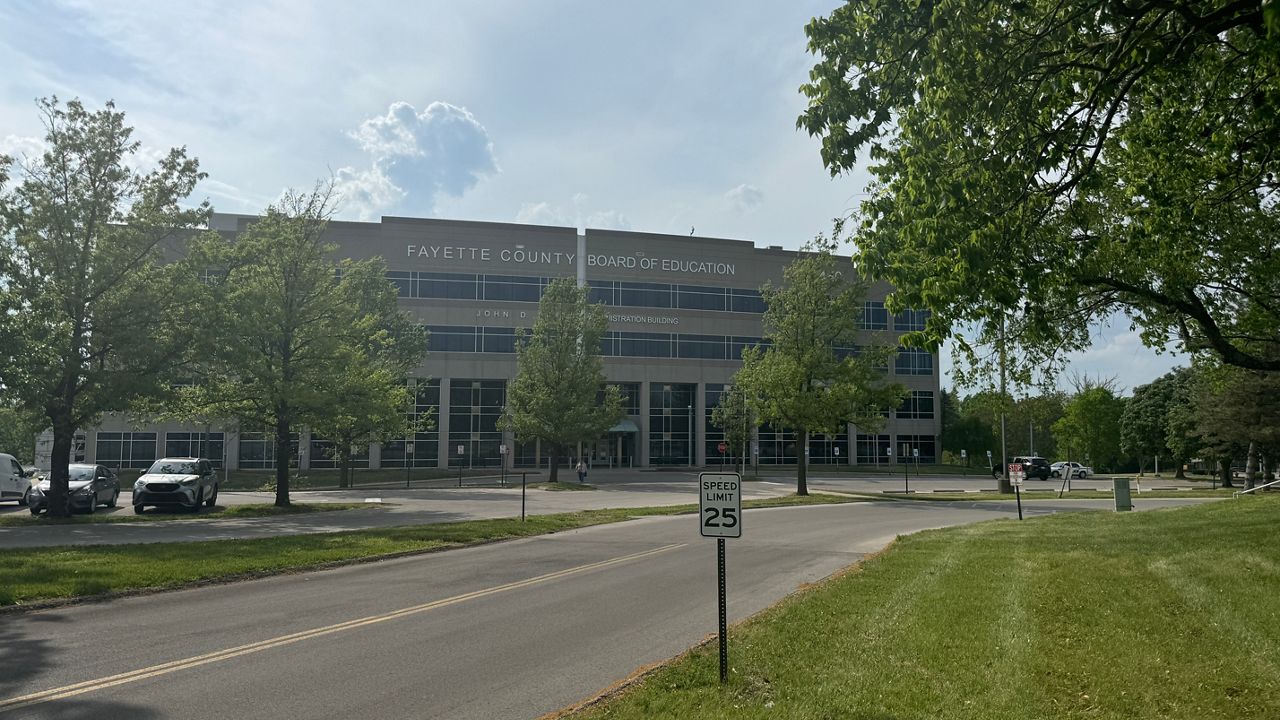
LEXINGTON, Ky. — As the school district works to rectify potentially decades of inaccurate accounting, two finance employees with Fayette County Public Schools are on paid leave. At the same time, two external reviews continue for Kentucky’s second-largest school district.
What You Need To Know
Two Fayette County Public Schools finance employees are on paid administrative leave
District leaders say accounting inaccuracies and improper practices may date back to 2008
Two outside reviews are underway, including one by the auditor of public accounts
The district may seek a short-term loan to cover expenses until property tax revenue is collected
FCPS Superintendent Demetrus Liggins said he’s been made aware of troubling and deeply concerning information.
“I’ve spoken with several of our district’s financial advisor and our external audit firm and have conducted our that’s conducted our routine audit. and those conversations have also revealed issues that I was unaware of,” Liggins said.
One review is from accounting firm Weaver and Tidwell, hired by the district, and another, which Liggins said he requested, is being conducted by the auditor of public accounts.
While those reviews are ongoing, and based on preliminary reporting, Liggins said he’s been informed of both inaccuracies and improper accounting practices that date back to 2008.
Advertisement
Last month, the district hired Kyna Koch, a former associate commissioner of finance for the Kentucky Department of Education, as the interim chief financial officer.
Since taking on the task, she said she doesn’t have confidence in the numbers she’s been asked to review.
“Federal and state requirements may not have been followed, and our accounting procedures may not have been aligned with acceptable practices,” Koch said.
Koch said inaccuracies were found in revenue collection, record-keeping, invoicing, and that spending guidelines may not have been followed.
Now she’s helping set new measures, like additional reviews, to dig deeper and provide a clearer financial picture.
Advertisement
“It’s clear that these practices are sometimes nuanced and not easily identified through routine financial reports that are provided to the superintendent and the board. Some of these things would not have been readily apparent based on the information typically generated,” Koch said.
Koch is also recommending that the district get a short-term loan to cover expenditures until next fall’s property taxes are collected.
Though the district is not releasing names at this time, Liggins did comment on the status of some finance administrators.
“We currently have three administrators in our financial and accounting office. Two are on paid administrative leave, and one is on medical leave,” Koch said.
Those on paid administrative leave are pending an investigation.
Advertisement
Liggins said while they are still awaiting finalized reports from those outside audits, they’re aiming for accuracy and transparency in their next moves.
“As we continue this work, I’m committed to following the facts wherever they may lead, and whatever they may uncover, we’re only after the truth,” Liggins said.
Liggins was asked on Thursday whether property taxes would increase for the 2026-27 school year. He said they are not currently planning to ask the board to raise property taxes any more than they typically have in years past.
On Monday, Koch will present her latest findings to the board at its regularly scheduled finance meeting.
Koch also said the district plans to have a loan proposal ready as soon as next month.
SixCap Healthcare Finance added Dan Carroll as senior relationship manager, reporting to the company’s co-founder and chief investment officer, Dan Whitwer.
Carroll brings more than 20 years of commercial finance, portfolio management and healthcare asset-based lending experience to SixCap. Throughout his career, he has managed complex healthcare lending relationships, led portfolio management teams, overseen loan closings and partnered closely with borrowers to support growth while maintaining disciplined credit management.
Most recently, Carroll held leadership positions at Siena, CNH Finance and Triumph Healthcare Finance, building extensive expertise in healthcare lending, credit analysis, loan structuring, risk management and client relationship management.
In his new role, Carroll will oversee borrower relationships across SixCap’s growing healthcare portfolio, working closely with clients to provide proactive portfolio management, responsive service and financing solutions that evolve alongside their businesses.
“We’re thrilled to welcome Dan to the SixCap team,” Whitwer said. “I’ve had the privilege of working alongside Dan and have seen firsthand the integrity, experience and thoughtful approach he brings to every client relationship. He understands healthcare, he understands asset-based lending and, most importantly, he understands the value of building lasting partnerships. As our portfolio continues to grow, Dan’s leadership and commitment to exceptional client service make him a tremendous addition to our team.”
Two of Chicago’s most pivotal but challenging undeveloped sites — Foundry Park on the North Side and the vacant South Loop parcel known as The 78 — moved forward in a big way Wednesday before the City Council adjourned for a summer recess.
Mayor Brandon Johnson introduced a $201.6 million tax increment financing subsidy for JDL Development’s scaled back vision for North Side industrial land along the Chicago River that once was supposed to be home to the Lincoln Yards megaproject.
And despite a slew of concerns from Council members, the full Council approved a $425 million TIF for The 78, a reference to Chicago’s unofficial 78th community area. The subsidy will bankroll public improvements needed for the South Loop development, anchored by a $750 million soccer stadium privately financed by Chicago Fire billionaire owner Joe Mansueto.
Downtown Ald. Bill Conway (34th), whose adjacent TIF is being raided to help The 78, again refused to go along with the $250.1 million piece of the infrastructure package that will primarily be used to build a 1,200-space parking garage. The $216 million garage will serve as the “podium” for an open-air plaza and future high-rise development on the air rights above the garage.
Referring to the Bears’ long-running stadium saga, Conway said Wednesday he appreciates the Fire “not trying to move to Hammond, Indiana, and become the Hammond Sparks.” But he said he “cannot look the taxpayers in the eye and tell them” he supported spending “$250 million to build a stadium parking garage and plaza.”
Advertisement
Finance Chair Pat Dowell, whose 3rd Ward includes The 78, has argued that the podium “brings the site to grade at Roosevelt Road” and is the key to “unlocking the site from the isolation that has stalled every previous development proposal.”
Deputy Planning Commissioner Jeff Cohen made that same point Wednesday, with a new wrinkle.
“The idea here is to incorporate that garage into the podium,” Cohen said. “It’s addressing a design and development plan that allows for all of the land within The 78 to be open for investment, rather than having to have either temporary or permanent surface parking lots to accommodate the car traffic.”
An artist’s rendering of the planned Chicago Fire soccer stadium at The 78 in the South Loop.
Advertisement
Related Midwest & Gensler
The $201.6 million subsidy proposed for Foundry Park pales by comparison to the $1.3 billion that former Mayor Rahm Emanuel once proposed for Lincoln Yards. That massive subsidy became a political lightning rod, with the avalanche of criticism led by the Chicago Teachers Union and then-union organizer Brandon Johnson.
The $201.6 million subsidy that Johnson introduced at Wednesday’s Council meeting is more likely to be criticized for being too little.
It will support just over 25% of the $800 million worth of roads, bridges, utilities and mass transit improvements that 2nd Ward Ald. Brian Hopkins has said were mandated as part of the Lincoln Yards plan.
Advertisement
Foundry Park developer Jim Letchinger acknowledged that there is “other infrastructure that the neighborhood would like to see done that is not possible right now.”
But Letchinger added it’s a start that includes the long-promised extension of the popular 606 Trail. “If you don’t start with something that’s achievable, you can’t achieve anything.”
“We have a plan to actually start building and creating revenue right away in conjunction with building our infrastructure … A lot of parks. Massive riverwalk. Ten acres of public open space. Very usable, very engaging,” Letchinger said Wednesday.
“As we continue to build, since we’re not using anywhere near all the increment that we’re creating, the other increment can go toward other projects that the neighborhood would like to see — whether it’s to build a bridge or fixing Elston Avenue, or anything else that they’re anxious about,” he said.
Public improvements promised to residents, but not covered by the $201.6 million subsidy, include another bridge crossing the Chicago River and a realignment of Elston Avenue, which Letchinger called a positive move in the long run, but a “massive undertaking” complicated by cost and property control.
Advertisement
“No private developer can realign Elston. It’s impossible. The city is the only one that can do that, and they’re working on it. There’s plans for it. But it will take a very long time,” Lechtinger said.
Ald. Scott Waguespack (32nd) said there is “one bridge that a lot of people still want,” but it goes through private properties owned by Ozinga Ready Mix Concrete and several other owners.
“The city would have to do it as a taking [of property], and that would be in the hundreds of millions of dollars. So they took that off the table because … that bridge wasn’t necessary at this time,” Waguespack told the Chicago Sun-Times.
Letchinger’s plan for roughly 34 vacant acres of the site calls for up to 3,737 residences, 20% of them designated as affordable to comply with the city’s set-aside rules. The new design includes low- to mid-rise buildings, some for offices, grouped near open space and riverfront access. Buildings would get ground-floor retail, and one is slated as a boutique hotel.
The project’s reduced density has drawn praise from residents. And Waguespack said he’s satisfied with the reduced public subsidy.
Advertisement
“In the future if there’s more needed, we could go back and do it. But this is much more grounded in a realistic infrastructure project that will still satisfy all the needs of connecting the neighborhoods,” Waguespack said.
Hopkins said he views the scaled-down subsidy and the infrastructure projects as “wholly inadequate” and a broken promise to Lincoln Park and Bucktown residents.
“Lincoln Yards provided for two bridges with the possibility of a third. Foundry Park has zero,” Hopkins said. “I don’t want to move on a vague verbal promise that we might consider adding a bridge later. The time to add it is now while the redevelopment agreement is still pending. And the fact that it was omitted is tragic. Also, the [Elston-Armitage] intersection redesign and the new Metra station seems to have fallen by the wayside.”
Also at Wednesday’s meeting, Johnson proposed a tax break for Chicago’s booming film and television industries — by reducing the 15% personal property lease transaction tax to 11%.
The tax has been raised twice in recent years and was the biggest piece of the revenue package that helped balance the $16.7 billion budget for 2026. It has exceeded revenue projections by $40.3 million through June 30, allowing Johnson to offer the break in hopes of attracting more film and TV productions to Chicago.
Advertisement
The City Council also followed a trail blazed by Gov. JB Pritzker and his counterparts in six other states by prohibiting present and former city employees — and elected officials — from using insider information to bet on prediction markets. Apps including Kalshi and Polymarket are used to place bets on everything from election winners and the number of candidates entering a specific race for office, to budgetary and foreign policy decisions by elected officials.
Championed by Ald. Timmy Knudsen (43rd), the ordinance prohibits current or former city officials, appointees and employees from using “confidential information or any non-public information, including the identity of the subject of an investigation” to either participate in prediction markets or “assist any other person” placing those bets.
The Council also confirmed Johnson’s appointment of Dr. Garth Walker as the city’s public health commissioner.
Covering the cost of fertility treatment can feel like yet another hurdle in a process that is already physically and emotionally draining. Not only do you have to go through the testing and medical procedures involved, you can also end up paying tens or even hundreds of thousands of dollars.
For families who want to have kids or women who want to afford themselves a little more time, though, this can feel like a price well worth paying. But the process may necessitate some financial planning. Research can also go a long way, as insurance companies increasingly offer coverage.
How much can fertility treatments cost?
The cost of fertility treatments can vary widely depending on the specific treatment that is necessary. A “typical egg preservation cycle is about $10,000,” while a frozen embryo transfer “could total about $2,500,” said The Bump. Meanwhile, a procedure like in vitro fertilization (IVF) “could add up to a total of $13,000 to $14,000.” Opting for a surrogate, meanwhile, can run anywhere from $80,000 to $100,000.
The Week
Escape your echo chamber. Get the facts behind the news, plus analysis from multiple perspectives.
SUBSCRIBE & SAVE
Advertisement
Sign up for The Week’s Free Newsletters
From our morning news briefing to a weekly Good News Newsletter, get the best of The Week delivered directly to your inbox.
From our morning news briefing to a weekly Good News Newsletter, get the best of The Week delivered directly to your inbox.
Latest Videos From
There is also the reality that a fertility treatment is not always a one-time thing. In fact, “most people will need more than one cycle to achieve pregnancy,” said The Wall Street Journal.
Can insurance help cover fertility treatments?
Over the past decade, “more companies have already stepped up to help employees,” said Jaime Knopman, a reproductive endocrinologist for CCRM Fertility of New York, to the Journal. Now, said the outlet, “more than 40% of companies offer overall fertility benefits, according to a 2024 survey of employee benefits plans from the International Foundation of Employee Benefit Plans.”
Still, this does not mean you will get full coverage, and certain parts of the treatment process may not be covered. For example, “your plan may cover fertility medications, but only those of a specific brand. Or it may cover routine lab work, but only at designated labs,” said Discover. This makes it absolutely vital to do in-depth research and ask questions.
Advertisement
If your company does not offer coverage, it could be worth asking HR. “Some patients even successfully lobbied their human-resources departments to change a company’s policies and benefits plans,” said the Journal.
Join 350,000+ subscribers and keep yourself informed with a selection of
The Week’s most interesting, enlightening and entertaining stories – plus daily puzzles.
What are other options for covering the cost of treatments?
There are options besides your own bank account or insurance for helping to cover the cost of fertility treatments. Some alternatives include:
FSA or HSA funds: Flexible spending accounts, or FSAs, and health savings accounts, or HSAs, “may be used to help pay for IVF and other fertility treatments,” said First Citizens Bank.
Provider payment plans or financial assistance: Your doctor “may offer a payment plan, discounts for uninsured patients or even a shared-risk program,” said Discover.
Advertisement
Nonprofits and charities: There are many “national and local nonprofit organizations that support fertility treatments and related costs,” said Discover. They may have eligibility requirements, however, as some are “established to assist with specific types of patients, while many include income thresholds.”