Lifestyle
What I learned watching every sport at the Winter Olympics


The Olympics are exhausting. Above, Taiwan’s Li Yu-Hsiang reacts after competing in the figure skating men’s singles free skating final in Milan on Feb. 13.
Gabriel Bouys/AFP via Getty Images
hide caption
toggle caption
Gabriel Bouys/AFP via Getty Images
Let us say up front that watching some of every sport at the Winter Olympics is not as challenging as watching some of every sport at the Summer Olympics. The Summer Olympics are a sprawling collection of activities, where you might see horses or swords or boats or surfboards.

The Winter Olympics still feel very rich, but they’re a bit more focused. My own brain roughly sorts them into team sports like curling and hockey, figure skating, running on snow, going down a hill on snow, sliding down an icy track, and flying through the air in much the way I might if I went skiing or snowboarding, except it’s graceful and on purpose, and you generally do not end up in the hospital.
And I found it all completely captivating.

Franjo Von Allmen of Switzerland in action during the men’s downhill on Feb. 7.
Alexis Boichard/Agence Zoom/Getty Images
hide caption
toggle caption
Alexis Boichard/Agence Zoom/Getty Images
Alpine skiing: One of my limitations as a watcher of downhill skiing is that most of the runs look similar to me unless someone crashes or unexpectedly departs the course. You could show me 10 skiers going down a mountain, and without their times showing up in green or red, I would have no idea which ones were good or which ones were bad. I would simply say, “Great job getting to the bottom very quickly.” And yet, through the fantabulous deployment of technique, you can earn edging someone out by a tenth of a second. A tenth of a second! Or less!
The slalom events are delightful, because they progress from slalom … to giant slalom … to super-G, which is super giant slalom. There is only one way for this to go, as we all know, and that is in the direction of mega super giant slalom, or M-S-G (which makes all other skiing more appealing because it adds umami flavor). I could try not to say “whoosh, whoosh, whoosh” out loud while watching the slalom events, but why? In 50 years, when we are all watching jetpack slalom, I will still say “whoosh, whoosh, whoosh.”
Biathlon: This is the rare sport that seems to me to be fully wicked, for the simple reason that no one should be asked to hit a tiny target after wearing themselves out. Imagine you run 10 miles and then somebody hands you a slingshot and says, “Lie on the ground and hit that 5-Hour Energy drink bottle way over there.” That is unkind. Biathlon also has a rule where missing shots can require you to ski a “penalty loop,” which is the most “coach gets mad and makes you run laps” thing I have ever seen at the Olympics. I admire and sympathize with everyone involved.
Bobsled: Watching a team smoothly (usually) jump as many as four bodies into a very small vehicle — while running — is such a feat that bobsled would be enjoyable if it were only that. But like all of the sliding sports, it also suggests a willingness and an ability to skirt the line between controlled descent and mad careening. I particularly enjoyed the women’s monobob, both because Team USA athlete Elana Meyers Taylor won her first gold at her fifth Olympics and because the word “monobob” (a one-person sled) is delicious and melodic.

Cross-country skiing: I am exhausted just from typing those words. Where I live, we are just getting rid of snow and ice on the ground that hung around for a month. For the first week or two that we existed in its presence, one of my primary goals on any given day was not to traverse it for any reason. At one point, I picked up a heavy sandbag and walked out into my own backyard, laying down a sand track in front of myself, picking my way across the ice rink and making my way to a piece of trash my dog had found somewhere so I could remove it (in case it was something he should not have, like a chicken bone or an ex-mouse; it was in fact a paper towel). By the time I got back to the house, I certainly felt like I had earned a gold medal. What I’m saying is this: I am in awe of cross-country skiers for their stamina, resilience and balance, even though in fairness, they did not have to carry sand at the Olympics.

Curling: Oh, how I love curling. That anyone can slide a 40-ish-pound rock down the ice something like 150 feet and get it to land on a spot the size of your shoe is astonishing. From time to time, a curler makes a shot that seemingly sorts through a clump of red and yellow stones and knocks out all of one color without disturbing the stones of the other color. From 50 yards away! Moreover, you get to hear the players talking. Everybody has mics on, so they chat about what shot they should try, what shot is too risky, what shot the other team will try to make based on what shot they try to make … like baseball, it is meditative, with long periods of deceptive quiet followed by bursts of excitement. Like baseball, it rules.

Figure skating: The best thing about figure skating is that it is beautiful and graceful and athletic, and the programs have become more creative (to my eye) and less staid since I was a kid. Of course, the most difficult thing about it is that a single fall — truly, a single bad moment — can prevent a skater who has worked toward a goal for 15 or even 20 years from realizing that goal, even if it’s a fluke, a one-off, a thing that never happens. NBC’s coverage this year has really focused on sending the camera practically up into the nostrils of a skater who has just had a bad moment so you can have the most visceral possible look at their pain. That does not prevent post-bad-program interviews in which they are asked to explain their pain 30 seconds after it happens, sometimes at the cost of covering people who did well.

It makes sense that U.S. coverage focused, for instance, on the many problems that befell Ilia Malinin in the men’s free skate (resulting in an 8th-place finish for a heavy gold-medal favorite), but there was also triumph for Kazakhstan’s Mikhail Shaidorov, who won the gold medal after a free skate during which the commentators were explaining that he was not really a medal contender this year, but might be in another four years. I mean, you’ve gotta love that.
Freestyle skiing: There is much to love about freestyle skiing, which crosses over with some of the things to love about snowboarding. There are aerials, there are tricks, and there is the aptly named discipline “Big Air.” But perhaps my favorite event is moguls, where the competitors go down a course that is intentionally made up entirely of bumps, and one of the tricks is to let your knees absorb all the bumps so that your upper body barely moves at all. I think everyone who has ever so much as sprained an ankle watches moguls with astonishment. If I consistently say “whoosh” while watching slalom, I consistently say “ow ow ow” while watching moguls.

The U.S. women’s ice hockey team huddles prior to a match against Czechia on Feb. 5 in Milan.
Jamie Squire/Getty Images
hide caption
toggle caption
Jamie Squire/Getty Images
Ice hockey: I am not particularly invested in Olympic ice hockey, particularly the men’s, because it involves so many professional players who play each other all the time, and that’s not what I’m watching the Olympics for. But I try to catch some of the women’s tournament every time. (It’s perhaps not surprising, given the fact that trying to follow the puck has always kept me estranged from hockey, that I so dearly love curling, which has all the ice and all the precise shots, except with a “puck” that is huge and slow.)
Luge: What an absolutely terrifying notion. Surely the most terrifying sport the Olympics could possibly come up with. Only the security offered by doubles luge, in which two people lie on top of each other, could possibly make this feel like a good idea. Lying on your back? Without being able to see where you’re going? If your kid wanted to go down the driveway like this on a flattened cardboard box, you would probably ground them.

Einar Lurås Oftebro of Norway’s Nordic combined team competes on Feb. 11.
Alex Pantling/Getty Images
hide caption
toggle caption
Alex Pantling/Getty Images
Nordic combined: This is cross-country skiing plus ski jumping. Two very efficient ways to cross snow, although one of them requires a ramp and a tolerance for risk. Here’s a question: Why isn’t this biathlon? This could be biathlon, and what is now biathlon could be the ski-n-shoot. I’m just throwing ideas out there. Innovating. (In all seriousness, read up on the status of Nordic combined and the athletes, women in particular, who stand to lose out based on International Olympic Committee decisions about the present and future.)
Short track speedskating: This is the speedskating I like the best, because I am unsophisticated and impatient. I don’t want to watch each person methodically lay down a time that other people then try to beat. I want to watch a bunch of fearless adrenaline junkies go fast around a track like it’s roller derby, except (mostly) trying not to knock each other over. I want to watch them hurl themselves across the finish line, sometimes backwards.
Skeleton: What’s this I’m hearing? Oh, never mind, this is the most terrifying sport they could have created. If you think flying down the track not being able to see where you’re going is scary, you’ll love flying down the track being able to see exactly where you’re going, because you are leading with your head. There’s been a lot of chatter this year about the way the Winter Olympics, more than the Summer Olympics, feel like they’re made up of various ways to barely not splatter yourself across the host city, and nothing says that to me like skeleton. They really only give you a helmet, and I wouldn’t do it in a helmet. I would require a helmet and a shark cage. And honestly at that point, I would just close my eyes.
Ski jumping: Ski jumping is very cool, and it’s kind of unfortunate that coverage got distracted this year by a story about … well, about the suits that the men wear, and how they’re fitted, and some other things. The amount of time that ski jumpers spend in the air is unfathomable to me, and the fact that they land on their feet instead of on an enormous inflatable cushion seems impossible, but they do it.

Germany’s Finn Hoesch competes in men’s sprint ski mountaineering on Feb. 19.
Dimitar Dilkoff/AFP via Getty Images
hide caption
toggle caption
Dimitar Dilkoff/AFP via Getty Images
Ski mountaineering: I have seen only a bit of this sport, because it’s its first year at the Olympics, and it didn’t really start until Thursday. If you’ve never watched it, here’s what it looked like when I watched it: The athlete runs up the mountain part of the way on skis with “skins” on the bottom for traction. Then the athlete takes off the skis and runs up a set of stairs. Then they put the skis back on, run up the mountain on skis the rest of the way, take the skis off, rip the skins off the skis, put the skis back on, and ski down the mountain. The women’s gold medal was determined not by the speed of running in skis, running out of skis, or skiing, but the speed of changing the gear all those times. (This also can happen in biathlon, where sometimes you ski well and you shoot well, but you spend too much time noodling around with your gun.) It is a truly wild sport, and I loved it instantly. Who hasn’t been foiled on a busy day by the inability to get your shoes on and off quickly?
Snowboard: I love to watch snowboarders, because they are so much less likely to look devastated when something bad happens than, say, figure skaters. This is partly because they often have more than one run, and it certainly doesn’t mean that they are less competitive or work less hard. But the culture of snowboarders seems to be a little different, and from time to time you will see one absolutely wipe out, and then hop up and throw their arms over their head in a combination of “Wooo!” and “I’m fine!” It’s good to have fun.
Speedskating: Speedskating is the sport I admire more than love. As with long-distance running, I am brimming with admiration for the people who do it, but I struggle to be entertained as a spectator. (Other people think this about curling, I realize. Imagine that!)
But this is part of what watching the Olympics is, right? You try out lots of sports. You sample some fast ones, some more slow-paced ones, some with short races and some with long races. And you decide: This one is mine, this is the one I’m going to follow. And it’s great.
Even for those of you who do not choose curling.

Megan Oldham of Team Canada warms up prior to the women’s slopestyle final on Feb. 9.
Patrick Smith/Getty Images
hide caption
toggle caption
Patrick Smith/Getty Images
This piece also appeared in NPR’s Pop Culture Happy Hour newsletter. Sign up for the newsletter so you don’t miss the next one, plus get weekly recommendations about what’s making us happy.
Listen to Pop Culture Happy Hour on Apple Podcasts and Spotify.




Lifestyle
She rebuilt a classic Chevy after the L.A. fires — but still gets asked if it’s her dad’s work

Carmen Vera is in the business of buying and restoring classic cars. She stands out when she brings her fresh build-outs to places like Pomona Swap Meet, where gearheads, lowriders and hot-rodders have met to show off their cars since the 1970s.
“This arrogant man came up to me with a cigar and said, ‘Let me guess, this is your old man’s car,’” said Vera. “It blew his mind when I told him it was mine.”
Vera, who was born and raised in northeast Los Angeles, grew up watching her dad and cousins fixing up their cars in the lowrider scene of 1990s Los Angeles. “Whatever I know, I’ve learned from my dad or playing with my own cars,” said Vera. “And as a single mom, I needed to learn how to rotate a tire or do an oil change on my own.”
In the past seven years, Vera built her own restoration company while working full-time, one of four businesses she owns, and later became a partner with Sal Rivas at Pasadena Classic Car. Her customer base now stretches from Los Angeles to Mexico, Arizona, Hawaii and Texas. Her young daughter loves being in the shop too, watching her mom transform cars from junk into treasure.
Sal Rivas, left, and Carmen Vera, co-owners of Pasadena Classic Car, look at Vera’s restored 1972 Chevy C10 short bed at the shop.
For Vera, restoring old cars isn’t just a job, it’s an art. “To me these cars have a family story that I fall in love with,” said Vera.
So when a trio of smoke-damaged and burned Chevrolets pulled from a garage that collapsed during the Eaton fire — including an original 1972 C10 pickup — arrived at the shop, Vera had a vision.
“I built that full-restoration truck in seven months with original parts,” said Vera, whose goal, which she attained, was to showcase it in October at the Specialty Equipment Market Association Show, an annual, industry-only automotive trade show held in Las Vegas.
“The point was to bring back what burned,” said Vera.
For seven months, she worked from 5 a.m. to 11 a.m. every day with her team restoring the truck. “My crew is the best,” said Vera. “They’re professionals … they believe in my dream.”
“I started this business 19 years ago, and I think this is one of the best builds we’ve done,” said Rivas, who was raised in Altadena. For him, this build hit different. “Man, that thing went from ashes to new life,” said Rivas.

A photo of the burned-out 1972 Chevy C10 short bed, scorched in the Eaton fire in Altadena and now refurbished by Vera.
The restored 1972 Chevy C10 is finished in a burnt orange exterior, paired with a pearlescent white leather interior. The build was completed as a full body-off-frame restoration — a process that separates the truck’s body from its chassis to rebuild each component from the ground up, with original components carefully sourced and preserved wherever possible. Nearly all of the work was done in-house, including fabrication and a handmade interior produced through Vera’s own upholstery department, reflecting an emphasis on craftsmanship and historical continuity rather than cosmetic overhaul. Rebuilds of this caliber often run into the hundreds of thousands of dollars and Vera paid for everything out of pocket, though she wouldn’t say how much it actually ended up costing. Once Vera was done with it, the C10 was ready for the SEMA Show, where it received nothing but good feedback.
Rivas noted, however, that at SEMA, 80% of people who walked up to their booth couldn’t believe it was Vera’s car. “They thought I was just a car model or something,” said Vera, who reports that men’s demeanors change the instant she starts talking about her car.

Vera sits in the 1972 Chevy C10 short bed that she spent seven months — from 5 a.m. to 11 a.m. every day — restoring with her team.

A view of new LS engine conversion in the 1972 Chevy C10 short bed.
“[Vera] is definitely in a category of her own,” said Crystal Avila, marketing and media manager at FiTech Fuel Injection, a fuel injection manufacturer, who met Vera at last year’s SEMA where she showcased the C10. Avila recognized the C10 from social media — a video of the original owner cracking a beer and crying over his Chevy collection which was all but gutted in the Eaton fires. She was instantly impressed with Vera’s work. Avila noted that because SEMA functions primarily as a manufacturer showcase, it was especially significant that multiple vendors chose to feature Vera’s cars — a rare distinction that underscored the industry’s recognition of her work.
Elaborate build-outs typically require multiple specialized teams at every level — from fuel injection and bodywork to upholstery — whereas Vera does all of her work in-house with her own team, handling the interior, fabrication and installation.
Vera is a self-described “Chevy girl.” In addition to the C10, she restored a 1964 blue Chevy Impala bubble top. “When these cars come in, I have relationships with them, and I hate to see them leave,” said Vera.
But her favorite car to drive is her first: a pink 1979 Oldsmobile Cutlass that she saved up for and bought on OfferUp for $4,000. “That’s how I learned how to fix up classic cars and how the market works,” said Vera. She said she fell in love with the car in the time she spent restoring it back to life. “She saw my struggle, she knows the pain I was going through while I was building her up,” said Vera, who explains she was going through a difficult time with her family while she worked on the Oldsmobile. “She’s my number one baby.”
“We’re a full-restoration shop,” said Rivas. “[Cars] come in as junk, and leave as works of art.” But the C10 is special as both a rebuild and as a piece of personal history, not only for Rivas and Vera and their team, but for Angelenos and fire survivors.
“We haven’t taken it out to Altadena yet,” said Rivas, but it’s on the schedule. “We’re taking it to the big shows first, then out to the street to see what the feedback is,” said Rivas, noting that the story of the truck from fires to finish has already been well-circulated online.
“I see the beauty in these cars,” said Vera. “I want to put a classic car back out in the streets, one at a time, every single day if I can.”
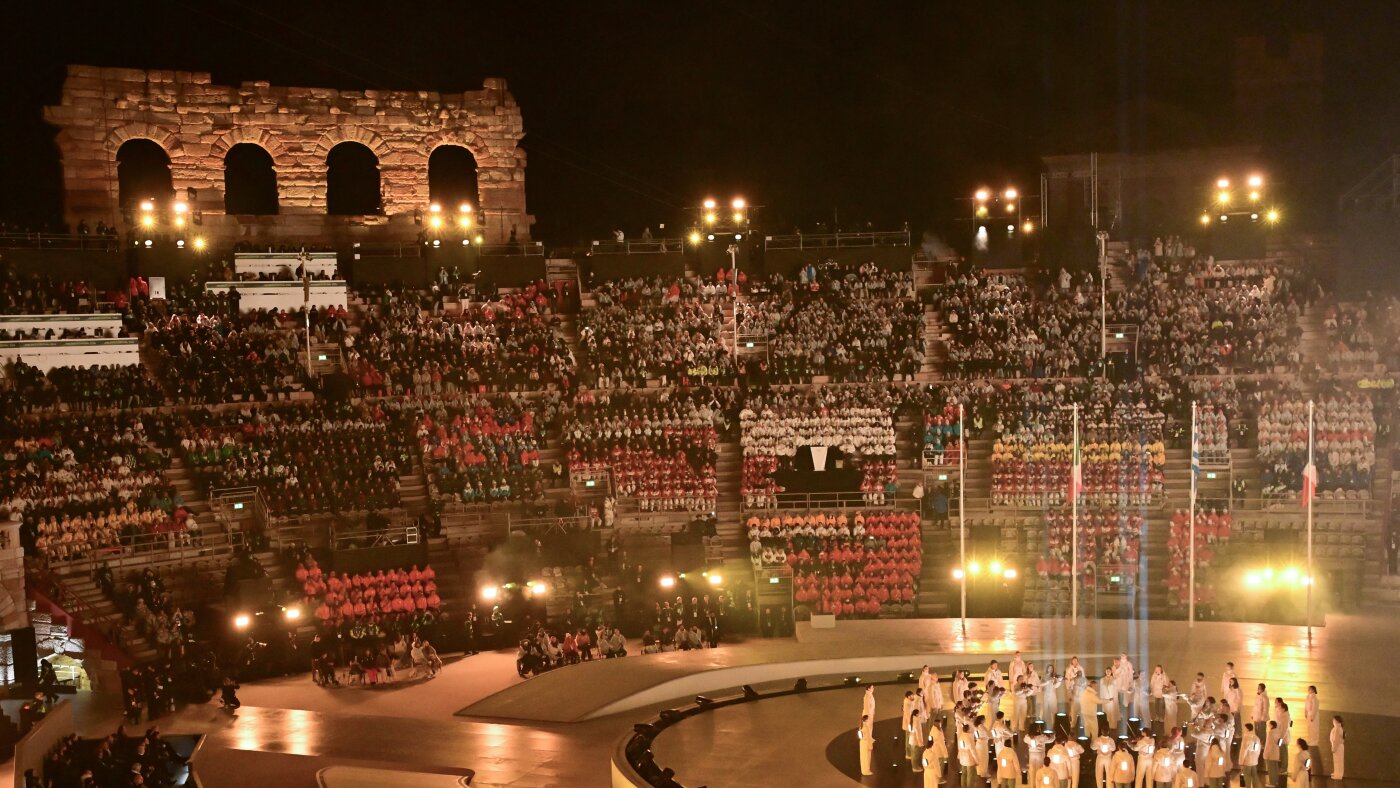
Musicians, choir members and athletes perform during the flag handover portion of the night.
Piero Cruciatti/AFP via Getty Images
hide caption
toggle caption
Piero Cruciatti/AFP via Getty Images
VERONA, Italy — The Winter Olympics are officially over. We were among the thousands of people who helped bid them goodbye in a Roman amphitheater in Verona, Italy, on Sunday, with a ceremony that was mostly sentimental but punctuated by rousing bursts of lights, confetti and electropop music.

The closing ceremony echoed some of the pomp and circumstance of its opening counterpart 16 days earlier: the athletes’ Parade of Nations, the raising of flags, the respective lighting and extinguishing of the two Olympic cauldrons (in Milan and Cortina).
But after two-and-a-half weeks of fierce competition, storied traditions and emotional ups and downs, this celebration had a noticeably more relaxed feel — at least among athletes and spectators.

The night’s musical performances brought high-tech set design to a roughly 2,000-year-old amphitheater.
Dean Mouhtaropoulos/Getty Images Europe
hide caption
toggle caption
Dean Mouhtaropoulos/Getty Images Europe
For one, the Verona Arena — which was built around 30 AD for gladiator battles — holds a considerably smaller crowd than Milan’s San Siro stadium (some 15,000 vs. 75,000 people). It’s an open-air venue with stone seats, which made for a fair bit of shuffling around (and occasional phone calls) among spectators. Each seat held a tote bag with a slim seat cushion in it, to make the two-and-a-half hour event a little cozier.

The closing ceremony’s Parade of Nations was essentially just a parade of flag-bearers, but unlike the opening ceremony, it went without an announcer. This time, the snow queens in puffer-coat-gowns from the opening ceremony were replaced with volunteers wearing loose-fitting tunics, the ceremony equivalent of putting on sweatpants after a hard day’s work.
Even the athletes were dressed more for comfort this time around. Team USA, outfitted by Ralph Lauren for the 10th straight Games, traded their opening ceremony pleated trousers and wool coats for streetwear-inspired baggy pants and puffer jackets.
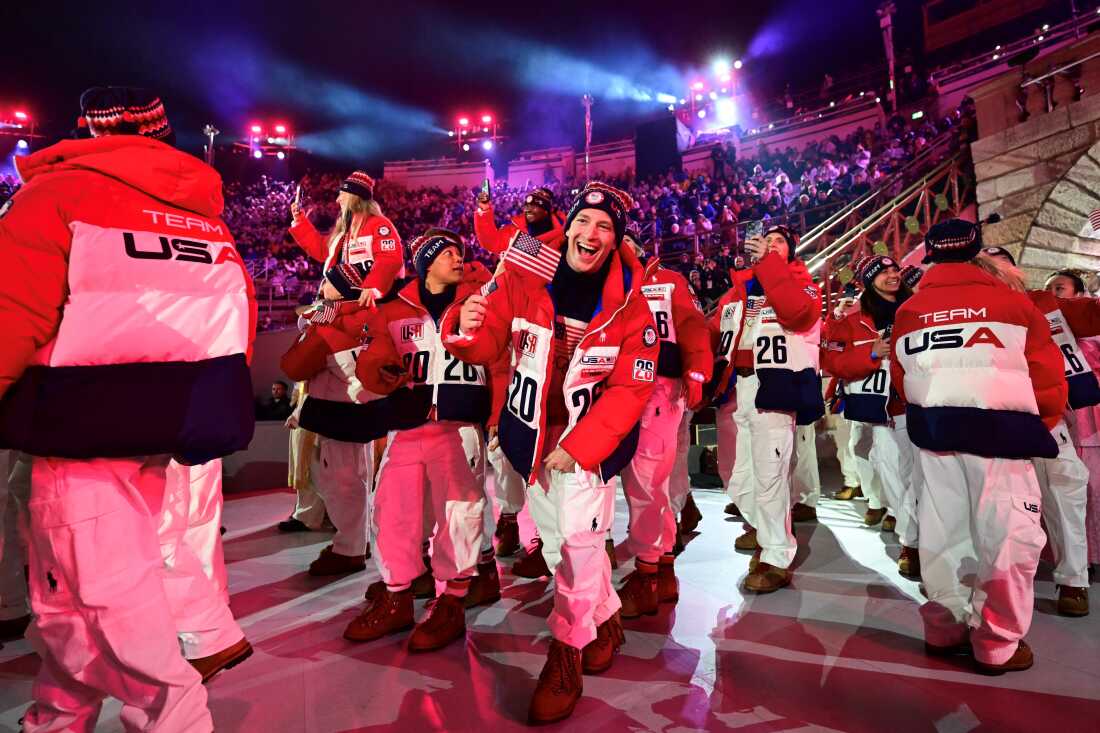
Hunter Wonders parades with other members of Team USA at the closing ceremony at the Verona Arena in Verona, Italy, on Sunday.
Stefano Rellandini/AFP via Getty Images
hide caption
toggle caption
Stefano Rellandini/AFP via Getty Images
The event was a little shorter than the opening, but there was still a ton to take in. There were the requisite speeches from International Olympic Committee President Kirsty Coventry and the head of the Italian organizing committee, with many, many thanks given to the regional hosts and the 80,000 volunteers who staffed the Games (some of whom were watching next to us in the stands).

There was also the customary passing of the metaphorical torch to the next Winter Olympics host: France, whose Alps will be the site of the 2030 Games. And there was a shoutout to the Paralympics, which kick off — at the same Verona venue — on March 6.
At times, people in the crowd stood up to clap for medalists — and got quickly shouted down by the journalists wielding telephoto lenses behind them.

Gloria Campaner plays the piano, surrounded by candelabras, at Sunday’s closing ceremony.
Dean Mouhtaropoulos/Getty Images Europe
hide caption
toggle caption
Dean Mouhtaropoulos/Getty Images Europe
And there were so many candelabras, a recurring motif in this “night at the opera”-themed event. At one point, there were performers dressed as candelabras, moving candelabra floor lamps, while attached to a large dangling candelabra chandelier.

Speaking as spectators in the media nosebleed seats, this ceremony was more fun to watch than the opening, which was still a total blast. But this one came with a tangible sense of relief and a lot more crowd participation: beams of light shone all around us, confetti floated down on top of us and Diplo (the legendary DJ) commanded us all to dance.
You read that right. The sober dousing of the Olympic flame was immediately followed by a seat-shaking DJ set from electronic music supergroup Major Lazer, which got much of the arena on their frozen feet.

Major Lazer got the crowd moving with a medley of their hits, joined by collaborators including Jamaican singer Nyla.
Stefano Rellandini/AFP via Getty Images
hide caption
toggle caption
Stefano Rellandini/AFP via Getty Images
The rave — and the ceremony — ended a few minutes later. But like all good parties, there was still fun to be had on the way out.
Afterward, as we navigated the crowds and street closures, we stopped to let an international stream of athletes cross the road.
Some of the uniform-clad Olympians hopped on buses that took them back to Milan; others had the same idea as us and ducked into McDonald’s. Inside we spotted Union Jack sweaters, Team Latvia coats and the Winter Olympic GOAT, Johannes Høsflot Klæbo, with his fellow Norwegian cross-country medalists, putting in several orders of chicken wings.

Colorful confetti — seen during Major Lazer’s set — beams of light and glitter cannons illuminated the night sky at various points.
Joosep Martinson/Getty Images
hide caption
toggle caption
Joosep Martinson/Getty Images

Jennifer Lopez
My Babies Are 18!!!😭
Published
Jennifer Lopez‘s twins Emme and Max are all grown up, and JLo couldn’t be prouder! The singer commemorated their 18th birthday with a moving, heartfelt post that was absolutely busting with love for her babies.
JLo welcomed Emme and Max on February 22, 2008 with her then-husband Marc Anthony … a day Jen remembers well.
She wrote on Instagram … “You were born in the middle of the night, in the midst of the biggest, most beautiful snowstorm NY had seen in years.”
She added … “I remember riding in the car and looking out the window, where everything was twinkling and covered in white that night, as I held you both in my belly for the last few moments before I gave birth to you. It was as if God was making sure you would enter a world full of pure magic!! In my heart, I knew that’s how your life would always be!!”
According to JLo, holding them felt like holding 2 angels “sent straight from heaven above.”
“I cannot believe you are now adults…18 years old,” Jen continued. “You are both so kind-hearted, generous, and loving. How lucky the world was on this day 18 years ago when God decided to send you here with all of your talents and spirit and heart to make this world a better place, because that is what you do for me and anyone who is lucky enough to know you both every day.”
“Love Don’t Cost a Thing” but JLo’s last 18 years of memories mean everything!

North Korea’s Kim Jong Un re-elected as ruling party leader

Trump envoy rebukes Greenland leader for rejecting hospital ship proposal

Blood test could predict when Alzheimer’s symptoms will start years in advance

Team USA hockey stars keep America’s heroes top of mind after grabbing Olympic gold

AI dating cafes are now a real thing

Florida High School Football Rankings: Top 25 teams – Oct. 21

Cleary's 21 help Le Moyne down Central Connecticut State 69-64 in OT

How old is Bo Nix? What to know about Oregon quarterback ahead of 2024 NFL Draft

99th annual Pony Swim held in Virginia

Indiana Members Credit Union announced as new anchor tenant at Bottleworks District
Trump envoy rebukes Greenland leader for rejecting hospital ship proposal

Gulf countries back Kuwait’s sovereignty after Iraq draws new boundaries

Suspected gunman identified after being shot dead at Mar-a-Lago – US politics live

Video: Armed Man Is Shot and Killed at Mar-a-Lago, Authorities Say

Suspect identified after fatal shooting at Trump’s Mar-a-Lago estate: officials
-

 Montana3 days ago
2026 MHSA Montana Wrestling State Championship Brackets And Results – FloWrestling
-

 Oklahoma5 days ago
Wildfires rage in Oklahoma as thousands urged to evacuate a small city
-

 Culture1 week ago
Video: How Much Do You Know About Romance Books?
-

 Science1 week ago
What a Speech Reveals About Trump’s Plans for Nuclear Weapons
-

 Politics1 week ago
Schumer’s ‘E. coli’ burger photo resurfaces after another Dem’s grilling skills get torched: ‘What is that?’
-

 Technology2 days ago
YouTube TV billing scam emails are hitting inboxes
-

 Technology1 week ago
The DJI Romo robovac had security so poor, this man remotely accessed thousands of them
-
 Science1 week ago
Notoriously hazardous South L.A. oil wells finally plugged after decades of community pressure