Lifestyle
L.A. Affairs: I was about to move. But she had a loveliness I’d never encountered in L.A.


Two weeks after selling all my furniture and another two weeks before quitting my job, I made eyes with a girl at a queer event in West Hollywood. She had long, wavy brown hair with an intense stare to match. We didn’t speak until hours later. It was past midnight.
She had just moved from New York, she said. I didn’t tell her, but I was moving there at the end of the summer. Her stare was no longer intense now as we talked. It was soft, welcoming, curious. But I knew we would be missing each other.
I said it was nice to meet her and promptly left the bar.
When we matched on Tinder days later, it felt almost inevitable.
“Hi!” she wrote. “Did we meet briefly at Hot Flash on Saturday or was this a dream / do you have a twin?”
I looked closely at how she appeared in the light. In her first picture, she stood in a one-piece on a boulder, smiling, a waterfall pummeling behind her. In another, she was on a beach in black workout pants, hair settling in waves at her chest. So much of attraction exists in the realm of the ineffable, but if I had to articulate what drew me to her, the answer might be the image of her smile. She embodied a loveliness, a presence, I was longing for; something I hadn’t found in L.A. — or had lost.
“Not sure if this is a line lol but I’m going to go with yes,” I wrote back. “No twin unfortunately.” We made a plan to find each other not long after during Pride. We stood off to the side at Roosterfish, the same bar where we met. She wore a white frilly shirt and distressed black jorts and loafers. I didn’t hurry off this time.
We continued our conversation over juice the next day, around the corner from the Pride parade at the Butcher’s Daughter. She told me almost offhand what brought her to L.A.: She identified more with the lifestyle here — it was more laid-back, outdoorsy, spacious. And she had ended a long-term relationship in New York.
This didn’t faze me. I knew many people who traversed the L.A.-New York pipeline in both directions. A romantic rupture, or dissatisfaction, wasn’t an uncommon revelation. If I were to look closely at my own reasoning for wanting to leave L.A., I was sure I would discover one too.
By then I was living back at my parents’ house, all my books in storage and anticipating my summer of isolation in the Valley. I told her I was leaving my job days later and then immediately heading to Vermont for a writing residency. And then my summer was, but for my writing and job hunt, free and open. I made no mention of my anticipated move to New York. I wasn’t trying to be deceptive; I think I was trying to be protective. Once you say the thing, you will always have said it. I wasn’t sure what it was I wanted anymore.
“You are lovely,” she texted me that night.
The next weeks passed quickly. I wrote on the East Coast, though I didn’t feel the usual desire to stick around, and I wasn’t sure why. When I returned to L.A., I texted her.
We had a picnic at Barnsdall Art Park days after the Fourth of July. An L.A. native, I had somehow never been to the famed East Hollywood park with its clear-day view of Griffith Observatory. She brought paints, and while I hadn’t painted for over a decade at least, I managed to paint on a note card the fruit she’d laid out: two raspberries and three blueberries. We kissed at the end of the date, but my sunglasses bumped her face and my hair came between our mouths. I moved both out of the way.
“This feels like a rom-com,” she said. I laughed. It was true.
She left the next day for Hawaii, where she had to be for work through August. She sent me pictures of banyan trees, shared her plans to read my favorite book on the beach in the early mornings, told me she was a hopeless romantic: that she believed both in the lightning of connection and the build, not getting broken by it.
I would read her texts and reply from Barnsdall, with a book recommendation of hers in tow, the note card of painted berries as its bookmark, or from the beach. I’ve never been much of a beach person, but I spent a lot of time on the sand that summer, from Santa Barbara and Malibu to Oceanside. I felt a closeness with her there, like I could sense her too looking out beyond the horizon.
Meanwhile, I received an offer for a job that, contrary to my intentions, would be in the L.A. office. If the offer had arrived two months earlier, I wouldn’t have even considered it. Now, I wasn’t sure what to do. I was still interviewing for positions in New York, but I knew I wanted to be around when she returned. I accepted the offer. I would start after Labor Day. I would remain in L.A.
I could only admit the real reason to a select few.
In early August, back in town for a mere 48 hours, she sent me a list of date ideas: a comedy show, a concert at the Hollywood Bowl, cooking dinner at her place. In the end, we opted for a cold plunge and sauna. I’m highly sensitive to (and avoidant of) extreme temperature. The fact I joined her for this activity surprised even me.
“You make me brave,” I told her. She blushed. I meant it.
My entire body shuddered from the cold water, and she helped me out after only 30 seconds. Meanwhile, she stayed submerged for three minutes at a time. Our kiss was longer that day, natural and intuitive. I’d held her face between my hands.
The next time I saw her was the day before Labor Day. She was back from Hawaii for good now. We went to a rooftop screening of “Before Sunrise” at the Montalbán Theatre in Hollywood. She got us a refill of popcorn. She put on lip gloss midway, popped a breath mint, offered me one too. She rested her hand in the space between us. At one point, leaning forward, she turned back to give me a look. I thought I knew what that look meant, but I was wrong.
“I think I may not be ready to let someone in yet romantically,” she texted the next day.
Friendship felt disingenuous. She said she understood.
And the day after that, as planned, I started my job. Her, my reason for doing so, now lost to me — until she wasn’t. I ran into her later that fall in Venice. She was stopped at a red light with the top down. I was walking back from the beach.
I called her name from the sidewalk. She didn’t hear me. I called twice more. She looked up.
“I can’t help but feel like you’re meant to be in my life in some way,” she texted the next morning.
And so we played Rummikub at a restaurant in Laurel Canyon. We sent voice notes as we sat in traffic. We exchanged music, shared a playlist. She drove in a rainstorm to meet me for a Shabbat dinner.
But she still wasn’t able to open her heart, she said, and she couldn’t ask me to wait.
I can’t imagine a world where this is the end. This imagining stems less from a premonition of the future than a feeling of how deeply she has shaped my present. Meeting her reconnected me to something essential within myself and this city I call home. How, even with her gone, I’ve stayed.
The author is a writer from Los Angeles.
L.A. Affairs chronicles the search for romantic love in all its glorious expressions in the L.A. area, and we want to hear your true story. We pay $400 for a published essay. Email LAAffairs@latimes.com. You can find submission guidelines here. You can find past columns here.
Editor’s note: Have a dating story to tell about starting fresh? Share it at L.A. Affairs Live, our new competition show featuring real dating stories from people living in the Greater Los Angeles area. Find audition details here.


Could you see your life just as easily with children as without?
What if you’re not cut out for parenthood? What if you grow lonely in your old age? Or what if you have a loving partner, but you disagree on this choice? Deciding between parenthood and a child-free life requires clarity about your fears and deepest desires — no easy task. This episode, psychotherapist and author of the book, The Baby Decision, Merle Bombardieri, helps us get clear. She discusses minimizing regret, normalizing feeling ‘stuck’ and why waiting to have a baby at 38 may be best.
Want more about the decision to have kids?
Many women don’t want kids. And for good reason.
Why are people freaking out about the birth rate?
Support Public Media. Join NPR Plus.
Follow Brittany on Instagram: @bmluse
For handpicked podcast recommendations every week, subscribe to NPR’s Pod Club newsletter at npr.org/podclub.
Additional support for this episode came from Alexis Williams. It was edited by Neena Pathak. Our Supervising Producer is Cher Vincent. Our Executive Producer is Barton Girdwood. Our VP of Programming is Yolanda Sangweni.

“E Pluribus Unum,” or “Out of many, one.”
That phrase, engraved on some quarters photographer Blaise Hayward was counting in his New York City kitchen in July 2023, intrigued him. They were marks of the 50 State Quarters, a series of coins issued by the U.S. Mint from 1999 to 2008 for which each coin featured a symbol representing one of the 50 states.
With Hayward’s growing concern about the vitriolic condition of American politics, the phrase felt resonant.
Blaise Hayward looks over printed works of his “Quarters of Confederation” series, highlighting Canadian coins.
(Blake Ogden)
That moment sparked his photo series, “America ~ The Statehood Quarters,” and sent him on a quest to the bank to find every coin. Now a collection of 50 images, one for each state’s quarter, the series explores American unity, shared history and constant exchange.
“My goal was to gather these coins and present them in a cohesive, inclusive manner. Every state is represented,” Hayward said. “Everybody’s equal. It’s about equality, representation.”
Those interested can find his photos on his website, where he sells editioned images of the coins, ranging from $1,200 to $5,000.
Ahead of the United States’ 250th anniversary on Saturday, Hayward reflects on the series and its relevance today.
This interview has been edited and condensed for clarity.
Your photographs remind me of portraits. As large close-ups, each quarter has a unique character. Tell me about your approach to capturing them.
I started my career in the 1980s, and I was an analog photographer. I was late to digital. These are all captured digitally, as is most of my work now, but the most important aspect to my work is that it has an analog feel to it.
My goal was to present it as realistically and honestly as possible. I photographed them as they are, and I also do that with my portraiture. I’m a portrait photographer at heart, and portraiture is my first love. But I’ve found with my fine art career that unless they’re famous people, people aren’t drawn to buying portraits and hanging them in their house. But they are drawn to still life, so a lot of my artwork now is centered on still life. My portrait background probably played a subconscious role in how I presented the quarters.

The California state quarter.
(Blaise Hayward)
In your photographs, the quarters are old and tarnished, not shiny and new. Why?
That was important to me. If you go onto Wikipedia and type in “Statehood Quarters,” they photographed all 50 of them. They’re bright, shiny, right out of the Mint. I made a conscious decision to photograph them in circulation. I wanted them to emulate the hands they’ve passed through and illustrate the history of the country and the state.
How do you think about the people who held these quarters in relation to the project as a whole?
I think it tells the story of commerce and the story of exchange. I imagine there are a couple in there where people saved up some quarters and bought something personal. Some of these quarters could’ve been collected by children, and then they could’ve gone out and bought their first candy bar. Or they could’ve put the quarters in the soda fountain machine and got a Coca-Cola and been so excited.
I’m very attached to coins and bills. I see the artistry in it. It’s unfortunate that we’re going toward a society where we won’t have that tactile feeling anymore. There’s a difference between holding a handful of money and paying for a good than pulling your phone out and tapping.

The Delaware state quarter.
(Blaise Hayward)
You’re originally from Toronto, and have lived in New York for the last 30 years. How has living in the U.S. as an immigrant shaped the way you perceive America and represent it in this series?
It allows me to be an outsider looking in. I love the fact that I’m Canadian. It’s a badge of honor for me. It allows me to have a more sympathetic, wider and different understanding of what it’s like to live in the States.
With the “Statehood Quarters,” I don’t know if it influenced me when I photographed the project. I was just in awe of the history. If you start reading about the States and how the whole country came together, all of the people that made that journey were immigrants. Unless you’re Native American, we’re all immigrants here. I thought about that a couple of times because I was reading about the people that started it all.
Your series centers unity in a time of extreme divisiveness in American politics, whether it’s surrounding the federal crackdown on immigration or LGBTQ+ rights, among other issues. What does “unity” look like to you in this context? What do you feel Americans should be united on?
Americans could stand to be united on what a great country this is, even though at this present moment it’s not feeling like that for everybody. America is a great country. It’s been a beacon of democracy since its founding, and countries all over the world have held it in such high esteem.
Without giving away my political leanings — I don’t even mean to go there — sadly, in this present moment, I don’t think the country is showing its best self. We could stand to take a step back and reflect on the history and unity of the country. We could stand some compassion. We could stand some understanding. We could stand to be better listeners.
We don’t always have to agree. It’s just vitriol out there. It’s tearing the country apart. I think it will be a collective effort on both sides of the aisle for us to come together and dial the heat down.
I’m hoping that on this 250th anniversary, people put their political leanings aside and celebrate America. It’s got so much potential to be that beacon again, that leader in the world. At the end of the day, why can’t we just embrace “E Pluribus Unum”? Out of many, we are one. We are one nation.
For many people, America’s 250th anniversary will be a time of celebration and patriotism. For many others, it will be a time of criticism and protest. How do you feel your series engages each of these attitudes?
I hope that people look at the series and look at the country in a broader stroke, and say, “Wow. What an amazing collection. This ‘Statehood Quarters’ collection is so inclusive and symbolic of this great nation. Look at all these beautiful coins from these beautiful states.”
Kansas is one of my favorite coins. I’ve never been to Kansas, but the coin in the collection made me appreciate the state. It has gotten me thinking I’d like to visit every state and meet the people and have a meal and see what they’re like and see the landscape. I hope this collection inspires people to celebrate the country as a whole rather than looking at it state to state.

The Kansas Statehood Quarter.
(Blaise Hayward)
What does it mean to “celebrate the country”?
I’m an outdoor person and a nature person. For me, it means celebrating the land, and with that, celebrating the people in that land.
I was listening to somebody on the radio who was here for the World Cup. They were from Morocco, and they said every person they’ve met in New York has been so nice.
It’s time for this country to start being nicer to each other. I hope this project helps people be a little bit more kind to each other, a little bit more tolerant, a little bit more understanding, a little bit more loving and a little bit more hospitable.
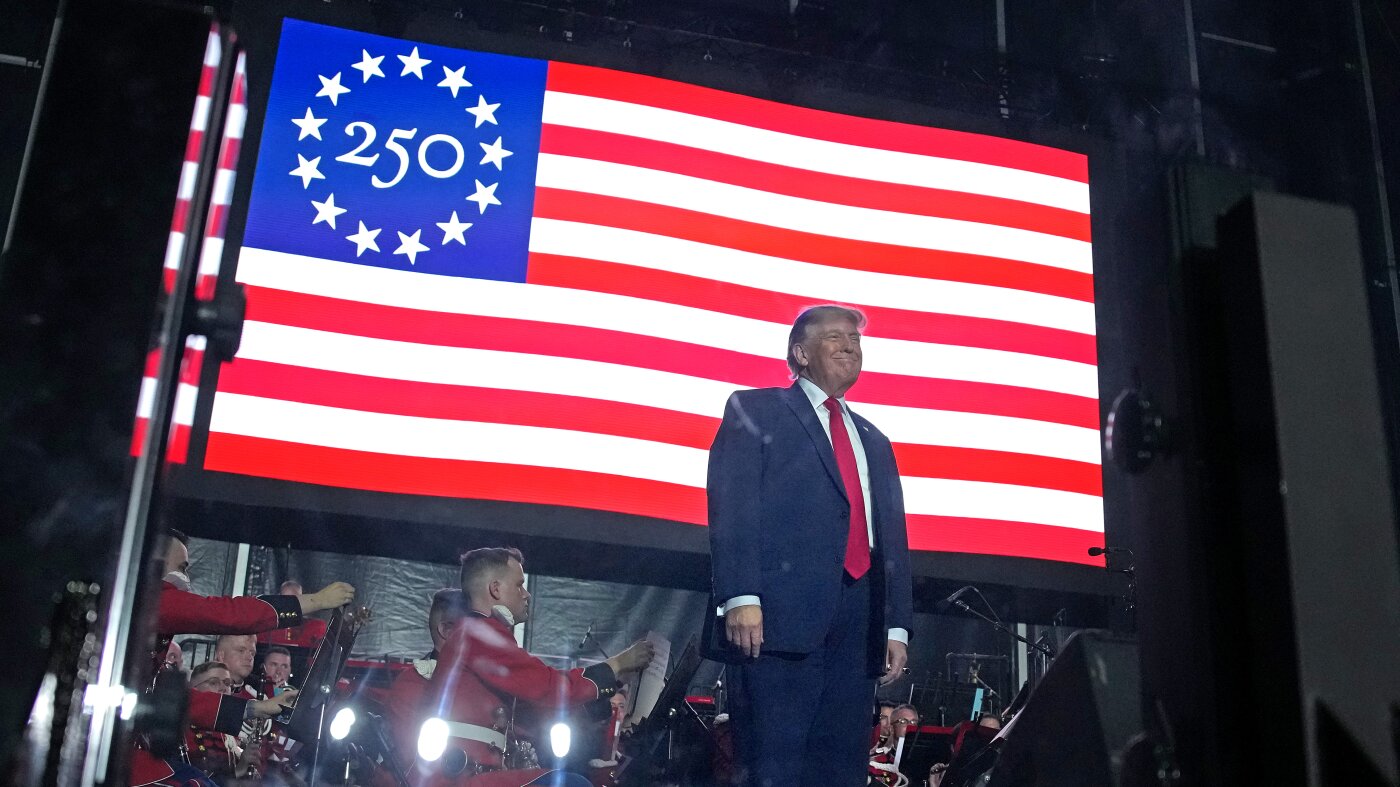
President Trump speaks at a rally kicking off the Great American State Fair last week, part of the anniversary celebrations organized by White House-backed group Freedom 250.
Andrew Harnik/Getty Images
hide caption
toggle caption
Andrew Harnik/Getty Images
As America’s birthday celebrations kick into high gear, so too do criticisms of the preeminent national group organizing them, Freedom 250.
Democrats on the House Natural Resources Committee published a 55-page report Thursday accusing the group of aiding President Trump in turning America’s milestone into a “hotbed of corruption and self-enrichment” through tactics that potentially amount to criminal fraud.
It’s titled “From Vanity to Insanity: How the White House Cheated the American People out of their 250th Birthday.”
Rep. Jared Huffman of California, the ranking Democrat on the committee, told NPR that the report was months in the making. It is based on interviews with unnamed whistleblowers, sworn Congressional testimony, internal Freedom 250 documents and other written responses.
“We put it all together to really tell the story … of how Donald Trump hijacked what should have been a unifying national celebration and repurposed it for his own interests,” Huffman said in a Zoom interview. “This was a team of operatives using the Freedom 250 shell company, but it was also Donald Trump himself telling them what to do.”
The White House referred a request for comment to Freedom 250, though Freedom 250 told NPR that it does not speak for the White House.
Freedom 250 is the public-private partnership behind some of the summer’s most high-profile anniversary events, including a UFC fight outside the White House in June, a controversial state fair on the National Mall, a July Fourth fireworks show opening with a Trump rally, and the “Patriot Games,” a high school athletic competition scheduled for August.
It was created via executive order last year, and describes itself as “the national, non-partisan organization leading the celebration of our Nation’s 250th birthday.” But it’s not the only one: Congress had created a nonpartisan commission called America250 for this same purpose in 2016.
Democratic critics and watchdog groups say Trump decided to forge ahead with his own group after unsuccessful attempts to pack America 250 with his allies. Freedom 250 was incorporated as an LLC in October 2025 under the National Park Foundation, the nonprofit arm of the National Park Service, whose board now includes a number of Trump loyalists, including Chris LaCivita, senior adviser on his 2024 campaign.

Visitors can buy Freedom 250 merchandise at the state fair on the National Mall.
Al Drago/Getty Images
hide caption
toggle caption
Al Drago/Getty Images
Thursday’s report describes Freedom 250 as “a shadow organization capable of infiltrating the celebrations and injecting America’s 250th with Trump’s extreme, partisan agenda.”
Several of its events, like the “Great American State Fair” and a prayer gathering on the National Mall, have been criticized for their sanitized presentation of history and overtly Christian bent. The report accuses the group of funding its programming through opaque and questionable avenues, including soliciting foreign funds, misleading donors and selling access to the president.
“Once you siphon off the funds and supplant the real bipartisan commission with this new entity and you declare it the main platform for our nation’s celebration, and you award all these shady contracts to your friends, you can do anything you want,” Huffman said. “And what these folks chose to do was to push a very divisive, very extreme and explicitly sectarian religious agenda into all these materials in our name, using our taxpayer dollars.”
Some of the accusations, if true, could be found to violate federal law. For example, the report alleges that the deception of donors who thought they were supporting America250 — but were actually given banking information for Freedom 250 — could constitute wire fraud.

Freedom 250 spokesperson Danielle Alvarez denied the report’s claims as “categorically false,” calling it a “partisan smear.”
“Congressional members should be ashamed they are spending countless hours fabricating a report instead of joining Americans in creating an absolutely beautiful celebration,” Alvarez wrote in a statement shared with NPR.
The report has not been adopted by the Natural Resources Committee, so does not reflect its official view. Republicans on the committee have so far refused to conduct any oversight on the issue, despite Democrats raising concerns at previous hearings. Republican ranking member Rep. Bruce Westerman did not respond to NPR’s request for comment.
Huffman said his team had tried for nearly a year to get information from Freedom 250, but faced “resistance and obstruction every step of the way.”
“I would hope that Freedom 250, if they claim that … there’s nothing to see here, open up your books,” he said. “Give us the documents that we’ve asked for, and the information we’ve asked for.”
Huffman said his investigation will continue well past July Fourth, especially if Democrats reclaim the House in this fall’s midterm elections. In that case, he didn’t rule out the possibility of subpoenas or criminal referrals if applicable.
Regardless, he believes more information and witnesses will come to light — and says a full accounting is critical to prevent such a playbook from being used again.
“We may not be able to undo the damage they’ve done to us and the national celebration,” Huffman said. “But we can do something very patriotic by reminding everyone that our government belongs to all of us, not to Donald Trump.”
What the report alleges
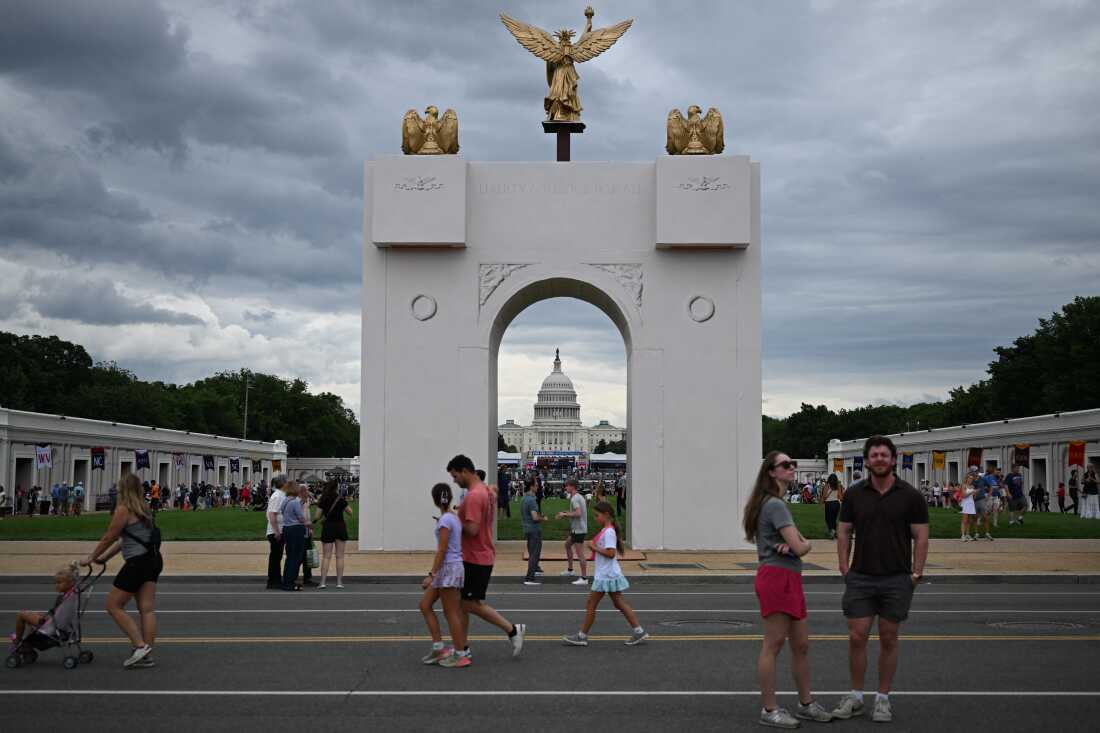
Trump also wants to commemorate the anniversary by building a 250-foot arch, a replica of which stands at the state fair.
Alex Wroblewski/AFP via Getty Images
hide caption
toggle caption
Alex Wroblewski/AFP via Getty Images
The report accuses Trump of long wanting to place himself at the center of the anniversary agenda. It points to events held on his birthdays — last year’s Army 250th parade and this year’s White House UFC fight — and longer-term projects like his plans to build a 250-foot-tall triumphal arch.
It alleges that when America250 resisted that vision, the Trump administration turned the National Park Foundation from a “beloved nonprofit into a presidential shell” by standing up Freedom 250 under its auspices.

It is not clear where that directive came from: Secretary of the Interior Doug Burgum, who serves as ex officio director of the foundation’s board, testified before Congress in May that he was “not aware of the final decision maker on Freedom 250.” That same month, he told CNN the organization is “run out of the White House.”
In any case, Freedom 250 emerged with more visibility and more federal funding than America250.
Alvarez, of Freedom 250, says it “stepped in to rescue our nation’s 250th birthday from years of wasted time, wasted money, and failed planning.” But the report argues it supplanted America250 “through a series of diversions and misrepresentations that drained the chartered Commission of the resources it needed to function.”
The report says Congress allocated $150 million in federal funds last year to the Interior Department for events celebrating the 250th anniversary, with the “understanding” that $100 million of that would go to America250. The group has only received $25 million, it says, citing unnamed sources.
A statement from Freedom 250 says no funds were specifically earmarked for one entity over the other, so “claims that federal funds were ‘diverted’ from America250 to Freedom250 are baseless.”
When asked for comment, America250 Chair Rosie Rios — who served as U.S. treasurer under President Obama — did not address the report. She said the organization “will continue to focus on the values-based programming approved by our bipartisan Commission” and is “supportive” of organizations planning events for the 250th.

The America250 logo is seen on a White House Christmas tree skirt in December. That group is less visible than Freedom 250, but is planning many community-based anniversary events and a concert in Los Angeles.
Anna Moneymaker/Getty Images
hide caption
toggle caption
Anna Moneymaker/Getty Images
The report alleges that Freedom 250 was advertised as an addition to America250 rather than as its replacement, creating confusion. For example, many of the performers who withdrew from a scheduled concert last month said they had falsely believed the event was nonpartisan (it was later rebranded as a Trump rally).
The report alleges that Freedom 250 capitalized on donors’ confusion in a way that potentially amounts to fraud.
“Donors who intended to support America250 were misled and apparently provided with Freedom 250’s banking information, meaning contributions solicited in the name of the nation’s nonpartisan birthday foundation were routed instead to the President’s substitute entity,” it reads.
Freedom 250 said in a statement that “every major sponsor received documentation identifying Freedom 250 as the recipient’s organization before funds were transferred, and donors were free to decline.”
Alan Zibel, a researcher with the progressive consumer advocacy nonprofit Public Citizen, called those allegations “very troubling.” He applauded House Democrats for looking into them, even though they don’t have subpoena power at the moment.
“They’ve given House Democrats, should they take the majority next year, months and months of investigative work to do,” he said. “And there are some pretty rich target opportunities.”
Many questions remain
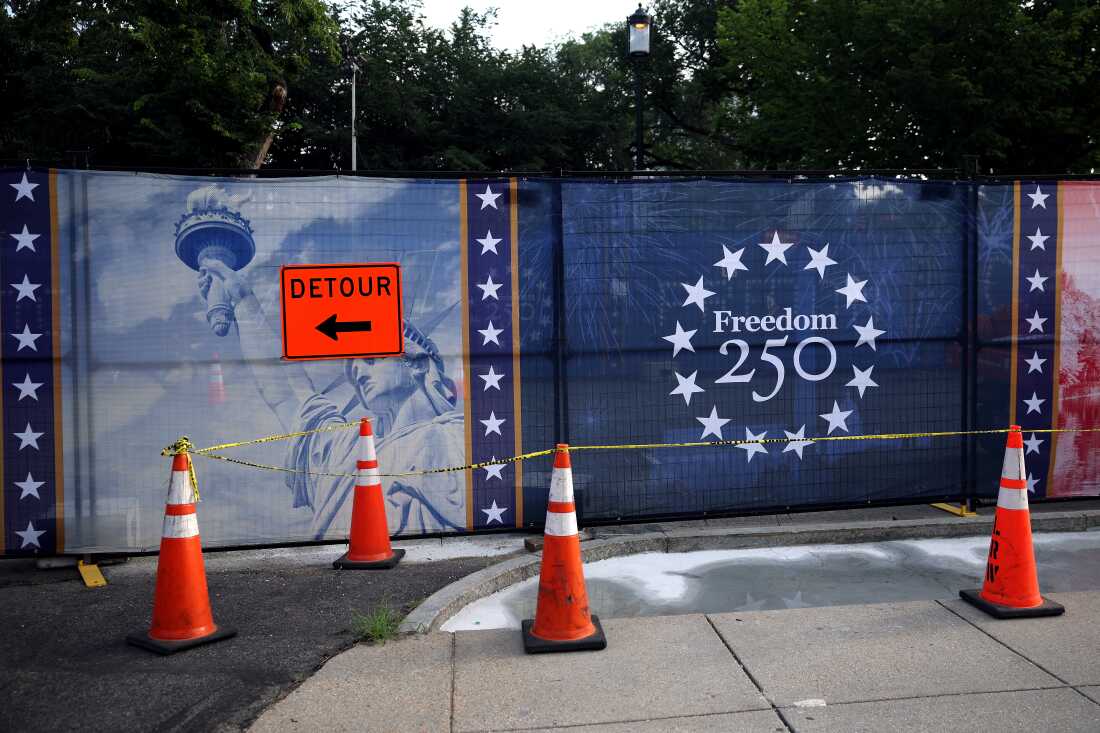
The Freedom 250 logo is visible on fencing around the National Mall on Thursday.
Kevin Dietsch/Getty Images
hide caption
toggle caption
Kevin Dietsch/Getty Images
The bigger-picture problem, critics say, is the lack of transparency throughout the entire process.
“All of these things have been so thoroughly conducted outside of public view,” said Toni Aguilar Rosenthal, a program director at the nonprofit Revolving Door Project. “But I think the House Dems’ report is an excellent extension of those sort of remaining questions that continue to plague just the entire situation and Freedom 250 organizationally.”
Aguilar Rosenthal co-authored a separate report on Freedom 250’s contracts and tactics, along with Zibel from Public Citizen.
Based on their analysis, Aguilar Rosenthal said of the more than $120 million in public funds funneled toward the anniversary celebrations, over $100 million has been “funneled” directly to projects, events and entities with ties to the Trump administration.
Some of those public contracts raise particular alarm among watchdogs. Federal contracts have directed tens of millions of dollars to a company called Event Strategies, Inc., which helped organize Trump’s infamous rally outside the U.S. Capitol on Jan. 6, 2021.

“They had a chance to do this in a bipartisan way or a way that wouldn’t enrich cronies, but they pretty clearly didn’t do that,” said Zibel. “I think that this is a follow-the-money situation that needs to be explored.”
Zibel says many companies — including major defense contractors and tech firms — that have donated to the 250th celebrations also rely on the government for contracts, funding and regulatory oversight. The report mentions that Freedom 250 circulated sponsorship packages culminating in a photo op with Trump, effectively selling access to the president.
Both reports raised questions about potential foreign influence. Alvarez, of Freedom 250, says it does not accept foreign donations.
But Keith Krach, a former Trump administration official who is the CEO of Freedom 250, appeared to solicit just that while speaking at the World Economic Forum in Davos, Switzerland, earlier this year, offering “toolkits for countries, states, companies, all of that.”
“What could be funner than marketing America, or really marketing freedom,” Krach said.
There is little visibility into the origins and destinations of donations in general, Aguilar Rosenthal says. Best case, they are still being used for some of America250’s original goals, she says. Worst case, she says, “public dollars and funds that have been earmarked for semiquincentennial celebrations are being used as a slush fund” for the administration and its political allies.
The report says the National Park Foundation’s donor structure “conceals the identities of those who give and the benefits they may be promised in return.” And at a congressional hearing in February, the foundation’s president and CEO, Jeff Reinbold, promised anonymity for any Freedom 250 donors who requested it (but said donations would otherwise be disclosed in the regular reporting process).
Huffman conceded that any anniversary celebration of this scale would merit scrutiny over spending and contracts. But he said if this had been organized by the bipartisan commission that Congress authorized — with representation from both parties to ask questions and do oversight — it would have been more transparent.
“There would have been public reporting,” he said, “because a publicly-created commission from Congress can’t hide behind the cloak of secrecy of an LLC.”
-

 Videos13 minutes ago
Iran gets ready for Khamenei’s funeral • FRANCE 24 English
-

 Los Angeles, Ca26 minutes ago
2 arrested after 3 LASD deputies injured during East L.A. World Cup celebration
-

 Detroit, MI44 minutes ago
Ex-girlfriend in custody after Taylor man found fatally stabbed, police say
-

 San Francisco, CA56 minutes ago
Marina braces for Golden Gate Bridge fireworks show, massive crowds
-

 Dallas, TX58 minutes ago
Maradona’s ‘Hand of God’ ball heads to auction in Dallas
-

 Miami, FL1 hour ago
Miami-Dade sheriff urges residents to celebrate Fourth of July safely
-

 Boston, MA1 hour ago
Jaylen Brown says Celtics showed ‘lack of respect’ after trade to 76ers – The Boston Globe
-

 Denver, CO1 hour ago
Who are the Top 5 offensive linemen in Denver Broncos history?

