Entertainment
Through ‘K-Pops!,’ Anderson .Paak sought deeper familial connection


When the pandemic hit, and reality settled in that life would be isolated and mostly inside, Grammy winner Anderson .Paak found himself on the outside looking in, in a way he didn’t anticipate. “I was the odd man out. My son was 8, and BTS took over the whole house,” .Paak explained in an interview with The Times at his WeHo lounge, Andy’s. “It was a K-pop storm. Before that, me and my son were bonding off of my music.”
.Paak’s son, Soul Rasheed, and his now ex-wife originally from Korea, Jaylyn Chang, had become obsessed with K-pop alongside much of America, which reminded .Paak of the intensity of Beatlemania. Black American music influenced the birth of a new style, which formed and expanded across oceans, then returned to the U.S. and exploded. This effect in the .Paak household was palpable, causing Soul and Chang to deeply bond in a new way. .Paak himself, as a soul, R&B and hip-hop aficionado, was tapped into the source, but not the reinterpreted subject. So he had to find a way in.
Soul, at the time, like many 8-year-olds, had also become obsessed with becoming a YouTuber. Besides .Paak’s music, the father-and-son duo had also previously connected over humor, so .Paak started there. They began with funny skits and eventually fused them with BTS dances. Soon, there were even videos featuring them comedically educating each other about their individual music tastes. “I loved it,” .Paak recalled, getting lost in the memory. “I was getting to know him more, and he was getting to know me. My mom would always say, ‘It’s one thing for your kids to love you, but it’s another to share things you’re interested in.’ It wasn’t like I was being Anderson .Paak, I was just Dad.”
“I was getting to know him more, and he was getting to know me,” .Paak said of bonding with his son, Soul.
(Carlin Stiehl / For The Times)
Through this exploration and the realization of a potential continued familial bond, a story idea emerged, then a treatment for a K-pop-centered film that .Paak would direct and he and Soul would both star in. .Paak then began directing a slew of music videos as the pandemic began to fade, building a portfolio and gaining experience in the medium. But he could start to sense Soul’s interest fading as time passed. After a few failed pitch attempts, .Paak urgently enlisted the help of one of his oldest friends and fellow entertainer, Jonnie “Dumbfoundead” Park, who brought .Paak and the idea to Stampede Ventures.
“The pitch was from an idea that Anderson had, and [to introduce it], we showed them this TikTok that he had with his son,” Park recalled over Zoom. “Anderson was like, ‘Do you know anything about BET, son?’ And [Soul] was like, ‘No, but I know BTS.’ Then they were just going back and forth, arguing about BET and BTS. That was literally the deck, [us saying] we would take that energy and put it into a two-hour film. They loved it. As soon as we walked out of the office, Anderson looked over like, ‘Are we greenlit?!’ They just understood it, the whole intergenerational, intercultural element of Black and Korean.” Stampede combined forces on the project with Live Nation Studios and .Paak’s debut feature “K-Pops!” was off to the races.
It’s important to note that .Paak is himself Black and Korean. His mother was adopted from Korea by a SoCal Black American military family and .Paak’s father was also a Black military officer. Thus, while his mother was born in Korea, he was raised almost entirely within a Black cultural space. .Paak didn’t experience much direct exposure to Korean culture until his 20s, when he met Chang at the Musicians Institute in Hollywood. As an immigrant directly from Korea, Chang showed him the fortitude of structure amid her community. He was also taken by their inherent family value system. “In Korean households, you stay in the house until you get older so you can take care of your parents, and your parents can help take care of the kids,” .Paak explained. “There’s an infrastructure that’s worked out. Also, Korean food is important, as is learning the language. I was drawn to that. My son didn’t eat anything outside of Korean food for so long, and he’s just now getting into tacos.”
.Paak then further explored his Korean side through a burgeoning friendship with Park, which happened a bit later, after Chang had already given birth to Soul. Park introduced .Paak to K-town-based Korean culture through their shared music scene. “The people that came from K-town had a lot of Latino and Black influences as well,” .Paak remembered. “There was a little more of a melting pot, and it was more urban. But in a similarly communal way [to Koreans from Korea], they were all hanging out in K-town with other Korean friends. They’d drink soju, and go to after-hours where you had to have somebody Korean with you.”

While .Paak had some opportunities in adulthood to grasp a bit of his Korean heritage, in “K-Pops!,” through his main character BJ, he also got to actualize what his mother may have missed. In the film, BJ, a failed karaoke bar R&B musician, gets a lucky chance to go to Korea and be the drummer for a popular K-pop competition series. There, he bumps into his estranged ex-girlfriend’s son, Tae Young (played by Soul), who is competing on the show. He then finds out that the kid is his. While a messy transition ensues, BJ and Tae Young eventually get to galavant around Korea and work together to try to win the competition. Through this exploration, BJ finds out he can thrive in Korea while still holding onto his Blackness. .Paak’s mother’s dive back into her roots had a different result. “My mom went abroad and spent a year in Korea, but when she went there, she just didn’t like it,” .Paak explained. “In the movie, initially, BJ doesn’t really have any connection to his Korean side and doesn’t really care to know, but then he finds a bridge.” That bridge is music.
Actor Yvette Nicole Brown, who in “K-Pops!” plays BJ’s mother, proclaimed over Zoom that, “Everything about the film and the music in it is Blasian, every culture is celebrated and massaged and made into something beautiful.” .Paak made a concerted, intentional effort to explore both the Black and Korean sides of K-pop in two scenes.
The first is an early breakdown initiated by Soul’s character, Tae Young, who explains the structured roles of a K-pop group, which may be fun for superfans and educational for laypeople to the genre. The next is a winding presentation by BJ to Tae Young about the influence of Motown groups like the Jackson 5 and boy bands like New Edition on the momentum of K-pop’s rise. It’s particularly poignant because it is all shot at a record store on the streets of Korea, where .Paak explained he actually found the records he was referencing. “There’s nothing wrong with people doing their interpretation of Black music, as long as you pay homage and as long as you respect it and take care of it,” .Paak declared. “Because [if you do], then they’ll take care of you, but the moment you don’t, you’ll see what happens … I wanted to explain that history because that’s how I saw it.”

Real-life father and son, Anderson .Paak, left, and Soul Rasheed, co-star in “K-Pops!”
(Jake Giles Netter)
”K-Pops!” has as much of who .Paak and Soul are as father and son as he could fit in. There are appearances by legacy Black artists like Earth, Wind & Fire, as well as K-pop stars like Vernon from Seventeen. There are original songs co-written and co-produced by .Paak and musician Dem Jointz, that feature K-pop fused with soul and funk, one of which Tae Young performs as his finale competition number (soundtrack arriving soon). The film was shot in both L.A. and Korea and provided ample time for bonding (especially during scenes filled with off-the-cuff humor) that .Paak envisioned from the beginning. Yet still, at the time they were about to shoot, .Paak almost couldn’t get Soul on board because he had turned 11 and wasn’t as into K-pop or acting comedically anymore; he insisted he was instead “into Slipknot.”
The duo did find their footing, though, and executed a winding story that centers on their connection. As a burgeoning teenager in 2024, Soul went with his father to the world premiere at the Toronto International Film Festival, along with a plethora of Korean relatives from his mom’s side. .Paak anxiously awaited their full reaction to the culmination of his quest for a deeper bond.
“Everybody really enjoyed it,” .Paak remembered, relieved. “[Soul] was like, ‘I’m proud of you, Dad.’ I asked him, ‘You think you would ever do part two?’ He was like, ‘Nah, I don’t think acting is my passion, but I’ll never forget those moments … You know what? On second thought, it depends on the script.’ But I think he’s really proud of it. I think it’s something like, when he gets older, he’ll see how special it is as well. But yeah, he didn’t say it’s cringe.”
“K-Pops!” has its L.A. premiere on Tuesday and debuts in select theaters Friday.



Cut to a seedy alley behind a Chinese restaurant in Rome: A dozen mobsters menace a slight young man who suddenly pulls out a pair of nunchucks. He swings the traditional stick-and-chain weapons and makes quick work of his enemies, who fall one by one, groaning in pain.
The comedic, legendary action scene is from the 1972 film “The Way of the Dragon,” written, directed and starring Bruce Lee. The martial arts star was a trailblazer, allowing Asian Americans to see themselves represented in a strong, positive light on-screen.
And now he has secured a place in California history, becoming the first Chinese American in state history to have a day designated in his honor.
Lee was born in 1940 in San Francisco. His mother was of European descent and his father was a Cantonese opera star who was on tour in the city, affording his son birthright citizenship.
Lee grew up in Hong Kong, where he followed his father’s path as a performer, acting in more than a dozen films as a child and studying the close-quarters southern Chinese martial art Wing Chun.
On May 17, 1959, an 18-year-old Lee returned to San Francisco and eventually made his way to Hollywood. He went on to influence an industry that was at the time bereft of Asian American talent, and helped to popularize the genre of martial arts films and ignite Western interest in Hong Kong action cinema.
In recognition of his contributions, state Assemblymember Matt Haney (D-San Francisco) introduced a bill designating May 17 as “Bruce Lee Day” in California. The bill, signed into law Tuesday by Gov. Gavin Newsom, encourages schools and communities to honor Lee’s life and cultural impact.
Haney has described Lee as a “symbol of pride, resilience and possibility for generations who rarely saw themselves reflected with strength and dignity.”
Lee, who saw himself not only as an actor but also as a poet and philosopher, encountered repeated barriers. Up for the main role in the 1970s television series “Kung Fu,” for example, he was rejected in favor of white actor David Carradine.
In 2020, filmmaker Bao Nguyen sought to show how Lee dispelled anti-Asian sentiment and long-held stereotypes of emasculated Asian men in his ESPN documentary “Be Water.”
“The Asian male was the face of the enemy to many Americans,” Nguyen told The Times in 2020. “It was this vicious cycle of society reflecting media and culture, and media and culture reflecting society. There had to be some kind of intervention there and Bruce, in a way, was that intervention. He was the hero that we hadn’t seen before.”
Lee learned much about the systemic oppression that Black Americans faced from his first student, Jesse Glover, who had been a victim of police brutality.
And scholars have pointed out that, although his films had far-from-perfect politics, they touched on themes of fighting oppression. The 1971 movie “The Big Boss” showed Lee battling alongside laborers. “Fist of Fury” saw him opposing Japanese colonialism and discrimination.
Lee died young in 1973, at age 32 — before he was able to witness the full extent of his stardom. He died just one month before the release of “Enter the Dragon,” which was a box-office sensation and is considered a masterpiece of martial arts filmmaking.

Starring: Kansas Bowling, Jessa Jupiter Flux and Julie Kashmanian
Directed by: Jason Zink
Rated: NR
Running Time: 80 minutes
Our Score: 3.5 out of 5 Stars
The found footage serial killer subgenre is surprisingly crowded with films like “Man Bites Dog,” “Maniac,” and the “Creep” franchise. So while it can be difficult to stand out, 2025’s “Looky-loo” and now “looky-loo: PART II” carve out their own identity by trapping us with very little dialogue and a killer who sees the camera as a creative tool rather than a simple recording device.
For the uninitiated (like I was a month ago), “Looky-loo” follows an aspiring filmmaker whose obsession with cameras evolves into voyeurism, stalking, and eventually murder. Not just one murder, either. He begins staging his victims like actors preparing for a scene, finding as much satisfaction in the production as the killing itself. That’s important because “PART II” picks up almost immediately afterward, with the killer seemingly releasing “Looky-loo” to the public like a drive-in snuff film. He even scrawls “PART II” in blood across a refrigerator, as if he’s proudly unveiling the title card for his next masterpiece.
My perspective may be slightly skewed because I watched both films within a 36-hour span. I never really had time to sit with the first film before diving into the sequel. While I think the original is a solid exercise in restraint, “PART II” noticeably improves on many of its quieter shortcomings. The first film feels a bit like “In a Violent Nature.” Instead of marinating in dense forests and ambient sound, “Looky-loo” lingers in sweaty breathing, uncomfortable silence, and victims blissfully unaware that a killer is standing in the closet. I think it works, but I can also understand why some viewers find it painfully slow.
“PART II” replaces much of that restraint with confidence. The killer stomps upstairs without hesitation, casually raids victims’ refrigerators, drinks their beverages, and only occasionally bothers wearing gloves, as if DNA evidence simply stopped existing. None of these moments feel like plot holes. They’re deliberate choices that suggest someone who either no longer fears getting caught or genuinely believes he’s untouchable. It’s difficult to know which because the film still reveals remarkably little about who he actually is.
What we do learn is perhaps the most interesting development of the sequel. I think our killer is creating incel art. The first film hints at it, but “PART II” pushes the idea much further. While he expands his victims to include men, the murders aren’t treated equally. The men often become victims of blunt rage. The women become productions. They’re staged, framed, and lingered upon with a disturbing artistic obsession. Even more revealing is his growing fixation on female artists. It’s almost as if he can’t tolerate the idea that women might be more creative, more fulfilled, or more talented than he is. The murders begin feeling less like random acts of violence and more like warped attempts to prove he’s the only true artist in the room.
That’s ultimately what elevates the “Looky-loo” series. Like “The Poughkeepsie Tapes,” it invites you to revisit it because so much of the story exists between the scenes rather than inside them. Every repeated viewing uncovers another clue about the psychology hiding behind the camera. Unlike charismatic fictional killers like Hannibal Lecter or Dexter Morgan, this murderer isn’t interested in charming us. He wants us to appreciate the process: the stalking, the waiting, the intrusion, and finally the kill. In his mind, we’re his audience. He believes we should admire his work just as much as he does. And if we don’t, we might as well become part of his next production.
“looky loo: PART II” will have its Midwest premiere at Hysteria Fest in St. Louis on Thursday July 9th.
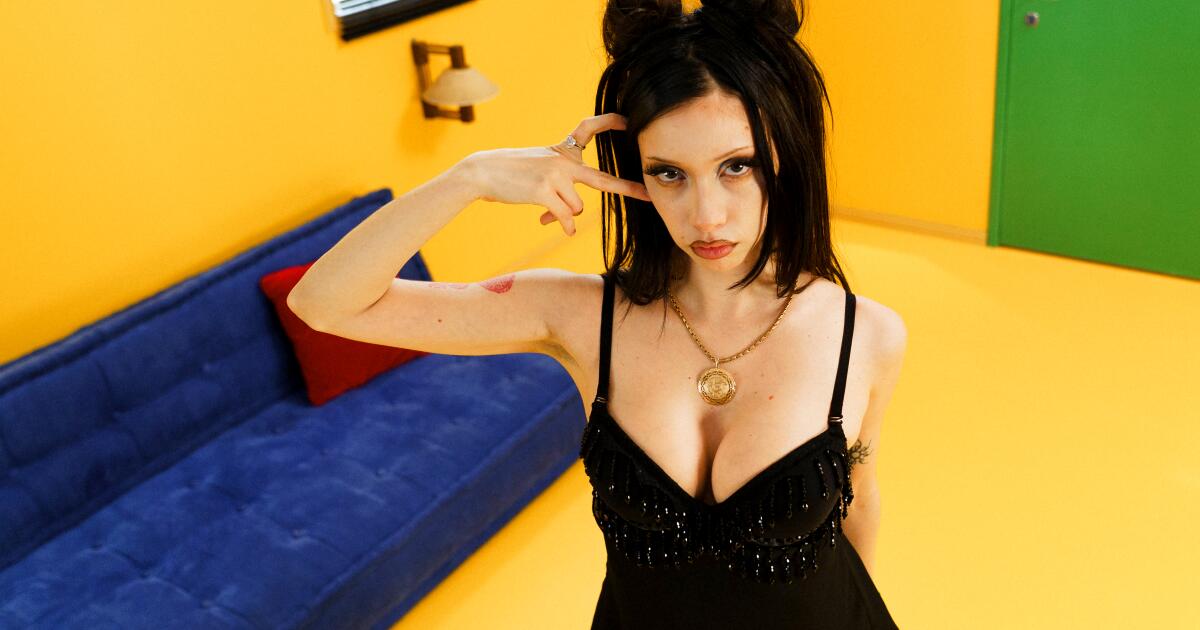
In an era hallmarked by what experts call a “sex recession,” Six Sex is a symbol of liberation.
The Argentine baddie fashions herself as a baby-voiced, bikini-clad fembot, beamed in from the clubs of Buenos Aires — and has become known for cheeky, instructive celebrations of desire. Her songs are designed to galvanize like-minded club rats into Dionysian revelry, or, in the case of the song “How to Make Your Ass Bigger,” squats.
To a certain subset of the Latine underground, she represents a pure-hearted hypersexuality. Yet, for the artist behind the persona, Francisca Agustina Cuello, this wasn’t always the intention.
“I don’t know if it was because I still had to keep my innocence or what, but I didn’t envision the project that way,” she said, calling from a hotel room in Barcelona. “That response sort of came about from the people, towards me. So, I said OK, I’m making it my own.”
In doing so, Cuello has churned out six thumping EPs as Six Sex, a campy character that she describes as a “fable” — a mix of “fantasía y hedonismo.”
That dynamic is taken to extremes on her debut album, “Ultra”, released June 6. It’s a dark and propulsive journey through decades of electronic dance music, best described by its own opening words portending “ultra terrorific fantasy.” (The phrase conjures up images of grandeur, but really, it evokes that “Blades of Glory” quote: “no one knows what it means, but it’s provocative.”)
“I feel like nothing I say is all that serious,” she said about her lyrics. “It’s a thing about my personality to be silly and goof around.”
“Ultra” centers Cuello’s winking, suggestive sense of humor. “Not Your Mom” features a conversation with a garbled, omnipotent voice akin to the parents in Charlie Brown; “FUchi!” features schoolyard taunts about “low dickie energy;” the album ends with “No More Porn,” a playful yet powerful subversion of sexual expectations.
“At the same time, for me, that acts as a filter,” she added with a laugh. “Weeding out the people who get scandalized by it, and identifying the people who get it and say: ‘Yas, yo también quiero tener cuatro novios.’”
Earlier this year, Cuello took the stage at Don Quixote, performing in front of a sold-out crowd for her Los Angeles debut. The smell of sweat permeated the air as she ripped through several of her hits — including collaborations with Reysha Rami and German producer MCR-T. Every single one of her signature ponytail flips sent the room into hysterics. The audience screamed every word at the top of their lungs; it was the loudest, most raucous show I’d been to in years.
Cuello took a breather in the middle of her world tour to chat with De Los over Zoom about all things Six Sex: her new record, her writing style and how it feels to connect with fans spun into febrile intensity.
This interview has been condensed for clarity and was translated from Spanish to English.

“[I’m] weeding out the people who get scandalized,” says Six Sex of her provocative music.
(Catalina Jacobo)
I was really taken by the “Ultra” album cover. You’re wearing a white bikini and in this “come to Jesus” pose. What was the goal?
[laughs] It was hard, because I wanted the cover to represent what the entire journey of the album meant to me. I was looking for something strong and heavy in visual terms, because with “Ultra”, this is the first time I’ve finished a long, heavy project and I see the start of something. It’s like something new was unlocked. I found a new way to convey feelings, and a new way to create as well. It’s not like I just finished, and it is what it is. Rather, it is the beginning of something bigger.
Is there an element of separation at all between the artistry and you as a person?
I think they’re pretty close. It’s as if Six Sex was sort of a fable, or like a hentai or comic [version of] my life. It’s also happened that things I wrote as a joke later became reality. But generally, I draw inspiration from things that actually happened to me.
Is it weird to put those intimate experiences on an album?
No, not for me. Because I’m not speaking so seriously, I don’t feel exposed. Even though my persona and my character are very close to one another, I don’t have to prove anything to anyone. I’m not trying to make you believe in something. The songs stop being about me as soon as someone else listens to them. There are certain things we can all see ourselves represented in, and I think my music aims for that, too.
I want to ask about your performance style. I saw you live in Los Angeles and was really taken by the energy exchange between yourself and the crowd. How do you approach live performance?
Nowadays, I’m in a balance between performance and being a human being that connects with people and can pause to look in the eyes of the audience to register how they feel. I like being in a showgirl role, and at the same time, knowing when to step out of it.
Sometimes I go up there after having a crappy day, thinking that I’m gonna screw it up. And when I get up there and connect with the people, everything flows in a perfect way.
Does the music transform when it’s performed live, versus on a record? A lot of your music seems designed to be played in the club.
I think it’s very personal. For me, I’m a bit autistic; sometimes when I’m at a show, I get different sensations. It really depends on the person. I like seeing people’s reactions live when I start playing these songs for the first time. People were super hyped. They were enjoying them and jumping around a lot. It feels really fresh.
You reference ‘90s club classics all over “Ultra,” including by U.K. band the Prodigy on “Bitch Up.” How did these sounds come into your life?
These sounds evoke a special kind of nostalgia for me. Even though I hadn’t been listening to them lately, they sounded like something I wanted to bring back to the table — songs my uncle used to listen to when I was really young. Like a CD [of] pirated songs that somehow ended up at my house, and at the time I was like, “Wow, what is this music?”
There’s an element of Six Sex that gives “fembot,” like a female, sexy robot. I’m curious if you feel that playing out in your work.
[laughs] I didn’t know about the fembot thing. I don’t use Twitter. I [keep] a bubble… against some things that I don’t know. But I’ve always liked the idea that people have that perception of me, to some extent.
How do you feel about the rise of AI as a musician, especially considering your persona adopts that perception?
I mean… I don’t have a formed opinion on the matter. I do think that, I don’t know, it’s all very relative. For one thing, I obviously feel like it strips away the human value, but at the same time, it’s also a tool for humans. So it’s kind of contradictory. I feel weird about it…. I don’t know.
Zooming out, I’ve noticed Argentina has been having a musical moment over the last few years between yourself, Ca7riel y Paco Amoroso, Juana Rozas… How do you feel Argentina being represented or even challenged in your music?
I feel that culturally, Argentina is a very rich country. However, I do feel like, over generations, a paradigm was broken, and new sounds have been created that don’t necessarily abandon the roots of our music, but were created out of counterculture.
That same kind of counterculture is what makes Argentina be in such turmoil. It’s also the context of our country. Economic, political, social. The key Argentinian figures we refer to nowadays are constantly changing. And that allows you to listen to a variety of genres from Argentina, from people doing different things, and at the same time raising the flag and saying: “Yo soy argentino.” And we love that.
-
World7 minutes ago
Iran prepares for dayslong funeral for late Supreme Leader Ayatollah Ali Khamenei, killed in war
-
 Lifestyle47 minutes ago
To be or not to be a parent : It’s Been a Minute
-

 Technology59 minutes ago
Sony’s PlayStation disc factory is already being repurposed
-

 World1 hour ago
Couple publicly caned after alleged TikTok kiss sparks outrage in Indonesia
-

 Politics1 hour ago
WATCH: Controversial SCOTUS decision strikes a divide among lawmakers
-

 Health1 hour ago
Big Medicare change slashes weight-loss drug costs for eligible seniors
-

 Sports1 hour ago
VAR denies Croatia’s game-tying goal as Cristiano Ronaldo leads Portugal to Round of 16
-

 Technology1 hour ago
New sodium-ion battery could reshape grid storage

