Lifestyle
This $384 water filter has a cult following in L.A. But the EPA sees red flags

Katya Mosely remembers the exact moment it all began, a few years ago. “It was my daughter’s piano teacher,” she says. “She had a 6-inch-long stick of charcoal floating in her glass water bottle. I saw it, and that’s what sent me down the rabbit hole.”
Mosely, the owner of Spirit Gate Acupuncture & Wellness in Mid City, was already using a Brita to purify her tap water, but she wasn’t sure she trusted the results. So down she went, spiraling deep into the world of charcoal-based filters, where she eventually landed on an odd-looking contraption with a friendly name: The Berkey.

In L.A., water rules everything around us. Drink up, cool off and dive into our stories about hydrating and recreating in the city.
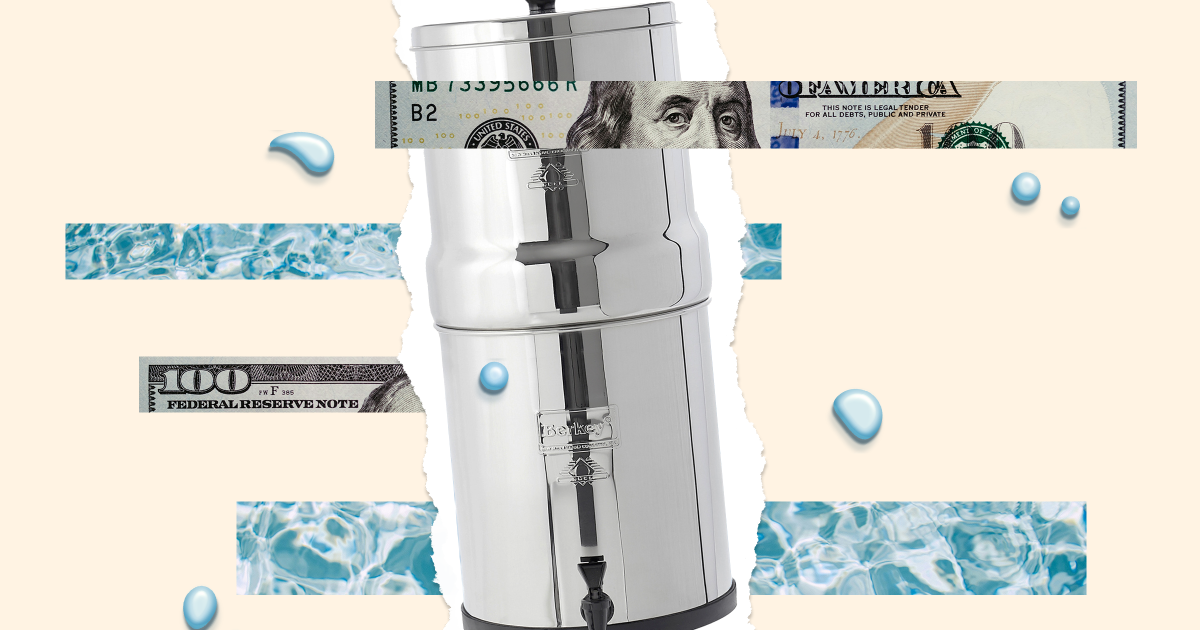
A stainless-steel vessel that claims to remove more impurities than better-known filters, the standard Berkey is nearly 20 inches tall and looks a bit like a cross between a Russian samovar and a decommissioned missile casing. By comparison, a plastic fridge-dwelling Brita appears toy-like — a Huffy trike parked next to a Tesla Cybertruck. The Berkey can also be harder to maintain than other systems, with long-lasting filters that require periodic cleaning. And it’s much, much slower, taking hours to filter a full 2.25-gallon tank.
Which is all to say, it was exactly what Mosely wanted. As a bonus, her Berkey now delivers more than just clean, crisp-tasting water at work.
“People come through my office and see it and give me a little nod of acknowledgment. Like, ‘Oh, she knows what’s up. Look at her Big Berkey,’” she says, laughing.
The if-you-know-you-know appeal of Berkey turns out to be one of its defining features here in L.A., where its name tends to prompt one of two reactions: Either you’ve never heard of it, or you’re obsessed. Maybe you’ve seen one at your GOOP-iest friend’s apartment or at an alternative healthcare practice where new healing modalities are welcome and plain-old tap water is absolutely not. Maybe you even noticed when the trendsetting L.A. apparel brand Online Ceramics released a bootleg Berkey hoodie in December, confirming the filter’s status as a kind of secret handshake for the town’s Palo Santo-burning, quartz-collecting cognoscenti.
“I think it’s popular because Britas are plastic. And plastic is becoming really not chic,” says Sabrina Lemus, a Los Feliz resident who jokingly self-describes as “wellness-pilled” and keeps crystals under her Berkey to charge the water with good vibrations. “Plus, the water just tastes so good.”
“I think it’s popular because Britas are plastic. And plastic is becoming really not chic.”
— Sabrina Lemus, Los Feliz resident
Amie-Ray Bourget, an L.A.-based doula, loves her Berkey so much that she uses it to repurify the water that comes out of her full-home filtration system. (“When it goes through the Berkey, it’s just extra filtered and extra good for you,” she says.) Like many fans I spoke to, Bourget and Lemus are both genuinely passionate about clean living and also quick to crack a self-deprecating joke about the unusual lengths they’ll go to achieve it. Other Berkey owners lightheartedly referred to their own water regimens as “ridiculous,” “insane” and even “psycho.”
Berkey’s stronghold here in L.A. makes sense The filter taps into a potent mixture of our preoccupations: clean living, water safety, sustainability, disaster preparedness and, crucially, attainable luxury (the average Big Berkey retails at $384). But the full, unfiltered account of Berkey’s rise is a murkier tale, involving fights with the Environmental Protection Agency and the state of California, doomsday preppers and a right-wing media blitz. Berkey’s water may be crystal clear; its story, on the other hand, is anything but.
It all started more than a hundred years ago, when a lethal cholera outbreak was ripping through the German town of Hamburg. Untreated water was to blame, and an unlikely hero emerged: Wilhelm Berkefeld, the inventor of a ceramic device that helped purify the city’s drinking water and reduce the epidemic’s death toll. The Berkefeld filter, as it was called, soon became famous outside its native country. An updated version of it is still sold today in the U.K., and the North American distribution rights were granted in 1998 to an American company with an opaque name: New Millennium Concepts Ltd. (NMCL).
When it arrived in the New World, Berkefeld was shortened to Berkey — but NMCL changed more than just the branding. They also revamped the filter to contain “a tortuous maze of micropores” that helps to “address 200+ typical contaminants found in tap water.”
In the water purification world, there’s nothing else quite like it. “It’s kind of its own unique filter,” says Tasha Stoiber, a senior scientist at Environmental Working Group, which has tested Berkey systems alongside other water filters. “In the other ones, you have a replacement cartridge that you throw out and replace it with another. With Berkey… it will last you years, about six years, seven years. What you do is you basically scrub the carbon, renewing the surface.”
According to EWG’s research, Berkey’s filters are great at removing some things (like PFAS, a.k.a. “forever chemicals”), and less great at excluding others (like hexavalent chromium and nitrates, carcinogens that were only partially reduced in EWG’s tests).
Berkey’s unusual combination of functionality, durability and crunchy stylishness has made it a rare point of agreement for groups that might not otherwise overlap. For every Westside wellness evangelist proudly displaying a Berkey at a garden party, there’s a disaster prepper who values the filter as a bulwark against disease in a post-apocalyptic world. On YouTube, channels with names like Survival Living and LDSPrepper (LDS as in Church of Latter Day Saints) debate the merits of the system alongside reviews of gas masks and solar power systems.
Perhaps the strangest part of Berkey’s success in L.A. is the company won’t even sell the Big Berkey in California. (Though it does sell other products here.) In 2009, the state of California enacted a law aimed at protecting the public from lead in drinking waters. In response, NMCL decided to simply cut California off its distribution map for certain products, including its flagship Big Berkey system. In a fiery statement, NMCL claimed that California’s new requirements — for example, independent testing and certification for water filters — were far too expensive for a small business. “The additional taxes, certifications, red tape, registrations, along with the expense of defending against activist litigators, have created too costly a barrier,” they wrote, calling California’s actions “mercurial and punitive.’”
Then came an even bigger regulatory fight. In May 2023, the U.S. Environmental Protection Agency issued a surprising order against Berkey International, halting the sale or distribution of Black Berkey Filters. The order said that the filters are unregistered pesticides sold in violation of the Federal Insecticide, Fungicide, and Rodenticide Act. The EPA’s reasoning hinges on an extremely technical definition of pesticides (which it calls “any substance … intended for preventing, destroying, repelling or mitigating any pest” — including microorganisms) and Berkey’s use of silver as an antimicrobial in the filters themselves. The EPA sent a similar order to some — but not all — of Berkey’s authorized dealers, leaving Berkey fans to scour the internet for available inventory.
If you find all of this slightly puzzling, join the club.
“I think it will be pretty confusing to the general public of why something like that might be registered as a pesticide,” says Stoiber, who notes that the EWG won’t comment on Berkey’s legal situation. “I’m not sure why it’s an issue with this company and not other companies, either.” (Other popular water filters also tout silver as an antimicrobial agent; to my knowledge, none of them are currently fighting the EPA over it.)
Berkey isn’t taking any of this lightly. In a lawsuit filed against the EPA this March, Berkey International asked for a restraining order on the EPA’s ruling, and argued that the agency’s “classification of Berkey filters as a pesticide is arbitrary, capricious, an abuse of discretion, and constitutes a clear error.” (Berkey’s original lawsuit has since been dismissed, leading the company to appeal and file an additional lawsuit.) On its official website, Berkey made an even bolder allegation: “We have been informed that the real issue is that because of Covid-19, the EPA does not like the fact that Berkey filters are capable of removing virus from your water.” (When contacted for comment, an EPA rep told the Times that the “EPA cannot provide further information on ongoing enforcement actions, and that the [Stop Sale, Use, or Removal Orders] should speak for themselves.”)
Following the EPA order, NMCL CEO Jim Shepherd also decided to take his story to the media — or at least, one specific corner of it. In September, he discussed the case at length in an online video with Mike Adams, a.k.a. “The Health Ranger” whose controversial media brand, Natural News, has been known to publish conspiracy theories and disinformation. In another interview, Shepherd chats with Emerald Robinson, an ultraconservative TV host who was let go from Newsmax after tweeting about a potential satanic connection to COVID vaccines. Shepherd even has a surprisingly powerful political ally in his fight. In October, Republican Florida Congressman Matt Gaetz — a Trump loyalist best known for leading the charge to unseat former House Speaker Kevin McCarthy — penned a letter to the EPA, boldly demanding that the agency “must end its attack on Berkey Water Systems immediately.” As of today, the EPA has yet to publicly respond.
Unsurprisingly, Berkey’s biggest fans are filtering out all this noise. Many of the people I spoke to for this story were completely unaware of Berkey’s legal woes, even as they’ve jumped through hoops to track down Berkey components online. Some of them even know people who have traveled across state lines to pick up a Berkey system at a non-California address.
Berkey is not hurting anybody. And of all the water systems I’ve tried, I love it more than anything.
— Jessica Frank, founder of Fairwell
Even if they do know about Berkey’s battles, this crowd tends to stay focused on their own journeys toward healthier living and cleaner water. Jessica Frank, founder of the L.A.-made, eco-friendly kids’ clothing brand Fairwell, says that while she’s “as liberal as they come,” she also supports Berkey’s fight against the EPA. “I’m all about ‘live and let live,’ ” she said. “Berkey is not hurting anybody. And of all the water systems I’ve tried, I love it more than anything.”
In fact, she likes it so much that she even gives it to her cat, Guava Kombucha, and her blind 11-year-old rabbit, Marshmallow, who has free run of the house. But she does draw a line at her seven Silkie chickens.
“They don’t get Berkey water, just regular water,” she says, before laughing and admitting: “With a little apple cider vinegar and oregano oil in it.”



A screenshot from George Mélière’s Gugusse et l’Automate. The pioneering French filmmaker’s 1897 short, which likely features the first known depiction of a robot on film, was thought lost until it was found among a box of old reels that had belonged to a family in Michigan and restored by the Library of Congress.
The Frisbee Collection/Library of Congress
hide caption
toggle caption
The Frisbee Collection/Library of Congress
The Library of Congress has found and restored a long-lost silent film by Georges Méliès.
The famed 19th century French filmmaker is best known for his groundbreaking 1902 science fiction adventure masterpiece Le Voyage dans la Lune (A Trip to the Moon).
The 45-second-long, one-reel short Gugusse et l’Automate – Gugusse and the Automaton – was made nearly 130 years ago. But the subject matter still feels timely. The film, which can be viewed on the Library of Congress’ website, depicts a child-sized robot clown who grows to the size of an adult and then attacks a human clown with a stick. The human then decimates the machine with a hammer.
In an Instagram post, Library of Congress moving image curator Jason Evans Groth said the film represents, “probably the first instance of a robot ever captured in a moving image.” (The word “robot” didn’t appear until 1921, when Czech dramatist Karel Čapek coined it in his science fiction play R.U.R..)
“Today, many of us are worried about AI and robots,” said archivist and filmmaker Rick Prelinger, in an email to NPR. “Well, people were thinking about robots in 1897. Very little is new.”
A long journey
Groth said the film arrived in a box last September from a donor in Michigan, Bill McFarland. “Bill’s great grandfather, William Frisbee, was a person who loved technology,” Groth said. “And in the late 19th century, must have bought a projector and a bunch of films and decided to drive them around in his buggy to share them with folks in Pennsylvania, Ohio, New York.”
McFarland didn’t know what was on the 10 rusty reels he dropped off at the Library of Congress’ National Audio-Visual Conservation Center in Culpeper, Va. A Library article about the discovery describes the battered, pre-World War I artifacts as having been, “shuttled around from basements to barns to garages,” and that they, “could no longer be safely run through a projector,” owing to their delicate condition. “The nitrate film stock had crumbled to bits on some; other strips were stuck together,” the article said. It was a lab technician in Michigan who suggested McFarland contact the Library of Congress.
“The moment we set our eyes on this box of film, we knew it was something special,” said George Willeman, who heads up the Library’s nitrate film vault, in the article.
Willeman’s team carefully inspected the trove of footage, which also contained another well-known Méliès film, Nouvelles Luttes extravagantes (The Fat and Lean Wrestling Match) and parts of The Burning Stable, an early Thomas Edison work. With the help of an external expert, they identified the reel as having been created by Méliès because it features a star painted on a pedestal in the center of the screen – the logo for Méliès Star Film Company.
A pioneering filmmaker
Méliès was one of the great pioneers of cinema. The scene in which a rocket lands playfully in the eye of Méliès’ anthropomorphic moon in Le Voyage dans la Lune is one of the most famous moments in cinematic history. And he helped to popularize such special effects as multiple exposures and time-lapse photography.

This moment from George Méliès’ Le Voyage dans la Lune (A Trip to the Moon) is considered to be one of the most famous in cinematic history.
George Méliès/Public Domain
hide caption
toggle caption
George Méliès/Public Domain
Presumed lost until the Library of Congress’s discovery, Gugusse et L’Automate loomed large in the imaginations of science fiction and early cinema buffs for more than a century. In their 1977 book Things to Come: An Illustrated History of the Science Fiction Film, authors Douglas Menville and R. Reginald described Gugusse as possibly being, “the first true SF [science fiction] film.”
“While it may seem that no more discoveries remain to be made, that’s not the case,” said Prelinger of the work’s reappearance. “Here’s a genuine discovery from the early days of film that no one anticipated.”

Joshua Jackson
I Got the Eye of the Tiger!!!
Published
BACKGRID
Joshua Jackson may have picked up a thing or two from “Karate Kid: Legends” … we got video of him going H.A.M. in a boxing gym with a trainer.
Watch the video … the 47-year-old actor ditched his shirt for the workout, really working up a sweat as he bobbed and weaved in the ring while throwing in some pretty impressive jabs!

He later goes to work solo on a speed bag like an old pro.
Joshua has publicly said that starring in “Karate Kid: Legends” in the role of a former boxer was a dream for him, but there’s no word on whether he’s training for another role or just really fell in love with boxing.
Either way … you’re looking great, Joshua!

Tracy Morgan, left, and Daniel Radcliffe star in The Fall and Rise of Reggie Dinkins.
Scott Gries/NBC
hide caption
toggle caption
Scott Gries/NBC
Tracy Morgan, as a presence, as a persona, bends the rules of comedy spacetime around him.
Consider: He’s constitutionally incapable of tossing off a joke or an aside, because he never simply delivers a line when he can declaim it instead. He can’t help but occupy the center of any given scene he’s in — his abiding, essential weirdness inevitably pulls focus. Perhaps most mystifying to comedy nerds is the way he can take a breath in the middle of a punchline and still, somehow, land it.
That? Should be impossible. Comedy depends on, is entirely a function of, timing; jokes are delicate constructs of rhythms that take time and practice to beat into shape for maximum efficiency. But never mind that. Give this guy a non-sequitur, the nonner the better, and he’ll shout that sucker at the top of his fool lungs, and absolutely kill, every time.
Well. Not every time, and not everywhere. Because Tracy Morgan is a puzzle piece so oddly shaped he won’t fit into just any world. In fact, the only way he works is if you take the time and effort to assiduously build the entire puzzle around him.
Thankfully, the makers of his new series, The Fall and Rise of Reggie Dinkins, understand that very specific assignment. They’ve built the show around Morgan’s signature profile and paired him with an hugely unlikely comedy partner (Daniel Radcliffe).
The co-creators/co-showrunners are Robert Carlock, who was one of the showrunners on 30 Rock and co-created The Unbreakable Kimmy Schmidt, and Sam Means, who also worked on Girls5eva with Carlock and has written for 30 Rock and Kimmy Schmidt.
These guys know exactly what Morgan can do, even if 30 Rock relegated him to function as a kind of comedy bomb-thrower. He’d enter a scene, lob a few loud, puzzling, hilarious references that would blow up the situation onscreen, and promptly peace out through the smoke and ash left in his wake.
That can’t happen on Reggie Dinkins, as Tracy is the center of both the show, and the show-within-the-show. He plays a former NFL star disgraced by a gambling scandal who’s determined to redeem himself in the public eye. He brings in an Oscar-winning documentarian Arthur Tobin (Radcliffe) to make a movie about him and his current life.
Tobin, however, is determined to create an authentic portrait of a fallen hero, and keeps goading Dinkins to express remorse — or anything at all besides canned, feel-good platitudes. He embeds himself in Dinkins’ palatial New Jersey mansion, alongside Dinkins’ fiancée Brina (Precious Way), teenage son Carmelo (Jalyn Hall) and his former teammate Rusty (Bobby Moynihan), who lives in the basement.
If you’re thinking this means Reggie Dinkins is a show satirizing the recent rise of toothless, self-flattering documentaries about athletes and performers produced in collaboration with their subjects, you’re half-right. The show feints at that tension with some clever bits over the course of the season, but it’s never allowed to develop into a central, overarching conflict, because the show’s more interested in the affinity between Dinkins and Tobin.
Tobin, it turns out, is dealing with his own public disgrace — his emotional breakdown on the set of a blockbuster movie he was directing has gone viral — and the show becomes about exploring what these two damaged men can learn from each other.
On paper, sure: It’s an oil-and-water mixture: Dinkins (loud, rich, American, Black) and Tobin (uptight, pretentious, British, practically translucent). Morgan’s in his element, and if you’re not already aware of what a funny performer Radcliffe can be, check him out on the late lamented Miracle Workers.
Whenever these two characters are firing fusillades of jokes at each other, the series sings. But, especially in the early going, the showrunners seem determined to put Morgan and Radcliffe together in quieter, more heartfelt scenes that don’t quite work. It’s too reductive to presume this is because Morgan is a comedian and Radcliffe is an actor, but it’s hard to deny that they’re coming at those moments from radically different places, and seem to be directing their energies past each other in ways that never quite manage to connect.

Precious Way as Brina.
Scott Gries/NBC
hide caption
toggle caption
Scott Gries/NBC
It’s one reason the show flounders out of the gate, as typical pilot problems pile up — every secondary character gets introduced in a hurry and assigned a defining characteristic: Brina (the influencer), Rusty (the loser), Carmelo (the TV teen). It takes a bit too long for even the great Erika Alexander, who plays Dinkins’ ex-wife and current manager Monica, to get something to play besides the uber-competent, work-addicted businesswoman.
But then, there are the jokes. My god, these jokes.
Reggie Dinkins, like 30 Rock and Kimmy Schmidt before it, is a joke machine, firing off bit after bit after bit. But where those shows were only too happy to exist as high-key joke-engines first, and character comedies second, Dinkins is operating in a slightly lower register. It’s deliberately pitched to feel a bit more grounded, a bit less frenetic. (To be fair: Every show in the history of the medium can be categorized as more grounded and less frenetic than 30 Rock and Kimmy Schmidt — but Reggie Dinkins expressly shares those series’ comedic approach, if not their specific joke density.)
While the hit rate of Reggie Dinkins‘ jokes never achieves 30 Rock status, rest assured that in episodes coming later in the season it comfortably hovers at Kimmy Schmidt level. Which is to say: Two or three times an episode, you will encounter a joke that is so perfect, so pure, so diamond-hard that you will wonder how it has taken human civilization until 2026 Common Era to discover it.
And that’s the key — they feel discovered. The jokes I’m talking about don’t seem painstakingly wrought, though of course they were. No, they feel like they have always been there, beneath the earth, biding their time, just waiting to be found. (Here, you no doubt will be expecting me to provide some examples. Well, I’m not gonna. It’s not a critic’s job to spoil jokes this good by busting them out in some lousy review. Just watch the damn show to experience them as you’re meant to; you’ll know which ones I’m talking about.)
Now, let’s you and I talk about Bobby Moynihan.
As Rusty, Dinkins’ devoted ex-teammate who lives in the basement, Moynihan could have easily contented himself to play Pathetic Guy™ and leave it at that. Instead, he invests Rusty with such depths of earnest, deeply felt, improbably sunny emotions that he solidifies his position as show MVP with every word, every gesture, every expression. The guy can shuffle into the far background of a shot eating cereal and get a laugh, which is to say: He can be literally out-of-focus and still steal focus.
Which is why it doesn’t matter, in the end, that the locus of Reggie Dinkins‘ comedic energy isn’t found precisely where the show’s premise (Tracy Morgan! Daniel Radcliffe! Imagine the chemistry!) would have you believe it to be. This is a very, very funny — frequently hilarious — series that prizes well-written, well-timed, well-delivered jokes, and that knows how to use its actors to serve them up in the best way possible. And once it shakes off a few early stumbles and gets out of its own way, it does that better than any show on television.
This piece also appeared in NPR’s Pop Culture Happy Hour newsletter. Sign up for the newsletter so you don’t miss the next one, plus get weekly recommendations about what’s making us happy.
Listen to Pop Culture Happy Hour on Apple Podcasts and Spotify.

Indiana Pacers Must Manage Two-Way Contract Player Availability Down Stretch

Iowa Boys High School State Basketball Tournament Sets Two Classes

Why Matthew Driscoll continues to say Kansas State is ‘close’

Three NKY girls wrestlers win titles, including a third for Emma Moore
Louisiana Lottery Powerball, Pick 3 results for Feb. 28, 2026

Florida High School Football Rankings: Top 25 teams – Oct. 21

Cleary's 21 help Le Moyne down Central Connecticut State 69-64 in OT

How old is Bo Nix? What to know about Oregon quarterback ahead of 2024 NFL Draft

99th annual Pony Swim held in Virginia

Indiana Members Credit Union announced as new anchor tenant at Bottleworks District

Mamdani’s response to Trump’s Iran strike sparks conservative backlash: ‘Rooting for the ayatollah’

Activists hail ‘historic’ EU’s decision on accessible abortion

A long-buried recording and the Supreme Court of old (CT+) : Consider This from NPR

2 Survivors Describe the Terror and Tragedy of the Tahoe Avalanche

Iran fires missiles at US bases across Middle East after American strikes on nuclear, IRGC sites
-

 World3 days ago
Exclusive: DeepSeek withholds latest AI model from US chipmakers including Nvidia, sources say
-

 Massachusetts4 days ago
Mother and daughter injured in Taunton house explosion
-

 Montana1 week ago
2026 MHSA Montana Wrestling State Championship Brackets And Results – FloWrestling
-

 Louisiana6 days ago
Wildfire near Gum Swamp Road in Livingston Parish now under control; more than 200 acres burned
-

 Denver, CO3 days ago
10 acres charred, 5 injured in Thornton grass fire, evacuation orders lifted
-

 Technology1 week ago
YouTube TV billing scam emails are hitting inboxes
-

 Technology1 week ago
Stellantis is in a crisis of its own making
-

 Politics1 week ago
OpenAI didn’t contact police despite employees flagging mass shooter’s concerning chatbot interactions: REPORT