Lifestyle
This $384 water filter has a cult following in L.A. But the EPA sees red flags

Katya Mosely remembers the exact moment it all began, a few years ago. “It was my daughter’s piano teacher,” she says. “She had a 6-inch-long stick of charcoal floating in her glass water bottle. I saw it, and that’s what sent me down the rabbit hole.”
Mosely, the owner of Spirit Gate Acupuncture & Wellness in Mid City, was already using a Brita to purify her tap water, but she wasn’t sure she trusted the results. So down she went, spiraling deep into the world of charcoal-based filters, where she eventually landed on an odd-looking contraption with a friendly name: The Berkey.

In L.A., water rules everything around us. Drink up, cool off and dive into our stories about hydrating and recreating in the city.
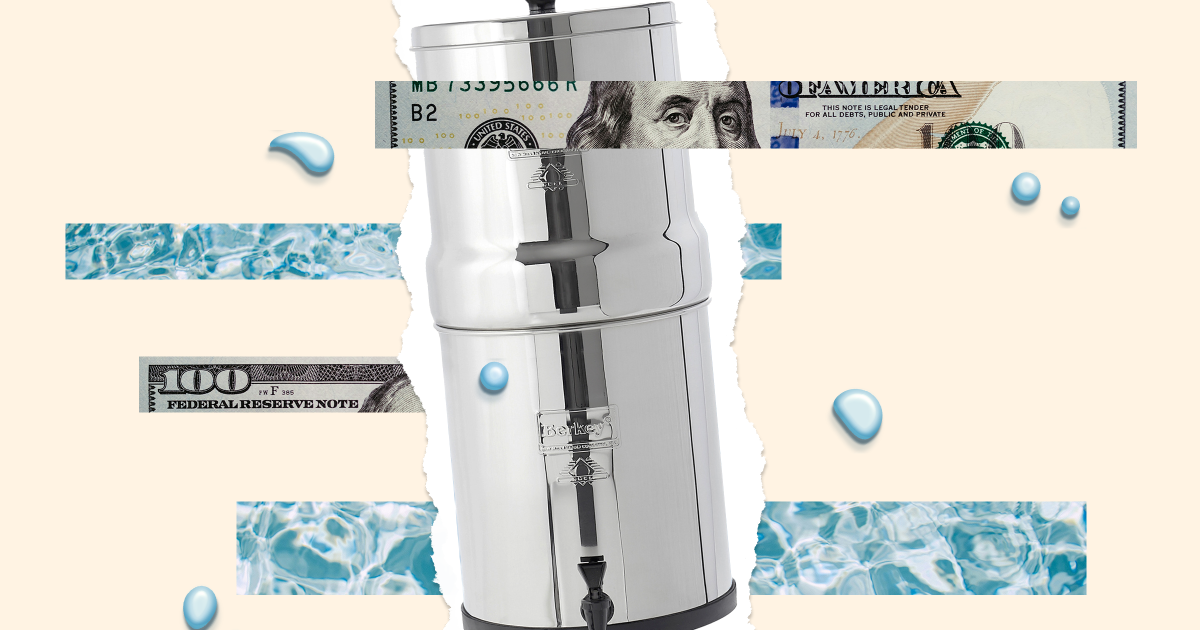
A stainless-steel vessel that claims to remove more impurities than better-known filters, the standard Berkey is nearly 20 inches tall and looks a bit like a cross between a Russian samovar and a decommissioned missile casing. By comparison, a plastic fridge-dwelling Brita appears toy-like — a Huffy trike parked next to a Tesla Cybertruck. The Berkey can also be harder to maintain than other systems, with long-lasting filters that require periodic cleaning. And it’s much, much slower, taking hours to filter a full 2.25-gallon tank.
Which is all to say, it was exactly what Mosely wanted. As a bonus, her Berkey now delivers more than just clean, crisp-tasting water at work.
“People come through my office and see it and give me a little nod of acknowledgment. Like, ‘Oh, she knows what’s up. Look at her Big Berkey,’” she says, laughing.
The if-you-know-you-know appeal of Berkey turns out to be one of its defining features here in L.A., where its name tends to prompt one of two reactions: Either you’ve never heard of it, or you’re obsessed. Maybe you’ve seen one at your GOOP-iest friend’s apartment or at an alternative healthcare practice where new healing modalities are welcome and plain-old tap water is absolutely not. Maybe you even noticed when the trendsetting L.A. apparel brand Online Ceramics released a bootleg Berkey hoodie in December, confirming the filter’s status as a kind of secret handshake for the town’s Palo Santo-burning, quartz-collecting cognoscenti.
“I think it’s popular because Britas are plastic. And plastic is becoming really not chic,” says Sabrina Lemus, a Los Feliz resident who jokingly self-describes as “wellness-pilled” and keeps crystals under her Berkey to charge the water with good vibrations. “Plus, the water just tastes so good.”
“I think it’s popular because Britas are plastic. And plastic is becoming really not chic.”
— Sabrina Lemus, Los Feliz resident
Amie-Ray Bourget, an L.A.-based doula, loves her Berkey so much that she uses it to repurify the water that comes out of her full-home filtration system. (“When it goes through the Berkey, it’s just extra filtered and extra good for you,” she says.) Like many fans I spoke to, Bourget and Lemus are both genuinely passionate about clean living and also quick to crack a self-deprecating joke about the unusual lengths they’ll go to achieve it. Other Berkey owners lightheartedly referred to their own water regimens as “ridiculous,” “insane” and even “psycho.”
Berkey’s stronghold here in L.A. makes sense The filter taps into a potent mixture of our preoccupations: clean living, water safety, sustainability, disaster preparedness and, crucially, attainable luxury (the average Big Berkey retails at $384). But the full, unfiltered account of Berkey’s rise is a murkier tale, involving fights with the Environmental Protection Agency and the state of California, doomsday preppers and a right-wing media blitz. Berkey’s water may be crystal clear; its story, on the other hand, is anything but.
It all started more than a hundred years ago, when a lethal cholera outbreak was ripping through the German town of Hamburg. Untreated water was to blame, and an unlikely hero emerged: Wilhelm Berkefeld, the inventor of a ceramic device that helped purify the city’s drinking water and reduce the epidemic’s death toll. The Berkefeld filter, as it was called, soon became famous outside its native country. An updated version of it is still sold today in the U.K., and the North American distribution rights were granted in 1998 to an American company with an opaque name: New Millennium Concepts Ltd. (NMCL).
When it arrived in the New World, Berkefeld was shortened to Berkey — but NMCL changed more than just the branding. They also revamped the filter to contain “a tortuous maze of micropores” that helps to “address 200+ typical contaminants found in tap water.”
In the water purification world, there’s nothing else quite like it. “It’s kind of its own unique filter,” says Tasha Stoiber, a senior scientist at Environmental Working Group, which has tested Berkey systems alongside other water filters. “In the other ones, you have a replacement cartridge that you throw out and replace it with another. With Berkey… it will last you years, about six years, seven years. What you do is you basically scrub the carbon, renewing the surface.”
According to EWG’s research, Berkey’s filters are great at removing some things (like PFAS, a.k.a. “forever chemicals”), and less great at excluding others (like hexavalent chromium and nitrates, carcinogens that were only partially reduced in EWG’s tests).
Berkey’s unusual combination of functionality, durability and crunchy stylishness has made it a rare point of agreement for groups that might not otherwise overlap. For every Westside wellness evangelist proudly displaying a Berkey at a garden party, there’s a disaster prepper who values the filter as a bulwark against disease in a post-apocalyptic world. On YouTube, channels with names like Survival Living and LDSPrepper (LDS as in Church of Latter Day Saints) debate the merits of the system alongside reviews of gas masks and solar power systems.
Perhaps the strangest part of Berkey’s success in L.A. is the company won’t even sell the Big Berkey in California. (Though it does sell other products here.) In 2009, the state of California enacted a law aimed at protecting the public from lead in drinking waters. In response, NMCL decided to simply cut California off its distribution map for certain products, including its flagship Big Berkey system. In a fiery statement, NMCL claimed that California’s new requirements — for example, independent testing and certification for water filters — were far too expensive for a small business. “The additional taxes, certifications, red tape, registrations, along with the expense of defending against activist litigators, have created too costly a barrier,” they wrote, calling California’s actions “mercurial and punitive.’”
Then came an even bigger regulatory fight. In May 2023, the U.S. Environmental Protection Agency issued a surprising order against Berkey International, halting the sale or distribution of Black Berkey Filters. The order said that the filters are unregistered pesticides sold in violation of the Federal Insecticide, Fungicide, and Rodenticide Act. The EPA’s reasoning hinges on an extremely technical definition of pesticides (which it calls “any substance … intended for preventing, destroying, repelling or mitigating any pest” — including microorganisms) and Berkey’s use of silver as an antimicrobial in the filters themselves. The EPA sent a similar order to some — but not all — of Berkey’s authorized dealers, leaving Berkey fans to scour the internet for available inventory.
If you find all of this slightly puzzling, join the club.
“I think it will be pretty confusing to the general public of why something like that might be registered as a pesticide,” says Stoiber, who notes that the EWG won’t comment on Berkey’s legal situation. “I’m not sure why it’s an issue with this company and not other companies, either.” (Other popular water filters also tout silver as an antimicrobial agent; to my knowledge, none of them are currently fighting the EPA over it.)
Berkey isn’t taking any of this lightly. In a lawsuit filed against the EPA this March, Berkey International asked for a restraining order on the EPA’s ruling, and argued that the agency’s “classification of Berkey filters as a pesticide is arbitrary, capricious, an abuse of discretion, and constitutes a clear error.” (Berkey’s original lawsuit has since been dismissed, leading the company to appeal and file an additional lawsuit.) On its official website, Berkey made an even bolder allegation: “We have been informed that the real issue is that because of Covid-19, the EPA does not like the fact that Berkey filters are capable of removing virus from your water.” (When contacted for comment, an EPA rep told the Times that the “EPA cannot provide further information on ongoing enforcement actions, and that the [Stop Sale, Use, or Removal Orders] should speak for themselves.”)
Following the EPA order, NMCL CEO Jim Shepherd also decided to take his story to the media — or at least, one specific corner of it. In September, he discussed the case at length in an online video with Mike Adams, a.k.a. “The Health Ranger” whose controversial media brand, Natural News, has been known to publish conspiracy theories and disinformation. In another interview, Shepherd chats with Emerald Robinson, an ultraconservative TV host who was let go from Newsmax after tweeting about a potential satanic connection to COVID vaccines. Shepherd even has a surprisingly powerful political ally in his fight. In October, Republican Florida Congressman Matt Gaetz — a Trump loyalist best known for leading the charge to unseat former House Speaker Kevin McCarthy — penned a letter to the EPA, boldly demanding that the agency “must end its attack on Berkey Water Systems immediately.” As of today, the EPA has yet to publicly respond.
Unsurprisingly, Berkey’s biggest fans are filtering out all this noise. Many of the people I spoke to for this story were completely unaware of Berkey’s legal woes, even as they’ve jumped through hoops to track down Berkey components online. Some of them even know people who have traveled across state lines to pick up a Berkey system at a non-California address.
Berkey is not hurting anybody. And of all the water systems I’ve tried, I love it more than anything.
— Jessica Frank, founder of Fairwell
Even if they do know about Berkey’s battles, this crowd tends to stay focused on their own journeys toward healthier living and cleaner water. Jessica Frank, founder of the L.A.-made, eco-friendly kids’ clothing brand Fairwell, says that while she’s “as liberal as they come,” she also supports Berkey’s fight against the EPA. “I’m all about ‘live and let live,’ ” she said. “Berkey is not hurting anybody. And of all the water systems I’ve tried, I love it more than anything.”
In fact, she likes it so much that she even gives it to her cat, Guava Kombucha, and her blind 11-year-old rabbit, Marshmallow, who has free run of the house. But she does draw a line at her seven Silkie chickens.
“They don’t get Berkey water, just regular water,” she says, before laughing and admitting: “With a little apple cider vinegar and oregano oil in it.”


Since leaving office, former Vice President Mike Pence founded the policy and advocacy organization Advancing American Freedom.
Drew Angerer/Getty Images
hide caption
toggle caption
Drew Angerer/Getty Images

Since leaving office, former Vice President Mike Pence founded the policy and advocacy organization Advancing American Freedom.
Drew Angerer/Getty Images
Former Vice President Mike Pence played a key role in bringing President Trump to power in 2016. By putting his name on the Republican ticket, he helped reassure the Republican establishment and evangelical voters who were wary of Trump’s brash brand of populism.
Pence’s departure from Trump’s leadership of the Republican party began when Trump called on Pence to refuse to certify the results of the 2020 election — pressure Pence rejected.
“For four years, we had a close working relationship. It did not end well,” Pence wrote in his memoir So Help Me God, which was released in 2022.
In the years since leaving office, Pence has been advocating for an ideological restructure of the Republican party, and founded the policy and advocacy organization Advancing American Freedom. Pence builds on the theme of reimagining the Republican party in his new book What Conservatives Want, which provides a critique of the second Trump administration and what he terms the “populist right.”
In an interview with Morning Edition, Pence detailed to NPR’s Steve Inskeep his critique of the second Trump administration, shared his perspective on civil rights legislation and challenged Trump’s tariffs and other interventions in the economy.
Listen to the full interview by clicking on the blue play button above; and read highlights from the conversation below.
‘The populist right’ does not represent conservative beliefs
Pence believes that Trump has embraced “the populist right” over traditional conservatives in the Republican party.
The sale of economic American company U.S. Steel to Nippon Steel in Japan exemplifies this shift, Pence said.
In his first term, President Trump opposed the sale. But in his second term, he approved the sale and took a golden share — a class of shares in which a government can own a very small percentage of the company but has outsized voting rights.
Pence said that he was taken aback by Trump’s decision to take a golden share.
Free trade is essential to American conservatism
Pence takes umbrage with his former boss’ tariff-laden economic policy.
Pence said it violates conservatism’s bedrock belief in the power of free trade, and Trump has gone about granting exceptions to tariffs in an unfair way.
Granting waivers to large corporations from certain tariffs is “one of the lesser reported aspects of the tariff regime that’s been imposed by the administration,” Pence added.
Trump and Pence ran in 2020 on a mission to “drain the swamp,” rooting out government corruption and wasteful spending. However, Pence said Trump appears to have shifted from those goals.
“There’s maybe nothing more swampy than the battle over getting tariff waivers for big business,” Pence said.
Women’s rights on the right
There is a debate among the ultraconservative right about the role of women in civic life.
The concept of “household voting,” has become a familiar talking point for ultra-right-wing communities online. Supporters of “household voting” advocate that every American household should get one vote, the vote being that of the husband’s. This concept has been promoted by figures such as Abby Johnson, a prominent anti-abortion activist who spoke at the 2020 Republican National Convention. When asked about whether he supported household voting, Pence said he is not aligned
“It’s one person, one vote in this country. And people have bled and died for that principle throughout the years of our history,” Pence said.
He added that American families don’t need to be propped up by government programs to boost childbirth. “What American families need is an application of the kind of principles that will create higher wages, more opportunities, more jobs,” Pence said.
Should conservatives stand for civil rights?
Pence said he was an admirer of senator and one-time presidential candidate Barry Goldwater.
Notably, Goldwater voted against the Civil Rights Act of 1964.
“Should conservatives stand for civil rights?” asked Inskeep.
Pence responded that civil rights are important to conservatives, but that equality of opportunity is what legislation ought to enshrine, not equality of outcome.
Pence added that he stood by the Supreme Court’s decision to ban partisan gerrymandering on the basis of race, rendering ineffective a key provision of the Voting Rights Act of 1965.


Milly Alcock in Supergirl.
Warner Bros. Pictures
hide caption
toggle caption
Warner Bros. Pictures
Hollywood’s newest Supergirl is kind of a dirtbag — in the good way. Fearless and grumpy, Supergirl (Milly Alcock) sets out on a quest to support a new pal’s revenge journey and to make a point that should be clear by now: Never mess with a lady’s dog. Also featuring David Corenswet and Jason Momoa, is Supergirl a worthy follow up to Superman?
If you want more DC superhero action, check out these episodes:
‘Superman’ takes off and nails the landing
‘The Batman’ puts the emo in emote
Connect with Pop Culture Happy Hour:
Letterboxd / Facebook
Our weekly newsletter
Support Pop Culture Happy Hour+
-

 Delaware22 seconds ago
Annual Delaware River Sojourn honors the nation’s 250th anniversary
-

 Florida6 minutes ago
Florida Lottery Mega Millions, Jackpot Triple Play results for June 26, 2026
-
Georgia13 minutes ago
Georgia Lottery Mega Millions, Cash 3 results for June 26, 2026
-

 Hawaii15 minutes ago
Police recover 19 gaming machines, $7K in Kakaako gambling bust
-

 Idaho21 minutes ago
The reactor race has begun
-

 Illinois28 minutes ago
New Illinois bill aims to overhaul public defense system | The Chicago Report
-

 Indiana30 minutes ago
Driver airlifted after NW Indiana police chase ends with crash into tree
-

 Iowa36 minutes ago
Vote: Class 1A Iowa High School Softball Midseason Player Of The Year

