Sports
Don Garber: 25 years of the most powerful man in American soccer


Don Garber is a storyteller.
Over lunch at a Midtown Manhattan rooftop restaurant last month, as he chronicles his journey from Bayside, Queens to the NFL offices on Park Avenue to MLS commissioner, it is clear he knows it is the little details that make a story sing.
He didn’t just work at a gas station in high school, it was Barney’s Gulf, a sponsor of the Tony DePhillips Little League baseball team he played for. He didn’t just deliver newspapers, he learned how to properly fold up the Long Island Press to toss while riding his Stingray bike. He reels off the names of characters he has met along the way, like his wife Betsy’s boss at public relations firm Ruder and Finn, who told her she could find Betsy a better match “than this knucklehead”. “We’ll be married 39 years,” he notes. Or the man who ran the farmstand he worked at during summer break while a student at SUNY Oneonta.
He drops a few surprises, too. Garber’s resume may start at a vocational school near LaGuardia Airport, but his first year and a half after college was spent sleeping in a Ford van, working at bars and installing irrigation lines to pay his way across the U.S. and Mexico with some buddies.
“Old guys have great stories,” Garber says, with a smile.
Next month will mark 25 years for Garber as MLS commissioner, and his ability to tell a story — and to sell it — make him one of the most impactful figures in American soccer history.
Garber, 66, joined a fledgling MLS in 1999 from the NFL. His background in public relations, marketing and sales was essential to keeping MLS afloat. Garber had to sell soccer — to the public, to sponsors and, eventually, to investors. He navigated MLS through near bankruptcy and dissolution in 2001, ushered it into solvency with the creation of Soccer United Marketing, the commercial arm of the league that leveraged the growing popularity of the sport to keep the league afloat, and then led its expansion and foundational growth over the ensuing two decades.
MLS has a permanence now that never previously existed in the sport’s history in the U.S. and Canada. Whereas past pro soccer leagues came and went, an alphabet soup of attempts to make soccer “the sport of the future,” MLS now has 30 teams, 22 soccer-specific stadiums in markets across the U.S, with another two under construction and two more no longer in use, and club valuations that continue to rise at a head-spinning rate.
“I can confidently say we wouldn’t be where we are today, in fact, the league may not still be in business, without Don’s leadership,” said FC Dallas owner Clark Hunt, who also owns the NFL’s Kansas City Chiefs.
Garber’s legacy is that foundation but, two and a half decades later, the job is hardly done.
Whereas he once sat across the table in a conference room with three owners, on Wednesday Garber will sit on a dais in a hotel ballroom for a board of governors meeting with nearly 100 people representing all 30 ownership groups. His job is to build consensus in that group at a time in which soccer has continued to grow in popularity in the U.S. and Canada, but where MLS is still fighting for its place in the sports landscape.
MLS is confronting a moment in time as consequential as when Garber first sold the idea that kept the league alive in 2001. The World Cup is coming in two years, and everyone wants a bite at the market Garber has called the sport’s ATM. The greatest player of all time, Lionel Messi, plays for Inter Miami and has brought more eyeballs to MLS than ever before. The league announced this week it has set midseason records in attendance and in sponsorship sales. But how they fully take advantage of the moment remains very much up for debate, even within their own board.
Once again, Garber — who is in the final stages of a contract extension to remain as commissioner — is tasked with seeing the right path forward; of understanding the risks, but also recognizing the opportunity.
Don Garber talks to The Athletic’s Paul Tenorio (MLS)
Garber shakes his head at the question: How much is Queens still a part of who he is?
“You cannot take the Queens out of anybody who truly was born and bred there,” he says. “It is a part of your DNA.”
Garber grew up in Bayside in the 1960s and 70s, a middle-class community built around immigrant families. Your reputation was built playing basketball and stickball, and you were judged not just by how good you were on the fields, but also how good of a hang. Garber didn’t struggle in either area.
“He was the glue, he was the guy who created a lot of the fun,” said New York Islanders owner Jon Ledecky, who went to grade school with Garber in Queens. “He was a ringleader, if you will, but not in a mischievous way, a very positive way of organizing everything, from being on the sandlot to hoops and just hanging out and having fun. As little kids, there are guys you look up to. Don was one of those guys.”
For Garber, being from Queens is about deep loyalty, but also “real ambition to want to be in an environment that still has the connectivity and the loyalty and the friendships from where you came from, but sort of aspires to be across the river.” It was a hunger that built up in his group of friends, many of whom went on to great success. The group includes a billionaire, a sports team owner and a commissioner, as well as several others who have risen to the top of their field.
Ledecky, a Harvard grad, said the cohort may be the smartest group of people he has been with in a concentrated fashion. There is a group of them, about 15 or 20, that still get together at a bar back in the old neighborhood around the holidays.
“We were all part of a group of guys who had drive and ambition burned into us by immigrant parents,” Ledecky said.
Garber left home to attend SUNY Oneonta, and then, after living in a van for about 18 months, got a letter from his mom trying to lure him back home with a job advertisement clipped from the newspaper. It was for a PR job at the Bulova School of Watchmaking, a tuition-free program for veterans. Garber moved back to the old neighborhood and got to work, coaching a wheelchair basketball team at the school.
Eventually, his aunt recommended he get an internship at Rudder and Finn, a PR firm, which was starting a sports department. There, Garber worked on accounts for 7Up, Miller Lite and Kinney’s Foot Locker. He eventually parlayed his PR work into a job with NFL Properties.
In an office filled with MBAs from Ivy League schools, the kid from Queens felt he constantly had to prove himself. Garber put his head down and worked in what was an unforgiving environment. It was there he learned how to sell and to “chart through choppy waters.” It was also there that Garber learned to trust his vision for what others might not be able to see.
When NFL Properties decided to keep just one sales exec to run the team, Garber remembers a colleague, Rick Dudley, coming into his office.
“Hey Don, you’re out,” he said.
As a VP of business development, Garber oversaw areas that came at a cost for the NFL. The other employee who worked in media sales was bringing in money. Garber, though, could not fathom the idea he was out.
“I said to Rick, ‘Why don’t you let me go home and I’m going to create a department for all these things that we’ve been working on,’” Garber said. “We can do an event at the Super Bowl. I think we can do TV shows. I think we should change the halftime show. There’s a whole events business… I went home and I came up with a plan.”
Garber returned and took the plan to the sales team. He was asked a simple question: Could they find sponsors to fund these ideas? If they did, it would get moved up the chain to NFL commissioner Paul Tagliabue. Over the next few months, they sold the plan.
“We went to Coke, went to Amex, went to Frito Lay on the halftime show,” Garber said.
The NFL Experience launched in 1992, drawing 100,000 fans. Three years later, the success of NFL Experience led Tagliabue to tab Garber, then 37, to run the NFL international business. Garber built out a successful group there, too.
His success selling American football to the world prompted New England Patriots owner Robert Kraft to approach Garber to see if he would be willing to take over as MLS commissioner and try selling soccer in the U.S. Newspapers around the country panned the decision to hire an NFL executive with no soccer knowledge to run the league. For Garber, it felt like a similar pitch to the one he made around the NFL Experience. He understood the potential.
“There was so much opportunity,” Garber said. “They weren’t really doing everything they needed to do. And you have to have the kind of mind to see that, and that was my skill set. I saw something in soccer that I think a bunch of owners saw, but I don’t think a lot of other people saw. You have to look and see what could be as opposed to what’s right in front of you.”
It wouldn’t take long until that skill set was tested.
Garber was just over one year into his tenure as MLS commissioner but, as he sat around the dining room table at Phil Anschutz’s ranch in Colorado with a handful of owners in December 2000, the existence of the league was in jeopardy.
Multiple teams were struggling at the gates. The league was losing money and bankruptcy attorneys were on retainer. MLS’s handful of owners gathered to discuss whether there was a path forward. Garber and then-deputy commissioner Mark Abbott presented two plans. The first was to continue doing business as usual.
“We’re going to lose more money and I can’t sit here today and tell you that, three years from now, we would recommend going forward,” Garber recalled saying. “We don’t think it’s a viable plan for a professional sports league.”
Plan B was more involved: “Quadruple down, take some big risks,” Garber said. Fold two teams, build stadiums and invest tens of millions into a new business focused on growing the commercial market around soccer. Garber said the idea was to prove there was, indeed, an appetite for the sport — and through that, a market for MLS.
“We needed to create a commercial engine that would raise the overall commercial value of soccer in America, because that hadn’t existed,” Garber said. “You couldn’t talk to a sponsor about investing in soccer. They didn’t know what soccer was. They couldn’t see any value in soccer.”
It wasn’t an easy sell to the owners.
“When we presented that plan, a number of owners said ‘I’m out’,” Garber said. “I don’t like Plan A, which is gonna lose more money and the league is going to fold, and I don’t want to put in any more money (for Plan B). And we needed to sit in that famous dining room and not leave until we had at least come up with an iteration of the plan which kept the original owners together. And that was backroom negotiations and some really fun discussions that got heated at times, that had everybody looking each other in the eye and saying: ‘Are you in? If you’re in, I’m in.’”
Three owners, Anschutz, Kraft and Lamar Hunt, committed to stay in. Hunt and Anschutz took on ownership of multiple teams. Teams in Miami and Tampa Bay were contracted after the 2001 season. Most crucially, the owners launched Soccer United Marketing, purchasing the American television rights to the 2002 and 2006 men’s World Cups and 2003 Women’s World Cup — which had no buyer at the time — for around $40 million, covering all production costs and selling advertising for ESPN.
“Don’s a great salesman and he was able to convince us that there was an opportunity to create an economic model that went beyond the league, that Major League Soccer could participate in, that would help sustain the sport,” Clark Hunt said. “The creation of SUM was pivotal at that time. I think today, you look back at it and know that was one of those seminal moments in the history of the league.”
The decision around that table set the stage for the next phase of MLS: stabilize the league and then, just a few years after contracting teams, expand again. That Garber carved the path there was no surprise to those who had watched him ascend to the job.
“I think the reason they hired Don is they saw what I saw when he was a kid,” Ledecky said. “They saw that gift of being able to bring people together and to say, ‘Look, we’re gonna go from A to B, and we’re gonna be OK doing it.’ That is one of his superpowers.”
The images have become ubiquitous over the past decade in MLS. Garber on a stage wearing the scarf of a new expansion city, or in a hard hat holding a shovel in front of a stadium site.
If Garber’s legacy in his first decade and a half in MLS was keeping the league afloat and helping it find some degree of stability, the past 10 years have been about the league’s growth, both across the continent and vertically in the stadiums and facilities it has built.
The turning point came in 2009, when Garber stood on the field in Seattle in awe of the 32,000-plus in attendance. The league started to expand again in 2005, welcoming franchises into Los Angeles — one of the league’s biggest mistakes, Chivas USA, which it dissolved in 2014 — as well as Salt Lake, then relocating a team to Houston in 2006 and welcoming Toronto in 2007.
David Beckham’s arrival with the LA Galaxy in 2007 also gave the league a level of credibility it had long sought. But the images of packed stadiums in Seattle became the selling point on which the trajectory of the league flipped.

Don Garber and David Beckham, two hugely influential figures in MLS history (MLS)
“That was the shot heard around the world,” Garber said. “Like, ‘Hey, there’s something here that everybody’s missing.’”
Soccer was suddenly sellable. The Seattle Sounders were the 15th team in MLS. Ten years later, the league had grown to 24 teams, with expansion franchises in Philadelphia, Portland, Vancouver, Montreal, New York, Orlando, Atlanta, Minnesota, Los Angeles and Cincinnati. Five more teams would join from 2019-23.
“It was very hard to get people interested in the league with no fee to join (at the beginning),” Clark Hunt said. “And Don kept working at it and started nurturing some relationships that he had and building new relationships with people who were interested in the sport, and slowly but surely we were able to start attracting investors and also gaining traction with city leaders in various parts of the country who were interested in potentially bringing a Major League Soccer team to their city and helping build a stadium where that new team could play.”
As the league grew, Garber pushed owners to invest in facilities. Billions of dollars were spent on training facilities and stadiums around the country. The images of those soccer-specific stadiums, and the atmospheres in them, have become arguably the league’s greatest asset.
“One of the biggest accomplishments that our owners have achieved, which takes blood, sweat, enormous planning, intense lobbying municipalities and real courage, is the fact we built 26 soccer stadiums,” Garber said. “When I walk into this office every day and I walk past a long wall of (pictures of) stadiums, I find it’s still incredibly inspiring. We did that one brick at a time.”

Don Garber surveys St Louis’ CityPark stadium in 2022, shortly before it officially opened (MLS)
 As the league’s infrastructure and real-estate portfolios have grown, so too have valuations around the clubs. Forbes ranked LAFC as MLS’s most valuable club at $1.2 billion this year, just ahead of Messi and Miami’s $1.03 billion valuation. Forbes estimates the average value of an MLS club is around $658 million.
It is a remarkable number, considering Forbes’ estimates that MLS teams average around $66 million in revenue and the league recently locked into a 10-year media rights deal with Apple for $2.5 billion, a deal in which the league covers all of the production costs. The Apple deal is considered one of the league’s biggest bets, moving the entirety of its product — local, national and international media rights — behind a paywall on a streaming service, but also in partnership with one of the world’s most powerful companies.
The market has remained bullish on MLS, especially with the World Cup around the corner. San Diego recently paid a $500 million expansion fee and will begin play next year, while Indianapolis is now lobbying for its own expansion team.
On Monday, the league announced increases in league and club sponsorship revenue by about 10 percent year over year, as well as increases in jersey sales and social engagement.
“It was an average (team) value of $10 million 20 years ago,” LAFC owner Bennett Rosenthal said. “You’ve got close to $20 billion of enterprise value (now). That’s a legacy of itself, that you’ve created something of such economic value.”
Garber, meanwhile, has grown into the most powerful figure in American soccer. In addition to running MLS, he has sat on the board of U.S. Soccer for more than two decades, a seat that drew the ire of fans this year when MLS attempted to pull its team out of the U.S. Open Cup. In the end, only eight MLS teams participated in the 110-year-old tournament. Garber has been accused of wielding his influence too much to favor MLS over other professional leagues and of putting the good of the league’s business over that of the sport itself. The relationship between MLS and U.S. Soccer was also long considered too cozy, with a shared media-rights deal brokered by SUM, though the U.S. Soccer and SUM relationship ended in 2021 after nearly 20 years of partnership.
Garber, however, has long pushed back at the idea he has too much power, instead saying it falls on the pro leagues to have that sort of influence on growing the game.
“There is no doubt we take it very serious that we have an obligation to build this sport,” Garber told The Athletic earlier this year. “And that’s something we think about every day. I’ve been on the board of U.S. Soccer for decades, I’ve never missed an (annual general meeting), and I take that responsibility passionately and seriously. But we all have to think about our evolving world of soccer as something that can’t just be based on what was — but has to evolve in a world of what it is and what it needs to be. And that requires rethinking things.”
That idea applies to more than just the U.S. Open Cup or U.S. Soccer, however. With the appetite for the sport continuing to increase, MLS must now determine the best way forward. Garber again will have a hugely influential impact on that direction.
Messi’s arrival in Miami last summer turned an even bigger spotlight on MLS and highlighted areas where the league still has massive opportunity. While the business metrics are positive and the valuations have soared, the sporting side of the league still lags behind much of its global competition.
For so long, MLS has been about steady, targeted growth. But whether that approach is still the right one is very much up for debate in a boardroom that has had an injection of new personalities and opinions during the league’s boom era of expansion. Some owners want the league to push forward more aggressively. Others favor the continuation of the more conservative approach.
“In the past, we had 100 percent unanimity on every vote. We don’t anymore. Now, there’s lots more debate,” Garber said. “And that’s OK. It requires us to do a little more work on ensuring everybody understands the decisions they’re making and what impact that’s going to have on the enterprise. But that’s the reality of a maturing sports league. It happens in every other league. You’re going to have big markets and small markets. You’re going to have legacy owners and new owners… I need to be focused and the league office needs to be focused on enterprise success on behalf of all. That’s a very, very, very different job than it was 10 years ago.”
Garber’s ability to navigate the boardroom has become an increasingly important — and difficult — job. Many of these owners are billionaires who have built ultra-successful businesses. All of them have strong opinions.
“Those are not 30 shrinking violets — and, by the way, it’s not necessarily 30 (owners), it’s 60 or 80 personalities,” Sounders owner Adrian Hanauer said, “Don has a superpower of relating to people in the way they need to be related to. He has a breadth of knowledge but also just a humanity about him that allows him to have empathy, to understand what people are going through and what they need.”
Nashville owner John Ingram said: “He can be a tough New Yorker when he needs to be, but he’s also just a lovely person too.”
Garber said he got one last piece of advice from Tagliabue when he left the NFL: “Keep the owners who hate you away from the ones who are undecided.” As the number and variety of opinions have increased, that task is probably put to the test more often. While his ability to tell a story and sell a sport may have been his most important skill when he first took over as commissioner, it is the skill set of the kid from Bayside, that ability to bring people together, that became his most important attribute over the past decade.
“As a commissioner, it’s not just having the ideas; it’s being able to get people to rally around them and join hands,” LAFC co-owner Larry Berg said. “And he’s very good at that.”

Don Garber meets Nelson Mandela in 2010, with President Clinton also present (MLS)
As Garber now moves into the back half of his third decade in charge of MLS, however, he has to determine the best path for owners to rally around. The league’s success with a deliberate approach over the past 25 years undoubtedly still informs the strategy today.
Garber clearly understands that, as the global market evolves, MLS’s ability to evolve with it is critical to its continued growth. What was accomplished in his first 25 years as commissioner has set the league up to be ready for what comes next, he said.
“Where it was a primary focus on building long-term stability and viability in the past and having to make some really creative or tough decisions to achieve that, today we’ve achieved that long-term viability and stability,” Garber said. “And now we need to turn a lot of our energy into thinking about: How do we take everything that we built and turn it into something that will truly achieve our goal of being one of the top soccer leagues in the world?
“What does that mean to our player signing strategy? What does it mean to our focus on competitive balance? What does it mean to our competitive schedule and competition format? What does it mean to how we centralize a lot of our commercial rights? We need to go through a process to determine: Are the things that we’ve done that have driven us to where we are today the same things that will drive us to where we need to go tomorrow? And I’m not convinced they are.
“I think we do need to take a big step back so we can take five steps forward.”
The many questions Garber posed remain unanswered as he and MLS determine what those five steps forward look like. At its core, Garber believes the task is still the same one he signed up for 25 years ago. Selling a dream about what top-division soccer can look like in the U.S. and convincing people to care.
“We will be one of the dominant leagues in the world,” he said. “The question isn’t if, it’s when. We will be. Nothing but time will stop that. And we just have to be smart enough to not be lazy and think we can get there too quickly. We have to earn it.”
It’s a story Garber’s not quite done telling yet.
(Top photos: Getty Images and Austin FC; design Eamonn Dalton)





Sports
Folarin Balogun admits that red-card reversal affected USA World Cup teammates: ‘A lot of outside noise’

NEWYou can now listen to Fox News articles!
The United States Men’s National Team had all the momentum when Folarin Balogun’s red card from the Round of 32 was suspended, giving him a chance to play in the Round of 16 — at least, that’s what American soccer fans thought.
The day before the USMNT’s Round of 16 game against Belgium, which Balogun was originally supposed to miss because of a red card in the previous game, FIFA ruled that he would be eligible.
The ruling added to what was already a huge controversy, as it was argued Balogun should not have been red-carded in the first place. Nonetheless, Balogun was active despite an appeal and strong reaction from Belgium.
United States forward Folarin Balogun kicks the ball against Bosnia and Herzegovina in the Round of 32 of the 2026 FIFA World Cup at Levi’s Stadium in Santa Clara, California. (David Gonzales)
However, it was hardly a needle-mover, as Belgium embarrassed the Stars and Stripes with a 4-1 win. If anything, the needle might have moved the wrong way, Balogun himself said.
“My initial reaction was I was happy to be back in the team, but when I kind of started to reflect, I knew it was going to cause a lot of controversy, and I could almost see within my teammates a bit of nerves, because it is something that is so unique,” Balogun told CBS on Tuesday.
“The closer we got to the game, I tried to just focus as best as I could, but it was difficult. A lot of outside noise and that’s hard to avoid.”
Balogun said the entire situation was “confusing,” as the team was initially practicing without him. But the team found out on the bus to practice that Balogun would be active.
“Everybody was screaming and shouting,” Balogun said.
BELGIUM MANAGER PRAISES CLASSY GESTURE BY FOLARIN BALOGUN AFTER RED CARD CONTROVERSY: ‘I REALLY LIKED THAT’
Folarin Balogun of the U.S. celebrates scoring their first goal during the FIFA World Cup 2026 Round of 32 match against Bosnia and Herzegovina in Santa Clara, California. (Phil Noble / Reuters via Imagn Images)
But that did not change the whirlwind of emotions, which may or may not have contributed to the loss.
“It’s more just being able to separate the emotion from the job at hand. We’re all professionals, so it’s not something I think was too difficult to be able to separate once we got over the initial announcement. You saw it was a difficult game against Belgium and that can kind of overshadow whether we were focused or not. From me being inside the camp and inside the setup, I know we had full concentration going into the game,” he said.
President Donald Trump admitted to calling FIFA President Gianni Infantino to ask for a review of the red card.
“All I did was, I asked for a review, because I didn’t think it was a foul,” Trump said. “And again, I’m good at this stuff. I didn’t think it was a foul. I thought it was two great athletes who crashed into each other and got entangled. That was not a guy punching somebody in the face or anything that would be different.
Team USA striker Folarin Balogun celebrates scoring a goal during the FIFA World Cup 2026 Round of 32 match against Bosnia and Herzegovina at Levi’s Stadium in Santa Clara, California. (Jamie Squire/Getty Images)
CLICK HERE TO DOWNLOAD THE FOX NEWS APP
“I think it’s a terrible… if they wouldn’t allow a top player, maybe the best, maybe among the best on the team, to play, I think it would have had a big stain. I relayed it. I didn’t tell him what to do. I don’t believe he made the decision. I think it was a committee that made the decision, and they made the right decision because, No. 1, it wasn’t a foul, and you want to see a game with your best players.”
Belgium was knocked out by Spain in the quarterfinals, and Spain will face France in the first semifinal match Tuesday in Atlanta.
Follow Fox News Digital’s sports coverage on X, and subscribe to the Fox News Sports Huddle newsletter.
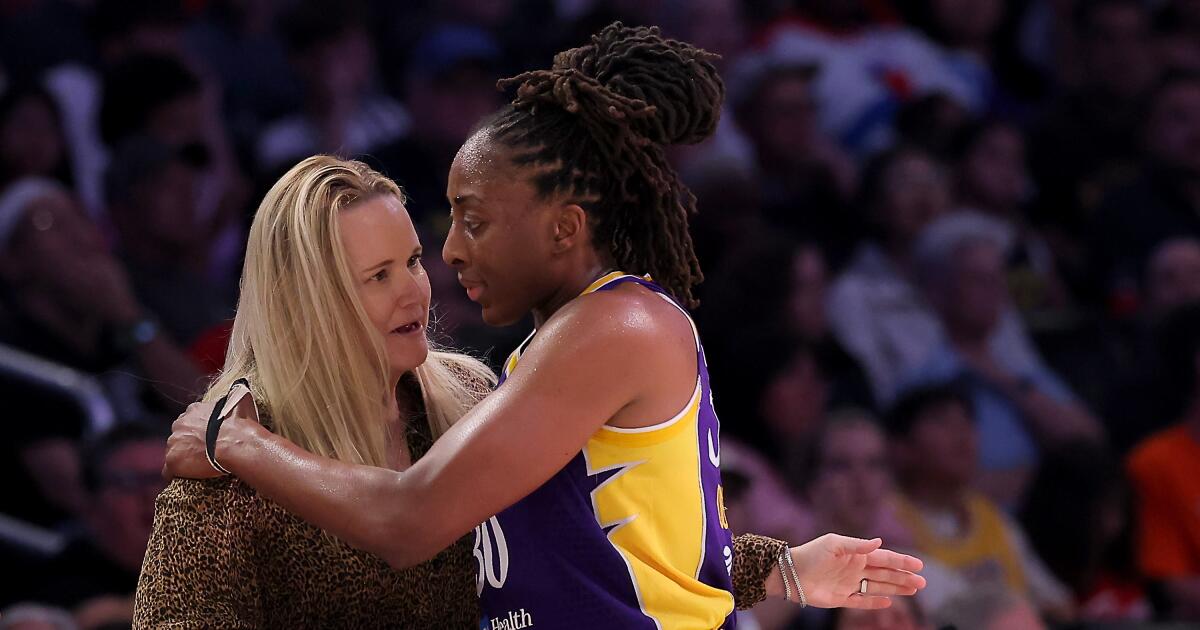
A day after general manager Raegan Pebley was fired, the Sparks were in Atlanta and seemingly still focused on trying to reach the playoffs this year.
The suggestion that Pebley’s removal was a sign that the team is performing poorly didn’t sit well with coach Lynne Roberts.
“I don’t think we underachieved last year and this year is still going,” Roberts said in Atlanta on Monday before the team’s loss to the Dream. “For where we want to get, that’s not where we want to be, but we tripled our win total in my first year — that’s not underachieving. We haven’t hit our stride, we’ve been injured all year. Hopefully we get [Kelsey Plum] and Cam [Brink] back. Our system is designed around KP. I’m not close to thinking we are underachieving.”
Pebley and the rest of the Sparks’ organization signaled a clear intention to compete this season, signing veterans Nneka Ogwumike and Erica Wheeler in the offseason, signing Dearica Hamby to a three-year deal and trading for Ariel Atkins.
The Sparks’ Rae Burrell protects the ball under pressure the Chicago Sky’s Natasha Cloud at Crypto.com Arena on July 10.
(Luiza Moraes / Getty Images)
They are still in the playoff race midway through the season, but have the second-worst defensive rating in the WNBA and sit a game below the postseason cutoff line.
They have competed without Plum, their top scorer, for 12 games and former No. 2 overall pick Brink during the past nine contests.
But even with their struggles, culminating in an 82-64 loss to Seattle on July 6, the Sparks responded well with consecutive home wins against Indiana and Chicago. After those games, Roberts seemed to think the team was moving in the right direction, but team owners made a major change.
The Sparks have a decision to make about how hard they want to push the rest of this season as the team flirts with missing the playoffs for a sixth consecutive season. With the trade deadline on Aug. 2, they could make some moves to improve this season or sell off their veteran assets and attempt to rebuild again.
The Sparks haven’t made the playoffs since 2020 and have made some controversial moves while trying to snap out of the slump.
In addition to the questionable trade of 2024 fourth overall pick Rickea Jackson to Chicago for veteran Atkins this offseason, Pebley traded the picks that would become Storm post duo Awa Fam and Dominique Malonga for Plum and Kia Nurse. In her sole season with the Sparks, Nurse averaged 7.6 points per game.
Pebley also traded the No. 8 pick in 2024 (that later was used to draft Alissa Pili) to Chicago for Julie Allemand and Li Yueru, then lost Allemand in the expansion draft. Yueru was sent to Seattle in the Plum trade and is now playing with Dallas. The Sparks’ 2025 first-round draft pick Sarah Ashlee Barker was left unprotected and went to Portland in the expansion draft.
The Sparks waived their top pick in this year’s draft, Ta’Niya Latson, after barely playing, and she has gone on to join Las Vegas. Sania Feagin, a 2025 first-round draft pick, was waived and signed with Portland.
Most of those moves, though, came after the Sparks lost the top spot in the 2025 draft lottery to Dallas, which selected Paige Bueckers with the No. 1 pick. Before the lottery result, it seemed like the Sparks — who went 8-32 in 2024 before that draft — were lining up for a youth movement led by Brink and Bueckers. A lineup of those three, a healthy Feagin, Barker and Allemand would be an entirely different kind of team.
Once that failed, they focused on adding veterans who could win now and have only managed modest improvement.
The Sparks have their next two first-round draft picks and four players still on rookie contracts after this season (Brink, Chance Gray, Kate Martin and Pili). Brink is their lone lottery pick left from their disappointing past six seasons. (Pili was a top-10 pick, but she has struggled to stay on a WNBA roster and just signed a player developmental contract with the Sparks this month.)
Pebley told The Times in an interview on Friday that she was open to making moves to compete at the deadline this year.

Players on the Sparks’ bench celebrate during a win over the Chicago Sky at Crypto.com Arena on July 10.
(Luiza Moraes / Getty Images)
“We are in a space where we are here to win,” she said. “This is a city that wants to win. We have an ownership that wants to win. You see what they’re doing with the Lakers. You see what they’ve done already with the Dodgers. … We have to always continue to invest in the roster. We have a responsibility to always listen and be aware of what’s out there.”
A league source not authorized to discuss trade conversations publicly told The Times that Pebley had been aggressive ahead of the deadline, and now teams are unsure what approach the Sparks will take moving forward.
“I found out when everybody else did,” Roberts said of Pebley’s firing. “It was a surprise. She’s a good friend of mine. I think the tone is set that we need to keep building and get the Sparks back to where they have been. That’s been the tone. Raegan did some great things for our org in that regard and improved a lot of things. That work can’t go undenied. It’s full-steam ahead and I’m focused on what I can do.”
It would be difficult to move some of their heftier contracts, especially since WNBA teams cannot take on more salary than their remaining cap space allows in a trade. Hamby, 32, is signed for two more years for more than $1 million per season. Atkins is also signed for two years at $1 million-plus and is having a career-worst offensive season, shooting 36.4% with 8.7 points per game.
Wheeler, 35, has another year left on her deal, but a $625,000 cap hit for a player who would be a backup point guard on most teams is a tough sell.
Plum and Ogwumike are on expiring deals, and the Sparks’ most valuable roster asset, Rae Burrell, is a restricted free agent, but one of the few young players left on the Sparks’ roster.
The Sparks have a limited $86,000 in cap space, too, so if they decide they want to buy at the deadline, they have to find a way to clear space.
They enter the trade deadline period in a difficult spot as a team in purgatory that just fired its general manager.
Yet what they decide to do in the next month might be the most clearest sign of their ambition and hope for the future.

NEWYou can now listen to Fox News articles!
ATLANTA — The FBI and Atlanta Police Department are getting ready for a massive security operation ahead of the World Cup semifinals between England and Argentina at Atlanta Stadium.
Both agencies have used drones to search for potential threats on the ground and in the sky. The FBI is enforcing the Federal Aviation Administration’s Temporary Flight Restrictions around the venue.
The FBI has confiscated more than 600 drones nationwide since the World Cup began. Special Agent in Charge of the FBI Atlanta Field Office Marlo Graham said 86 of those drones were seized in Atlanta.
Graham said the FBI uses a “mechanism” that allows agents to see unauthorized drones in restricted airspace. Agents then work to mitigate the threat posed by unknown drones.
“We’ve been able to safely land drones that have been unauthorized in the flight restricted area,” Graham said.
The FBI has confiscated more than 600 drones at World Cup events since the tournament started. (FBI Atlanta)
While the FBI treats every drone as a potential threat, Graham said the threat level can increase depending on the size of the drone and how close it gets to the stadium.
“Obviously, the closer to the venue, the larger the crowd. We are fortunate here in Atlanta that we have a closed dome stadium,” Graham said. “We don’t want the game to be impacted because a hobbyist couldn’t control their drone, and it lands right when one of our star players was getting ready to score a goal.”
EXCLUSIVE: FBI ADDS ALLEGED COVID FRAUDSTER TO MOST WANTED LIST
The Atlanta Police Department’s Drone Unit has helped the FBI track down people suspected of flying in restricted zones.
Sgt. Kindu Franklin said most of the people caught flying drones around World Cup venues are hobbyists with no intent to harm the crowd of soccer fans below.
“In some cases, they just recently bought a drone just for FIFA to get some of the cool footage that they want to put up on their social media,” Franklin said. “There are different ways that you can weaponize these drones. So, we’re operating in a proactive manner.”
The Atlanta Police Department’s drone mission at the World Cup focuses on surveillance. (FOX)
The Atlanta Police Department’s drone mission is focused on surveillance. Officers are looking for potential threats, traffic issues and people the FBI suspects are flying drones illegally.
“So, what we want to do is give our command staff a view that they can’t get from the ground,” Sgt. James Cunningham with APD’s Drone Unit said.
ARMED MAN ARRESTED AT US CAPITOL BARRICADE AS POLICE PROBE WHY HE DROVE ONTO RESTRICTED GROUNDS
Cunningham’s unit can launch drones remotely from handheld controllers. Other drones are launched from docking stations strategically placed across the city, and officers control them from the back of an SUV using a computer and a PlayStation controller.
The Atlanta Police Department launches some drones from docks strategically placed across the city. They are controlled by a computer and a PlayStation controller. (Fox News)
The drone docks are used year-round to help the police get an aerial view of emergency situations before officers arrive. The computer shows the drone pilot where all the police body cameras and vehicles are in the area, allowing them to communicate better with officers on the ground.
For the World Cup, the drone docks let the department have more eyes in the sky and respond to emergencies faster.
“It’s going to cut down time. We’re going to get there quick. And then you’re going to get an aerial perspective of what you can’t see on the ground,” Cunningham said.
The Atlanta Police Department launches some drones from docks to get more eyes in the sky and respond to emergencies faster. (Fox News)
Cunningham said the drone unit has completed more than 1,400 flights and logged more than 550 flight hours since the beginning of June.
“Some people haven’t even done that in years or haven’t even reached those numbers in the life of their drone unit,” Cunningham said.
“We train for the environment. We live here, so we know what to expect,” Anais Paredes, an APD drone pilot, said.
CLICK HERE TO DOWNLOAD THE FOX NEWS APP
The FBI is asking that hobbyist drone pilots know the Temporary Flight Restrictions in their area before taking off.
There is a one-mile restriction around World Cup stadiums on non-match days, and a three-mile restriction on game day.
-

 Health6 minutes ago
Notable figures who died from the same heart condition linked to Lindsey Graham’s death
-

 Sports12 minutes ago
Folarin Balogun admits that red-card reversal affected USA World Cup teammates: ‘A lot of outside noise’
-

 Technology18 minutes ago
Humanoid robots perform live surgery in world first
-
 Business24 minutes ago
A ‘next generation studio’ for YouTube creators
-
 Entertainment30 minutes ago
Finn Wolfhard is taking ‘control of the narrative’
-
 Lifestyle35 minutes ago
What are your most cherished memories of the 2026 World Cup in L.A.?
-
 Politics41 minutes ago
Commentary: Two Lorenzos from Mexico. One fulfilled his American dream. ICE killed the other
-
Sports53 minutes ago
What will the Sparks do next? The franchise is at a crossroads after firing its GM

