Lifestyle
These dictators are different. 'Autocracy, Inc.' explains how


Naval vessels participate in a Taiwanese military drill near the naval port in Kaohsiung in southern Taiwan on Jan. 27, 2016.
Sam Yeh/AFP via Getty Images
hide caption
toggle caption
Sam Yeh/AFP via Getty Images
The United States and other major democracies face the most challenging geopolitical landscape in decades. The crises include a bloody battle for land in Eastern Europe that challenges the principle of territorial sovereignty, the risk of a Chinese invasion of Taiwan in the coming years and a brutal war in Gaza that could still spread.
We are in a new era, but how do we define it, and what is the fundamental threat?
Several recent books tackle this crucial question. New York Times White House and National Security correspondent David Sanger calls this historical moment “New Cold Wars.” He sees the U.S. defending the West against a rising China and resurgent Russia. CNN anchor and Chief National Security analyst Jim Sciutto calls it “The Return of Great Powers.”
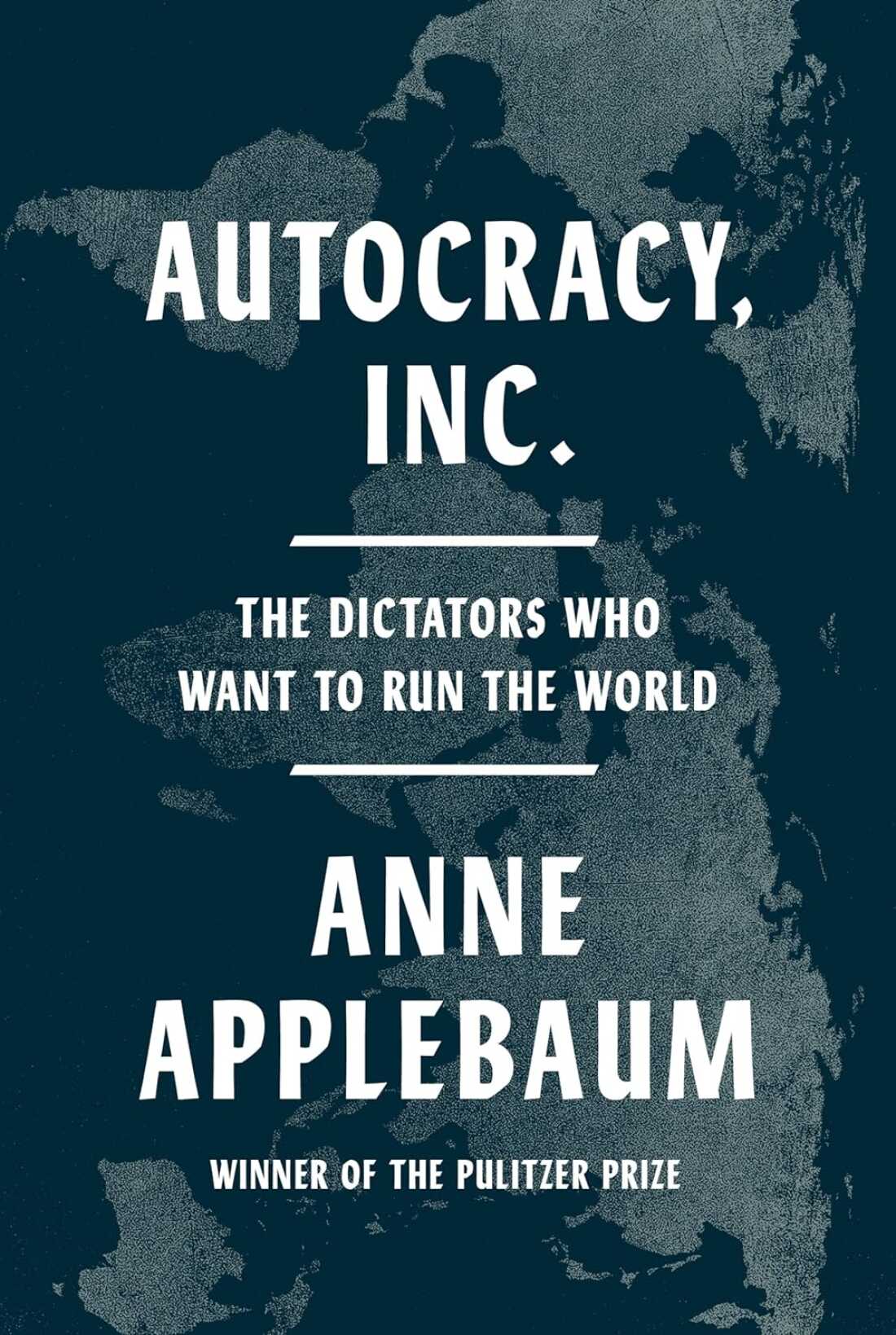
In her new book, the Atlantic’s Anne Applebaum takes a different, more sweeping view. We are not in Cold War 2.0, she argues, but a battle for the future world order against what she calls “Autocracy, Inc., The Dictators Who Want to Rule the World.”

Autocracy, Inc., is not a club. There are no meetings like SPECTRE in a James Bond movie, where villains give progress reports on their kleptocratic gains and attacks on democracy. Instead, Applebaum writes, it is a very loosely knit mix of regimes, ranging from theocracies to monarchies, that operate more like companies. What unites these dictators isn’t an ideology, but something simpler and more prosaic: a laser-focus on preserving their wealth, repressing their people and maintaining power at all costs.
These regimes can help each other in ways large and small, Applebaum writes.
Countries such as Zimbabwe, Belarus and Cuba voted in favor of Russia’s annexation of Crimea at the United Nations in 2014. Russia gave loans to Venezuela’s authoritarian President Nicolas Maduro, while Venezuelan police use Chinese-made water cannons, tear gas and surveillance equipment to attack and track street protesters.
Of course, U.S. companies have also supplied authoritarian regimes. When covering the crushing of the democracy movement in Bahrain during the Arab Spring, I rummaged through bins of empty rubber bullet canisters made by a company in Pennsylvania.
More recently and more alarming, though, have been China’s tacit support for Russia’s invasion of Ukraine and President Vladimir Putin’s June visit to North Korea, which the U.S. accuses of supplying weapons to Russia.
But Autocracy Inc., uses more than conventional arms to attack democracies. In order to retain power and build more wealth, autocrats also undermine the idea of democracy as a viable choice for their own people. Fearful of its former Soviet republics drifting further West – see Ukraine – Russia and its three main TV channels broadcast negative news about Europe an average of 18 times a day during one three-year stretch.
China extends its message through local media and helps other dictatorships. After satellite networks dropped Russia Today – RT – following the invasion of Ukraine, China’s StarTimes satellite picked up RT and put it back into African households, where it could spread Moscow’s anti-Western, anti-LGBTQ message, which resonates in many African nations.
The goal is not to persuade people that autocracy is the answer, but to encourage cynicism about the alternative. Applebaum says the message is this: You may not like our society, but at least we are strong and the democratic world is weak, degenerate, divided and dying.
How did the world end up here?
Applebaum is strong on how Western misjudgment and greed enabled and empowered autocrats over the decades. A working theory in Washington and Berlin was that greater economic integration and dependency between the West and China and Russia would serve as a glue and deterrent, making conflict too costly. But Europe’s dependence on Russian gas predictably backfired. Moscow used it as a source of blackmail following the invasion of Ukraine.
Meanwhile, corporate America’s heavy investment in China helped fuel the country’s extraordinary economic rise, but didn’t lead to the desired political results. Instead of becoming a more liberal, Western-friendly regime, the Communist Party became a more powerful rival. Among other things, Beijing used its new wealth to build islands in the South China Sea and a blue-water navy to challenge America’s.
At just over two hundred pages, Applebaum’s book is slender. She might have done more to detail the boomerang effect of globalization. When American companies exported jobs to China, they cut labor costs, boosted profits and lowered prices for consumers. Those business decisions devastated communities built on everything from auto plants to furniture factories.

That sowed the seeds for the populist backlash in 2016 that continues to roil the country to the benefit of America’s authoritarian opponents.
What is to be done? First, make life harder for dictators.
Applebaum says democratic nations have to make it more difficult for kleptocrats to stash their money overseas. She suggests an international coalition of treasury and finance ministry officials across Europe, Asia and North America work to strengthen transparency and tighten laws together.

This will be tough. Kleptocrats make lucrative clients for lawyers, financiers and real estate agents. One of London’s unofficial industries is money-laundering. And, in a complex political landscape, it can be useful for democracies to work with corrupt regimes to achieve bigger goals.
Another way to combat dictatorship is for democracies to deliver at home, as Charles Dunst argues in Defeating the Dictators: How Democracy Can Prevail in the Age of the Strongman. Political grid-lock, income inequality, stagnant wages and rising crime can provide fertile ground for populists.
Anti-incumbency and accountability have stood out as themes during this epic year of elections as voters punished long-serving parties, such as the Conservatives in the UK and the African National Congress in South Africa.
More broadly, Applebaum says, democratic countries need to reduce their economic dependence on authoritarian rivals. Europe’s reliance on Russian gas was an embarrassing and costly lesson. Minerals could prove another one for the United States.
Today, the U.S. only produces 4% of the world’s lithium and 13% of its cobalt, while China processes more than 80% of all critical minerals.
With the world’s next geopolitical fault-line perhaps lying in the waters around the Taiwan Strait or the South China Sea, this kind of math just doesn’t figure.
Frank Langfitt is NPR’s Global Democracy correspondent. Previously, he spent nearly two decades reporting overseas, based in Beijing, Nairobi, Shanghai and London. In February 2022, he covered Russia’s invasion of Ukraine.


Milly Alcock in Supergirl.
Warner Bros. Pictures
hide caption
toggle caption
Warner Bros. Pictures
Hollywood’s newest Supergirl is kind of a dirtbag — in the good way. Fearless and grumpy, Supergirl (Milly Alcock) sets out on a quest to support a new pal’s revenge journey and to make a point that should be clear by now: Never mess with a lady’s dog. Also featuring David Corenswet and Jason Momoa, is Supergirl a worthy follow up to Superman?
If you want more DC superhero action, check out these episodes:
‘Superman’ takes off and nails the landing
‘The Batman’ puts the emo in emote
Connect with Pop Culture Happy Hour:
Letterboxd / Facebook
Our weekly newsletter
Support Pop Culture Happy Hour+
Lifestyle
L.A. Affairs: After decades of near-misses, I finally told him: ‘I’m not leaving here without you’

It didn’t take endless quarantining with my spouse during the COVID-19 pandemic to end my marriage of over two decades. By the summer of 2019, menopause — and the extra-added “bonus” of frontal fibrosing alopecia that it awakened — was pummeling me physically and mentally to the extent that I no longer had the capacity to function inside the dysfunction of my life.
The relief that came with the decision to finally let go was completely dwarfed by the immense pain of severing a family in two. I cried as I packed. I cried as I unpacked. I was rolling endlessly in a dark wave that would not stop; my feet could not tell sand from sky. Once I managed to break the surface, I reached out.
I called Tish, Diane and Michelle, three smart, strong, nurturing women who’d been through and survived divorce. I also called my brother, Dan, and my friends Doug and Steve, three kind, creative, funny men who always “got” me.
As for Steve, we met in the spring of 1984 when he auditioned to be the drummer for the Secrets, the band Dan, Doug and I had started the year before. In our small-town high school of fewer than 400 students, he had flown completely under my radar, as he was two years younger, and he joined marching band the year after I’d ditched my baritone horn for a microphone and Pat Benatar tights. Steve aced the audition, and the four of us clicked immediately over our shared love of the Pretenders and all things Monty Python. By mid-June, the Secrets were playing local bars and biker parties in the middle of nowhere, and I was head over heels in love with the drummer.
It wasn’t supposed to happen like that. I wasn’t supposed to fall in love with a boy from my hometown.
I had spent my whole life dying to get out of Middlebourne, W.Va., and had been champing at the bit to leave for college, but by late August, that no longer meant freedom; it meant that I’d have to leave Steve behind. I told myself we’d defy the odds and make it work. He was my soul mate. But we were just kids, and there was no internet, no cellphones with unlimited text and calling. By February 1985, the divide was too great. In a moment of loneliness, I cheated on him. It was over, and I was firmly told to take my place in the friend zone.
I spent the following year flailing and failing in college before making the bold, half-baked decision to drop out of the West Virginia University theater program and move to Los Angeles, a place I’d never been, to pursue a singing career. When Steve found out that I was moving across the country, he softened his friend-zone stance and told me he loved me. On July 13, 1986, he went with my parents to Pittsburgh International Airport to see me off.
For the next 33 years, we would come together and drift apart — sometimes as lovers but mostly as friends. During a visit to my Hollywood apartment in 1988, when he was still in college and the timing was still wrong, I told him, “Who knows. Maybe in 30 years, I’ll come back and get you.”
In November 2019, Steve came to visit me for a long weekend.
I picked him up at Los Angeles International Airport and took him straight to Zuma Beach for a picnic, where we watched dolphins jumping in the waves while the seagulls stole our potato chips. The following day, we cozied up for an afternoon of wine and cheese at Cornell Wine Co. in Old Agoura, then made our way over Topanga Canyon for dinner at Canyon Bistro & Wine Bar.
The night before he flew home, we watched the sun set from our table by the lake at Zin Bistro Americana in Westlake Village. I felt giddy, excited, seen, understood and appreciated in a way I hadn’t felt in a very long time. While it was tempting to jump right in with both feet, we decided to date long distance and take things slowly.
On March 26, 2020, while Steve was still recovering from being profoundly ill with COVID, I arrived at his doorstep at 6 a.m. and proclaimed, “I’m not leaving here without you.”
Two weeks later, after packing most of his belongings into U-Haul shipping crates, we left Parkersburg, W.Va., in Steve’s red Volkswagen Golf with two suitcases, one Treeing Walker Coonhound and one Aussie/Chow mix. I-40 West was practically empty; just us and the occasional car or Amazon truck.
We arrived in California on Easter Sunday and joined the rest of the world in quarantine, not knowing how it would affect our work and financial future. We took a lot of long walks to help deal with the stress of the not knowing, but the magic panacea for me came the day Steve’s Harley-Davidson arrived in one of the crates.
We cruised up and down PCH, and roared our way up and over Mulholland Highway, Stunt Road, Malibu Canyon and Decker Canyon, stopping along the way to stretch our legs, feel the sea spray on our faces and take in views from the valleys to the coastline. We were surrounded by so much beauty; it was almost impossible to let trepidation win.
On one particularly memorable ride on Mulholland Highway between Kanan Road and SR 23 near Saddle Rock, we came around a bend and — bam! — right in front of me was the greenest mountain range I’d ever seen in California, gleaming spectacularly in the sunlight. As I inhaled its gorgeousness and exhaled my stress, I thought, “I can’t believe I get to see this. I can’t believe I get to do this. I can’t believe I get to be with Steve.”
In September 2024, I got to marry Steve.
As my brother, Dan, said at the reception, “What a long, strange trip it’s been.”
The author lives in the suburbs of Los Angeles with her husband, Steve, and their dogs, Coco Puff and Kira.
L.A. Affairs chronicles the search for romantic love in all its glorious expressions in the L.A. area, and we want to hear your true story. We pay $400 for a published essay. Email LAAffairs@latimes.com. You can find submission guidelines here. You can find past columns here.

Sydney (Ayo Edebiri) and Carmy (Jeremy Allen White).
FX
hide caption
toggle caption
FX
There has always been a metaphorical parallel between The Bear, the television show, and The Bear, the fictional restaurant on the television show. Even as Carmy (Jeremy Allen White) and Sydney (Ayo Edebiri) transformed the Italian beef joint into the fancy restaurant of their dreams and wished for a Michelin star, there were undoubtedly locals who thought, “This is great and all, and I’m sure the food is good, but … I liked the beef sandwiches.” There’s still a window at The Bear to get them, but the focus is certainly elsewhere.
When it started, The Bear was mostly about the work that took place in the kitchen. The stresses of too many orders, territoriality from Richie (Ebon Moss-Bachrach), the arrival of Sydney, and the tightly wound but undeniably talented Carmy, making everybody both extremely stressed and significantly better. Over time, it shifted and grew, putting together beloved departure episodes like “Fishes” in Season 2, which introduced a boatload of guest stars for a flashback story of a disastrous family dinner before Mikey (Jon Bernthal) died. It spent time with Sydney’s family, it explored the way Tina (Liza Colón-Zayas) and Mikey originally met, it followed Marcus (Lionel Boyce) to Copenhagen, and it went with Richie to work for Andrea (Olivia Colman). All these episodes were excellent. And there was still a kitchen. But the focus seemed to be elsewhere.

At times, the show seemed to have disappeared up its own nose, to the point where you weren’t watching the show The Bear as much as you were watching the phenomenon The Bear. There were too many real-life chef cameos, until it seemed like those chefs were checking a box on a list of “things all the cool kids do.” There were too many other cameos, culminating in a rare miss from the reliably charismatic John Cena. The show placed a lot of narrative weight on Carmy’s love interest, Claire (Molly Gordon) — weight that the underwritten character couldn’t support. But even if every experiment and every diversion had worked, viewers couldn’t be blamed for missing the close focus on the kitchen and the camaraderie — for thinking, “This is all really special, but I do miss the beef sandwiches.”
The fifth and final season dispenses with the departure episodes, and it mostly dispenses with cameos. It all takes place on one day, just after Carmy tells Richie and Sydney that he wants to step back from the restaurant and give it to them and Sugar (Abby Elliott) to run, and it mostly takes place right there at The Bear. Now that the clock set by Jimmy (Oliver Platt) has run out, his money has run out as well, and a series of cascading disasters puts Sydney, Carmy and Richie behind the 8-ball from very early in the day, not least because of the tension hanging over all three of them as they prepare to tell the staff about Carmy’s decision to leave.

Tina (Liza Colón-Zayas).
FX
hide caption
toggle caption
FX
We spend this day mostly with the people we know best: our three leads, along with Sugar, Tina, Marcus, and the rest of the staff — including Luca (Will Poulter), who has stayed around to keep working with Marcus. Jimmy is running around with Computer (Brian Koppelman) and a young apprentice of his named Cheese (Elsie Fisher of Eighth Grade), trying to figure out what to do about his finances since it is Jimmy, and not just the restaurant, who’s out of money.
This day takes a while to get cooking, so to speak. The first three episodes of the season are slow, the first two in particular. It’s pouring rain outside, the lighting is dim, and the score maintains the same contemplative melancholy for a long, long time. For about two and a half episodes, it feels like one extended, low-energy scene.
But after that, there’s a shift in tone as the staff looks to get through service, and through seven episodes (FX did not make the finale available in advance for critics), the rest of the season is terrific. What you see is the core story of The Bear, which is people trying to serve food and overcome problems, but through the lens of everything that has happened over the show’s run: Carmy’s retreat from his obsessiveness, Richie’s expansive (and inspiring) discovery of his gift for hospitality; Sydney’s stepping forward from second-in-command to leader; Tina’s complex relationship with the restaurant and her grief over Mikey; Sugar and Carmy’s relationship with Donna (Jamie Lee Curtis); the arrival of Marcus as a high-end pastry chef.
The question the show asks over the last four episodes is: Given all those digressions and flashbacks, given all those visits with families and others, given everything we know about where all these people have been and what they’ve experienced, how does a high-pressure service — of the same kind we used to see in that first season — look now? How do they behave differently, and how does their behavior read differently? How are they the same people we have always known, but at a different juncture, in a different context? How do their wins mean more to them, and to the audience?
On the one hand, making a season this way, there are fewer surprising grace notes, like “Napkins,” the Tina/Mikey flashback episode in Season 3, or “Worms,” the episode in Season 4 where Sydney hung out with her cousin (Danielle Deadwyler) and her cousin’s kid. The Bear feels less daring and more conventional.
But oh, when they have victories under pressure? Victories, large or small? It is immensely, richly satisfying. There’s also more comedy other than just the goofy Faks family than we’ve had in a few seasons; Richie is perhaps the MVP of the season, and that’s partly because of how often he gets to be really funny. Ayo Edebiri continues to be the show’s best reactor, showing Syd eternally a little bit surprised (dismayed?) that she’s chosen to throw in her lot with these people.
There are a couple of questions yet to answer in the finale, both little plot items and broader character resolutions. Over these seven episodes, though, there is much to cheer.


-

 World5 minutes ago
Burkina Faso cuts diplomatic ties with former colonial ruler France
-
 News32 minutes ago
A day after Alito’s testy response to Sotomayor’s dissent, court says it was a ‘misunderstanding’
-

 Los Angeles, Ca2 hours ago
Watch Project Angel Food's 'Lead with Love' telethon on KTLA
-

 Detroit, MI2 hours ago
Metro Detroit weather forecast, June 26, 2026 — 4 p.m. Update
-

 San Francisco, CA2 hours ago
Newlyweds celebrate Pride-themed weddings inside SF City Hall as parade preparations underway
-

 Dallas, TX2 hours ago
All Dallas restaurants firing up specials for July 4th and America’s 250th
-

 Miami, FL3 hours ago
Helping Venezuela: State Department deploys Miami-Dade search-and-rescue team
-

 Boston, MA3 hours ago
Photos: Norway takes on France in high-powered World Cup matchup in Foxborough – The Boston Globe

