Connect with us

Lifestyle

No holiday plans? This social app will match you with a group of strangers for dinner

Published

on

No holiday plans? This social app will match you with a group of strangers for dinner
When David Brown moved from Chicago to Los Angeles this summer, one of the first things he did was download an app that aims to “fight big-city loneliness.”

The 35-year-old sales director had seen an Instagram ad for Timeleft, which matches users with strangers for dinner via a personality algorithm. Since he only knew a handful of people in his new city, he decided to give it a shot.

On the night of his first dinner, Brown, a self-described introvert, was “super nervous” as Timeleft provides participants with limited details about who they will be dining with, including their job industry and zodiac sign. No names or photos are disclosed. But Brown’s fears were quickly dispelled once the host led him to his assigned table and he met the other diners, who were just as anxious as he was.

“It’s difficult to meet people in L.A. and I know it’s not just me because a lot of the people who’ve come to these dinners have been living in L.A. for 20 years,” says Cristina Haraba.

(Etienne Laurent / For The Times)

Advertisement

“Everybody kind of committed to the experience and was just open minded,” says Brown, who lives in West Hollywood. Afterward, the group went to a bar hangout, also facilitated by Timeleft, for drinks and to meet other app users who also went to a dinner that night.

“I made at least two best friends at that first dinner,” says Brown, adding that one of them is now his roommate. Since then, he’s been going to Timeleft dinners almost every week and has started an Instagram group for users to stay in touch.

Brown is one of nearly 10,000 Angelenos who have attended a Timeleft dinner since the platform — which started in Lisbon last year and is now in more than 300 cities in 65 countries — expanded to L.A. in May. Los Angeles is the app’s second- largest market in the United States, behind New York City.

Every Wednesday (excluding some holidays), Timeleft hosts more than 400 dinners in L.A. neighborhoods — stretching from Santa Monica to North Hollywood — with the purpose of helping attendees meet new people and hopefully make a friend. In an effort to combat loneliness, particularly during the holiday season — a 2023 survey by ValuePenguin found that 61% of Americans expected to feel lonely or sad during the season — Timeleft is hosting dinners on Dec. 25 and Jan. 1, both of which fall on a Wednesday. Among the participating restaurants, which are open to the public on the holidays, are Butcher’s Daughter, Zinque and Formosa Cafe.

Advertisement

Carlie Armstrong, who leads Timeleft’s West Coast region, says the company wanted to offer an alternative option during the holidays for people who may have lost loved ones, who live far from their families or those who may not have a good relationship with them.

“This is also a particularly polarizing year so there are a lot of people who maybe are shying away from those interactions and maybe want to try something new during this time, but still be with other people,” she says. A recent American Psychological Association survey of more than 2,000 U.S. adults found that nearly 40% participants said they are avoiding relatives they disagree with politically during the holiday season.

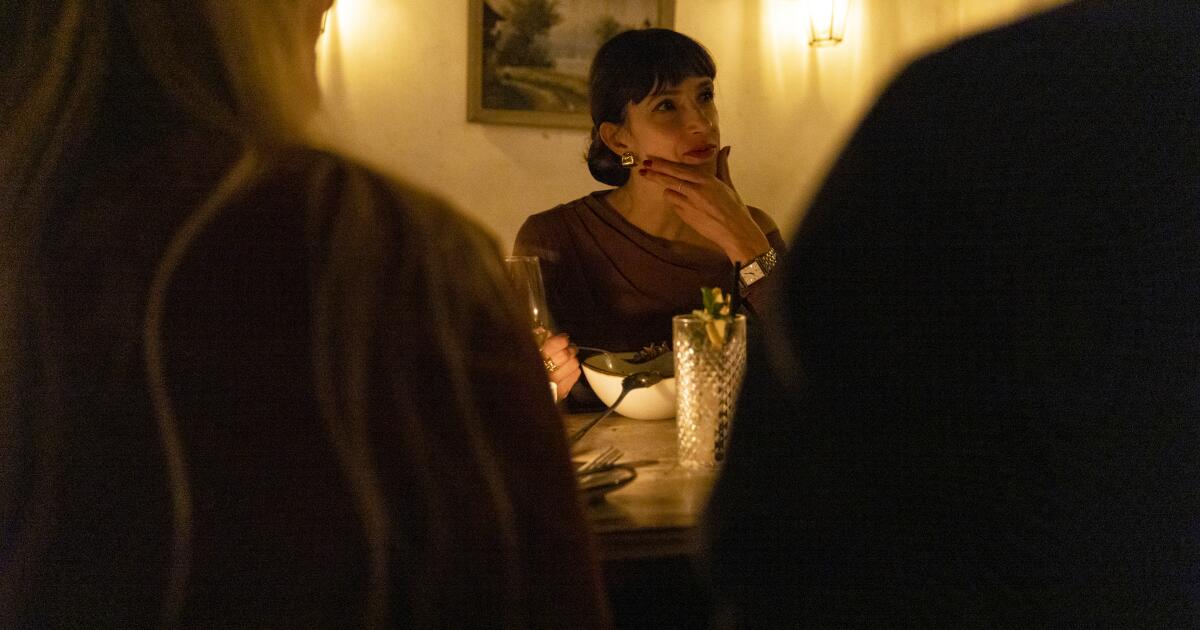
Jonathan Alexander listens to Cristina Haraba as they dine together with strangers at Bacari in Los Angeles

Jonathan Alexander listens to Cristina Haraba talk during a recent Timeleft dinner with strangers at Bacari in West Hollywood.

(Etienne Laurent / For The Times)

Each of the holiday dinners will follow the format a typical Timeleft gathering. To join, you can purchase a ticket for $16 or sign up for a membership starting at $26 per month, then you will be prompted to select your preferred dinner date. Users can also indicate their budget for dinner as the app works with various types of restaurants (casual, fine dining, etc.). On the Tuesday before the event, you’ll receive a brief introduction about your fellow diners. Guests are responsible for paying for their own meals.

Advertisement
Before your Timeleft dinner, you'll learn a few details about your fellow diners in the app.

Before your Timeleft dinner, you’ll learn a few details about your fellow diners in the app.

I attended my first Timeleft dinner last month at Bacari in West Hollywood. Upon arrival, I showed the hostess my table number, which was provided by the app, and two other folks who were there for the dinner introduced themselves to me. A staffer then guided us to our table and eventually four other diners — one of whom was celebrating his birthday — trickled in to join us. Everyone in my group had attended at least five dinners with the platform, so they were past the awkwardness that you’d think would come from meeting with a group of strangers for the first time.

Conversation flowed effortlessly at our table, so much so that we didn’t even pull out the question game that Timeleft provides to help break the ice. As we threw back strong cocktails and nibbled on delicious shareable plates, we talked about our jobs, hobbies, hometowns and upbringings (one woman had moved to L.A. from Romania). At one point, I told the group that someone I used to date, but hadn’t seen in a year, had walked into the room, which launched a venting session about dating woes in L.A. We were comfortable, to say the least, and anyone walking by would’ve thought we’d known each other much longer than two hours.

The restaurant would only take a limited number of credit cards although staff encouraged us to share plates, so we had a minor headache trying to figure out how to split the bill. Ultimately, one person put their card down and we sent them money.

Strangers interact as they dine together at Bacari in Los Angeles

Maxime Barbier, who lives in Paris, founded Timeleft in 2023 because he wanted to help people combat loneliness in big cities.

(Etienne Laurent / For The Times)

Advertisement

Cristina Haraba, 42, who moved to L.A. from London three years ago, is considering attending one of the app’s holiday dinners because she doesn’t have any family in town. Like Brown, she came across an ad for Timeleft on Instagram and decided to go because she was struggling to make friends.

“It’s difficult to meet people in L.A. and I know it’s not just me because a lot of the people who’ve come to these dinners have been living in L.A. for 20 years. Some of them were born here,” says Haraba, who said she is used to having a “very rich social life.”

Haraba, who’s originally from Romania, has been to about six Timeleft dinners so far and has made a few friends she still keeps in touch with. What keeps her coming back is the opportunity to try new restaurants in her area and meet interesting people who she can explore the city with, she says.

Timeleft founder Maxime Barbier, who lives in Paris, says it was important for him to target the app to folks of various ages, including people like his 71-year-old dad. Barbier encouraged his dad to attend a dinner after he suffered a serious brain accident that caused him to be less social. He now goes at least once a month, Barber says.

Advertisement

“Something I find sad is that all the new concepts are really focused on the new generation like ‘This is only for Gen Z,’” Barbier says. “But people who are the same age as my parents know how to use a computer or an iPhone and I think they need help because they [can get] lonely.” At most Timeleft dinners, people are paired with people who are within 10 years of their age, but some folks have been matched with folks of other generations as well.

Myra Hermosa, 37, grew up in the San Fernando Valley, but recently moved back to the area after living in San Diego and North Carolina for a few years.

Strangers interact as they dine together at Bacari in Los Angeles on Wednesday, November 20, 2024.

“What sold it for me was that you have five people at that dinner table who you never would’ve met had you just gone through your day to day life,” says Myra Hermosa, 37.

(Etienne Laurent / For The Times)

“When I got back here, I was like “Welp, most of my friends are gone, or at least not in the area,” says Hermosa, who works from home. She decided to attend her first Timeleft dinner this summer because she was “itching to get out, make friends and be social again,” she says.

Advertisement

“What sold it for me was that you have five people at that dinner table who you never would’ve met had you just gone through your day to day life. And they were just sharing their stories, their background, where they come from and what they do for a living,” Hermosa says, adding that she met an actress and an army veteran. They played Timeleft’s game in the app, which included reflective questions like “Why did you move to L.A.?” and “What is an event that had a significant impact on your life?” “I figured how crazy is it that these five people are sitting at a table and actually talking and interacting? This is kind of cool.”

For those who are thinking about attending one of Timeleft’s holiday dinners or on another Wednesday night, former attendees say it’s essential to remain open, be yourself and to follow up if you vibe with someone.

“Don’t be afraid to be honest,” says Brown, adding that the dinners have helped him gain confidence. “If you can’t be vulnerable, it’s going to be really hard for people to relate to you in your experience. We’re all at this dinner table for a reason. Most of us are here to make more friends, not just to sit at dinner with a stranger for two and a half hours.”

Advertisement

Lifestyle

Worldwide Pinhole Photography Day

Published

on

Worldwide Pinhole Photography Day

Nancy Breslin’s double self-portrait taken on Worldwide Pinhole Photo Day 2019. 4 minute pinhole exposure.

Nancy Breslin


hide caption

toggle caption

Advertisement

Nancy Breslin

Pinhole photography is an analog technique that uses a small aperture — a “pinhole” — and a light proof container to capture wonderfully dreamy-looking images.

April 26 is Worldwide Pinhole Photography Day. To celebrate, NPR’s Scott Simon spoke to Nancy Breslin, a fine art photographer specializing in pinhole photography.

Breslin brought a few pinhole cameras into the studio — one made of teak and brass, and one made of an old cookie tin. Breslin explained how the cookie tin camera works. First, you need a light tight container. Then you put a hole in it.

Advertisement

“Ideally you want it to be pinhole sized, like putting in a sewing needle, maybe half a millimeter or so.” Then, put in a piece of photographic paper. “When enough light hits, you have an image,” Breslin explained.

Capturing an image can take anywhere from a few minutes to a few hours, depending on how much light is being let in through the camera’s pinhole. The resulting images are surreal and a little spooky.

Breslin’s main series is called “Squaremeals: A Pinhole Diary of Eating Out.” She takes her pinhole camera out to lunch with friends. Then she takes one image during the meal.

A photo from Nancy Breslin's "Squaremeals: A Pinhole Diary of Eating Out" series.

A photo from Nancy Breslin’s “Squaremeals: A Pinhole Diary of Eating Out” series.

Nancy Breslin


hide caption

Advertisement

toggle caption

Nancy Breslin

Breslin describes an image from this series. Because the exposure was long, the still objects, like a waterglass, are sharp and in focus. But the moving objects, like Breslin and her dining companion, are blurry. “It becomes very ghostlike. Is that not the way our memories work? You know, our memories aren’t tight. It’s more like the impression,” Breslin said.

Advertisement

If you want to participate in this year’s Worldwide Pinhole Photography Day, you can make your own pinhole camera using household objects.

Make your own pinhole camera:

  1. Find a light proof container. A cylindrical oatmeal container works well. 
  2. Line the inside black, either with black paper or black matte paint. This prevents light from bouncing around the container. 
  3. Poke a small hole directly into your container.
  4. Attach a “shutter” that covers the hole, but can be easily removed and replaced to take your picture. 
  5. Load photo sensitive material, like photopaper, inside of the container on the opposite side of your lens. 
  6. Take your photo! Point the hole toward the scene you want to capture and open your “shutter” to allow the light to enter the hole and deposit the image onto your photosensitive material. Remember that darker areas will require the shutter to be open longer, and brighter areas can have a lower exposure time.
  7. Develop your images. You can send your film to a photography lab, or, take to a local darkroom. Enjoy your pinhole masterpiece!

Ariel Plotnick edited this story.

Continue Reading

Lifestyle

Tell us: How much did you spend on Olympics tickets?

Published

on

Tell us: How much did you spend on Olympics tickets?

When tickets for the 2028 L.A. Olympics dropped earlier this month for locals, emotions around town quickly moved from pure excitement to shock and confusion.

Prices have been all over the place. A seat at the opening ceremony ranges from $329 to $5,519, The Times reported. Tickets for sessions similarly run the gamut. Some prices we’ve seen and heard: $2,460 for the women’s gymnastics team final. $498 for the men’s volleyball preliminary. $1,141 for the mixed track and field final. Women’s handball for $241. And yes, some lucky fans were able to grab $28 tickets for some events, but those opportunities have seemed slim.

We’re asking readers: If you have been lucky enough to snag tickets, how much did you spend and what event(s) will you be attending? Also, what does being at the first Los Angeles Olympics in 44 years mean to you? Share your experience using the form below and we may feature you in an upcoming story.

Advertisement
Continue Reading

Lifestyle

Make Way for the Investment Bank Influencers

Published

on

Make Way for the Investment Bank Influencers

It’s 5:30 a.m. Allison Sheehan switches on the light in the bathroom of her New York City apartment and stretches in front of the mirror. “Welcome back to another morning in the life of an ‘investment baker,’ which means someone who works at an investment bank but also makes cakes,” she says at the beginning of the video, which she uploaded to TikTok in early 2025.

Tying an apron over her pajamas, Ms. Sheehan, now 26, proceeds to pipe lilac buttercream ruffles on a heart-shaped funfetti cake she had baked the night before.

At 6:50, she heads to the gym, filming herself doing crunches before heading home to shower, put on makeup and pick out an outfit. By 8:20, Ms. Sheehan heads to her wealth management job, at Goldman Sachs (she didn’t reveal the name of the bank in her videos while employed there).

In 2023, Ms. Sheehan, who has since made cakes for brands including Goop and LoveShackFancy as well as the model Gigi Hadid, was posting on social media as “The Investment Baker,” a persona she created for her custom-cake business, Alleycat.

On her Investment Baker Instagram and TikTok pages, Ms. Sheehan posted familiar influencer content like “What I eat in a week” and day-in-the-life videos, along with breakdowns of her corporate wardrobe. At the time, her DMs were inundated both with cake orders and with young women seeking advice on how to break into finance.

Advertisement

The finance industry remains one of the most sought-after sectors for college graduates. In 2025, Goldman Sachs saw 360,000 students competing for just 2,600 internships — up 15 percent from the previous year. It has also historically insisted that employees maintain a low profile on the internet. Ms. Sheehan was careful never to disclose the bank at which she worked in her videos, and she never filmed herself in the office, per her employer’s rules. In fact, she never discussed finance much at all. Still, the tension between the “two worlds of baking and being a financier was the whole allure,” Ms. Sheehan said.

Yet Ms. Sheehan was informed that her baking content was seen as a “reputational risk” for the firm. She was instructed to delete every post on her TikTok and Instagram and to change her handle so that it made no reference to the word “investment.” When Ms. Sheehan drew comparisons to the firm’s chief executive, David Solomon, who moonlights as a D.J., she was told she could not compare herself to him. She pushed back, saying that the firm’s policy should apply to everyone. “It doesn’t work like that,” she said she was told.

Like Ms. Sheehan, Sahilee Waitman, 28, used the fact of her employment at an investment bank as a hook for her TikTok videos. Ms. Waitman moved to New York City from Amsterdam to work in compliance at an investment bank in 2023. She soon started posting day-in-the-life content, detailing everything from her workouts to what she ate for lunch, with the goal of building financial autonomy outside her corporate role. Both women were clear that while they worked at investment banks, they were not investment bankers, often a point of contention or confusion in the comments section.

The New York Times reached out to many of the investment bank employees on TikTok, but they declined to comment for this article, fearing the risk to their reputation. The New York Times also reached out to 14 different banks, among them Goldman Sachs, but none responded to requests for comment regarding the matter of social media use among employees.

Despite these fears, investment banking content is going viral across social media. Nearly 60,400 videos tagged #investmentbanking have appeared on TikTok in recent years. Time-stamped 100-hour work weeks and late-night keyboard A.S.M.R. regularly draw hundreds of thousands of views on TikTok. Part of the appeal is that influencers offer a more realistic depiction of the world of work than can be gleaned from shows like “Industry” on HBO or from actual recruitment events.

Advertisement

Ms. Sheehan was determined to show that even bankers could have a life outside work. In October 2024, a year after posting her first video, a meeting with her manager appeared unexpectedly on Ms. Sheehan’s calendar. At first, she thought it might be good news. But the excitement was short-lived when she was greeted by three compliance officers. “We see you have an online persona called ‘The Investment Baker,’” she recalled them saying.

At present, there is no widely agreed-upon policy regarding employees’ personal social media use. The Financial Industry Regulatory Authority, the largest independent regulator for brokerage firms in the United States, and the Securities and Exchange Commission, a government agency that regulates the entire U.S. securities industry, have rules and guidance dictating that employees cannot share any information that is deemed confidential or in any way sensitive. But how firms apply their own internal policy is at their discretion.

Hannah Awonuga, the former head of colleague engagement at Barclays U.K. and a cultural transformation and inclusion consultant, sees both parties as at risk. Employees might find themselves on the wrong side of human resources. For employers, “once you allow staff to post freely,” she said, “you run the risk that they might express an opinion on a Saturday that goes against your values.”

For decades, “workism” — the belief that work is central to one’s identity — has infiltrated the American ethos, particularly for many city dwellers, whose hobbies and leisure activities can fall by the wayside. Increasingly, younger workers are pushing back, demanding a healthier work-life balance and actively working to decouple their identity from their careers.

The world of high finance is one of the last sectors to catch up. “Once you work in these industries,” Ms. Waitman said, “you’re essentially taught to choose one lane.” You are either a “serious professional,” she said, or a “creative.” “I just don’t believe those things are mutually exclusive,” she added.

Advertisement

Ms. Waitman, who is Black, hoped that by posting on TikTok, she would be promoting diversity in the industry. She received the occasional negative comment, insisting she must be a “secretary,” but a majority of her messages were positive, she said, and came from other women seeking her advice about pursuing careers in finance.

At the time, Ms. Waitman did not receive pushback from her employer on her videos, though she made sure to declare any outside business activity to compliance and her director. “I think firms are just now catching on to this,” Ms. Waitman said. “Once they find out, you have compliance on your neck.”

A recent glossy fashion spread in Interview Magazine entitled “Meet the Finest Boys in Finance” highlighted what can happen when young finance professionals attract the wrong kind of publicity. The designer-heavy photo shoot was mocked and meme-ified online for violating Wall Street’s sacrosanct rule against flashiness.

Across social media, some women were quick to point out the double standard at play. “But women get fired from Goldman for being influencers …” read one comment left on a TikTok video about the spread.

In fact, many of the people posting influencer-like content are young women, which is at odds with the traditionally male-dominated world of high finance.

Advertisement

A spokesperson for Goldman Sachs told Bloomberg that the interviews in Interview Magazine were not approved by the firm.

After the compliance meeting, Ms. Sheehan did as she was instructed and archived all her social media posts. Three months later, though, she put them back up. “I didn’t see my posts as a violation of the bylaws,” she said. Immediately, another meeting with compliance landed on her calendar. This time, her cake business was taking off, and Ms. Sheehan decided to hand in her resignation. (Goldman Sachs did not respond to requests for comment.)

As banks are forced to iron out their policies in an ever more online world, workers sharing the minutiae of their days is likely to become an increasing headache for compliance. “If you have five followers, there’s no need to make anyone aware,” Ms. Awonuga said. But, she added, “as more Gen Z’s come into the workplace and grow in their roles, I just don’t know how feasible it becomes to say you’re not allowed a social media presence.”

Ms. Sheehan, meanwhile, has no regrets. “I cannot believe,” she said, “that they were concerned about me making pink cakes when people are insider trading.”

Advertisement
Continue Reading
Advertisement

Trending
