Lifestyle
Need a soundtrack for an L.A. stroll? There's a walking podcast for that


• In April, comedian Allan McLeod launched “Walkin’ About,” a podcast in which he and a guest stroll somewhere in the L.A. region.
• His walking companions have included actor Dan Stevens, Ed. Begley Jr. and comedian Jon Gabrus.
• Through his many adventures on foot, Mcleod has discovered that walking “can be really complex and profound.”
It’s hot when Allan McLeod and I meet up for a walk in Old Pasadena, but thankfully we’ve missed the early September heatwave that blanketed L.A. County with triple-digit temps. He’s no stranger to braving our county’s persistent heat. Since he began making his podcast, “Walkin’ About,” in April, his recording studio is often outdoors.
Even before he launched the series, walking was something McLeod was constantly thinking and talking about.
“I’m very annoying to friends and family,” he admits. “So I decided to put that energy into a podcast.”
Now in its second season, each episode features McLeod and a guest exploring a different L.A. location by foot, something he feels is both simple and profound.
McLeod takes a selfie with Sodaro at the disc golf course at Hahamongna Watershed Park. He uses selfies as cover art for each episode.
Most people might take the act of putting one foot in front of the other over and over again for granted. But for McLeod, walking enhances so many different aspects of life, creatively, mentally, physically.
“It’s great for problem-solving, for clearing your head,” he said. “It also makes me feel like I’m connecting with my community.”
Los Angeles as a whole is not exactly a city built for pedestrians. Our freeways and massive sprawl can sometimes act as a barrier to traveling by sidewalk. But McLeod is convinced that attitudes are slowly changing, and that if you look hard enough, there are communities of people all over who are enthusiastic about creating a pedestrian-friendly environment. And talking about it.
While our walk isn’t for the podcast, I’m excited to get a taste of what recording an episode of “Walkin’ About” might be like, having already powered through most of the 20 episodes available on walks of my own. We start outside Copa Vida Cafe on the corner of Raymond Avenue and Green Street. Old Pasadena is McLeod’s favorite area, given its preserved history and the fact that it just feels like it’s meant to be experienced on foot.
“[Walking is] great for problem-solving, for clearing your head. It also makes me feel like I’m connecting with my community.”
— Allan McLeod, comedian and host of “Walkin’ About”
McLeod, 44, dressed in a short-sleeve button-down shirt and a pair of Hoka Bondi 7s, spends most of our walk pointing out factoids about buildings gleaned from research he’s done ahead of time.
“I believe this is one of the first co-op buildings in California,” he says, stopping in front of the Moorish Colonial-style Castle Green apartment building that was once a long-term hotel for wealthy travelers who used Pasadena as a winter escape.
Across the street we pause at the old Spanish-style train station where major train lines like the Santa Fe used to unload passengers, including wealthy Castle Green guests. It’s now a Metro stop for the A Line heading downtown. The main depot room is a restaurant cleverly called The Luggage Room.
McLeod came up with the concept of “Walkin’ About” after meeting Harry Nelson, executive producer at Adam McKay’s production company, HyperObject Industries, at a party. McLeod was telling Nelson about a passion project he’d been working on, an audio tour guide of Old Pasadena. Nelson was intrigued. The two took the audio guide and reformatted it into “something that was a little broader, a little less site specific.”

Shadows are casts as McLeod walks and talks with Sodaro in Pasadena. Past guests have included Andy Richter and Dan Stevens.
The structure of the podcast is simple: Each episode, McLeod meets up with a guest for a walk through a different part of Los Angeles. While on foot the pair chat about subjects such as the history of the area, what they’re seeing around them or each guest’s personal relationship with walking. So far, McLeod has strolled through Barnsdall Park with Ed Begley, Jr., hiked the Arroyo Seco with actor Dan Stevens and traversed the Bunker Hill Pedway with comedian Jon Gabrus. If McLeod had a dream guest for the podcast, it’d be Rick Steves.
“He’s one of America’s greatest ambassadors,” McLeod says excitedly.
We head across Central Park and up Fair Oaks Avenue toward the One Colorado Shopping Center, stopping in front of the iPic movie theater. Here, McLeod points up to a painted sign advertising the old Clunes Theatre, which was a vaudeville venue in the early 1900s. It also showed an early screening of the 1915 controversial silent film “Birth of a Nation,” which might have led to the formation of the Pasadena chapter of the NAACP.
“There’s a tangential connection there, but I don’t know the exact story,” McLeod caveats. But it’s these kinds of facts and trivia that he likes to pepper into his walks. For him, that’s part of the fun.
A native of Alabama, McLeod has lived in Los Angeles for about 20 years, arriving as a fresh-eyed graduate of the University of Alabama in Tuscaloosa. In college, he’d taken an advanced production class led by the director Tom Cherones, who would later become his mentor.

McLeod and Sodaro on the Devil’s Gate Dam. McLeod enjoys including facts and trivia about the area he’s exploring in each “Walkin’ About” episode.
“Tom said to me, ‘You’re a writer, you should move to L.A.” recalls McLeod. “So that’s what I did. That’s all it took.”
Today he considers himself more of an actor-writer: “Acting is where I’ve had more success, professionally.” After years of doing improv comedy at Upright Citizens Brigade, McLeod has landed roles in shows like “You’re the Worst” and “Drunk History.” In the Hulu comedy series “Interior, Chinatown,” coming out in November, he plays Desk Sergeant Felix.
McLeod has a dry, slightly deadpan sense of humor and a gentle voice that can sometimes get lost in ambient traffic noise. If this were an episode of the “Walkin’ About,” we’d each have small DJI lapel mics — a tiny microphone that records audio remarkably well — clipped to our shirts.
“It’s a newish microphone technology that’s kind of amazing,” says McLeod. He wants each episode to feel as immersive as possible, which means including surrounding noise like buses honking, a busker singing in an alleyway or a volunteer asking if we have time for gay rights.
(As this is his first podcast, he admits it took some trial and error, and a lot of lost audio segments, to get the recording-while-walking rhythm down. He credits his team of editors at HyperObjects for helping in that department.)
Our final stop is the corner of East Colorado Boulevard and Raymond Avenue, across the street from another Spanish Colonial-style building. McLeod points out it’s one of the most haunted buildings in Pasadena. Supposedly it’s built on top of an old mission, which is never a good start.

Allan McLeod, right, with Sodaro, at Hahamongna Watershed Park.
“It was originally a bank, and there are stories of people dying in it — the bank manager’s daughter was found dead in the vault, a big robbery that went wrong, things like that.” Now it’s an AT&T store; there’s an escape room next door.
By the end of our time together, it’s clear just how much McLeod really does love walking. In the 50 minutes and roughly 1½ miles that we’ve spent together, I’ve learned more about Pasadena than I have in the last 10 years of living in L.A. And aside from my desperate need for air conditioning, I almost lament my need to get back in my car to head home.
Would our conversation have made for good tape? For McLeod, the key to a successful episode of “Walkin’ About” is finding guests who enjoy walking as much as he does.
“That’s the trick,” he says. “The goal is to have people talking about walking in different ways. Because the subject can be really complex and profound.”

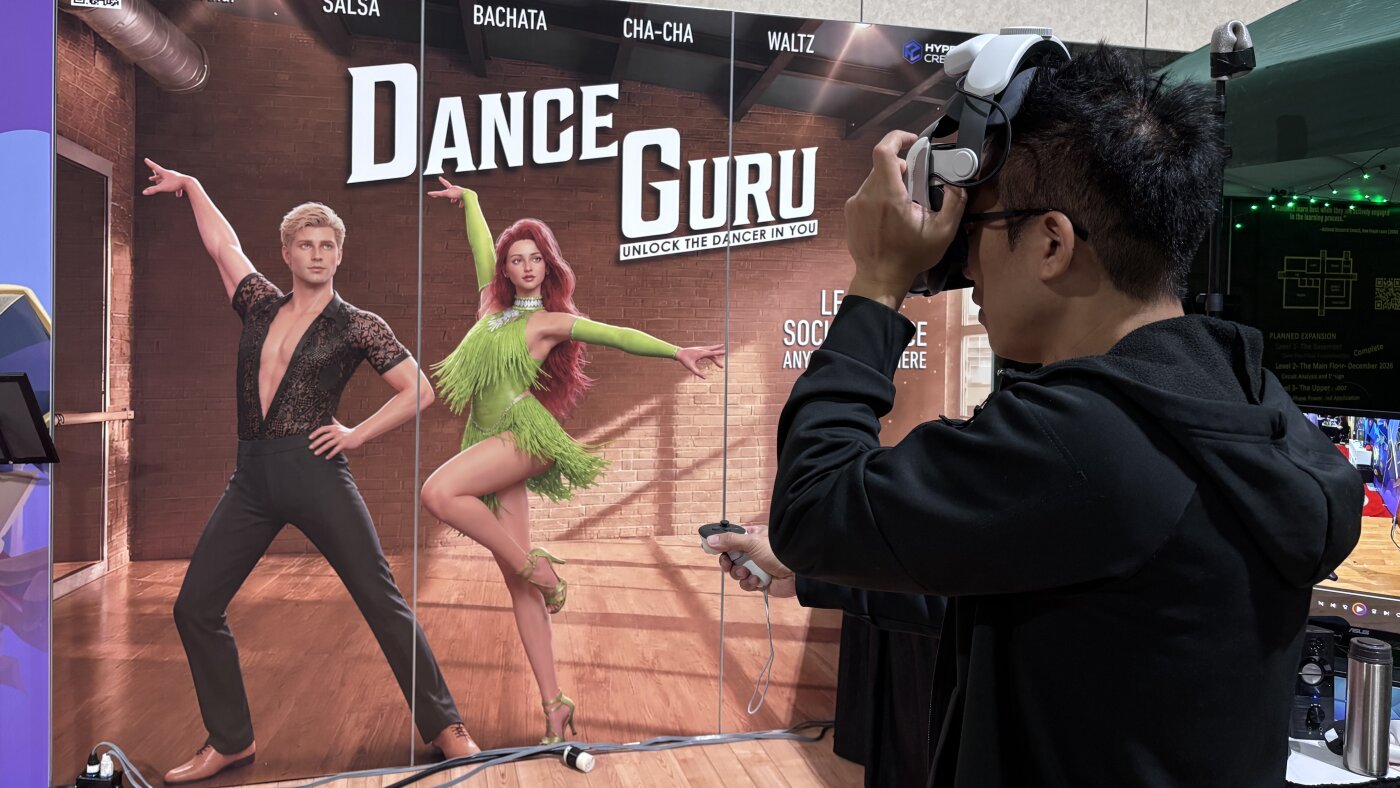
Entrepreneur David Huang tests out a VR headset while conducting demonstrations of the social dance lesson app Dance Guru at the Augmented World Expo in Long Beach, Calif., June 17, 2026.
Chloe Veltman/NPR
hide caption
toggle caption
Chloe Veltman/NPR
Wedding season is in full swing, bringing with it a familiar sense of dread for anyone who fears the dance floor.
But relief may finally be at hand with the help of a new app, Dance Guru, and a virtual reality (VR) headset.
The social dance instruction app transports users to a spacious, digital dance studio. Waiting inside is a computer-generated coach: a handsome, male avatar wearing a shirt open to his navel. He speaks with a slightly gravelly English accent.
“Watch me now,” he instructs at the start of a waltz lesson — which NPR tried out at the Augmented World Expo in Long Beach, Calif., an annual conference showcasing the latest developments in virtual and augmented reality.
The avatar then demonstrates a basic box step.
From there, the lesson becomes interactive. The coach tells the user to hold his hand while an electric pinging sound tracks the student’s foot placement.
“One, two, three, four, five, six,” the virtual teacher counts down.
When the user stumbles, he remains remarkably patient. “Do not worry, foundations take time. Let’s try that again. Work on grounding your steps more intentionally.”
Solving the beginner’s dilemma
Dance Guru creator David Huang said he came up with the idea for the app a couple of years ago out of frustration.
“I always wanted to learn to dance and I was always terrible at it,” Huang said. “And I always ended up stopping midway through the lessons.”
He soon realized that many beginners hit the exact same roadblocks.

“Private lessons are too expensive, and you feel like you’re always forgetting the dance steps,” Huang said. “You cannot find a partner to dance with. So I figured maybe I can create something like this.”
The Dance Guru platform currently offers tutorials in salsa, bachata, waltz, and cha-cha, in both lead and follow modes. To make the digital instruction feel authentic, Huang used motion-capture technology to record the movements of real-life dance teachers — with their permission.
Building on the legacy of online tutorials and video games
Dance Guru belongs to a small but growing wave of apps using VR to demystify social dance. At a nearby booth, conference attendee Victor Chen is testing out a competing app called Trip the Light. It currently offers salsa lessons, as well as freestyle options, where a user can dance with a partner without having to learn specific steps.

Trip the Light’s booth at the Augmented World Expo included posters of the app’s virtual instructors. Real-life performers, who gave Trip the Light permission to motion capture their movements, were used as a basis for these avatars.
Chloe Veltman/NPR
hide caption
toggle caption
Chloe Veltman/NPR
“A lot of times when you’re trying to learn a choreography, it’s watching a YouTube video and you have to pause it, rewind, and play it,” Chen said. “If you were to have a virtual avatar dancing in front of you and correcting for any parts that you missed, it might be a lot easier.”
Interactive video games like Dance Dance Revolution and Just Dance, and YouTube tutorials have been helping people improve their skills in private for years. But those games are mostly aimed at solo players. Unlike the new generation of immersive VR apps, they cannot simulate the mechanics or confidence required for partner dancing on a live dance floor.
The reality check
But this kind of app won’t work for every dancer.
“Everyone learns a little bit differently. And so unless you have a game that has lots of different ways of teaching, you’re going to have things that work for some people and don’t work for others,” said Ariana Katana, a trained contemporary dancer and dance content creator who’s active on YouTube, Twitch and other platforms. “Also, it’s hard to dance with a headset on.”
And then there’s the issue of not being able to physically feel a virtual partner’s hand or shoulder while dancing with them. Patrick Ascolese, the creator of Trip the Light, said the experience could become more tactile in the future. “Haptic suits and wearables will be coming, but I think we’re a little away from that,” he said.
Ascolese said even with their limitations, immersive tools like Trip the Light have immense potential as judgment-free training grounds — giving reluctant dancers the baseline confidence they need to eventually step onto the dance floor with real partners in the real world, including at weddings.
“Just like anything else, practice makes perfect,” said Ascolese. “So the more time you spend in VR with a virtual partner, it works towards helping you get over that social hurdle. We are teaching you the moves that you have to do in order to go out and have fun.”
Jennifer Vanasco edited the broadcast and digital versions of this story. Chloee Weiner mixed the audio.



For half a century, Deidre Hall has taken on every kind of disaster in the drama-packed town of Salem, Ill., as a star of “Days of Our Lives.”
There was the time — actually, it happened twice — when her character, Dr. Marlena Evans, was famously possessed by the devil and even levitated.

In Sunday Funday, L.A. people give us a play-by-play of their ideal Sunday around town. Find ideas and inspiration on where to go, what to eat and how to enjoy life on the weekends.
Or the time a serial killer, who was actually Marlena under hypnosis, seemed to kill several beloved characters. The long-running show’s storylines have become legendary, and in March, while promoting “Hail Mary,” actor Ryan Gosling even gave Hall a shout-out, admitting he was a fan, praising the hard work of soap opera actors and calling her an “OG acting inspiration.”
But Hall’s real life in Santa Monica is much quieter than her character’s, and she likes it that way.
“When I bought my house in Santa Monica, I didn’t realize how great it would be to live near Montana Avenue,” says Hall, 78, about the popular shopping spot. Every day, she walks to the main street with her golden retriever, Riley, and enjoys Pilates, art and good food along the way. “The owners of the Farms Market even keep dog biscuits, so guess where the dog wants to go every time we walk — the Farms, of course,” she says, laughing.
When she isn’t filming the daily soap opera, which airs on Peacock, Hall enjoys raising monarch butterflies, exploring the shops and restaurants on Montana, and hosting movie nights at home with her two sons.
Here’s what a perfect day in L.A. looks like for her.
This interview has been lightly edited and condensed for length and clarity.

7 a.m.: Breakfast and dog walk
I usually kick off my day with a protein shake, feed our golden retriever and take her out for a walk. She’s a phenomenal girl. When we adopted her, her name was Riley, but I did think about naming her after Mrs. Hughes from “Downton Abbey.”

10 a.m.: Church and garden time
After I walk the dog and go to church, I like to spend some time in my yard. I’m not a natural gardener, but I really enjoy it. I started raising monarch butterflies because my identical twin sister, who played my twin on the show, planted a butterfly garden. Monarchs are amazing because they are transitional. Every year, they travel from Mexico to southern New England, but it’s getting harder for them. Their numbers have dropped by about 80%. To help, I plant milkweed, which is what they need to survive. I buy my milkweed from the Staghorn Garden on Wilshire Boulevard in Santa Monica. Julie, who owns the nursery, is delightful and has a wide variety of milkweed. The monarchs always seem to find my garden. Julie was raising some caterpillars too, and she cared a lot about them. We talked about how important it is to help the butterflies. That’s why I do this. Sometimes I get milkweed with eggs already on it, and Julie knows her butterflies are going to a good home.

1 p.m.: Walk to Montana Avenue for some lunch
I live near Montana and love taking long walks, going to Pilates and trying out the great restaurants nearby, like R+D Kitchen and La La Land. I’m a big fan of the waffles at the Courtyard Kitchen. Just a few days ago, I had a chicken salad on raisin bread with an Arnold Palmer, and it was delicious. It is right on Montana and has a nice outdoor seating area. It’s one of my favorite spots. La La Land always has a long line in the morning, which is perfect if you want coffee. They serve coffee, doughnuts, croissants and avocado toast. There’s plenty of outdoor seating, and you can even bring your dog.

2 p.m.: Peek inside a clock shop
There’s a small clock shop on Montana Avenue that’s closed on Sundays, but if you walk by, you’ll see all kinds of clocks — standing, table and wall clocks. The owner is great at fixing them. Once, I bought a wall clock from MacKenzie-Childs, but it didn’t work. And I was really upset because it matched everything else on my countertop. I brought it to the owner and said, “I love this, but I can’t make it work.” He fixed it right away. His name is John, but I call him Geppetto. And we all know why. He really does have a magic touch.

2:30 p.m.: Visit a neighborhood art gallery
Ten Women Gallery is run by 10 artists, all of whom show their work there. I was drawn to some watercolors there, bought a few cards and spoke with one of the artists. She told me, “You seem to love watercolors,” and mentioned that the artist who painted them, Pamela Harnois, lives in Los Angeles and teaches nearby. I got Pamela’s name and found out she taught at the Brentwood Art School. I was so inspired by her gift that I started taking private lessons with her on Saturdays. That gallery is where I discovered my love for watercolor painting.

3 p.m.: Grab some ice cream at Rori’s
The other day, my longtime girlfriend wanted to get ice cream and told me, “We are walking to Rori’s Artisanal Creamery.” It’s a small shop on Montana near Lincoln. They make everything themselves, using local ingredients from grass-fed cows with no added hormones. The place is family-owned and probably has the healthiest ice cream you’ll find. They switch up their flavors often, but my favorite is the salted caramel.

6 p.m.: Family dinner and movie night at home
R+D Kitchen is always packed, so my sons, who are 31 and 33, do the cooking. They come over, and together we make salads and cook dinner. There’s a neighborhood grocery store called the Farms, off Montana, a small family-run place that has everything we need. Everyone knows each other there, and people bring their dogs. We try to have movie night every Sunday. Sometimes the day changes, but we always make sure to have one night a week where we cook a meal and sit down as a family. Keeping that tradition has become really important to us. My sons are great cooks, which is funny because they definitely didn’t get that from me. [Laughs]
9 p.m.: Take Riley for one last walk and visit neighbors
After dinner, I take my dog for a walk. It’s a great way to meet neighbors. We always go around the same block. We’ve met so many people, and since she’s a golden retriever, she loves meeting everyone.

10 p.m.: News, knitting and bedtime
I am a news junkie, so I usually watch whatever is on the news before I go to bed. I have a long-standing passion for knitting. Lately, though, the news would make me drop a stitch.
For Iris van Herpen, couture is a laboratory as much as a runway. Our chief fashion critic, Vanessa Friedman, takes us inside this Dutch designer’s latest Paris show — from sci-fi-inspired gowns to an audacious attempt at a dress made of charged plasma.
-
Lifestyle15 minutes ago
Shy on the dance floor? Virtual reality ‘partners’ aim to help you find your groove
-

 Technology27 minutes ago
Are you filthy enough for a $700 portable shower?
-

 World29 minutes ago
Former British MP and reality TV star Ann Widdecombe found dead; man arrested for murder
-

 Politics35 minutes ago
Trump takes unusual step, lets bipartisan housing bill become law unsigned amid SAVE pressure campaign
-

 Health42 minutes ago
Eating common dairy food every day may slow biological aging, study suggests
-

 Sports45 minutes ago
CM Punk to defend Undisputed WWE Championship against Cody Rhodes at SummerSlam
-

 Technology50 minutes ago
Would you pay $8,000 for a robot to fold laundry?
-
 Business57 minutes ago
Legendary Television City may be be sold in further blow to Hollywood

