Lifestyle
Cheddar bay biscuits, cheap margs and memories: Readers share their nostalgia for chain restaurants


Affordable, familiar and reassuring are the features that make American chain restaurants a near-ubiquitous presence throughout the country; it is almost as if they are baked into our roadside culture.
Despite well-documented financial struggles, a tough economy and shifting diet trends, these restaurants withstand time.
This series explores why these places have such strong staying power and how they stay afloat at a time of rapid change.
Read our first three pieces in this series, including how these restaurants leverage nostalgia to attract diners, how they attempt to keep costs affordable, and how social media has changed the advertising game – and become a vital key to restaurants’ success.
America’s chain restaurants are not the most glamorous places to eat. And yet, as we’ve reported, they hold a special place in many Americans’ hearts.
We asked readers what comes to mind when they think of restaurants like Olive Garden, Applebee’s or Texas Roadhouse — and you shared plenty of stories.
Not all of the respondees waxed poetic about the merit of these restaurants. David Horton, 62, from New York, for example, said: “The food is mostly frozen and only has flavor from the incredible amounts of sodium they use.”
But overwhelmingly, responses described vivid childhood memories shared in booths looking excitedly over laminated menus and the type of adolescent rites of passage that seem right at home in the parking lot of a suburban chain restaurant.
There’s a science behind why these sorts of memories have such a hold on us.

The feeling of nostalgia is linked closely to food and smell, and these restaurant chains are often where core memories – like graduation celebrations or first dates – are made.
Chelsea Reid is an associate professor at the College of Charleston who studies nostalgia. And she’s no more immune to nostalgic feelings than anyone else even though she has a better understanding of the chemistry behind the feeling.
“Even just saying Red Lobster, I can kind of picture the table and the things that we would do and the things we’d order, and my mom getting extra biscuits to take home,” she said.

A Red Lobster restaurant is seen in Fairview Heights, Ill., in 2005.
James A. Finley/AP
hide caption
toggle caption
James A. Finley/AP
Her nearest Red Lobster closed down, but a local farmers’ market sells a scone reminiscent of Red Lobster’s famed Cheddar Bay Biscuits – a scent she says immediately transports her back to those childhood family outings to the seafood chain.
“I can see my mom wrapping these up in a napkin and putting them in her purse for when we would be like, ‘hey, we’re hungry,’ and she pulls out a purse biscuit.”
Full disclosure: Your intrepid reporters are not without sentimentality. Before launching this project, when it was just a kernel of an idea, we talked frequently about the role these restaurants played in our own lives.
Jaclyn: I distinctly remember cramming into a booth at my local Chili’s in my hometown, Cromwell, Ct., for most birthday dinners until the age of 13 or so.
I’d be surrounded by my mom, dad and brother, and I got to pick whatever I wanted. Except I always chose the same thing: Chicken crispers with a side of fries, topping the night off with the molten lava chocolate cake we’d share as a family.
I can picture it so clearly, down to the booth we’d sit in. Now, my family is spread out. But my love for Chili’s runs deep, and I still get warm and fuzzy when I think about it.
These days, I’m in my 30s, and I need to worry about my health and getting in 10,000 steps a day. So, no, I don’t regularly go to Chili’s now.
But when I do? Those chicken crispers I had as a kid are still on the menu, and yes, I’m likely to order them today (even if on my adult tastebuds, the salt content quickly turns my mouth into the Sahara Desert).
And it’s not to celebrate my birthday. It’s because one of my best friends is telling me she’s getting a divorce over cheap, and sugary, margaritas.
Alana: When the pandemic struck in 2020 and much of the country went into lockdown, there I was mostly alone in my one bedroom apartment, staring at the walls.
After what seemed like a lifetime, I was finally able to expand my tiny COVID bubble.
One of my first “dining out” experiences during that time was in the parking lot of the Hyattsville, Md., Olive Garden where my friend and I sat in absolute glee to be reunited – not just with one another, but also the chain’s staple soup (zuppa toscana for me, please), salad and breadsticks (you can have all the breadsticks if I can have your share of the salad tomatoes).
Since then, that friend and many others have moved away – too far to meet up for a sit-down over a (mostly) hot meal at a reasonably priced restaurant in a city not famed for being cheap.
I recently revisited the Hyattsville Olive Garden for this story. And even though my life is now different, my friends have moved away, and the world has shifted, there it was, exactly the same.
And I liked it.
Many readers said that these restaurants were the type of place a family who could rarely afford to eat outside a home could treat themselves on rare occasions.
Like Julie Philip, 51, from Dunlap, Ill., who wrote: “Growing up in the 70’s and 80’s, Red Lobster was an Easter tradition. We would dress up, go to church, then drive close to an hour to Red Lobster.”

She continued, “It was one of only a few days a year that we could afford to eat at a ‘fancy restaurant.’ I remember my parents remarking that they had to spend $35 for our family of four. I no longer consider Red Lobster a ‘fancy restaurant,’ but as an adult, my family and I often still eat there at Easter. I remind my kids that we are keeping up a family tradition and I tell them stories of my childhood while eating.”
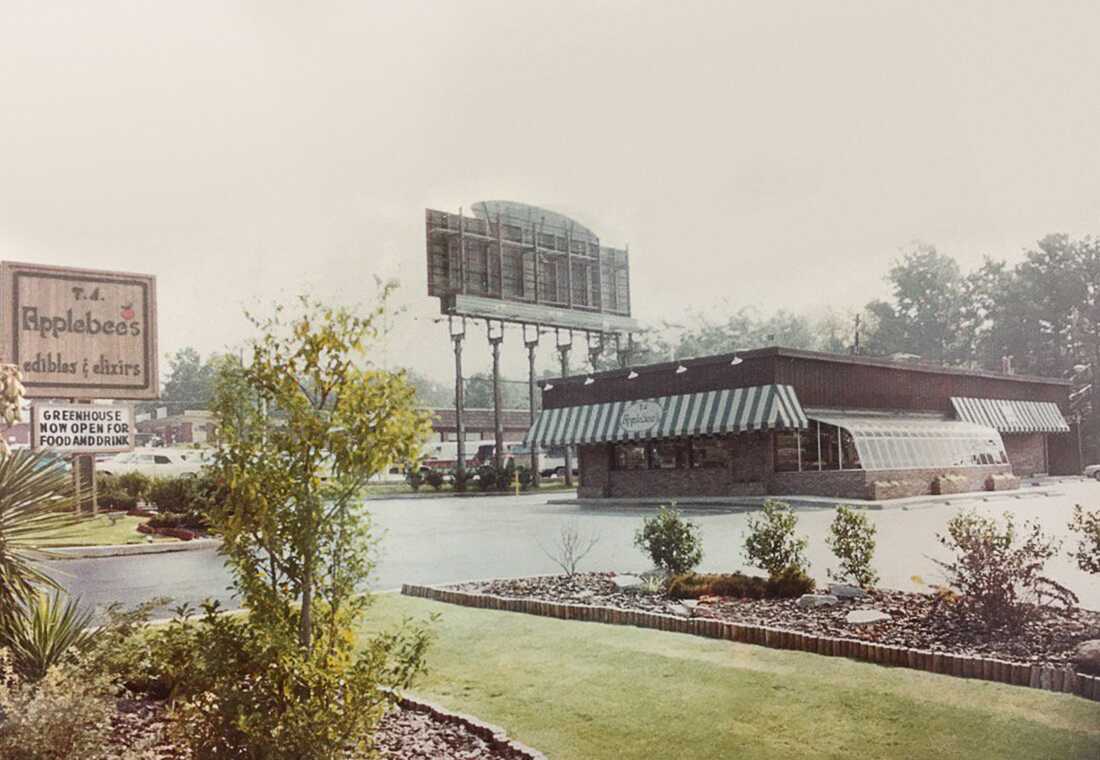
The original Applebee’s restaurant was called T.J. Applebee’s Rx for Edibles & Elixirs and it opened in Decatur, Ga., in 1980.
Applebee’s
hide caption
toggle caption
Applebee’s
For Sarah Duggan, an Applebee’s parking lot evokes a key memory from young adulthood.
Duggan, 32, from North Tonawanda, N.Y., wrote that every time she sees an Applebee’s, she remembers the time her friend, in an act of teenage rebellion, got her belly button pierced in the parking lot of a Long Island Applebee’s — inside the trunk of the piercer’s “salvage-title PT Cruiser.”
Duggan held the flashlight.
She wrote, “I can’t picture those sorts of college kid shenanigans happening in the parking lot of a regular Long Island diner or other independent restaurant, but it seems right that it was at Applebee’s.”
She continued, “It makes me think about how nobody, from riotous camp counselors to your spouse’s grandparents, looks or feels out of place at a chain restaurant.”



Can you say no to a friend’s wedding?
Getty Images/Getty images
hide caption
toggle caption
Getty Images/Getty images
Are we spending too much on other people’s weddings?
Going to a friend’s weddings can be so fun and meaningful… but it can also really hurt your wallet. A survey by LendingTree found that 31% of people who had been to a wedding in the past five years had accrued debt to attend. So what’s driving up the cost of weddings for guests? And what makes it so hard to say no to these expenses?
Brittany breaks it down with Allyson Rees, senior analyst at trend forecasting firm WGSN, and Annie Joy Williams, assistant editor at The Atlantic.
This episode was produced by Liam McBain, with additional support from Corey Antonio Rose. It was edited by Neena Pathak. Our Supervising Producer is Cher Vincent. Our Executive Producer is Barton Girdwood. Our VP of Programming is Yolanda Sangweni.
After the eight-day-long fire in a 500,000-square-foot Boyle Heights warehouse, eastern Los Angeles residents are contending with putrid smells, soot and potentially hazardous airborne chemicals after heavy plumes of smoke spread throughout the city. But those who grow food in nearby neighborhoods may also be wondering: How will the fires affect the plants and produce in my garden?
The Boyle Heights warehouse, owned by Lineage — a global temperature-controlled storage facility operator — housed 85 million pounds of frozen food and other products. In the days since the fire, local emergency visits for smoke inhalation and throat pain spiked while agencies still scramble to measure the amount of PM 2.5 — harmful fine particles — and heavy metals, like lead and arsenic, in the air.
According to researchers, any toxic airborne chemicals would likely stem from the charred foam insulation, metal exterior, burned solar panels and any lithium batteries that might have been present inside the warehouse.
After a fire, heavy metal particles can spread through ash and smoke over gardens and inhibit growth, said Olukayode Jegede, an agricultural toxicologist and assistant professor at UC Davis. Since the warehouse fire is so recent and cleanup has just begun, Jegede said the precise impact on gardens can’t be measured until comprehensive soil tests are conducted in the area.
While the L.A. city government hasn’t announced plans for soil testing, the Contaminant Level Evaluation and Analysis for Neighborhoods project at USC is offering free contaminant testing for Boyle Heights and East L.A. residents. Residents can collect soil samples and deliver them to Boyle Heights City Hall and other locations for an evaluation of lead, arsenic, chromium and mercury levels.
The good news is produce, plants and roots can still be preserved. According to Jegede, many of the soil tests conducted last year in the Altadena area after the Eaton fire showed that gardens and poultry were not as contaminated as one might expect.
“Quite a number of the soils we tested [in Altadena] were not really contaminated,” Jegede said. “We weren’t seeing many soils with concerning elevated levels of metal, so gardeners should not be too alarmed when these things happen.”
Nevertheless, there are several measures that gardeners can take to keep themselves, their children, plants and produce safe from potentially harmful contaminants stemming from the fire. Researchers, gardening experts and horticulturists offered some guidance on the handling, recultivation and cleanup that can keep you and your garden in good health.
How do I remove ash and contaminants from my garden?
Altadena horticulturist Leigh Adams said Boyle Heights plants and produce already live in a difficult environment, surrounded by industrial warehouses that spread contaminants daily.
“That area has been used industrially for 100 years, and the soil is impacted by many, many, many things,” Adams said. “Low-income neighborhoods and gardens usually don’t have a lot of resistance against dominant manufacturing.”
This means that the contamination of gardens in eastern L.A. won’t be as catastrophic as compared with those in Altadena, a more suburban environment, Adams said. But fallen ash still poses major health risks if ingested or inhaled.
An advisory from University of California Agricultural and Natural Resources last year recommended suiting up in an N95/KN95 mask, long sleeves, pants, close-toed shoes and gloves before attempting to deal with ash in the garden to limit exposure to potentially toxic contaminants. The advisory added that individuals should make sure all of this gear is cleaned thoroughly before bringing it back inside.
Once in the proper gear, Adams recommends removing the top two inches of topsoil from gardens, where the highest concentration of contaminants will settle after a fire. Using a plastic bag to collect the soil and disposing of it in the garbage — not green yard waste bins — will help to reduce the spread of airborne chemicals.
Gardeners with raised beds are advised to remove approximately six inches of soil, because excess ash can raise the pH level and prevent nutrients from soaking into the soil bed.
After this, watering the garden gently but plentifully will help to promote soil health and get rid of most of the ash present on plant leaves and stems. Adams said replacing the top two inches of soil with store-bought mulch or straw will help to contain any remaining ash and prevent it from spreading any further.
Experts say to avoid using leaf blowers if ash is present in the garden because they can send particles airborne. Doing so will increase the likelihood of heavy metal particles, which can carry lung irritants and carcinogens, being spread and inhaled.
A Boyle Heights resident keep a watchful eye on the fire at the 5,000-square-foot commercial building, which stores 85 million pounds of frozen food.
(Genaro Molina / Los Angeles Times)
Is it safe for me to eat produce from my garden?
Several studies, including one from the UC Cooperative Extension of Sonoma County, have shown that consuming produce in a fire-affected area poses minimal health risks.
Jegede said most root vegetables like potatoes and carrots, along with any fruit that has an outer layer, can be washed to remove potential contaminants, even if they were covered in ash. Peeling the outer layer of your produce can also help to reduce potential risks, he said.
Lettuce and other leafy foods with multiple layers pose a higher risk of contamination, but with a vigorous wash and peeling the outer layers, even the greens can be saved. The County of Los Angeles Department of Public Health recommends soaking leafy produce and fuzzy fruits like peaches in a 10% white vinegar and 90% water mixture.
Jegede said if the leaves or fruit are too delicate to wash or ash is still visible, it would be best to dispose of the produce.
How can I tell if my soil is contaminated?
After ridding your garden of visible ash, you might wonder how to tell if your plants will still thrive in the soil.
At-home soil tests that measure for alkaline, fertility and pH levels are widely available and can be purchased for $15 to $100 (for more detailed results) online. But Jegede said these tests can’t tell the full story of soil health.
Comprehensive soil testing is “something you can’t do properly at home,” Jegede said. “In labs, we are testing for metals like lithium and zinc, stuff that an at-home test will not show … If it comes to the point that you’re worried about your soil, I would just send it out to a lab.”
Wallace Laboratories in El Segundo, Babcock Laboratories in Riverside, Waypoint Analytical in Anaheim and other labs offer more detailed soil tests that measure heavy metal particles in addition to other fertility factors. Prices at Wallace Laboratories can range from $115 to $295 for a complete compost test.
The soil below two inches should be unharmed, Adams said, so long as new compost is set and plants are watered plentifully, which will promote natural biological cycles.
“What you’re doing is capping the soil, so that moisture stays in there, and instead of being dirt, it’s a living system called soil,” Adams said. “The more carbon we can get into our soil, the better.”
What can I do to help my soil recover?
For the last 12 years, Adams has been working with Metabolic Studio, a Los Angeles-based art and research hub focused on environmentalism, on methods for bioremediation, the practice of using additional fungi, plants and compost to decontaminate ash and break down contaminants.
Adams said straw, mushrooms, corn, rye and sunflowers are great bioremediators that can help to repair damage to soils. She said certain samples she’s worked on with Metabolic Studio have gone from testing at high heavy metal levels to nearly contaminant-free.
But for a more immediate fix, wash your produce, water your plants and have a little patience during ash cleanups. Your garden should look better in no time, Adams and Jegede said.

Inde Navarrette and Michael Johnston in Obsession.
Focus Features
hide caption
toggle caption
Focus Features
Two big horror films, Obsession and Backrooms, just smashed all box office expectations. So much of their success has been driven by Gen Z, which is now the biggest moviegoing demographic. But what makes a movie a Gen Z movie? Today we’re bringing you an episode of NPR’s It’s Been a Minute. Host Brittany Luse talks about this trend with Sam Adams and Reanna Cruz.
If you want to hear more about these movies, check out these episodes:
In ‘Obsession,’ love hurts. It really, really, really hurts.
‘Backrooms’ brings YouTube horror to the big screen
Zendaya brings ‘The Drama,’ we bring the spoilers
Connect with Pop Culture Happy Hour:
Letterboxd / Facebook
Our weekly newsletter
Support Pop Culture Happy Hour+
-

 Kentucky11 minutes ago
Kentuckians deserve honesty about McConnell’s health | Letters
-

 Louisiana14 minutes ago
Leadership Louisiana Health Fellows Welcomes Inaugural Class – Leaders for a Better Louisiana
-

 Maine20 minutes ago
A hard lesson for Democrats in Maine. Plus, we have some news about Ed Markey. – The Boston Globe
-

 Maryland27 minutes ago
Governor Moore Announces Awardees for $1.23 Million Investment to Help Maryland Workers Thrive in a Changing Economy
-

 Michigan29 minutes ago
‘Big Brother’ season 28 to premiere this week. One guest from Michigan
-

 Massachusetts29 minutes ago
Cool off this summer at these 10 splash pads in central Massachusetts
-

 Minnesota41 minutes ago
EF2 tornado injures two, damages homes near Detroit Lakes, Minnesota
-

 Mississippi44 minutes ago
Mississippi’s first Dutch Bros now open in Pearl

