Colorado
Windstorm batters Colo., leave tens of thousands without power; restoration expected by Saturday night


BOULDER COUNTY, Colo. — Colorado’s foothills were hit by hurricane-force winds Friday morning, with gusts reaching 112 mph in Boulder County. The storm caused damage, outages, fires, and travel disruptions, but no injuries were reported.
Earlier in the week, on Wednesday afternoon and evening, a previous windstorm brought gusts up to 109 mph, knocking down trees and power lines and sparking fires near Yuma.
No serious injuries were reported from the fires near Yuma. Authorities believe no homes were lost. All fires were contained by Thursday night after burning just over 14,000 acres.
Power outages
Xcel Energy carried out another public safety power shutoff (PSPS) on Friday in response to hurricane-strength winds in the Front Range foothills, as crews worked around the clock to restore power to thousands of customers after initiating a Wednesday PSPS.
Xcel said PSPS conditions subsided as of 5 a.m. Saturday. However, about 57,207 Xcel customers were still without power.
Xcel Energy
The utility company said it’s aiming to restore power to customers by 10 p.m. Saturday, but warned that the outage could extend into Sunday for some customers.
“The safety of crew members is paramount as they work to restore power. Xcel Energy asks customers to help keep crew members safe as they work diligently to restore power as quickly as possible,” wrote Xcel Energy in a release.
Xcel said it has identified 396 customers who have been without power since the initial outage on Wednesday. The company said these customers are being prioritized as restoration efforts continue followed by other high-needs areas.
David Zalubowski/AP
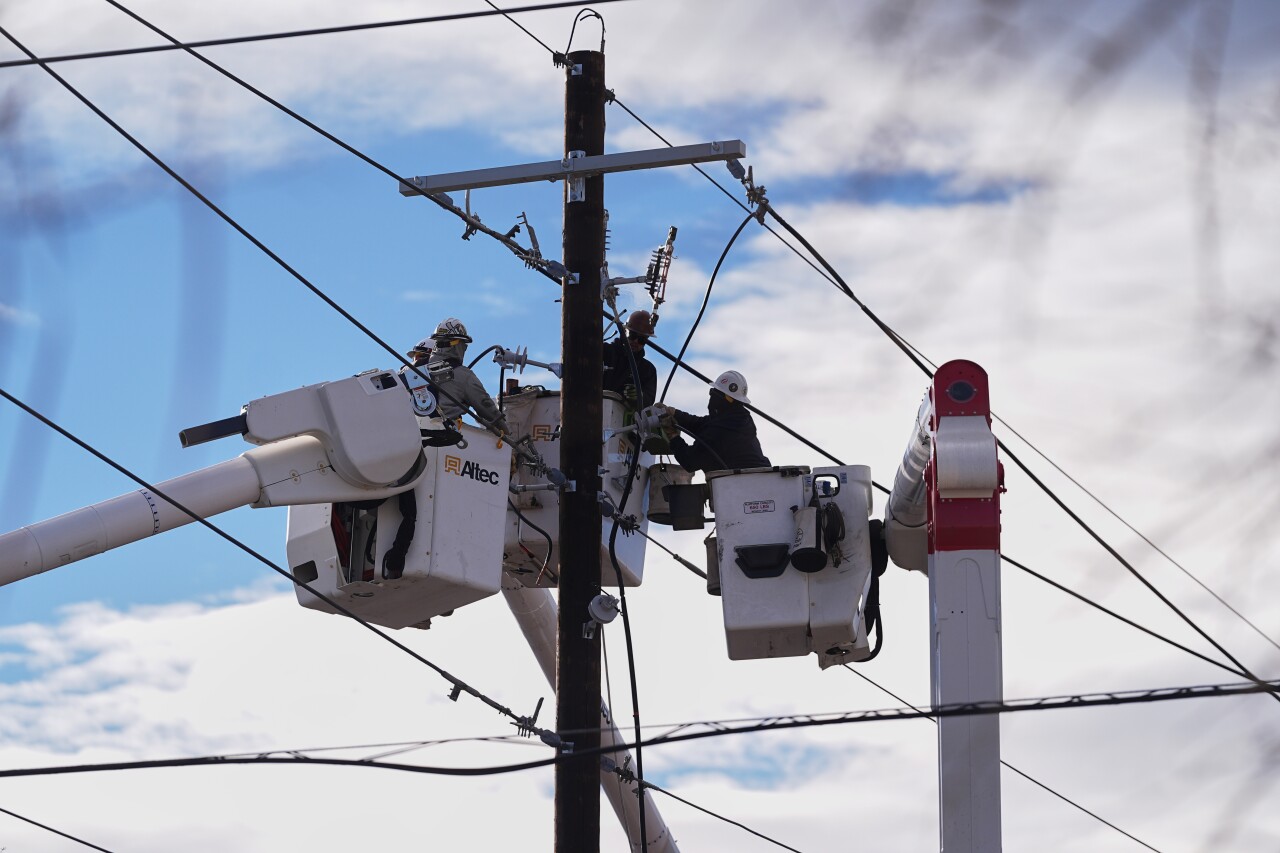
Xcel set up resource centers and charging stations in Evergreen, Gilpin County, Lakewood, and Idaho Springs.
On Saturday, Gov. Jared Polis urged residents to avoid directing their frustration at Xcel’s frontline crews over ongoing outages, saying workers are working long hours to restore service.
“As many Coloradans await the return of power to their homes and communities, I want to urge everyone not to take their frustrations with power being out on the hardworking men and women who make up the Xcel crews. The company and its crews are working around the clock to ensure our safety and to restore power. While I have expressed great frustration with Xcel and there’s much room for improvement in communications about what’s going on and timelines, I am grateful for Xcel’s frontline workers and all those people working to restore people’s power. Please thank them if you see them,” Polis said in a statement.
CORE Electric Cooperative, which provides power to parts of Clear Creek, Jefferson, and Park counties, said that 9,281 customers lost power during Friday’s storm.
CORE said the return of service for most members will likely not occur until later in the day on Saturday, as more favorable weather will help with restoration efforts. However, strong winds are still expected, and many trees have been weakened during the storm.
Damage and closures
Reports of downed trees, power lines, and street poles in and around Boulder and across the foothills during Friday’s wind event flooded emergency dispatch.
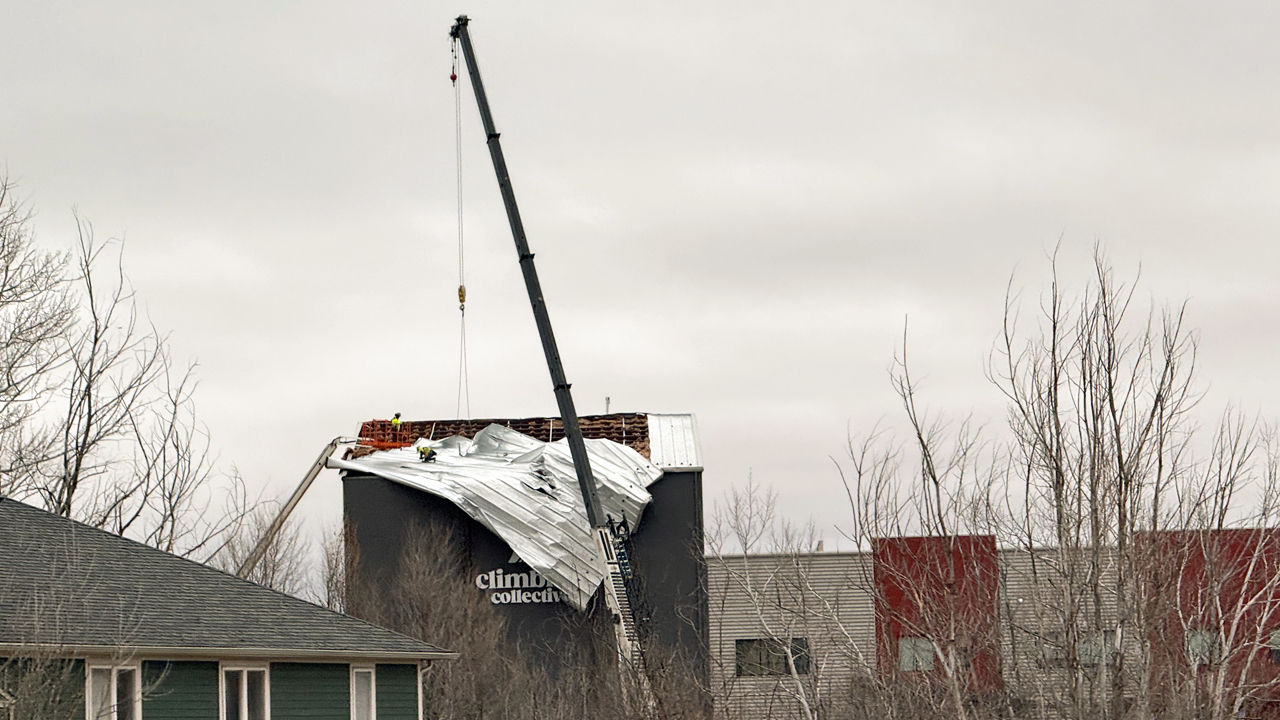
In Longmont, Friday’s windstorm severely damaged the roof of Longmont Climbing Collective, 155 Pinnacle Street, prompting the closure of the business as crews work to replace the roof.
Denver7
Longmont Climbing Collective said in a Facebook post that it hopes to reopen Sunday or Monday, but it may take longer. No injuries were reported.
Downed trees and street poles blocked roads and trails across Boulder County, causing major closures, including portions of CO 72, CO 93, US 36, and CO 128. But some reopened by nightfall.
Denver7

In the Allenspark area of Boulder County, a propane tanker on CO 7 rolled over after hitting black ice on Friday, trapping the occupants and prompting an evacuation and the closure of the highway.
According to the Allenspark Fire Protection District, high winds and leaking diesel fuel at the crash scene made the situation particularly sensitive and extended the time needed to resolve it.
Allenspark Fire Protection District
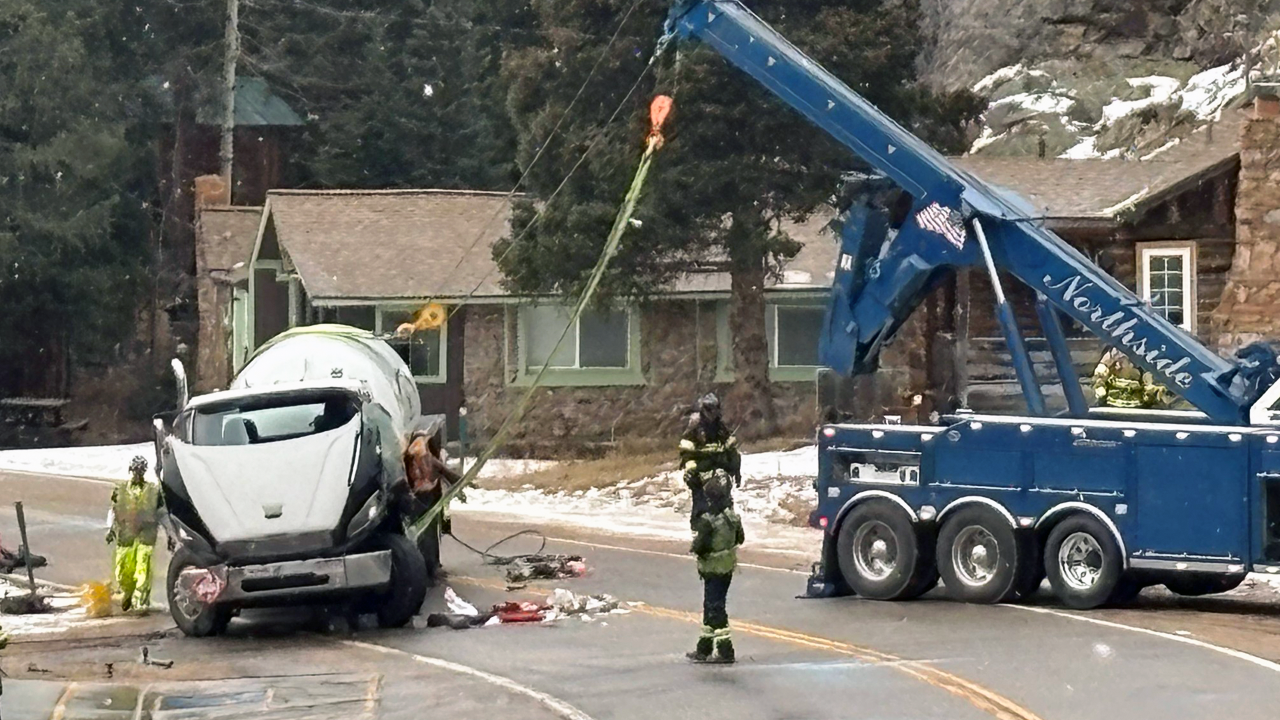
Due to concerns about possible propane leakage, residents and businesses were evacuated. However, no propane leakage was ultimately found.
No major injuries were reported.
Friday’s storm also closed schools across Boulder and Jefferson counties, as well as Evergreen.
Here are the top 10 wind speeds recorded on Friday from the National Weather Service:
- 112 MPH — 3 NW Marshall, Boulder, CO
- 110 MPH — Sunshine, Boulder, CO
- 102 MPH — 2 WNW Niwot, Boulder, CO
- 99 MPH — 1 NE Crisman, Boulder, CO
- 97 MPH — 1 S Wallstreet, Boulder, CO
- 96 MPH — 2 SW Hygiene, Boulder, CO
- 95 MPH — 1 NE Crisman, Boulder, CO
- 95 MPH — 3 S Carter Lake, Larimer, CO
- 94 MPH — 3 N Berthoud Pass, Grand, CO
- 92 MPH — 5 N Boulder, Boulder, CO
DIA impacts
Friday’s strong winds created a rough start to the December holiday travel season at Denver International Airport.
FlightAware reported more than 1,200 delays at DIA on Friday—the most nationwide—along with more than 80 cancellations.
Denver7

On Saturday, the numbers dropped considerably, resulting in only 88 reported delays.
Several pilots reported moderate-to-severe or even severe turbulence on Friday.
The Federal Aviation Administration defines turbulence as “severe” when it “causes large, abrupt changes in altitude and/or attitude. It usually causes large variations in indicated airspeed. Aircraft may be momentarily out of control.”
Back‑to‑back windstorms batter Colorado, leave tens of thousands without power
Coloradans making a difference | Denver7 featured videos
Denver7 is committed to making a difference in our community by standing up for what’s right, listening, lending a helping hand and following through on promises. See that work in action, in the videos above.



An investigation is underway after authorities found a body near a picnic area in western Colorado last weekend that appears to have been eaten by a bear.
The Mesa County Sheriff’s Office says the human remains were located on Sunday near the Wild Rose Picnic Area off Lands End Road on the Grand Mesa. Investigators say the remains were scavenged and scattered, and they believe the person was consumed by a bear and other wildlife.
The Mesa County Coroner’s Office is working to identify the person and officially determine their cause of death.
The sheriff’s office is asking anyone who was in the area of the Wild Rose Campground between June 22 and July 5, 2026, and noticed anything suspicious to contact Investigator Jenna Reed at (970) 244-3274.
They added that Colorado Parks and Wildlife believes there is no threat to the community at this time.
The area is home to black bears, and the MCSO shared several guidelines for the community to prevent human-bear conflicts:
- Stay alert and together: Go with others when possible, keep children in sight and close by, and avoid using headphones so you can hear your surroundings.
- Food safety: Double-bag food, pack out all food and trash, and don’t burn scraps and trash in fire rings/grills or leave them behind.
- Pet safety: Keep dogs on a leash at all times or leave them at home; don’t force a bear to defend itself.
- Camping safety: Set up camps away from dense cover or natural food sources and do not cook or store food near/in a tent. Secure food in bear-resistant containers or suspend at least 10 feet above the ground and 10 feet away from any part of the tree.
- Know how to respond: Don’t approach bears; quietly move away. Never run, as it may trigger a chase response. If a bear approaches, stand your ground, wave your arms, and yell until it leaves. Stay with your group, use bear spray, and fight back aggressively if necessary.
- Bear spray: Carry bear spray and know how to use it correctly. It’s not repellent; don’t spray your tent, campsite, or belongings.

Damage assessments are still ongoing for homes and businesses affected by the Aspen Acres Fire in southern Colorado, but over 200 homes have been confirmed destroyed so far. The United Way of Southern Colorado is working to raise relief funds for those affected and says it’s making progress towards its fundraising goal.
In an update on Wednesday afternoon, Pueblo County Sheriff David Lucero said they’ve assessed approximately 67% of the properties affected in the county. Authorities have confirmed the loss of 192 homes and four commercial structures so far and are working to contact property owners as quickly as possible.
Lucero urged everyone affected by the fire to use the survivor portal for more information on assistance.
Custer County Sheriff Rich Smith says they’ve lost approximately 83 homes so far, almost 2% of the county’s homes. The worst hit area is along the Highway 165 corridor, Smith added. He said that authorities don’t expect any new evacuation areas, but are not yet ready to release the existing evacuation orders.
Smith said a hotline is available during business hours for affected Custer County Residents to ask questions. He urged residents to contact them at (719) 467-0271 and advised they may need to leave a voicemail if the line is busy due to the high number of calls.
A flash flood watch is in effect for areas near the burn scar, which could affect nearby homes.
The President of the United Way of Southern Colorado, Shanna Farmer, said the organization is working to raise wildfire relief funds for those affected. Over the last few days, they have reached just over $417,000 of their $10 million goal.
“It has been incredible, the number of individuals and companies who have come out to support, to provide matches, and to provide innovative ways to raise those funds,” said Farmer. “And so, I encourage anyone who is willing to work with us on a corporate, business, or individual level to please reach out because it is going to take all of us to help rebuild.”
Farmer said that the community not only needs help with their immediate needs but also long-term support. She urged anyone interested in donating to visit their website.

The Pueblo County Sheriff’s Office says anyone who has evacuated needs to contact the Disaster Assistance Center located at 29 Lehigh Ave. in Pueblo. The center is open between 9 a.m and 6 p.m. and provides multiple resources for those forced to evacuate.
Residents must also visit the center to obtain a re-entry pass, which will allow them to return home once evacuation orders have been lifted. A photo ID and proof of residency are required. Visitors can sign up online to reserve a place in line for faster service.

A powerful search engine that organizes and provides access to vast information on the internet.
-

 New Mexico3 minutes ago
New Mexico’s ban on liquor ‘minis’ yields mixed results five years later
-

 North Carolina6 minutes ago
NC state budget includes $27M for Madison County’s new public service complex
-

 North Dakota12 minutes ago
The Women’s College Fan Guide To 2026 Junior Nationals – FloWrestling
-

 Ohio18 minutes ago
Ohio reports nearly 200 cases of ‘explosive diarrhea’ illness
-

 Oklahoma21 minutes ago
Every Oklahoma State Cowboys’ College Football 27 Preseason Player Rating
-

 Oregon26 minutes ago
Illicit massage businesses shut down in Washington County
-
Pennsylvania34 minutes ago
Man arrested over alleged antisemitic threats to Gov. Josh Shapiro | The Jerusalem Post
-

 Rhode Island36 minutes ago
Aquatic Weed Treatments Planned for 2 RI Ponds, 1 Lake


