Lifestyle
L.A. Times Concierge: Help me plan a family day out that won’t bore my teen boys!


We live in Pasadena with our two teen boys, 14 and 17. We moved from the East Coast four years ago and are still getting to know all the interesting neighborhoods, foods and quirks of Los Angeles. We spent a lot of time in Little Tokyo as we love all things Japanese, but we need to explore more and see other neighborhoods that we don’t even know about. We’re interested in art, but not really art museums because that’s too boring for teen boys. We love food as an anchor for a visit to a neighborhood. Can you give me some suggestions? — Margaret Hunt
Looking for things to do in L.A.? Ask us your questions and our expert guides will share highly specific recommendations.
Here’s what we suggest:
I don’t have kids yet, but every time my siblings visit me from Las Vegas, I’m reminded of how difficult it is to keep teenagers entertained (and off their phones). But it sounds like your boys have some cool interests. We’ve put together a few mini itineraries in different neighborhoods. You won’t be able to cover them all in one day, so choose your own adventure.
If your teens are into the art form of comic books, check out Revenge Of, not too far from Pasadena in Glassell Park. “The shop, with its black-and-white tile floors, murals and neon lighting, is full of comic books, graphic novels and collectibles,” Times entertainment and features editor Brittany Levine Beckman tells me. “There are also pinball machines and arcade games, which may be as fun for you as they are for your kids.” Next door is sister shop And Destroy, which offers coffee and inventive beverages (the November menu includes a cornbread matcha concoction and sweet potato latte), and hosts a board game day on Sundays. Up the street is Bub and Grandma’s diner (the tuna made our food critic’s list of great sandwiches in L.A. a few years ago). But be warned, it gets packed on the weekends, so prepare to wait for a table or order to go.
For a Westside option, given that your family is already acquainted with Little Tokyo, explore L.A.’s other Japanese enclave: Sawtelle. Kick off your adventure at Odd One Out, an award-winning boba tea shop, then take a quick walk to the Giant Robot store, which is often cited as the birthplace of Asian pop culture products. Your kids will love browsing the shelves. In a Times guide to Sawtelle, Grace Xue writes that it’s packed with “quirky-cool art pieces, blind boxes, plushies, home goods, toys, anime merch and gifts that will delight the young and young at heart.” Across the street is Giant Robot’s sister gallery, GR2. The snug art hub is anything but boring — this month’s group exhibit features dinosaur art. By now, you’ve probably worked up an appetite and the noodles at Wadaya are hearty enough to satisfy the stomachs of teen boys. Times contributor Tiffany Tse recommends its mazemen: “the rich, sauce-slicked, brothless cousin of the classic noodle bowl.”
A neighborhood that should be at the top of every East Coaster’s list is Los Feliz, one of the most walkable areas in L.A. Start your day off at Ululani’s Hawaiian Shaved Ice, a Maui-born sweet shop that sells cloud-like shaved ice that is so soft it practically melts in your mouth. There are fun flavors like cotton candy and pickled mango. Once you’ve secured your treats, head to Barnsdall Art Park, where you can relax on on a luscious lawn and take in a stunning view of the city. Don’t forget to bring a picnic blanket, and for bonus points, bring a card game to play. I did this with my siblings and we had so much fun. You can also tour the century-old, Frank Lloyd Wright-designed Hollyhock House from Thursday to Saturday — advance tickets are recommended. Have a quick dinner at smash burger hot spot Goldburger and be sure to order the curly fries. Finally, wrap up your evening at Vista, a glorious single-screen movie theater owned by Quentin Tarantino.
Now for some rapid-fire picks across L.A.: There’s Koreatown, where you can take your pick of delicious Korean BBQ joints, then go bowling at Shatto 39 Lanes, virtual golfing at W Screen Golf or sing your heart out at karaoke. My colleague, food writer Stephanie Breijo, also suggests checking out Santa Monica’s pier, Camera Obscura Art Lab, “some of the L.A.’s best pastries at Petitgrain Boulangerie” and having dinner at Southeast Asian hot spot Cobi’s. For an off-the-beaten-path art option, there’s Phantasma Gloria, one Echo Park man’s massive front-yard sculpture. It’s made of rebar and colorful glass bottles, and shines differently depending on the light that day. You can see the art from the street on a drive-by or schedule a free tour by texting the creator, Randlett King Lawrence, in advance at (213) 278-1508. He says he has some “recent spectacular expansions.” Finally, Downtown L.A. is overflowing with things to do such as exploring the treasured Last Bookstore, eating food from around the globe at Grand Central Market, taking a ride along the iconic Angels Flight railway and learning about music history at the Grammy Museum.
Living in L.A. is realizing how expansive it is. Each time I feel like I’ve figured this city out, something new and exciting pops up, sending me down a road of discovery. So as you and your family explore the sprawling city, I hope you find more and more reasons to love it as much as I do.



Can you say no to a friend’s wedding?
Getty Images/Getty images
hide caption
toggle caption
Getty Images/Getty images
Are we spending too much on other people’s weddings?
Going to a friend’s weddings can be so fun and meaningful… but it can also really hurt your wallet. A survey by LendingTree found that 31% of people who had been to a wedding in the past five years had accrued debt to attend. So what’s driving up the cost of weddings for guests? And what makes it so hard to say no to these expenses?
Brittany breaks it down with Allyson Rees, senior analyst at trend forecasting firm WGSN, and Annie Joy Williams, assistant editor at The Atlantic.
This episode was produced by Liam McBain, with additional support from Corey Antonio Rose. It was edited by Neena Pathak. Our Supervising Producer is Cher Vincent. Our Executive Producer is Barton Girdwood. Our VP of Programming is Yolanda Sangweni.
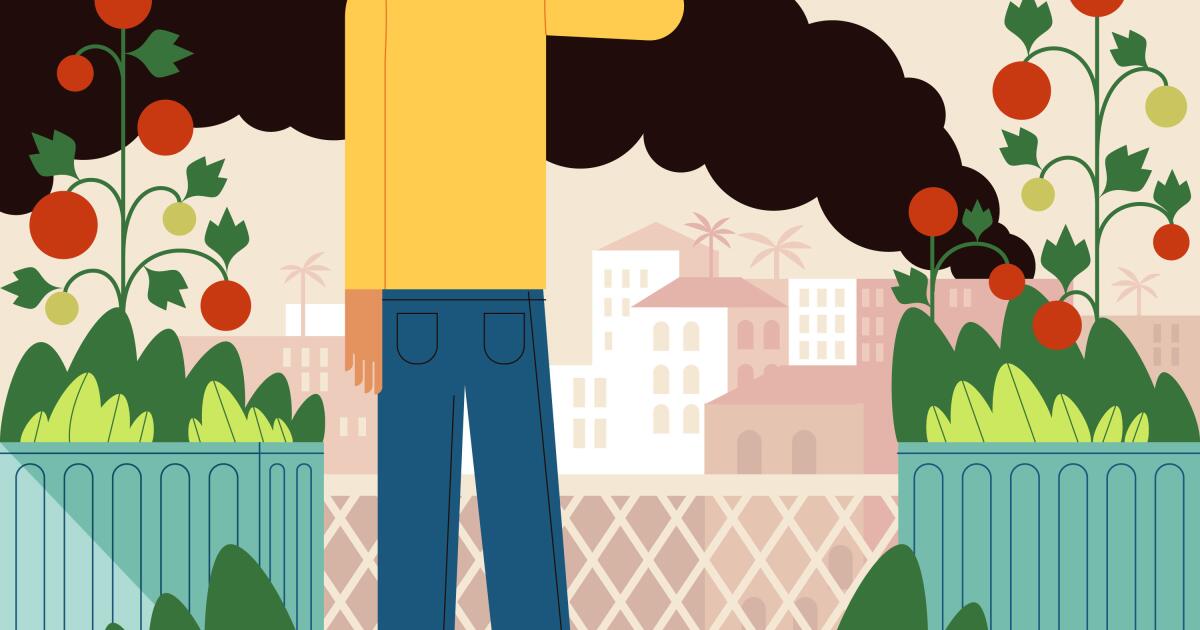
After the eight-day-long fire in a 500,000-square-foot Boyle Heights warehouse, eastern Los Angeles residents are contending with putrid smells, soot and potentially hazardous airborne chemicals after heavy plumes of smoke spread throughout the city. But those who grow food in nearby neighborhoods may also be wondering: How will the fires affect the plants and produce in my garden?
The Boyle Heights warehouse, owned by Lineage — a global temperature-controlled storage facility operator — housed 85 million pounds of frozen food and other products. In the days since the fire, local emergency visits for smoke inhalation and throat pain spiked while agencies still scramble to measure the amount of PM 2.5 — harmful fine particles — and heavy metals, like lead and arsenic, in the air.
According to researchers, any toxic airborne chemicals would likely stem from the charred foam insulation, metal exterior, burned solar panels and any lithium batteries that might have been present inside the warehouse.
After a fire, heavy metal particles can spread through ash and smoke over gardens and inhibit growth, said Olukayode Jegede, an agricultural toxicologist and assistant professor at UC Davis. Since the warehouse fire is so recent and cleanup has just begun, Jegede said the precise impact on gardens can’t be measured until comprehensive soil tests are conducted in the area.
While the L.A. city government hasn’t announced plans for soil testing, the Contaminant Level Evaluation and Analysis for Neighborhoods project at USC is offering free contaminant testing for Boyle Heights and East L.A. residents. Residents can collect soil samples and deliver them to Boyle Heights City Hall and other locations for an evaluation of lead, arsenic, chromium and mercury levels.
The good news is produce, plants and roots can still be preserved. According to Jegede, many of the soil tests conducted last year in the Altadena area after the Eaton fire showed that gardens and poultry were not as contaminated as one might expect.
“Quite a number of the soils we tested [in Altadena] were not really contaminated,” Jegede said. “We weren’t seeing many soils with concerning elevated levels of metal, so gardeners should not be too alarmed when these things happen.”
Nevertheless, there are several measures that gardeners can take to keep themselves, their children, plants and produce safe from potentially harmful contaminants stemming from the fire. Researchers, gardening experts and horticulturists offered some guidance on the handling, recultivation and cleanup that can keep you and your garden in good health.
How do I remove ash and contaminants from my garden?
Altadena horticulturist Leigh Adams said Boyle Heights plants and produce already live in a difficult environment, surrounded by industrial warehouses that spread contaminants daily.
“That area has been used industrially for 100 years, and the soil is impacted by many, many, many things,” Adams said. “Low-income neighborhoods and gardens usually don’t have a lot of resistance against dominant manufacturing.”
This means that the contamination of gardens in eastern L.A. won’t be as catastrophic as compared with those in Altadena, a more suburban environment, Adams said. But fallen ash still poses major health risks if ingested or inhaled.
An advisory from University of California Agricultural and Natural Resources last year recommended suiting up in an N95/KN95 mask, long sleeves, pants, close-toed shoes and gloves before attempting to deal with ash in the garden to limit exposure to potentially toxic contaminants. The advisory added that individuals should make sure all of this gear is cleaned thoroughly before bringing it back inside.
Once in the proper gear, Adams recommends removing the top two inches of topsoil from gardens, where the highest concentration of contaminants will settle after a fire. Using a plastic bag to collect the soil and disposing of it in the garbage — not green yard waste bins — will help to reduce the spread of airborne chemicals.
Gardeners with raised beds are advised to remove approximately six inches of soil, because excess ash can raise the pH level and prevent nutrients from soaking into the soil bed.
After this, watering the garden gently but plentifully will help to promote soil health and get rid of most of the ash present on plant leaves and stems. Adams said replacing the top two inches of soil with store-bought mulch or straw will help to contain any remaining ash and prevent it from spreading any further.
Experts say to avoid using leaf blowers if ash is present in the garden because they can send particles airborne. Doing so will increase the likelihood of heavy metal particles, which can carry lung irritants and carcinogens, being spread and inhaled.
A Boyle Heights resident keep a watchful eye on the fire at the 5,000-square-foot commercial building, which stores 85 million pounds of frozen food.
(Genaro Molina / Los Angeles Times)
Is it safe for me to eat produce from my garden?
Several studies, including one from the UC Cooperative Extension of Sonoma County, have shown that consuming produce in a fire-affected area poses minimal health risks.
Jegede said most root vegetables like potatoes and carrots, along with any fruit that has an outer layer, can be washed to remove potential contaminants, even if they were covered in ash. Peeling the outer layer of your produce can also help to reduce potential risks, he said.
Lettuce and other leafy foods with multiple layers pose a higher risk of contamination, but with a vigorous wash and peeling the outer layers, even the greens can be saved. The County of Los Angeles Department of Public Health recommends soaking leafy produce and fuzzy fruits like peaches in a 10% white vinegar and 90% water mixture.
Jegede said if the leaves or fruit are too delicate to wash or ash is still visible, it would be best to dispose of the produce.
How can I tell if my soil is contaminated?
After ridding your garden of visible ash, you might wonder how to tell if your plants will still thrive in the soil.
At-home soil tests that measure for alkaline, fertility and pH levels are widely available and can be purchased for $15 to $100 (for more detailed results) online. But Jegede said these tests can’t tell the full story of soil health.
Comprehensive soil testing is “something you can’t do properly at home,” Jegede said. “In labs, we are testing for metals like lithium and zinc, stuff that an at-home test will not show … If it comes to the point that you’re worried about your soil, I would just send it out to a lab.”
Wallace Laboratories in El Segundo, Babcock Laboratories in Riverside, Waypoint Analytical in Anaheim and other labs offer more detailed soil tests that measure heavy metal particles in addition to other fertility factors. Prices at Wallace Laboratories can range from $115 to $295 for a complete compost test.
The soil below two inches should be unharmed, Adams said, so long as new compost is set and plants are watered plentifully, which will promote natural biological cycles.
“What you’re doing is capping the soil, so that moisture stays in there, and instead of being dirt, it’s a living system called soil,” Adams said. “The more carbon we can get into our soil, the better.”
What can I do to help my soil recover?
For the last 12 years, Adams has been working with Metabolic Studio, a Los Angeles-based art and research hub focused on environmentalism, on methods for bioremediation, the practice of using additional fungi, plants and compost to decontaminate ash and break down contaminants.
Adams said straw, mushrooms, corn, rye and sunflowers are great bioremediators that can help to repair damage to soils. She said certain samples she’s worked on with Metabolic Studio have gone from testing at high heavy metal levels to nearly contaminant-free.
But for a more immediate fix, wash your produce, water your plants and have a little patience during ash cleanups. Your garden should look better in no time, Adams and Jegede said.
-

 Health2 minutes ago
Katie Couric couldn’t remember the year or the president during frightening brain episode
-

 Sports9 minutes ago
Justin Verlander announces he will retire after this season: ‘I’ve realized that time has come’
-

 Technology11 minutes ago
Apple AI security update proves hackers move fast
-
 Business16 minutes ago
Fire-damaged Pacific Palisades shopping center sets reopening date
-
 Entertainment24 minutes ago
Rhea Seehorn celebrates her ‘Pluribus’ Emmy nomination as she waits to hear about Carol and the atom bomb
-

 Lifestyle26 minutes ago
Urban Jürgensen: Introducing Elite Watchmaking to New Audiences
-
 Politics32 minutes ago
Commentary: On Skid Row, it’s been decades of frustration. Will the next mayor have a plan?
-
 Science39 minutes ago
What’s the deal with … coffee enemas?

