Lifestyle
Inside the secret poker games opening doors in L.A.'s art scene

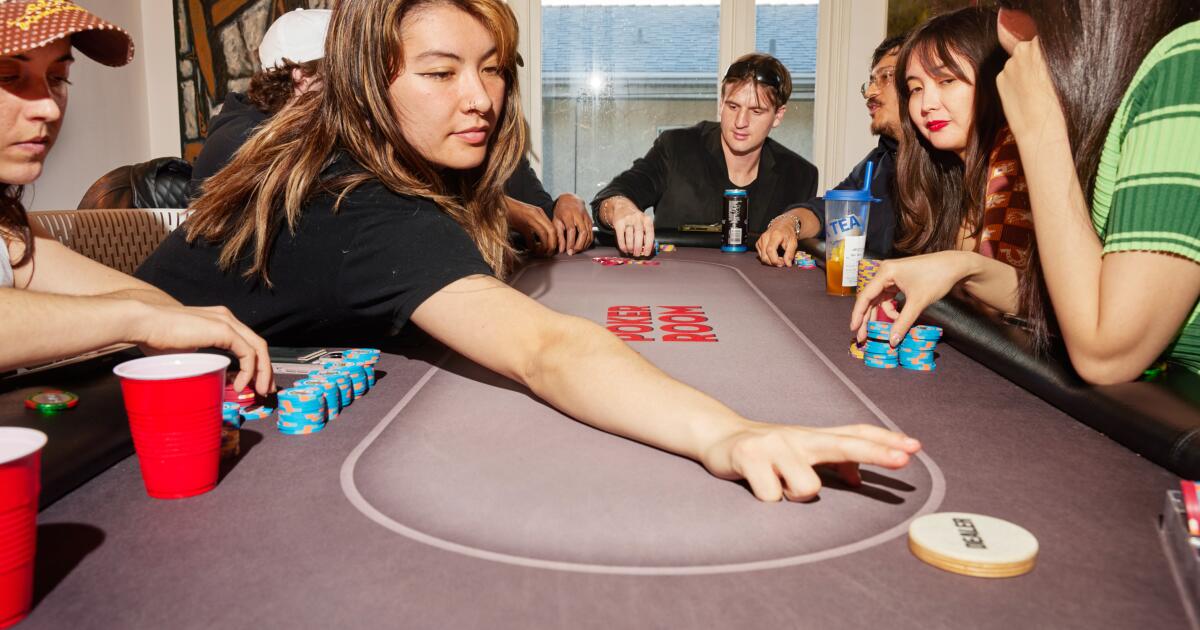
Artist Sarah Kim belongs to a poker group of up-and-coming art-world denizens. Part poker group, part art collective, they’re an equal mix of men and women, newbies and grinders, at varying levels of their creative careers.
Painter Sarah Kim realized soon after her move from New York to Los Angeles that learning Texas Hold ’Em would pay off. She’d heard whispers of an ultra-exclusive, high-stakes “art game” involving L.A.’s major artists, dealers and collectors going back decades. Trailing casino chip crumbs at gallery exhibits and artist studios, “It was clear to me that poker was a huge part of the art world in L.A.,” she said.
She tried her first hand at a game artist Isabelle Brourman hosted at Murmurs Gallery and soon fell in with an eclectic poker-playing group of local artists and curators. For Kim, whose landscape motifs tackle the anxiety of belonging, the felt-topped table became her social life raft and dealt her a newfound clarity and confidence.
“Being a woman in the art world, it’s like I’m playing the same game,” said Kim, who said thinking in bets has been one way to combat the volatile and, at times, cutthroat market. “I’m fighting for a literal seat at the table.”
Kim belongs to poker’s latest wave of underdogs pouring out from the creative cultural ferment. They’ve let the air out of the cigar-smoke-filled boys’ club and opened up the tables to a more diverse, inclusive and female-friendly pool of players. The storied L.A. poker scene — an obsession Tinseltown has self-mythologized since the Wild West — these days belongs to the emergent DIY art world. But the new guard has retained the fundamentals: a game as much about networking and camaraderie as card playing.
Poker is one of the few spectator games where the sexes compete on equal levels, yet 96% of professional players are men, according to the World Series of Poker. The series’ main event in Las Vegas last summer shattered the all-time attendance record of roughly 10,000 players. Still, it’s been nearly three decades since a woman made it to the final table.
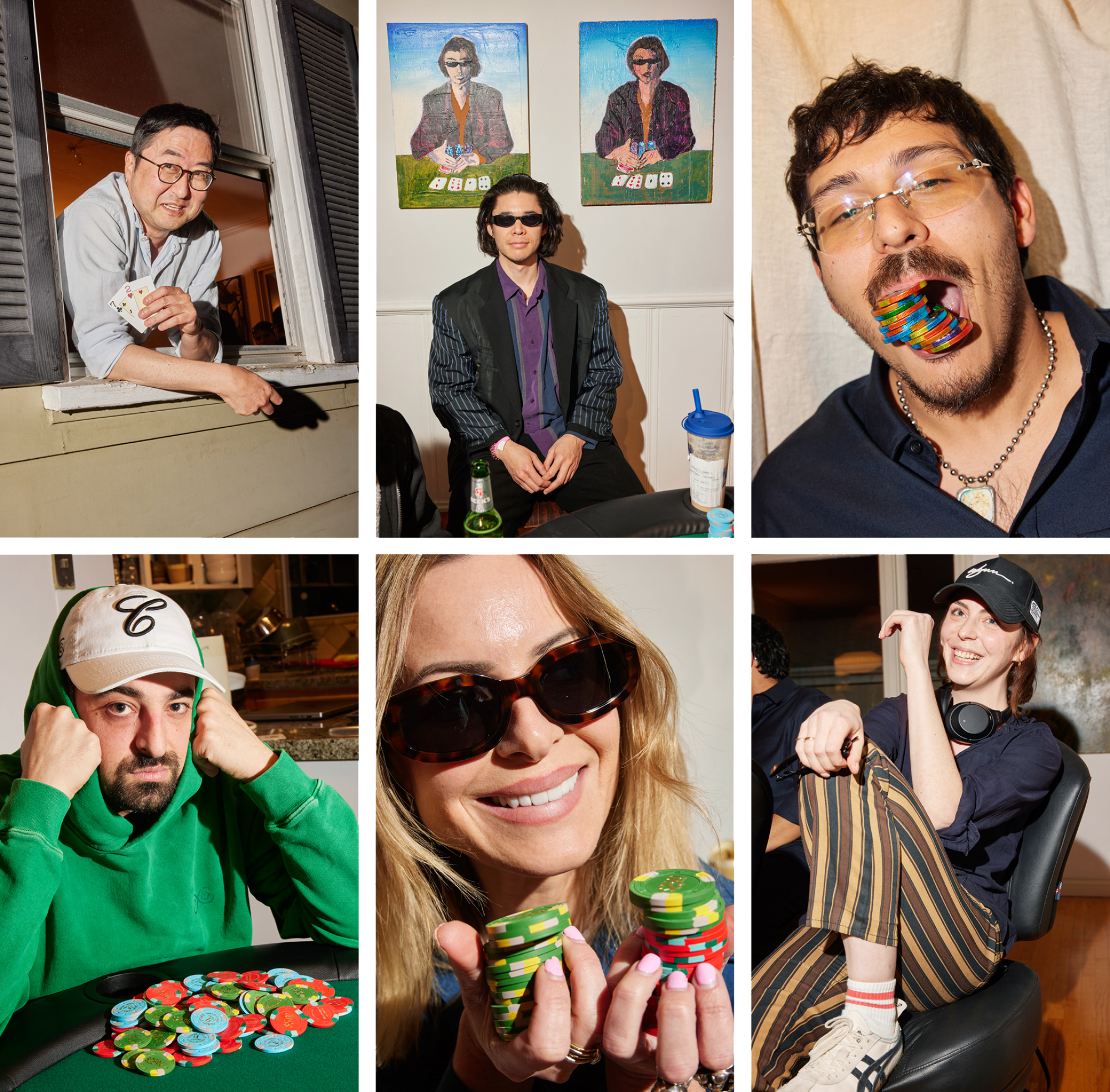
Top row: Gallerist Eric Kim, left, a poker mentor to dozens of early-career artists; Parker Ito, flanked by two self-portraits; and artist Higinio Martinez, devouring chocolate poker chips. Bottom row: Art collector Jason Roussos, left, “#Girlboss” author-turned-venture capitalist Sophia Amoruso and Lauren Studebaker, who helped organize her poker group’s DIY exhibit “At Home in the Neon.”
“Poker is not necessarily a hobby for the frugal, which is also why I think women haven’t historically played,” said Bita Khorrami of Casinola, which outfits sleek, private poker games for the cultural in-crowd. Her collaborator, Eddie Cruz — who started the streetwear boutique Undefeated — taught her the game on the promise that she’d become a better businesswoman. Khorrami, who cut her teeth in music and sports management, said it was the financial edge she needed. “When I have to counter someone in a negotiation, I’ll take a percentage of the money” from the playing funds, she said, which informs a raise, call or fold. “Whatever you’re gonna do is by percentage,” she said of bankroll management. “And the more you do those things, the more comfortable you are with it.”
Now, she and Cruz are going all in on Casinola as the first-of-its-kind creative collective and lifestyle brand rooted in poker. She joined on one condition: to not be the only woman in the cardroom. “My mission is going to be to bring women to poker,” she recalled telling Cruz. “Poker degenerates want to play with other poker degenerates,” she said. “They don’t want to be taking time necessarily to teach someone.”
They enlisted Jason Roussos, an art collector and pokerhead, to help retain their brand of backroom chic while also selling the idea of empowerment. “When things become too heavy or too reliant on one type of energy,” like the hypermasculine bro kind, he said, “that energy can take over a space.” Having more women brings a dynamic shift to the table, and lowering the barrier for entry often begins with smaller buy-ins with proper setups and dealers. Female-only live games are another incentive, like the time Casinola sponsored a poker night for Girls Only Game Club. “People sometimes use poker as a vice or form of escapism, but we’re using it as more of a socializing tool,” Roussos said.
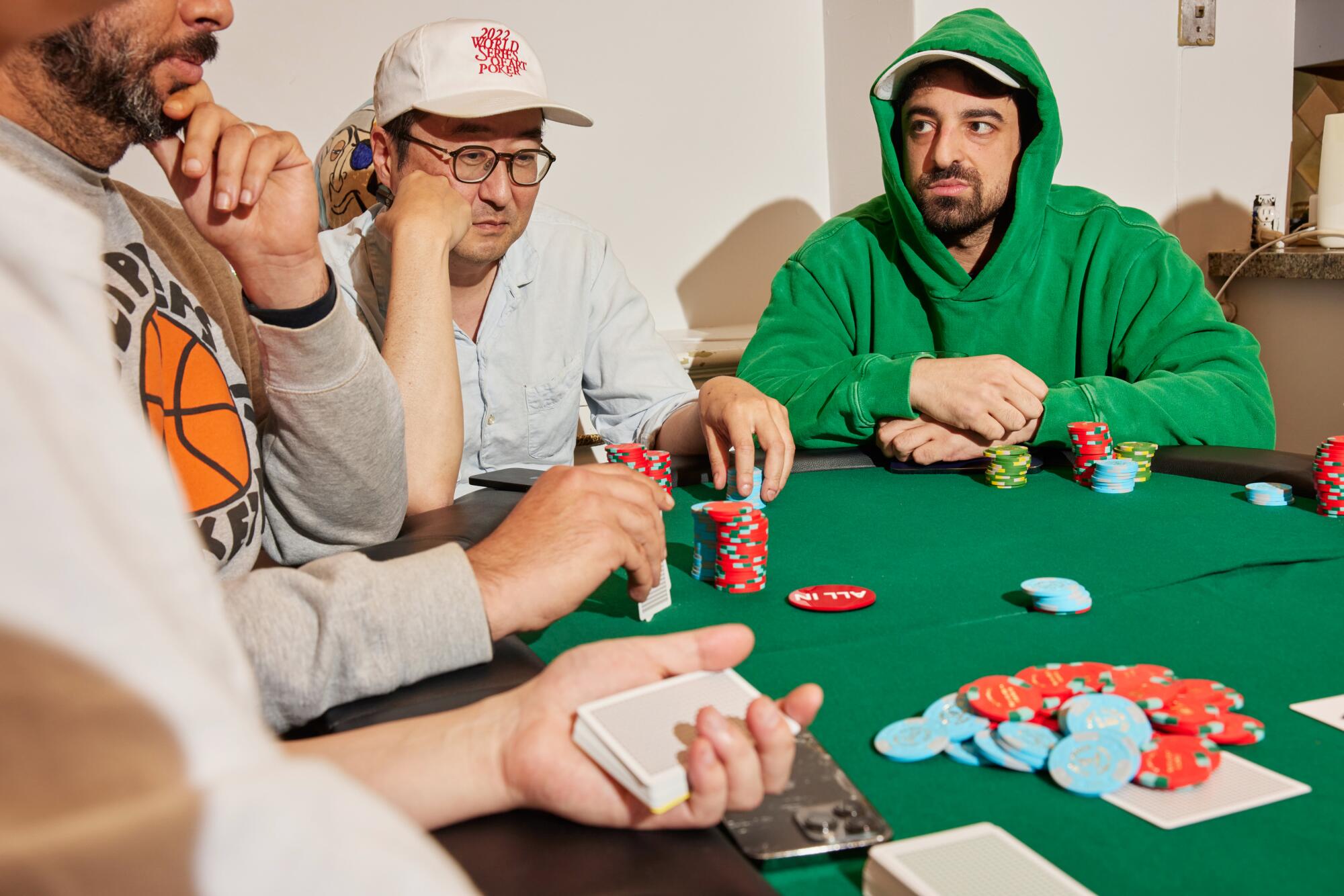
From left, ceramics artist Grant Levy-Lucero, gallerist Eric Kim and collector Jason Roussos are veterans of the high-stakes L.A. poker scene. These days they have more fun playing with their art-world friends, with Kim’s house as a hub.
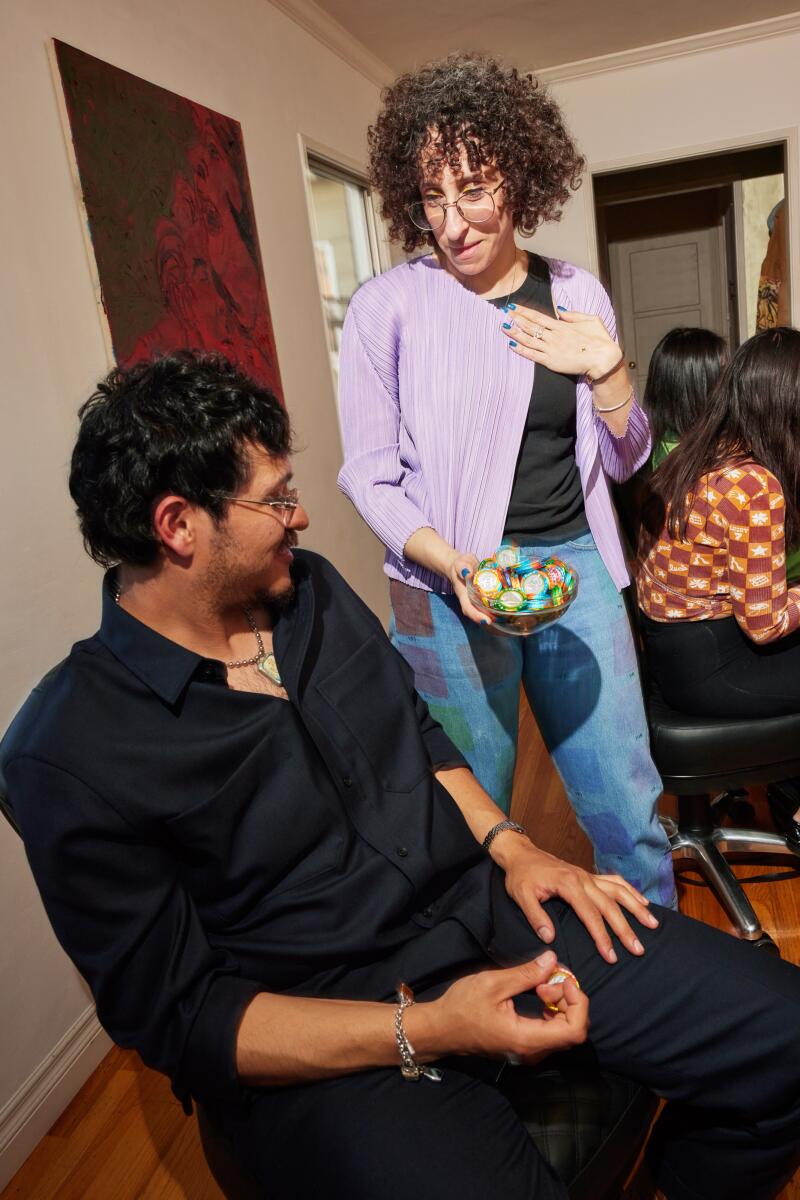
Higinio Martinez and Liz Conn-Hollyn were among the 15 artists who contributed to the poker-themed group exhibit “At Home in the Neon,” held at Eric Kim’s house gallery.
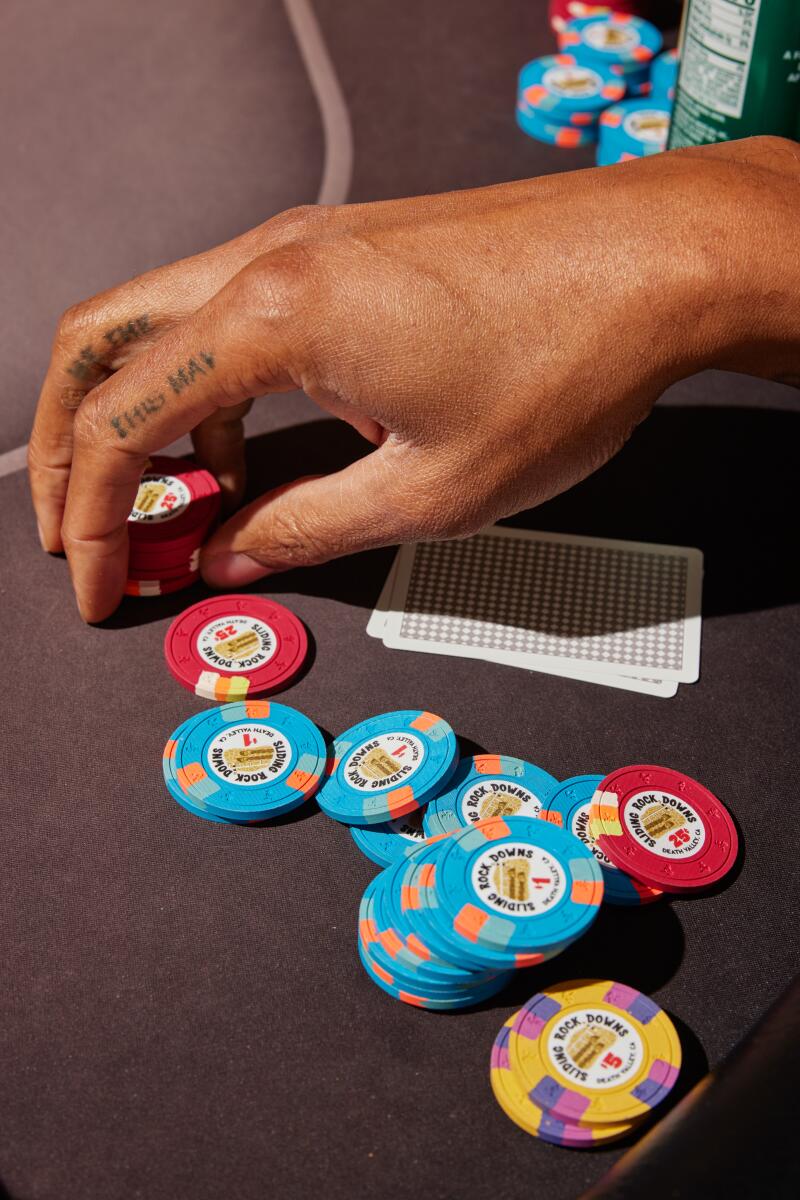
A fraction of gallerist Eric Kim’s collection of 40,000 poker chips.
Eric Kim, who co-runs artist spaces Human Resources and Bel Ami, estimated “poker and art went gangbusters” when online gaming swelled early in the pandemic. After stay-at-home orders lifted, however, he noticed a low-grade culture shock among his friends at crowded openings and art parties. “I think a lot of people enjoyed the contained structure of socializing at a poker game,” he said.
He’s opened his doors to the arts community in the last couple of years, doling out free one-on-one coaching and hosting weekly Hold ’Em nights as a kind of league mentor. The home games draw from his years at casinos and underground venues around L.A. His collection of 40,000 poker chips helps too.
His Silver Lake setup is an equal mix of men and women, newbies and grinders, at varying levels of their careers. Turns out his learning pod had the makings of an artists collective. Kim and Lauren Studebaker, an associate director at Matthew Brown Gallery, staged a poker-themed group show last month. They exhibited work from 15 poker-playing artists around the domestic gallery and called it “At Home in the Neon,” a crib from art critic Dave Hickey’s love letter to Las Vegas.
Julianne Lee, a perfumer, infused plaster chips with a rare scent derived from whale vomit and called it “Who’s the whale” (a reference to a very rich but very bad poker player). Adam Alessi’s good-luck shrine had a rendering of Vanessa Rousso, nicknamed “the lady maverick of poker,” inside. Jake Fagundo’s “Bad Beat” depicted a couple in a warm embrace after a tough loss. “A lot of it was inside jokes for ourselves,” said Studebaker, who paraphrased a wry quote from “The Gambler” by Fyodor Dostoevsky: “You gamble with your friends because you like to see them humiliated.” The group has embraced how the game puts everyone on equal footing. “Losing in front of these people is a fast track to bonding,” she said. “I think the losing has been almost better for me than the winning.”
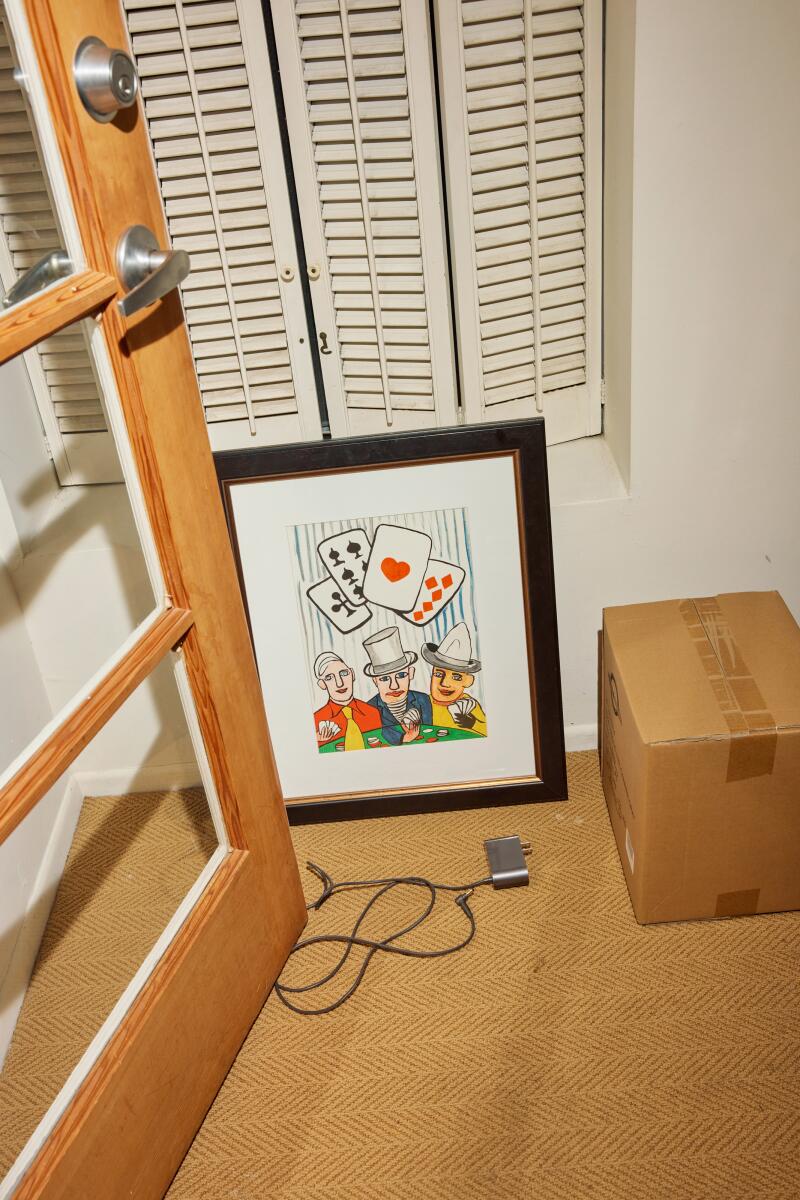
A stray Alexander Calder lithograph of three card players.
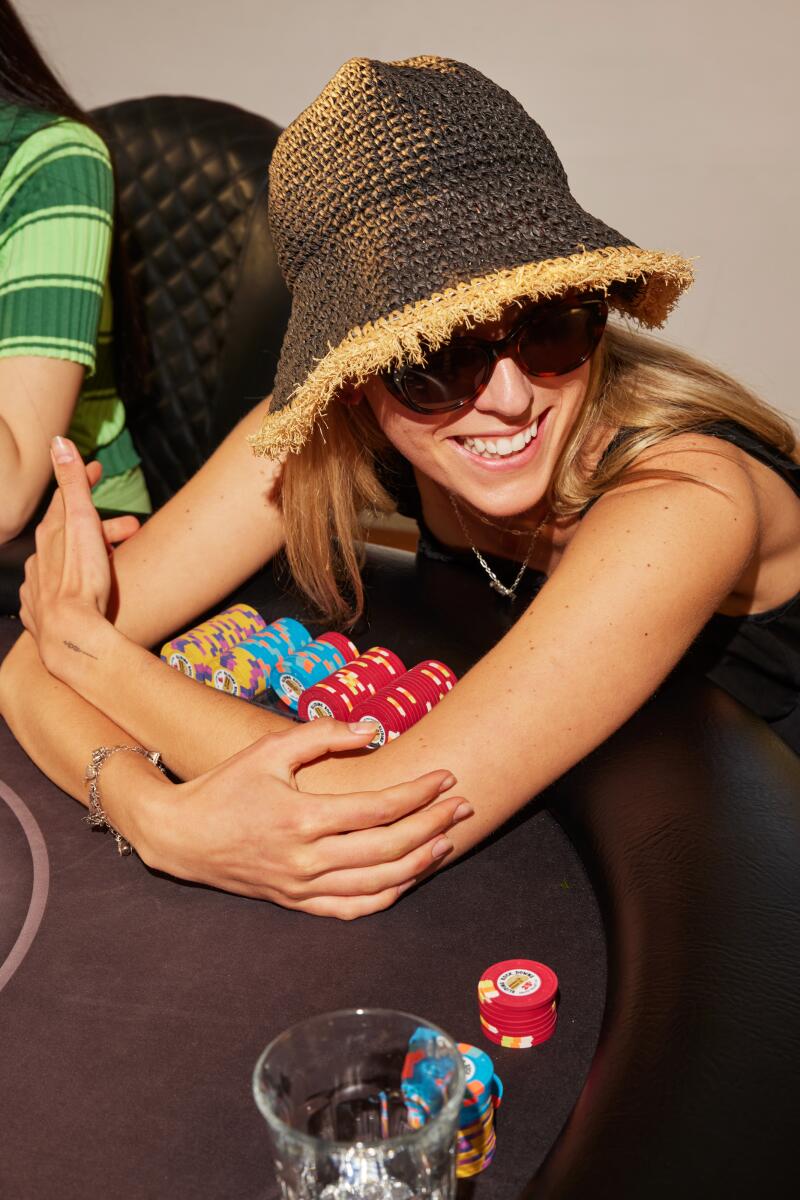
Artist Ava McDonough, another contributor to the poker-themed group show, hugs the pot.
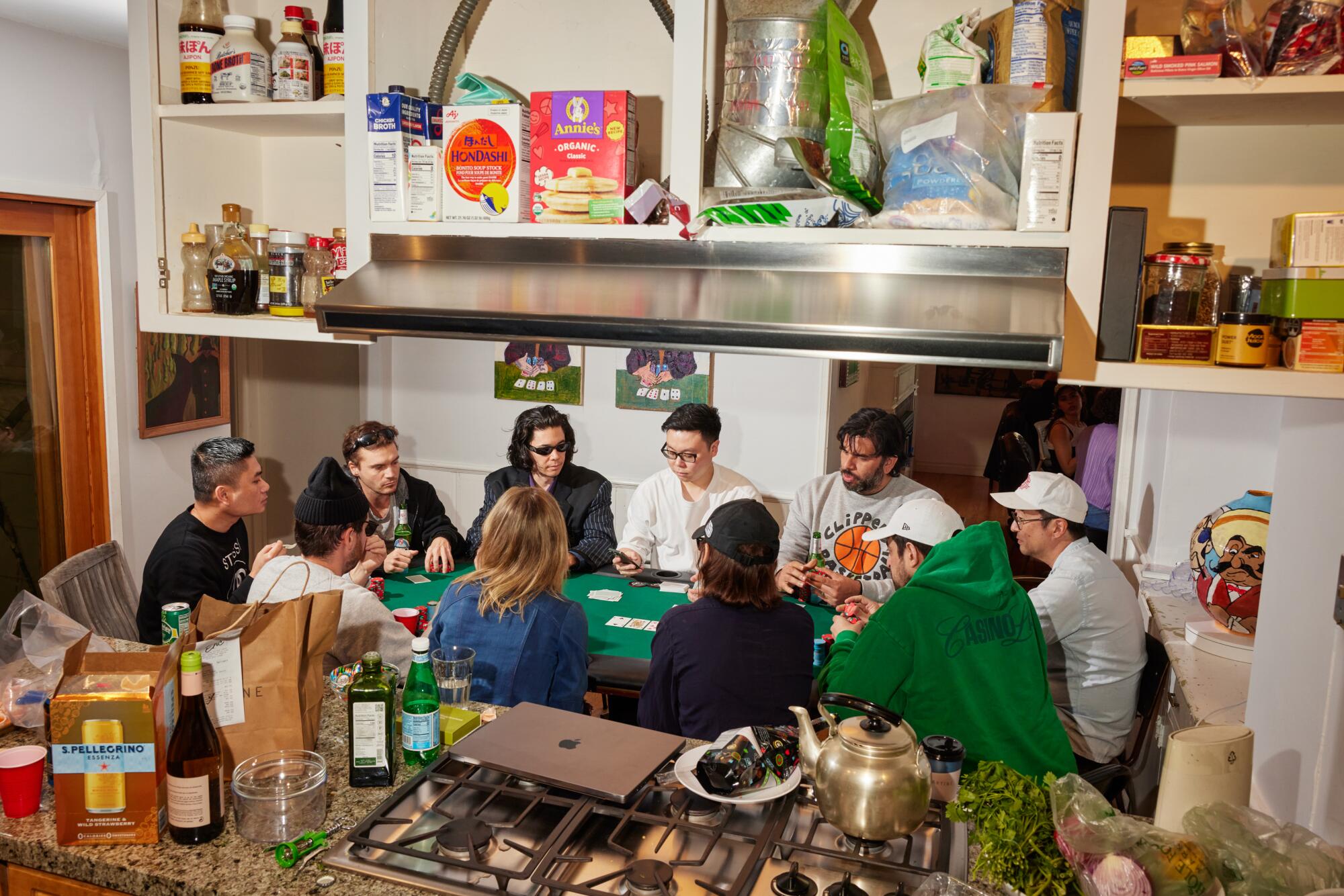
The crowd in the kitchen, including collector Khoi Nguyen and actor Emile Hirsch, at gallerist Eric Kim’s poker game, held at his home. Artwork by Adam Alessi, left, Parker Ito and Grant Levy-Lucero surrounds the table.
The scene’s marquee event today is the annual World Series of Art Poker (WSOAP), a highly guarded, 12-hour Hold ’Em marathon during so-called Frieze Week, when blue-chip galleries and high-rolling collectors jet into town for art fairs and their ensuing parties. “I look forward to it all year,” said artist Parker Ito, who at last year’s heads-up showdown lost to Jason Koon, arguably the best pro poker player today.
At the fourth WSOAP in March, Jonas Wood, “the reigning prince of contemporary painting,” screamed the ceremonial, “Shuffle up and deal.” His Warholian grasp on the art world was on full display as he glad-handed arrivistes from New York and Europe, clad in a sweatsuit made of cash (taken from Warhol’s silkscreen “192 One Dollar Bills,1962”). “This is my conceptual art project,” Wood said of his stylized homage to the early-aughts poker boom, when he came of age in the glow of the 1998 gambling movie “Rounders” and ESPN’s breathless tourney coverage.
Inside, Benny Blanco had his barber give him a lineup at the table. Tobey Maguire busted early but stayed to sweat the last hand of his friend Leonardo DiCaprio. Beyond the $500 buy-in, entry into the stacked poker den has become its own kind of currency, where talk of bad beats and mucked hands replaces the usual industry chatter. The last player standing wins $30,000 and a holy-grail 18-karat gold bracelet modeled after one awarded to the winner of the World Series of Poker.
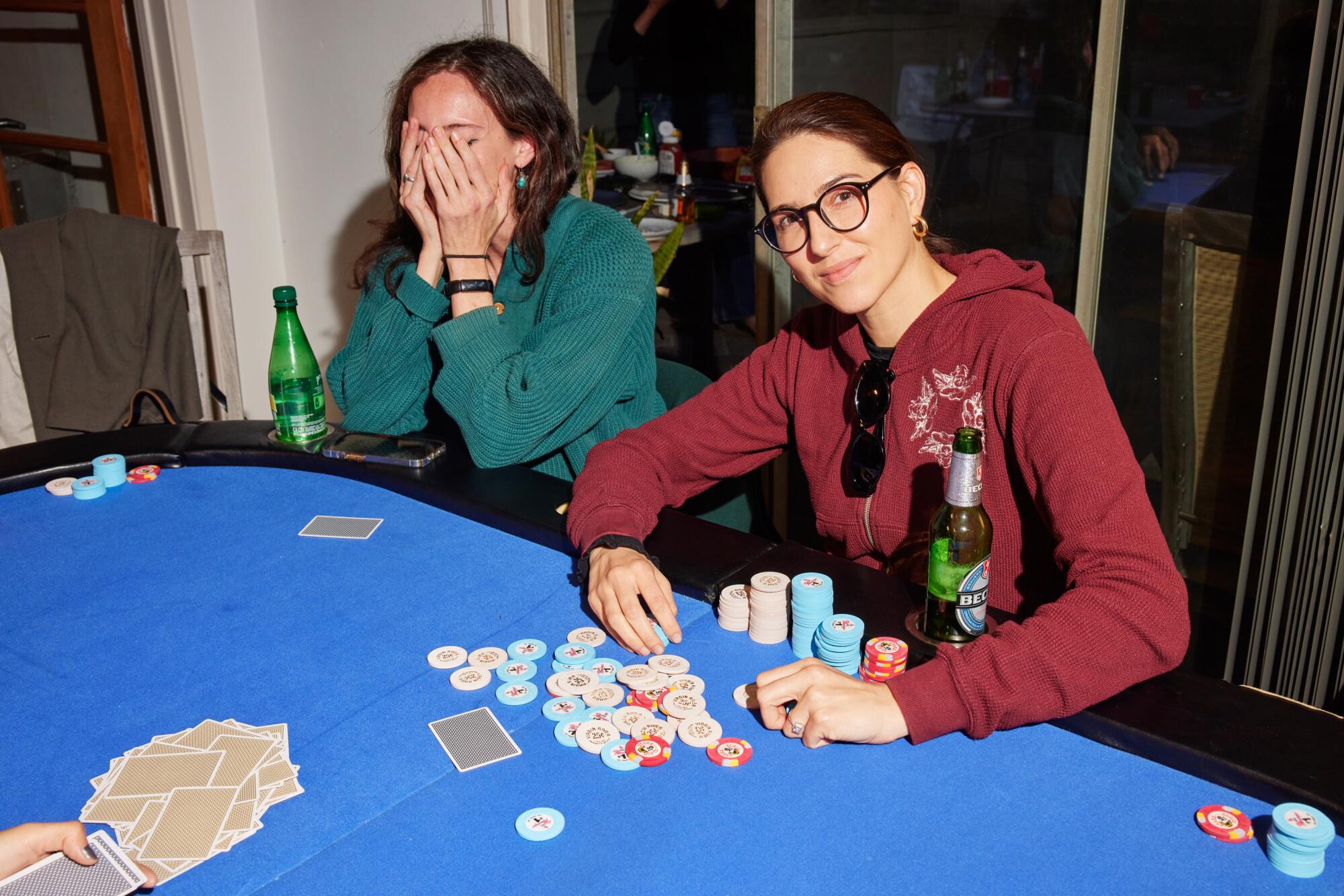
Artist Nihura Montiel has a sly poker face after winning.
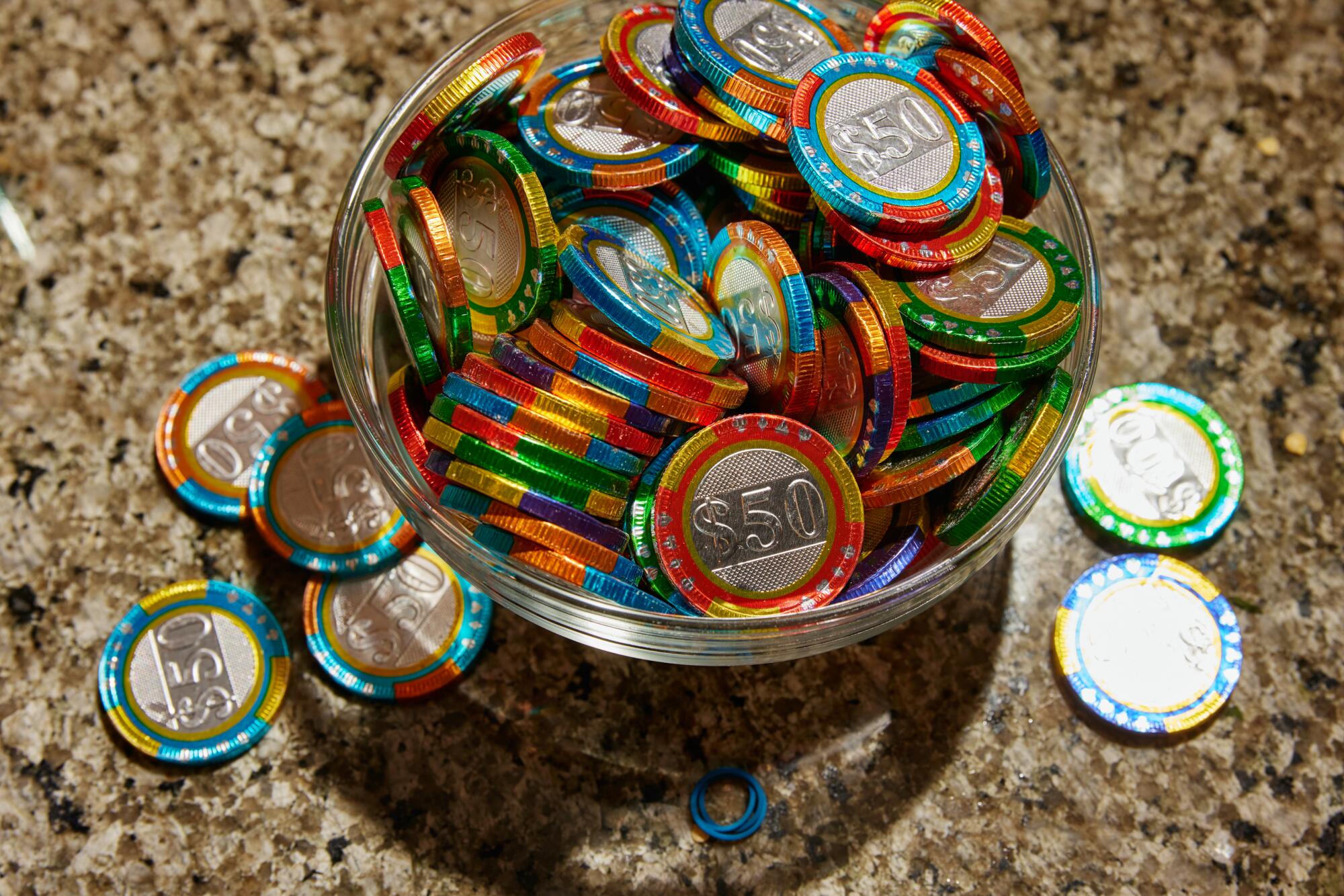
The biggest bluff of the night: chocolate poker chips.
Sophia Amoruso made it to the final 25 out of 130 entrants. “Poker has taught me more patience than anything,” said the Nasty Gal founder and “Girlboss” author, now in venture capital. She’d recently started her own home game after playing after-hours at tech conferences and in VC circles. “To be at the table with the guy who founded Hustler Casino Live, that’s priceless,” she said. “Next week, he’s coming to my house, and I get to learn from him.”
The tournament’s brain trust — Jonas Wood, Eddie Cruz and Eric Kim — rounded up their splinter poker groups to join forces in 2020. “The idea was to find out who’s the best,” Wood recalled. They’d piggyback off Wood’s fabled “art game” in the studio he rented from Ed Ruscha between 2007 and 2017, a revolving door for the city’s “art illuminati,” as Kim put it. Gallerists like Jeff Poe and François Ghebaly rubbed elbows with celebrities like Ellen DeGeneres and Jack Black, and emerging artists faced off against billionaire collectors with increasing regularity.
This year, with past pros like Erik Seidel and Phil Ivey absent from the usual “pros versus Joes” lineup, Wood livestreamed the final tables on Instagram to his 154,000 followers and saw the chance to make good on his original idea to organize the only tournament of its kind — for artists, by artists. He envisioned a wild-card upset winning the biggest pot of their life. It almost happened.
The final 10 players included artists like up-and-coming painter Ross Caliendo, sculptor Matt Johnson and Wood’s ceramist wife, Shio Kusaka. The crowd roared when she was busted out in eighth place — the last woman and artist standing. Michael Heyward, chief executive of the holding company that owns Genius and Worldstar, went on to win. “I really wanted a broke artist or some unknown person to win $30,000,” Wood said.


Paul Tremblay has made a career of pushing the horror genre – and the novel format – in strange and exciting new directions.
In his latest, Dead but Dreaming of Electric Sheep, the author offers an amalgamation of genre elements that can be best described as psychological-dystopian-science-fiction horror. It’s a mouthful, but the narrative does all of that and more in a way that defies categorization.
Julia Flang is a former semiprofessional gamer working two mediocre jobs she dislikes and living in a modest ranch house in a San Fernando Valley suburb with her retired uncle, whom she calls Uncle Fun. Julia likes movies and gaming but there’s little else going on in her life, so when her estranged mother, the CFO of a large tech company, contacts her with a possible job offer – a “once-in-a-lifetime thing” that pays handsomely just for doing the interview – she hesitantly agrees.

The job is relatively simple and perfect for someone with gaming skills: using a controller built into a phone to get a man, who is stuck in a vegetative state, from California to the East Coast. It will require her to learn how to control his body – walking, moving, sitting, standing, using his arms – so she can maneuver him out of the facility where he is located and into cars and planes and through crowded airports. A fan of movies, Julia decides to call the man Bernie – after the movie Weekend at Bernie’s. When the ethics of the job start to bother her, Julia realizes it’s too late and she must go through with it. However, she’s soon contacted by people interested in sabotaging the whole thing, people who, like her, don’t align with the shady interests of conglomerates and those set to make “gobs of money” from this new, somewhat inhuman technology.

As with every Tremblay novel, any synopsis barely scratches the surface. The novel’s chapters alternate between Julia and you (yes, you). Julia’s chapters are “normal” in the sense that they obey a chronological order and have action, basic descriptions of movement and places, and dialogue. The chapters in second person are like fever dreams from a shadow world; the desperate experiences of a man trapped inside his own body with no control of it, no clue what’s happening to him, and only a few fragmented memories of his life. Also, Tremblay uses a similarly fragmented style of storytelling (including words and sentences trapped in boxes and/or “moving” on the page) to keep things interesting but also confusing and creepy.
This novel operates on several different levels and – planes of existence? Bernie has a head full of AI that controls his body, but his consciousness is still there and struggling to regain control, struggling to remember things. There are monsters, leeches, mysterious rabbits, and eerie shadows in his world, but the true horror comes from the lack of control, from being moved around against his will and having no clue what comes next. Bernie is the embodiment of losing control to AI, and when taken together with the commentary of creativity and AI and the meta interludes in which the author takes a wrecking ball to the fourth wall and addresses readers, this is the best anti-Generative AI story horror has produced so far.
Despite the horror of it, this is a very funny novel. Julia is sarcastic and struggles to keep her comebacks in line, but the conversations she has and messages she writes are always entertaining. However, the humor is far from the crown jewel here. That title belongs to a plethora of big ideas Tremblay juggles. The nature of life, death, and consciousness, the evils of conglomerates, inhuman practices in the name of capitalism, and AI, and even what it means to be human are all explored here: “Is Bernie alive? Is he feeling pain? Is he experiencing everything as a prisoner looking through the bars of his body? Has his consciousness been winnowed to a metaphysical keyhole? Where does consciousness begin or end?” There are no definite answers here, but the way Tremblay infuses humanity, love, the importance of relationships, and humor throughout the narrative provides the kind of answers that can’t and don’t need to be spelled out.
A genre-bender full of big ideas that constantly switches between a world full of real or uncomfortably plausible nightmares and a bizarre hellscape in which loss of self, memory, and autonomy are only the tip of the proverbial iceberg, Dead but Dreaming of Electric Sheep is a horrific and terrifyingly disorienting novel that invites readers to consider a future that already started. Tremblay has always been an innovator, but this beautifully written collection of real and imagined grotesqueries cements him not only as one of the most original and exciting voices in horror but also as one of the smartest, most engaging authors in contemporary fiction.
Gabino Iglesias is an author, book reviewer and professor living in Austin, Texas. Find him on X, formerly Twitter, at @Gabino_Iglesias.


Give a girl a bow and arrow, take her to the woods, and anything feels possible.
That’s what I was thinking as I positioned myself in front of bales of hay in an open field at the Woodley Park Archery Range in Van Nuys. Channeling my inner Katniss, I took a “power stance:” shoulders back, legs slightly bent, bow cradled in my upper body. I slid a small but fierce-looking arrow bearing orange feathers onto the bow “nock,” filled my lungs with air, then heaved the tense bowstrings back to my jaw, one eye closed and the other narrowed in concentration.
Then I did what often feels impossible for me: I let go.
-
Share via
The arrow hurdled forward, unleashing an audible woosh followed by a distant thwack. I missed my target entirely, stabbing the hunk of hay more than a foot away from the bull’s-eye. But the feeling of release as the bowstrings were left vibrating in my arms was palpable, intensely satisfying.
This was Mindful Archery.

Angie Fadel, founder of Soulcare, leads Mindful Archery.
(Eric Thayer / Los Angeles Times)
The seemingly militaristic act of archery and peaceful meditation may seem diametrically opposed. But at Angie Fadel Soulcare, they make perfect sense together. Fadel leads workshops in Mindful Archery that combine meditation, somatic practices such as breathwork, immersive nature therapy and archery instruction.
The idea, Fadel says, is for participants to gather in a healing nature setting while becoming mindful of something they want to either let go of (an unfulfilling job or toxic relationship, for example) or something they’re aiming for and want to bring into their lives. Fadel leads a short guided meditation at the start of the workshop for participants to relax and get grounded, followed by a nature walk so they can further sink into the moment and become clear on what, exactly, their targets will be for the day — what they’ll be shooting for, or at. Then participants draw their individual targets on paper with colored markers that Fadel provides.

Attendees hold up their targets during a Mindful Archery class.
(Eric Thayer / Los Angeles Times)
One target might look like an abstract drawing representing a feeling, another might be a jumble of words and symbols such as “Love,” “$” and “Health.” Or an illustration of Donald Trump, as one past archer aimed for.
“I’ve seen everything,” Fadel says. “People have put their parents, their exes, people have put rapists — the most damaging things that have happened to them — on a target because if you can hit that thing, it feels better in your body. The same thing happens when you hit something good, it’s a hopeful mechanism in the body.”
Fadel’s archery instruction is as much about how the sport feels in the body as it is about technical precision. The slow and steady, intentional steps of deep breathing, taking aim and shooting at a carefully considered target is a powerful act, she says.
“Even if the arrow doesn’t go where you want, there’s this immediate thing that happens in your body that feels good,” Fadel says. “When you let go of that string, there’s an energy, there’s a movement — actual, physical energy moves. Something magical happens. It helps the things that are stuck in the body get unstuck. It’s somatic. Then it’s an extra bonus if you do hit your target, because the slap of the paper feels even better.”

Angie Fadel readies bows.
(Eric Thayer / Los Angeles Times)
Fadel, who lives in Portland, Ore., and calls herself “a soul-collaborator,” has a masters in spiritual companionship and spent a decade working as a pastor in a Portland church helping members find untraditional spiritual paths. She’s also been an archer for more than 15 years. She came to both practices — spiritual companionship and archery — separately before they organically entwined. Midway through pursuing her master’s in 2011 she discovered a friend was a master archer. She’d always wanted to learn archery, since she was a kid growing up in rural Washington, and she persuaded him to give her a lesson.
“It was just one lesson, but it changed my life,” Fadel says. “I was doing something that I’d always dreamed of doing. It unlocked something I didn’t realize could be unlocked.”

Targets pinned to a hay bale allow participants to take aim at what they want to bring into their lives.
(Eric Thayer / Los Angeles Times)
Fadel found archery increasingly therapeutic. She was doing a lot of introspective Jungian journaling at the time. As life challenges came up in her journaling — the stress of school or a difficult roommate, “or just society as a whole,” she says — she’d put them on targets in the form of words. Shooting at them helped her process the conflict. She thought the beneficial side effects of archery were particular to her, however. Then she took a struggling friend out for her first archery lesson and the response was profound.
“I realized, you know what? This works. I can take you from never touching a bow to your leaving with your nervous system relaxed. I thought: I have to figure out how to give this to other people.”
Now with Soulcare, Fadel conducts multiple types of archery workshops in Portland and around the country, including in Colorado, Texas and throughout California. She comes to Los Angeles to lead workshops several times a year. One workshop is a Mindful Archery class, not to be confused with her other course Meditative Archery, which involves Jungian journaling; and there’s a one-on-one archery session with spiritual guidance.
Empowering women and minorities, Fadel says, is a key part of her archery workshops.
“An archery range can be a very white, male-dominated space,” she says. “And the stance, with a bow and arrow in your hand, shooting — it’s very male. And [men] don’t have any problem, most of the time, taking up space. So it is a practice to remind ourselves, as a queer woman, a trans person, nonbinary person, anybody that’s kind of othered in our society, to be able to take up space. To adopt a power stance and be, like, I’m allowed to be here.”
Inside the Mindful Archery workshop
Our workshop began with gentle stretching in an open field. It was a cool, overcast day and as the wind rustled the tree leaves, a baby coyote raced across the lawn in the distance. During introductions, attendees shared why they were here.

Archery is about “letting go” and here, a student lets her arrow fly.
(Eric Thayer / Los Angeles Times)
“I’m actually a very anxious person,” said Rachel Clipper, 26, “so I’m always looking for something to help me feel more grounded and promote mind-body connection.”
Kati Lee, 29, said that as a “‘Hunger Games’ girlie,” she’d always thought archery was cool. “But what drew me to keep coming back was the mindful part of it,” she said. “My favorite part is that we make our own targets.”
During the nature walk, we ambled down a tangle of dirt trails as Fadel pointed out wild rose bushes, Aspen trees and elderberry, giving a recipe for syrup. When we came to a body of water in a clearing — the Woodley Park Wetlands — we watched as a majestic-looking cormorant stretched its wings in the distance.
“Think about what would feel good to either annihilate,” Fadel said as we returned to the range. “Or bring in, or let go of, or make peace with. You can put all of it on your target.”
And so we did. We hunkered down at a picnic table by the archery range for crafting and snacks that Fadel provided, every one of us falling into silent sketching and scribbling as we munched on peanuts and granola bars. It felt like summer camp.
Lee set her markers down. “Done,” she said, contemplating her target. It was adorned with words such as “Health,” “Love,” “Family” and “Friends” inside concentric hearts.
Yvonne Golomb, 70, said she’d done archery as a high school student in gym class. She was shy back then, but archery had made her feel bold. Now that she’s retired, she’s craving that feeling again and is returning to the sport for sustenance.
“It’s this nice memory, it made me feel strong, it was freeing,” she said. “Now that I’m retired I’m exploring it. I wanted to bring back those memories.”
When it was time for our archery lesson, Fadel conducted one last somatic exercise to loosen us up. She had us tap up and down our body parts, from our feet to our ears, before shaking out any remaining stress.
Then she coached us, individually, as we took aim at our targets in sets of three.
“Breathe, zero in on your target, OK, now smooth …,” she said, hovering over one attendee.
May Claire La Plante, 31, said she was doing archery today, in an “adaptive stance” Fadel had taught her, to build up her arm strength after a surgery.

Kati Lee, right, and Tristan Gonzales affix their targets during a Mindful Archery class.
(Eric Thayer / Los Angeles Times)
“I was feeling very frustrated that I couldn’t get it at the beginning,” La Plante said. “I didn’t even finish my arrows. But getting back up and the act of trying again — despite the injury and all the baggage that comes with it — is really empowering.”
“Bull’s-eye!” Clipper cheered nearby, her anxiety seemingly dissipated. She’d hit her target, dead center. What was on it? A labyrinth-like spiral of words with “Peace,” “Love” and “Creative Control” at the epicenter.
I wasn’t having as much luck and was missing my target repeatedly.
“Try loosening your grip,” Fadel coached. She adjusted my stance. “Now breathe.”
It seemed counterintuitive to slacken my grip given such a precise goal — to land a slender arrow in the epicenter of a black dot. But I did, letting the edge of the bow sit loosely, even wobbly, between my fingers. I took aim and shot. This time the arrow flew strong and straight.

One participant hit the bull’s-eye, which calls for “peace” and “love,” dead center.
(Eric Thayer / Los Angeles Times)
Another round later and it landed smack on the paper target, just above my bull’s-eye.
“See?” Fadel said, elated. “Archery isn’t about doing it right, it’s about repetition. The more you can be in your body, and relaxed with the repetition, the better you are. Rarely do I have someone not hit their target at least one time.”
She squinted at my target, then turned to me.
“It’s because they’re relaxed and it’s because they trust me,” she added. “And they learn to trust themselves more.”

-

 Detroit, MI3 minutes ago
Detroit Tigers tee off on New York Yankees with 5 homers in win
-

 San Francisco, CA13 minutes ago
Popular brewery shutters San Francisco location amid industry woes
-

 Dallas, TX18 minutes ago
Eight arrested after repeated attempts to enter World Cup matches without tickets
-

 Miami, FL25 minutes ago
Reports: Heat add potent bench scorer in Tim Hardaway Jr.
-

 Boston, MA28 minutes ago
Boston Pops gearing up for major July 4th celebration: ‘You only turn 250 once’ – Boston News, Weather, Sports | WHDH 7News
-

 Denver, CO33 minutes ago
Colorado wildfires destroy more than 100 structures, force more evacuations
-

 Seattle, WA40 minutes ago
Will Katie Wilson’s endorsements help or hurt Seattle’s position in Olympia?
-
 San Diego, CA43 minutes ago
Marine missing after training activity off San Diego is declared dead

