Lifestyle
‘I’m always plotting.’ Teyana Taylor and others on surviving and dressing for the chaos of awards season


Oscar campaigns are not won, they are endured. There are parties, festivals, For Your Consideration screenings, press junkets and talk show appearances. The night before the Academy Awards, I found myself — not an important person in the industry by any means — at two separate parties. Imagine if you’re a nominee, getting shuttled to and fro, shaking hands and making small talk. At the first event, I caught a glimpse of the legendary actor Minnie Driver, who was nominated for supporting actress for the film “Good Will Hunting” in 1998. She posed, smiled and looked as glamorous as ever. And, with an extreme amount of grace, she disappeared through a door in the back. Poof. Gone.
And like magic, she reappeared on the carpet right in front of me, at Chanel’s legendary pre-Oscar dinner at the Beverly Hills Hotel. She dazzled in a sparkling gown, a totally different outfit than the one I’d seen just an hour prior. After years of being in L.A., I’m not particularly starstruck anymore, but at this moment, I was something close to it. How does one glide through the chaos and the camera flashes of Oscar season with poise and perfection? And how do they keep a level head through it all?
It takes a strong will to be a star — to endure the setbacks and the struggles of making it in Hollywood. To stay on top, it takes even more. It takes a team. And one of the biggest members of any celebrity’s team is their stylist. The people who dream up the looks that sparkle at high-profile events, and who make sure that even if you don’t feel perfect, you at least look it.
Stylists are the consigliere, the therapist and the trusted right hand of any Oscar nominee. Without the stylist, Oscars season would look completely different, and probably a bit worse. How do they keep their clients from cracking under the pressure? “It’s just asking simple questions, like, ‘how are you doing today?’” I’m told by the buzzy celebrity stylist known as Turner. She’s the coolest celebrity’s go-to for fashion counsel, working with Natasha Lyonne and Kim Gordon of Sonic Youth. She says that a huge part of her job is “knowing that everything that is shared in that fitting room stays in that fitting room.” Because once you’re out of the fitting room and into an event like the Chanel dinner, the eyes and ears of the world are on you.
This year marked the 17th occasion of Chanel hosting its Oscar party, an event that insiders see as the last stop on the calendar before the big night at the Dolby Theatre. It’s co-hosted by British multihyphenate producer and entrepreneur Charles Finch, who presides over the affair with the charm and graciousness that typifies the best hosts. The Chanel dinner brings fashion, film and art together in an invigorating way. It’s both one of the most exclusive, sought-after invites in town and a jam-packed, raucous bash. Trying to make my way through the throng of movie stars, filmmakers and other luminaries was almost like an Olympic event. If they were handing out medals for not tripping over Mick Jagger, I should probably win gold.

Mick Jagger at the Chanel and Charles Finch annual pre-Oscar dinner at the Polo Lounge in Beverly Hills.
(Virgile Guinard / CHANEL)
Awards season itself is its own kind of gantlet. Millions and millions of dollars are poured into the sprawling motion picture economy of Los Angeles to drum up support for the year’s Academy Award nominees. Much of the economic health of the entertainment industry trades — Variety, the Hollywood Reporter, etc. — rely on the avalanche of ad spending and free content that comes from Oscar campaigning. The season just seems to get longer every year, creeping into the spring and summer months, with awards heavyweights like “Sinners” and “One Battle After Another” dropping mere months after the last Oscar ceremony. And as artificial intelligence and studio consolidation rock the business, the Oscars are an even more important barometer of the health of the movies themselves.
The demands placed on nominees, especially actors, are heavy. To be out in public, exposed and on display, in a fight for your professional life, you don’t just have to be charming, clever and witty in front of journalists and voters. You also have to look good for the gaggle of photographers that document your every move at events like the BAFTA Tea Party or the Essence Black Women in Hollywood Awards. Celebrities have to be prepared for the marathon at all times.


Lily-Rose Depp and Gracie Abrams at the Chanel and Charles Finch annual pre-Oscar dinner at the Polo Lounge in Beverly Hills. (Jon Kopaloff/WireImage)
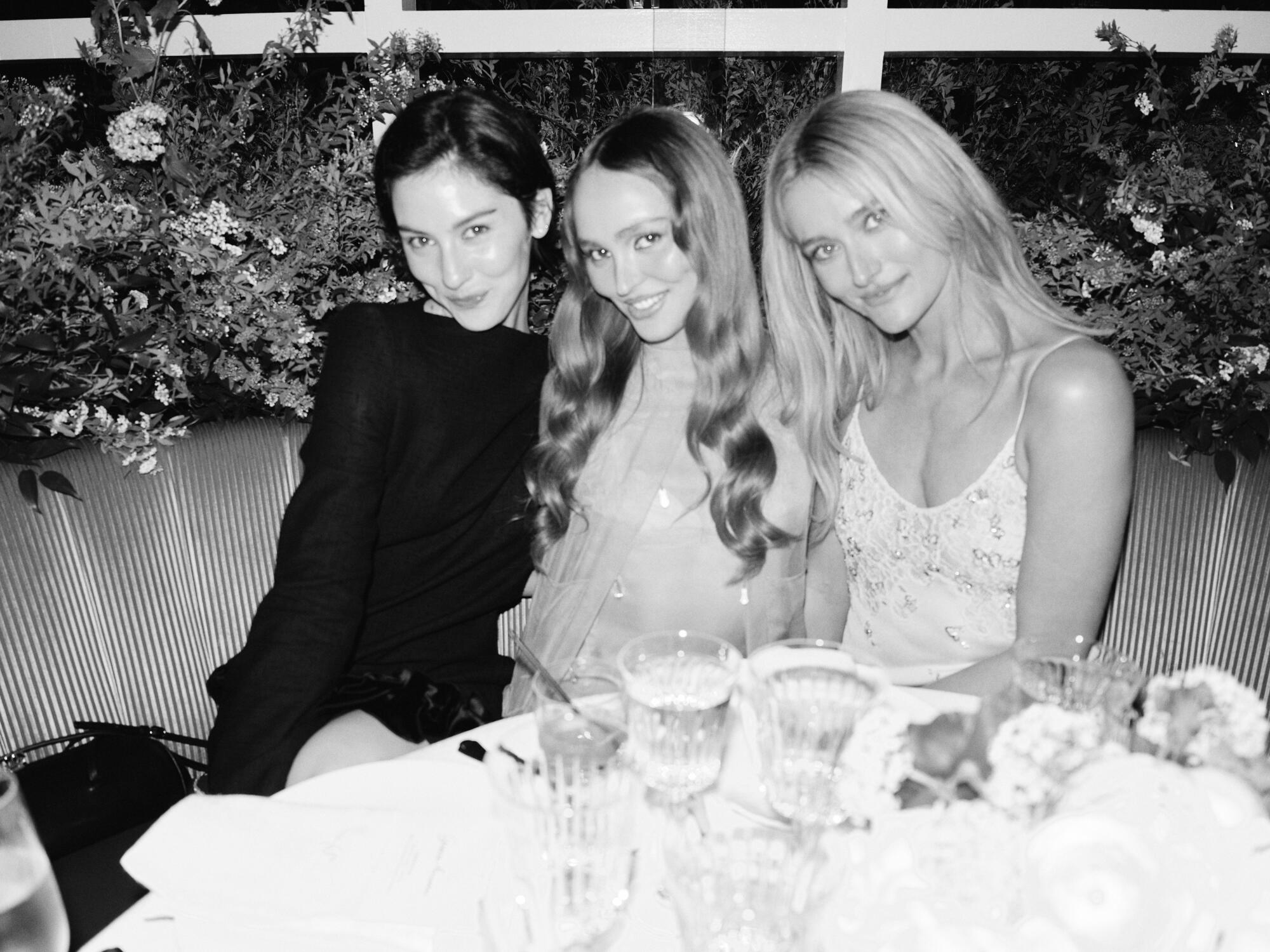
From left, Gracie Abrams, Lily-Rose Depp and Sarah Pidgeon at the Chanel and Charles Finch annual pre-Oscar dinner at the Polo Lounge in Beverly Hills.
(Virgile Guinard / CHANEL)
The conversation between stars and stylists begins early, often with collaborative meetings and moodboarding. Spencer Singer styles Chanel devotees Lily-Rose Depp (in a sleeveless vest embellished with pearls and rhinestones) and Gracie Abrams (wearing a beautiful black tweed dress). His process is extremely detailed and centered around the goals of the client. “With a particular project, you tend to go more thematic, or it’s just maybe the place that we’re both in in our lives of loving a particular aesthetic,” he says. “The most fun part is throwing everything against the wall and then pulling out the things that feel strongest.”

Teyana Taylor rocking a thrilling, multicolored shearling coat from the most recent Fall/Winter 2026 Chanel ready-to-wear collection.
(Jon Kopaloff/WireImage)
Sometimes, the client knows exactly what they want and makes the call on the spot. “I’m always plotting,” Teyana Taylor, supporting actress nominee for “One Battle After Another,” told me on the Chanel carpet. Taylor was rocking a thrilling, multicolored shearling coat — look 57 from the most recent Fall/Winter 2026 Chanel ready-to-wear collection. Taylor wore the coat fully buttoned up, ready to throw it off for a dramatic reveal later in the evening. She first saw the coat on the runway and knew immediately that she needed it. “I wasn’t even backstage before I was like, ‘The coat. I gotta get the coat.’ I knew that tonight would be the perfect night for it.”

“I really love this party, because it’s easy to see people that you admire and that you would love to work with,” says Sigourney Weaver of the Chanel pre-Oscar dinner.
(Jon Kopaloff/WireImage)
Sigourney Weaver has been nominated for an Academy Award three times and is one of the most accomplished veterans of the Oscar circuit. “It’s not a grind for me,” she said in a buttery yellow-and-black Chanel coat from Spring/Summer 2026. Weaver relishes the chance to dress up and embrace the glamour of the season. “I’m very informal in real life. I really love this party, because it’s easy to see people that you admire and that you would love to work with. The Oscars themselves are too formal, in a way, unless you’re backstage together.”
Weaver and Taylor both make it seem effortless, but sometimes, it’s not quite that easy. Alexandra Mandelkorn has styled dozens of A-list names (Janelle Monáe, Rachel Brosnahan and Laura Dern among others), helping them get through event after event looking their best. For Mandelkorn, styling is as much about storytelling as it is natural impulse. When starting a project, she asks, “Are we leaning into the character [they play in the film]? Is she an ingenue? Are we trying to have a resurgence or some sort of different look for her, and give her a new identity within fashion and the industry?” Once that’s laid out and the goals are clear, the story can be told. Clothes, like film, are a medium for creativity.
Stylists also have to get creative when things go wrong — and to make sure the cameras don’t capture a bad moment for eternity. “There’s so many things that can happen between the fitting and when you get to the carpet,” Turner says of the many perils of awards season. “Your dress can wrinkle in the car. Your strapless bra can drop four inches while you’re sitting in the car, and then you forget to, like, pull it up once you get to the red carpet. Did your strapless gown also fall when it was in the car, and you forgot to pull it up? And then you get to the carpet, and you look at the photos after, and you’re like, ‘oh, God, OK, noted for next time.’”
Mandelkorn tells the story of a perilous time where a strap popped off Monáe’s shoe. “She wouldn’t be able to walk with that,” she says. “It had to somehow be reattached. We ended up jerry-rigging it using safety pins. Thankfully, you didn’t see the shoe as she was walking.” Zippers can break, buttons can pop off, but stylists have to stay strong for their clients. “I keep upholstery thread in my kit because it’s so strong,” Mandelkorn said. “Generally when a zipper pops, it’s because it’s really tight. The girls love to be in a tight dress, so some of these zippers, they just give way. We make it work, and [fans] never know. You’d never know.”
The risks can be significant, and the rewards might not always come. Five people out of thousands of acting performances in a year can be nominated for an award, but only one wins. The uncomfortable shoes, flashbulbs and endless rides in rented cars could wear anyone down, but underneath all of the work, there must still be joy. Teyana Taylor said it simply: “I get excited because I love to wear clothes. I love clothes, I love fashion. I appreciate the art of it. I appreciate the fabric. I appreciate every garment.”

Nicole Kidman, left, and Teyana Taylor at the Chanel dinner. The spirit and beauty of the movies is alive and well.
(Virgile Guinard / CHANEL)
The attendees of this latest Chanel party were channeling all the joy they could muster before sitting for dinner. Even in a time that feels bleak, the spirit and beauty of the movies is alive and well. As I said my goodbyes and wandered back out into the lush darkness of the Beverly Hills Hotel, I thought about the end of another awards season coming to a close. Hollywood continues to undergo a transition that is shaking the foundation of the entire industry, the most important thing we can all do right now is just that. Appreciate the art of it.

Lifestyle
John Cena wanted to step away from the WWE ring before he became ‘too slow for the show’ : Wild Card with Rachel Martin

A note from Wild Card host Rachel Martin: First a confession: I have never watched a WWE match in its entirety. Don’t get me wrong, I appreciate the athleticism and the performance, it’s just not my thing. But there is something about John Cena I’ve never been able to shake.
Yes, he is a wrestling legend, but he has built a career as an entertainer that transcends the ring. The first time I saw him lead a cast was the 2019 family movie “Playing with Fire” and his rapport with kids in that film didn’t seem like acting at all. The man contains multitudes!
He co-stars with Eric Andre in his newest film, “Little Brother.”

Xie Miao and Yang Enyou in The Furious.
Norachai Kajchapanont/Lionsgate
hide caption
toggle caption
Norachai Kajchapanont/Lionsgate
There have been some fantastic movies released this year, and we know you can’t see them all. So we’re recommending four recent movies we missed that you should add to your watchlist: The Furious, Tuner, She’s The He, and Heresy.
If you need a few more fun film recommendations, check out these episodes:
Fun movies you may have missed
Our favorite movies on Tubi
We debate the best movies to watch on an airplane
Connect with Pop Culture Happy Hour:
Letterboxd / Facebook
Our weekly newsletter
Support Pop Culture Happy Hour+

A tarp covers the facade of the John F. Kennedy Memorial Center for the Performing Arts in Washington, D.C., on June 13. A federal judge has asked the arts complex’s leadership to explain the purpose of the tarp and the surrounding scaffolding.
Alex Wroblewski/AFP via Getty Images
hide caption
toggle caption
Alex Wroblewski/AFP via Getty Images
On Wednesday, the federal judge overseeing the Kennedy Center lawsuit ordered the center to give him a status report on the center’s operation and programming within the next few weeks. Judge Christopher R. Cooper also said that the Kennedy Center must explain the purpose and status of the tarp and scaffolding that have been placed over the front of the arts complex, where until recently both President Trump and President John F. Kennedy’s names were both displayed.
In a directive issued last Tuesday, Judge Cooper had given Kennedy Center administrators three days to update him on the arts complex’s immediate plans regarding construction, programming and public access. Trump, who now serves as the center’s chairman, had announced July 5 as the date the venue would close for major renovations.

Last Friday, on Cooper’s due date, lawyers for the Kennedy Center filed a request asking for an extension. In that filing, Matt Floca, who was promoted as the center’s president and CEO in March, said that the Kennedy Center’s current management intends to present its board with “an array of options” for trustees to vote on at their next meeting on an unspecified date in mid-July.
According to Floca, the options are a complete closure for extensive renovations; a partial closure “enabling some continued public access and limited programming” while some renovations are undertaken; and “a highly limited series of phased closures to address only the center’s most serious infrastructure needs while scheduling and maintaining a full slate of programming.”
In his newest order, Cooper denied Floca’s request for an extension. And he mandated that the center file a status report within seven days of the center’s July board meeting or by July 31, whichever date is earliest. He also ruled that the report must “indicate the purpose for and status of the tarp and scaffolding,” which were erected by workers over the center’s front signage in the early morning hours of June 13.
When asked for comment Wednesday, the Kennedy Center pointed back to the documents its legal team submitted to the court.
The tarp and scaffolding on the center’s front portico went up after the Kennedy Center’s administration slow-walked the court-mandated removal of President Trump’s name from the front of the center and from all digital materials, which was supposed to happen no later than June 12. Workers removed the lettering overnight into the following morning, hours after the federal court’s original deadline, and covered the center’s sign with a tarpaulin.
As of Monday, the sign remains hidden from the public.

Trump’s name was scrubbed from all of the Kennedy Center’s digital content on June 4, the same day an email order to do so was issued by the complex’s legal team; NPR obtained this memo the day it was sent out to Kennedy Center staff.
These court orders are part of the ongoing lawsuit filed by Rep. Joyce Beatty, D-Ohio, against President Trump and the board of the Kennedy Center. Earlier this year, Cooper ruled that Beatty, an ex-officio member of the Kennedy Center board, must be allowed to participate in board meetings. NPR has asked Beatty if she plans to vote at the July board meeting, but did not receive an immediate response.
It would be very difficult for the Kennedy Center to revive a thriving programming lineup for the months ahead. Over the past year, many prominent artists canceled their planned appearances, citing the politicization of the venue. Most of the center’s programming staff have departed, either via layoffs or resignations. Unlike top administrators at other major performing arts venues around the country, Matt Floca has no experience in artistic direction, fundraising or arts administration; formerly, he was the center’s head of facilities, and he holds a bachelor’s degree in construction management.
Established artists who typically perform at the Kennedy Center generally have their touring schedules set at least a year in advance, if not multiple years ahead. In years past, the center has publicly announced its upcoming season in mid-spring for performances beginning in September and running through the following summer.

Currently, only a handful of outdoor free movie screenings of nostalgic favorites like The Princess Diaries and Clue appear on the center’s calendar of events, along with some participatory workshops for kids. In the past, the Kennedy Center presented over 2,000 arts and education events each year.
The center also recently became ensnarled in litigation with one of its longtime tenants and artistic partners. On June 12, the Washington National Opera, a company formerly in residence at the Kennedy Center, sued the complex for $17 million. It claims that the Kennedy Center had withheld “years’ worth of donor gifts, bequests and endowment funds” that had been intended specifically for the WNO.
-

 Health28 minutes ago
Does Berberine Aid Weight Loss? The Best Time To Take It To Boost Results
-
Lifestyle43 minutes ago
John Cena wanted to step away from the WWE ring before he became ‘too slow for the show’ : Wild Card with Rachel Martin
-

 Technology55 minutes ago
Here’s a bunch of Prime Day deals on keyboards, mice, and other peripherals we like
-

 World58 minutes ago
Israel slams UN report as ‘political blood libel’ for alleging deliberate targeting of Palestinian children
-

 Politics1 hour ago
Biden judge rejects Trump’s sanctuary cities lawsuit, says even a win wouldn’t solve DOJ’s problem
-

 Health1 hour ago
Latest COVID vaccine may have unexpected health benefit, study suggests
-

 Sports1 hour ago
How to watch USA vs Turkey: Live stream the 2026 FIFA World Cup
-

 Technology1 hour ago
Bionic hands are now teaching robots to feel

