Lifestyle
Defining Depersonalization Derealization Disorder


Barrie Miskin was newly pregnant when she noticed her appearance was changing. Dark patches bloomed on her skin like watercolor ink. A “thicket” of hairs sprouted on her upper lip and chin.
The outside world was changing, too: In her neighborhood of Astoria, Queens, bright lights enveloped objects in a halo, blurring her vision. Co-workers and even her doctors started to seem like “alien proxies” of themselves, Ms. Miskin, 46, said.
“I felt like I was viewing the world through a pane of dirty glass,” she added. Yet Ms. Miskin knew it was all an illusion, so she sought help.
It took more than a year of consulting with mental health specialists before Ms. Miskin finally found an explanation for her symptoms: She was diagnosed with a dissociative condition called depersonalization/derealization disorder, or D.D.D. Before her pregnancy, Ms. Miskin had stopped taking antidepressants. Her new psychiatrist said the symptoms could have been triggered by months of untreated depression that followed.
While Ms. Miskin felt alone in her mystery illness, she wasn’t. Tens of thousands of posts on social media reference depersonalization or derealization, with some likening the condition to “living in a movie or a dream” or “observing the world through a fog.”
People who experience depersonalization can feel as though they are detached from their mind or body. Derealization, on the other hand, refers to feeling detached from the environment, as though the people and things in the world are unreal.
Those who are living with D.D.D. are “painfully aware” that something is amiss, said Elena Bezzubova, a psychoanalyst who specializes in treating the condition. It’s akin to seeing an apple and feeling that it is so strange it doesn’t seem real, even though you know that it is, she added.
The disorder is thought to occur in about 1 to 2 percent of the population, but it’s possible for anyone to experience fleeting symptoms.
Mental health providers have sometimes dismissed D.D.D. as its own diagnosis not only because of a lack of familiarity with the disorder, but also because its symptoms overlap with conditions like depression, anxiety or panic disorder.
As new research has emerged, it has become more widely acknowledged and discussed. The second edition of “Feeling Unreal,” a primer on D.D.D. originally published in 2006, was released in 2023. And Ms. Miskin published a memoir on the subject titled “Hell Gate Bridge” last June. The same month, the novel “Please Stop Trying to Leave Me” came out, featuring a protagonist with D.D.D. The author, Alana Saab, knows the disorder well: She was diagnosed several years ago.
“It’s kind of what I would imagine a drug trip would be,” she said of her experience with the disorder. “But it’s 2 in the afternoon and I’m completely sober.”
The Cambridge Depersonalization Scale is widely considered the most reliable measure of the disorder. Patients are asked to rate how often and how long 29 different experiences occur. Examples include feeling like “a robot,” losing bodily sensations like hunger or thirst and seeing a world that now looks “flat” or “lifeless,” like a picture.
People with D.D.D. may feel disconnected from themselves and their surroundings for months or even years at a time. Less commonly, they may also experience auditory distortions — like muffled or louder sounds.
D.D.D. is often associated with a history of emotional abuse or neglect. The symptoms can be brought on by anxiety, depression, the resurfacing of early trauma, major life stressors, cannabis and hallucinogens like LSD, said Dr. Daphne Simeon, an expert on the disorder and the co-author of “Feeling Unreal.”
In some people, there can be multiple triggers, particularly if there is an underlying propensity to dissociate.
“You can meet a person whose first episode was triggered by panic and then it happened again when they got depressed and then it happened a third time when they had a terrible divorce,” Dr. Simeon said.
Researchers have hypothesized that depersonalization/derealization might be part of the mind’s defense system.
“Your body and your mind are telling you something,” Dr. Simeon added. “You’re having an intolerable experience, essentially, from which you then have to detach.”
Jeffrey Abugel, Dr. Simeon’s co-author on “Feeling Unreal,” dealt with D.D.D. for more than a decade before finally getting a diagnosis. He knows exactly where it stemmed from: “Pot, plain and simple,” he said. The drug pushed him “over the edge,” he added, creating a “massive panic attack.”
Mr. Abugel, who is a health and wellness coach, eventually found help. He now offers private consultations and virtual support groups for people with the disorder.
Ms. Miskin’s symptoms improved with a combination of psychotherapy and medication. She restarted her antidepressant and also began taking lamotrigine, or Lamictal, a medicine best known for treating seizures and bipolar disorder.
Recovery was a painful process.
“You have to relearn how to be in the world,” she said, even though “you just want to lay in bed and pull the covers over your head and never come out.”



Taylor Frankie Paul attends the Oscars on Sunday, a week ahead of her scheduled Bachelorette premiere.
Mike Coppola/Getty Images
hide caption
toggle caption
Mike Coppola/Getty Images
The new season of ABC’s reality TV series The Bachelorette was all filmed and set to premiere on Sunday. But parent company Disney now says it will not air as planned.
The decision to shelve the show’s 22nd season came on Thursday, after TMZ published a video it says shows would-be bachelorette Taylor Frankie Paul physically attacking her then-boyfriend, Dakota Mortensen, in 2023.
“In light of the newly released video just surfaced today, we have made the decision to not move forward with the new season of ‘The Bachelorette’ at this time, and our focus is on supporting the family,” Disney Entertainment said in a statement reported by the Associated Press, New York Times and others.
The video, filmed by Mortensen, appears to show Paul hitting, grabbing and throwing three barstools at him. A child can be heard crying on the couch nearby, and Mortensen says at one point: “Your daughter is sitting right there.”
Paul has three children: two with her ex-husband Tate Paul and one, born in 2024, with Mortensen. She confirmed the end of their three-year on-again, off-again relationship in May 2025. NPR has reached out to both of their representatives.
In a statement shared with NBC News, Paul’s representative called the video the “latest installment of [Mortensen’s] never-ending, desperate, attention-seeking, destructive campaign to harm Taylor without any regard for the consequences for their child.”
Paul’s representative told People in a statement that Paul is “exploring all of her options, seeking support, and preparing to own and share her story,” and “very grateful for ABC’s support as she prioritizes her family’s safety and security.”
Mortenesen told Entertainment Weekly that he categorically denies “these baseless claims about me and our relationship,” calling it “a deeply upsetting situation.”
“I am focusing on our son and his safety, and hope that Taylor will do the same,” he added.

NPR has not independently verified the authenticity of the video, which TMZ says was used as evidence in legal proceedings. But it matches Utah’s Herriman City Police Department’s description of a February 2023 incident that led to Paul’s arrest on charges of assault, criminal mischief and commission of domestic violence in the presence of a child.
Court records obtained by NPR show that Paul agreed to plead guilty to the third-degree felony of aggravated assault and has been serving 36 months of probation. When asked about the incident on a 2025 podcast, she acknowledged that her kids were present but said she “never had hurt” her daughter and “never intentionally did anything with my children.”
The couple’s turbulent relationship was a central plot point of the other reality TV show that made Paul famous: The Secret Lives of Mormon Wives, which premiered in 2024 and just released its fourth season last week.
Earlier this week, People and other entertainment outlets reported that filming of the show’s fifth season had been halted amid reports of an investigation into domestic assault allegations involving Paul and Mortensen — presumably a separate incident, though details are scarce.
An unnamed spokesperson with Utah’s Draper City Police Department told People that “allegations have been made in both directions,” and “contact was made with involved parties” on Feb. 24 and 25, though declined to elaborate as the investigation is ongoing. NPR has reached out to Draper police, but did not hear back in time for publication.
There’s a lot we still don’t know. But if you’re just tuning in, we can help fill in some gaps.

(Left-right) Jennifer Affleck, Mayci Neeley, Mikayla Matthews, Taylor Frankie Paul, and Miranda McWhorter of The Secret Lives of Mormon Wives attend an event at SiriusXM Studios in May 2025.
Rodin Eckenroth/Getty Images
hide caption
toggle caption
Rodin Eckenroth/Getty Images
Who are we talking about?
At the center of the controversy is Taylor Frankie Paul.
She’s a 31-year-old influencer best known as the self-proclaimed creator of “MomTok,” a friend group-slash-collective of Utah-based Mormon moms that rose to social media fame in 2020.
They posted dance trends, beauty routines, skits and lifestyle videos to TikTok, promoting a more modern side of Mormonism and challenging its traditional gender roles. But it didn’t take long for controversy to strike, in the form of the 2022 “soft swinging scandal.”
The what scandal?
Paul revealed in a May 2022 livestream video that she and her then-husband, Tate Paul, had been “soft swinging” with other couples in their social circle. She described it as “when you hook up but don’t go all the way.”
“The agreement was just like, as long as we were both there and we saw it and we knew it, it was okay, and the second it goes behind without each other, then you’ve stepped out of the agreement,” she said. “And I did that.”
Paul and her then-husband, who had been in an open relationship, divorced later that year (she called the swinging situation “the tip of the iceberg” of their problems). Her confession also caused rifts in the MomTok community, since she had claimed — without naming names — that other members were involved in the swinging group.
When did Mortensen enter (and leave) the picture?
Paul and Mortensen confirmed their relationship on TikTok in September 2022, several months after she hinted at it online. It quickly turned rocky.
The couple broke up in December, then got back together in January 2023 — a month before the domestic violence incident that prompted Paul’s arrest. The relationship, while turbulent, continued, and Paul announced her pregnancy in September. Their son, Ever, was born in March 2024.
The Secret Lives of Mormon Wives, the documentary-style show following Paul and her #MomTok circle, premiered on Hulu later that year.
The first season ended with the birth of Paul’s son and cliffhanger claims about Mortensen’s alleged infidelity, raised by another cast member, which he has denied. The two split in December 2024, but sparked reconciliation rumors the following spring. Their dynamic has remained a focus of the TV show, including in the most recent season.
What about these Mormon wives?
The Secret Lives of Mormon Wives, aka SLOMW, follows eight Mormon moms-slash-influencers (and their families) as they navigate marriages, friendships, faith and increasingly, the personal and professional pressures of fame.
“I feel like if anything, it’s had a positive impact and it shows people that they don’t have to be perfect to be part of a religion, and be close to God and Jesus,” cast member Macyi Neeley told NPR last year.
Filming for the first season began in 2023, though paused and resumed after Paul’s arrest.

The first episode of its first season, which premiered in September 2024, shows Paul trying to smooth things over with the moms after the swinging scandal. It also covers the domestic violence incident, featuring body camera footage of police arresting a tearful Paul outside the house (though no footage of what transpired inside).
Hulu said the show’s premiere was its most-watched unscripted season debut of 2024, surpassing The Kardashians and leading to a rapid renewal of more episodes.
SLOMW has maintained a near-constant filming schedule, releasing two 10-episode seasons in 2025 and another earlier this month. Season four covers the fall of 2025, as Paul was preparing to film The Bachelorette.

The show’s popularity has catapulted several of its stars, not just Paul, into other high-profile roles. Two cast members, Whitney Leavitt and Jennifer Affleck, appeared on Dancing with the Stars. Leavitt is now doing a stint as Roxie in Chicago on Broadway, and helped the show smash its box-office record this week.
How did Paul become The Bachelorette?
Paul confirmed her relationship with Mortensen was officially over on a September 2025 episode of the Call Her Daddy podcast. That’s also where she announced she had been chosen as the bachelorette.
It was an unusual pick, not only because of Paul’s complicated relationship with her ex and her high profile, but because she hadn’t previously competed in the Bachelor franchise. That’s a first: Each bachelorette so far has been a fan-favorite contestant from the season of The Bachelor before it.
Disney is the parent company of both Hulu (SLOWM) and ABC (The Bachelorette). The choice to bring in an existing influencer-slash-reality star was seen as a move to revitalize the Bachelorette, which has seen a sharp decline in viewership in recent years. Part of that is, ironically, due to casting controversies including unexpected, post-season revelations about contestants on both sides of the rose.
What’s next for each show?
ABC plans to air a rerun of American Idol in the show’s place on Sunday. It’s not clear if Paul’s season of The Bachelorette will ever air. NPR has reached out to Disney for comment.
It’s also not clear when or whether filming of SLOMW will resume. At a press event for The Bachelorette earlier this week, Paul weighed in on the production pause, telling People: “my heart hurts to see it, to go through it, especially at this time.”
“It’s a heavy time, and it’s unfortunate,” she continued. “I’m struggling for sure, but also at the same time I feel like if I don’t show up, then I’m just giving these opportunities away and not enjoying what we’ve worked on and something super exciting that’s coming.”
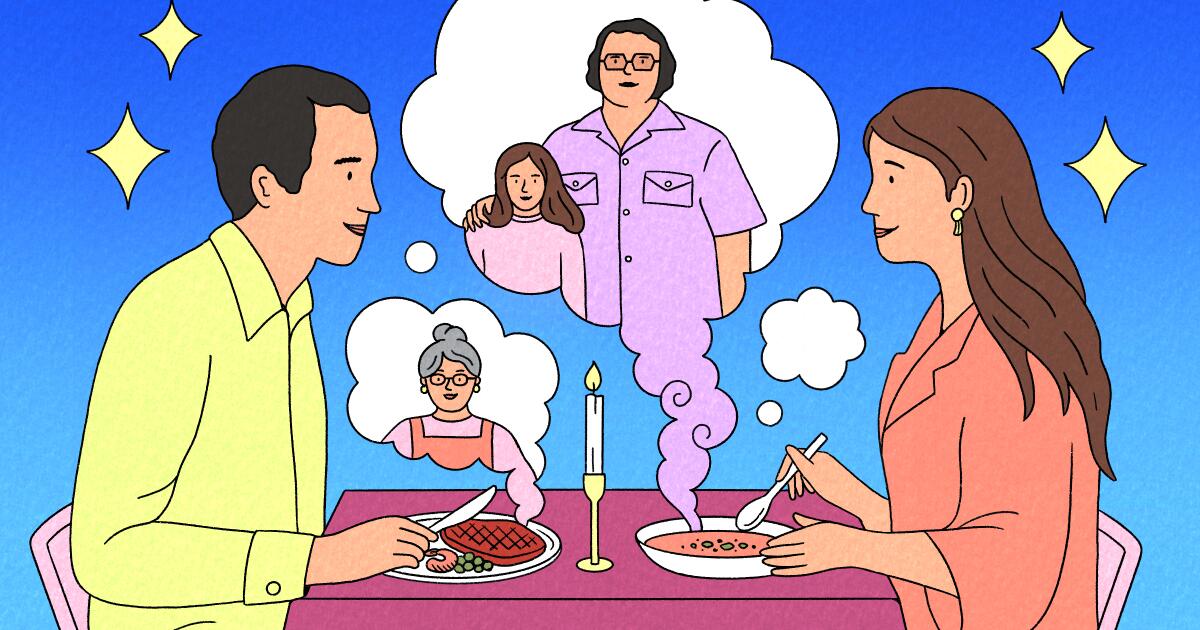
My father spent the 1970s selling hunger to America: soda, waffles, chips, anything that promised satisfaction in 30 seconds flat. He also weighed 450 pounds and was always on a new diet with me as his little diet coach. All his best material came from our kitchen table: “L’eggo my Eggo,” “Once You Pop, You Can’t Stop,” “Coke Is It” — the lines he’d toss out between bites.
My grandma Beauty did the opposite. She fed me comfort, one recipe at a time, until I believed emotions had a flavor. My dad could sell the American consumer comfort, but he couldn’t quite give that same safety to the girl sitting across from him. Between my dad, who treated cravings like a religion, and my grandmother, who treated food like therapy, I grew up thinking connection was something you could taste before you could name it.
So when I met my Bumble date years later after my divorce, it wasn’t fireworks. It was something quieter. A sense memory. A familiar click in the body before the mind catches up.
The first meal we ever shared was at Dan Tana’s: rare steak and shrimp swimming in oil and garlic. He ordered quickly, confidently, passing plates back and forth like this was something we’d always done. Somewhere in that meal, I felt that oyster-like disbelief when something simple tastes better than expected, and you pretend not to notice because the surprise feels too intimate to say out loud.
After that night, we slipped into a rhythm. We went out to dinner a lot. Before I could even open a menu, he’d tell the waiter, “Sauce on the side, she eats like a celebrity,” making me feel adored, not demanding.
The dishes were always exquisite. Slow-roasted bone marrow, branzino laced with herbs, the kind of flavors that made us lean in and feed each other. He’d study my face and say, “Love it or hate it?,” shooting me a warm smirk.
On quieter dates, we watched movies in bed, talked about our kids, anything except for whatever was forming between us. On the nights I slept over, he’d bring me matcha lattes in the morning casually like it was no big deal, and every single time, I felt like I’d won an Academy Award.
“Thank you, ladies and gentlemen!” I’d exclaim.
And he’d shake his head, amused. “You’re too easy to please.”
But what he didn’t realize was remembering that I liked only a splash of milk and an extra shot of matcha fed a hunger in me I didn’t know I longed for.
Our banter was fun, constant and warm. Everything worked except for when a question leaned into the future. That’s when something tightened, a brief, instinctual clam-closing and then loosening again just as fast. But I kept going because the present was good. Because we laughed a lot. Because the world felt softer when I was with him.
Then one Sunday evening, I asked, “What are you doing for the Jewish holidays?” He gave a quick, unreadable flicker. It was gone before I could interpret it. We didn’t talk about it. We didn’t need to. We were both leaving for our own family week. When I returned excited to see him and celebrate a big work milestone I’d helped him prepare for, I got “the text.” Careful. Polite. And at the end, a line that blew a hole through my chest.
“I don’t see a romantic future with you.”
I read it again and again until my body revolted. A wave of heat shot through me. I wanted to scream but I just stood there frozen, unable to breathe, like someone had cracked open my chest and scooped the air out.
Suddenly, I wasn’t a grown-up woman living in Hollywood. I wasn’t a mother, not a nutritionist, not someone who has taken care of people for years.
I was 9. I was in Chicago. It was 1975. I was in my grandma’s kitchen, the place I loved most in the world. The only place I ever remember feeling safe. My fingers were gripping her apron. The smell of dill wafting through the air. Her soup was bubbling. Nourishment, comfort, stability in the form of broth and steady hands. Then my mother’s voice sliced through it: “Dawn, get in the car.”
As I was pushed into the station wagon, there were boxes everywhere. Clio Awards, stacks of Playboy magazines with my dad’s byline, and when my mother slid in after me, she bumped into my dad’s cigarette and the ashes ignited the map — burning a hole straight through the Midwest. My stomach was in knots. I kept reaching my hand toward my grandmother.
“Don’t make me go.”
My mom, irritated, honked the horn, and my dad stepped on the gas.
Standing in my kitchen decades later, looking at the text message, the same feeling of nausea washed over me. The ground shifted. My friends, trying to support me, started texting me. “Don’t you dare text him.”
But I did.
“Hi.”
He responded immediately. We met for Japanese that night, and without trying, we fell right back into our rhythm over Santa Barbara uni and lamb chops cooked exactly the way we like them, crisp on the outside, tender on the inside, the kind of dish that cracks when your knife hits it and then gives way like warm silk. We were not awkward. We were not mad. We were not resolved. We were two people who kept finding each other at a table, even when everything else was uncertain.
Then, somewhere between courses, he looked up and said, “You remind me of my mother.”
The words hit something in me I couldn’t name. Not a wound, an internal flinch. He always told me his mother was unpredictable. Warm one moment, stormy the next. Comforting and chaotic in the same breath. I was none of those things. And I knew instantly that whatever he meant was tangled and that my warmth might feel like comfort to him, but also, unconsciously, like danger. That being cared for and being overwhelmed lived very close together in his body.
I didn’t take it personally. I took it as information. Maybe I felt familiar to him in a way that carried both safety and alarm. A green light and a red light at the same intersection. And the strangest thing was, in that same moment, he reminded me of my father, a man who could charm a room, feed America slogans that defined a generation, win awards and still feel shaky where it mattered most — with me.
Two grown-ups sitting across a table, mirroring childhood patterns that neither of us fully understood.
Later, when he drove me home, he dropped something heavy: his story, not mine to tell. The kind of truth that shifts the room without explaining the entire plot.
Sitting there in his car, I realized it was never just the two of us. We both brought our ghosts, and they probably showed up before we even opened our menus. Maybe that’s the real story. You can share the same cravings and still have to adjust the salt and heat as each new combination of flavors come together and unfold.
The author is a nutritionist who wrote the bestselling book, “My Fat Dad: A Memoir of Food, Love and Family, With Recipes.” Find her on Instagram: @DawnLerman.
L.A. Affairs chronicles the search for romantic love in all its glorious expressions in the L.A. area, and we want to hear your true story. We pay $400 for a published essay. Email LAAffairs@latimes.com. You can find submission guidelines here. You can find past columns here.
Editor’s note: On April 3, L.A. Affairs Live, our new storytelling competition show, will feature real dating stories from people living in the Greater Los Angeles area. Tickets for our first event are on sale now at the Next Fun Thing.


Only 30% of Milwaukee police supervisors live in the city. A new contract has an incentive

CIO 100 Leadership Live Atlanta: AI spending enters a reckoning phase

Clergy allowed to visit Minneapolis ICE holding facility in latest ruling

Indianapolis police officer charged with illegal deer harvesting

Mister Rogers’ legacy lives on in Latrobe and Pittsburgh

Florida High School Football Rankings: Top 25 teams – Oct. 21

How old is Bo Nix? What to know about Oregon quarterback ahead of 2024 NFL Draft

Cleary's 21 help Le Moyne down Central Connecticut State 69-64 in OT

99th annual Pony Swim held in Virginia

Indiana Members Credit Union announced as new anchor tenant at Bottleworks District

Pritzker pushes prosecutions of Trump officials as part of Dem ‘Project 2029’ agenda

Iran’s Khamenei says enemy ‘defeated’ in written Nowruz message

Gold Trump coin moves forward after Treasury invokes rare authority

Meet the longtime biz partner of Ilhan Omar’s husband as questions swirl over her skyrocketing net worth

‘Nobody can blackmail us’: Leaders excoriate Orbán’s veto
-

 Detroit, MI2 days ago
Drummer Brian Pastoria, longtime Detroit music advocate, dies at 68
-

 Oklahoma6 days ago
Family rallies around Oklahoma father after head-on crash
-

 Nebraska1 week ago
Wildfire forces immediate evacuation order for Farnam residents
-

 Georgia5 days ago
How ICE plans for a detention warehouse pushed a Georgia town to fight back | CNN Politics
-

 Massachusetts1 week ago
Massachusetts community colleges to launch apprenticeship degree programs – The Boston Globe
-

 Alaska6 days ago
Police looking for man considered ‘armed and dangerous’
-

 Colorado1 week ago
‘It’s Not a Penalty’: Bednar Rips Officials For MacKinnon Ejection | Colorado Hockey Now
-
 Southwest1 week ago
Talarico reportedly knew Colbert interview wouldn’t air on TV before he left to film it