Connect with us

Lifestyle

A robot gets a face of living ‘skin’ that allows it to smile

Published

on

A robot gets a face of living ‘skin’ that allows it to smile
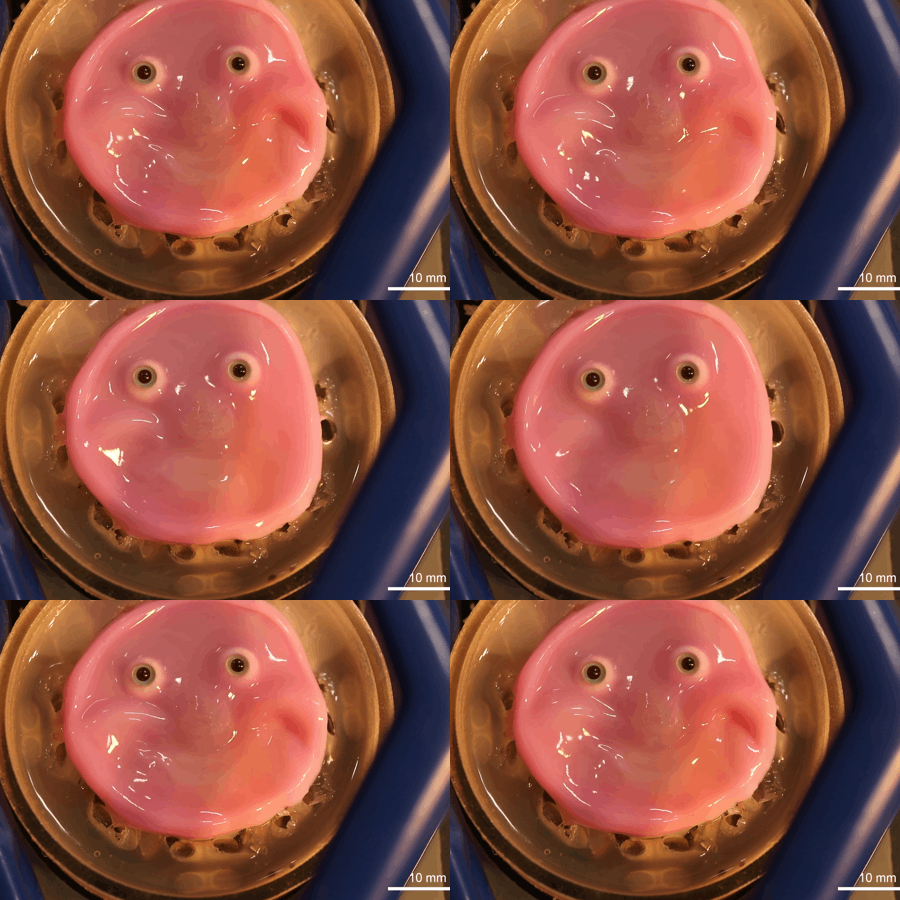
An image released by University of Tokyo researchers shows a robot smiling, with the help of mechanical actuators beneath a flexible layer of living skin.

Takeuchi et al. CC-BY-ND

hide caption

toggle caption

Takeuchi et al. CC-BY-ND

Advertisement

If humanoid robots make you a bit queasy — would it help if they had fleshy faces that can smile at you?

The uncanny feat is the result of new technology using engineered living skin tissue and human-like ligaments to give robots a more natural smile, according to Tokyo University researchers who unveiled their work this week.

“In this study, we managed to replicate human appearance to some extent by creating a face with the same surface material and structure as humans,” professor Shoji Takeuchi, the team leader, said in a news release. In the process, he added, “we identified new challenges, such as the necessity for surface wrinkles and a thicker epidermis to achieve a more humanlike appearance.”

The approach promises to make robots more lifelike — and in the future, the researchers say, similar techniques could also be used on humans, in the cosmetics and plastic surgery industries. Their findings were published in the journal Cell Reports Physical Science.

A new method of binding living skin tissue to a robotic skeleton will allow more humanlike expressions and better range of motion, according to researchers from the University of Tokyo.

A new method of binding living skin tissue to a robotic skeleton will allow more humanlike expressions and better range of motion, according to researchers from the University of Tokyo.

Takeuchi et al. CC-BY-ND

Advertisement


hide caption

toggle caption

Takeuchi et al. CC-BY-ND

Advertisement

To overlay and connect the lab-produced skin on a robotic skeleton, a layer of collagen gel containing cultured human dermal fibroblasts (a type of connective tissue cell) binds to an innovative system of tiny V-shaped perforations in the surface, letting the skin move with the underlying structure without tearing or peeling. The work of muscles — creating a smile, and other motions — is done by actuators.

Takeuchi’s Biohybrid Systems Laboratory has previously engineered skin that can heal, created small robots with biological muscle tissue, and 3D printed lab-grown meat. He says the latest work on living skin has a string of potential next steps.

“Self-healing is a big deal — some chemical-based materials can be made to heal themselves, but they require triggers such as heat, pressure or other signals, and they also do not proliferate like cells,” he said. “Biological skin repairs minor lacerations as ours does, and nerves and other skin organs can be added for use in sensing and so on.”

It’s critical for robots to have the ability to heal and self-repair, the researchers said in their study, because even small scratches could develop into serious impairments.

Biomimetic robots could also become even more realistic with thicker skin, Takeuchi said, adding that future projects could look to add sensors, pores and even sweat glands and fat. The team’s paper says their work could also bring insights into how humans’ wrinkles are formed. And by incorporating more sophisticated actuators and eventually, cultured muscle tissue, their approach could help robots in the future move in fluid, humanlike ways.

Advertisement

For now, the robot can’t feel its face, putting it in a category pioneered by Abel Tesfaye, a.k.a. The Weeknd. Not long ago, many of us smiled when technology managed to put the singer’s words about his face into the mouth of a U.S. president.

Lifestyle

Mundane, magic, maybe both — a new book explores ‘The Writer’s Room’

Published

on

Mundane, magic, maybe both — a new book explores ‘The Writer’s Room’

There’s a three-story house in Baltimore that looks a bit imposing. You walk up the stone steps before even getting up to the porch, and then you enter the door and you’re greeted with a glass case of literary awards. It’s The Clifton House, formerly home of Lucille Clifton.

The National Book Award-winning poet lived there with her husband, Fred, starting in 1967 until the bank foreclosed on the house in 1980. Clifton’s daughter, Sidney Clifton, has since revived the house and turned it into a cultural hub, hosting artists, readings, workshops and more. But even during a February visit, in the mid-afternoon with no organized events on, the house feels full.

The corner of Lucille Clifton's bedroom, where she would wake up and write in the mornings

The corner of Lucille Clifton’s bedroom, where she would wake up and write in the mornings

Andrew Limbong/NPR


hide caption

Advertisement

toggle caption

Andrew Limbong/NPR

“There’s a presence here,” Clifton House Executive Director Joël Díaz told me. “There’s a presence here that sits at attention.”

Advertisement

Sometimes, rooms where famous writers worked can be places of ineffable magic. Other times, they can just be rooms.

The Writer’s Room: The Hidden Worlds That Shape the Books We Love

Princeton University Press

Katie da Cunha Lewin is the author of the new book, The Writer’s Room: The Hidden Worlds That Shape the Books We Love, which explores the appeal of these rooms. Lewin is a big Virginia Woolf fan, and the very first place Lewin visited working on the book was Monk’s House — Woolf’s summer home in Sussex, England. On the way there, there were dreams of seeing Woolf’s desk, of retracing Woolf’s steps and imagining what her creative process would feel like. It turned out to be a bit of a disappointment for Lewin — everything interesting was behind glass, she said. Still, in the book Lewin writes about how she took a picture of the room and saved it on her phone, going back to check it and re-check it, “in the hope it would allow me some of its magic.”

Let’s be real, writing is a little boring. Unlike a band on fire in the recording studio, or a painter possessed in their studio, the visual image of a writer sitting at a desk click-clacking away at a keyboard or scribbling on a piece of paper isn’t particularly exciting. And yet, the myth of the writer’s room continues to enrapture us. You can head to Massachusetts to see where Louisa May Alcott wrote Little Women. Or go down to Florida to visit the home of Zora Neale Hurston. Or book a stay at the Scott & Zelda Fitzgerald Museum in Alabama, where the famous couple lived for a time. But what, exactly, is the draw?

Advertisement

Lewin said in an interview that whenever she was at a book event or an author reading, an audience question about the writer’s writing space came up. And yes, some of this is basic fan-driven curiosity. But also “it started to occur to me that it was a central mystery about writing, as if writing is a magic thing that just happens rather than actually labor,” she said.

In a lot of ways, the book is a debunking of the myths we’re presented about writers in their rooms. She writes about the types of writers who couldn’t lock themselves in an office for hours on end, and instead had to find moments in-between to work on their art. She covers the writers who make a big show of their rooms, as a way to seem more writerly. She writes about writers who have had their homes and rooms preserved, versus the ones whose rooms have been lost to time and new real estate developments. The central argument of the book is that there is no magic formula to writing — that there is no daily to-do list to follow, no just-right office chair to buy in order to become a writer. You just have to write.

Continue Reading

Lifestyle

Bruce Johnston Retiring From The Beach Boys After 61 Years

Published

on

Bruce Johnston Retiring From The Beach Boys After 61 Years

Bruce Johnston
I’m Riding My Last Wave With The Beach Boys

Published

Advertisement

Advertisement

Advertisement

Advertisement

Continue Reading

Lifestyle

On the brink of death, a woman is saved by a stranger and his family

Published

on

On the brink of death, a woman is saved by a stranger and his family

In 1982, Jean Muenchrath was injured in a mountaineering accident and on the brink of death when a stranger and his family went out of their way to save her life.

Jean Muenchrath


hide caption

toggle caption

Advertisement

Jean Muenchrath

In early May 1982, Jean Muenchrath and her boyfriend set out on a mountaineering trip in the Sierra Nevada, a mountain range in California. They had done many backcountry trips in the area before, so the terrain was somewhat familiar to both of them. But after they reached one of the summits, a violent storm swept in. It began to snow heavily, and soon the pair was engulfed in a blizzard, with thunder and lightning reverberating around them.

“Getting struck and killed by lightning was a real possibility since we were the highest thing around for miles and lightning was striking all around us,” Muenchrath said.

To reach safer ground, they decided to abandon their plan of taking a trail back. Instead, using their ice axes, they climbed down the face of the mountain through steep and icy snow chutes.

Advertisement

They were both skilled at this type of descent, but at one particularly difficult part of the route, Muenchrath slipped and tumbled over 100 feet down the rocky mountain face. She barely survived the fall and suffered life-threatening injuries.

This was before cellular or satellite phones, so calling for help wasn’t an option. The couple was forced to hike through deep snow back to the trailhead. Once they arrived, Muenchrath collapsed in the parking lot. It had been five days since she’d fallen.

 ”My clothes were bloody. I had multiple fractures in my spine and pelvis, a head injury and gangrene from a deep wound,” Muenchrath said.

Not long after they reached the trailhead parking lot, a car pulled in. A man was driving, with his wife in the passenger seat and their baby in the back. As soon as the man saw Muenchrath’s condition, he ran over to help.

 ”He gently stroked my head, and he held my face [and] reassured me by saying something like, ‘You’re going to be OK now. I’ll be right back to get you,’” Muenchrath remembered.

Advertisement

For the first time in days, her panic began to lift.

“My unsung hero gave me hope that I’d reach a hospital and I’d survive. He took away my fears.”

Within a few minutes, the man had unpacked his car. His wife agreed to stay back in the parking lot with their baby in order to make room for Muenchrath, her boyfriend and their backpacks.

The man drove them to a nearby town so that the couple could get medical treatment.

“I remember looking into the eyes of my unsung hero as he carried me into the emergency room in Lone Pine, California. I was so weak, I couldn’t find the words to express the gratitude I felt in my heart.”

Advertisement

The gratitude she felt that day only grew. Now, nearly 45 years later, she still thinks about the man and his family.

 ”He gave me the gift of allowing me to live my life and my dreams,” Muenchrath said.

At some point along the way, the man gave Muenchrath his contact information. But in the chaos of the day, she lost it and has never been able to find him.

 ”If I knew where my unsung hero was today, I would fly across the country to meet him again. I’d hug him, buy him a meal and tell him how much he continues to mean to me by saving my life. Wherever you are, I say thank you from the depths of my being.”

My Unsung Hero is also a podcast — new episodes are released every Tuesday. To share the story of your unsung hero with the Hidden Brain team, record a voice memo on your phone and send it to myunsunghero@hiddenbrain.org.

Advertisement
Continue Reading

Trending
